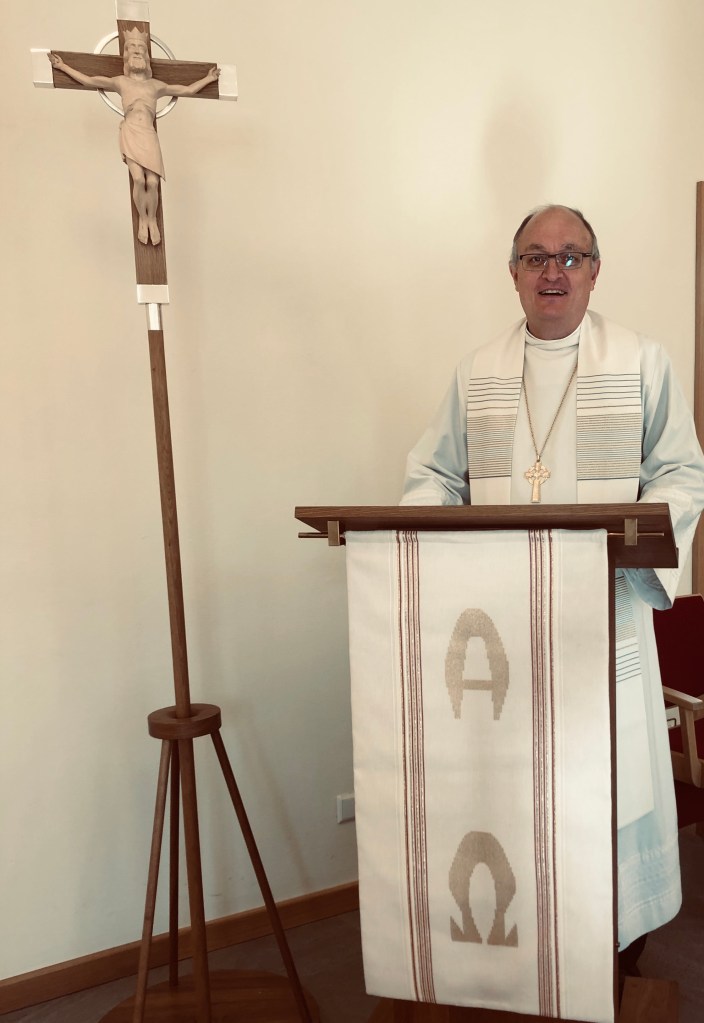
Der Herr ist auferstanden + Er ist wahrhaftig auferstanden und seinen Jüngern erschienen + Des sollen wir uns nicht fürchten, sondern alle fröhlich sein; denn der Herr Christus spricht: „Fürchte dich nicht! Ich bin der Erste und der Letzte und der Lebendige. Ich war tot, und siehe, ich bin lebendig von Ewigkeit zu Ewigkeit und habe die Schlüssel des Todes und der Hölle.“ (Offb.1,17-18)
Der Herr ist nicht hier. Er ist auferstanden. Geht und sagt es seinen Jüngern – und Petrus!
Auf BR-Klassik spielt auf „Laudate“ die herrliche „Oster-Historie“ von Arnold Matthias Brunckhorst mit Andrea Hornung-Boesen, Sopran; Rainer Seifert, Countertenor; Dietrich Wrase, Tenor; Sebastian Mattmüller, Bass; Ensemble musica poetica Freiburg: Hans Bergmann. Herrlich! https://www.br-klassik.de/progr…/…/ausstrahlung-2048890.html
Es ist alles bereit: Kommt, sehet und schmecket wie freundlich der Herr ist!
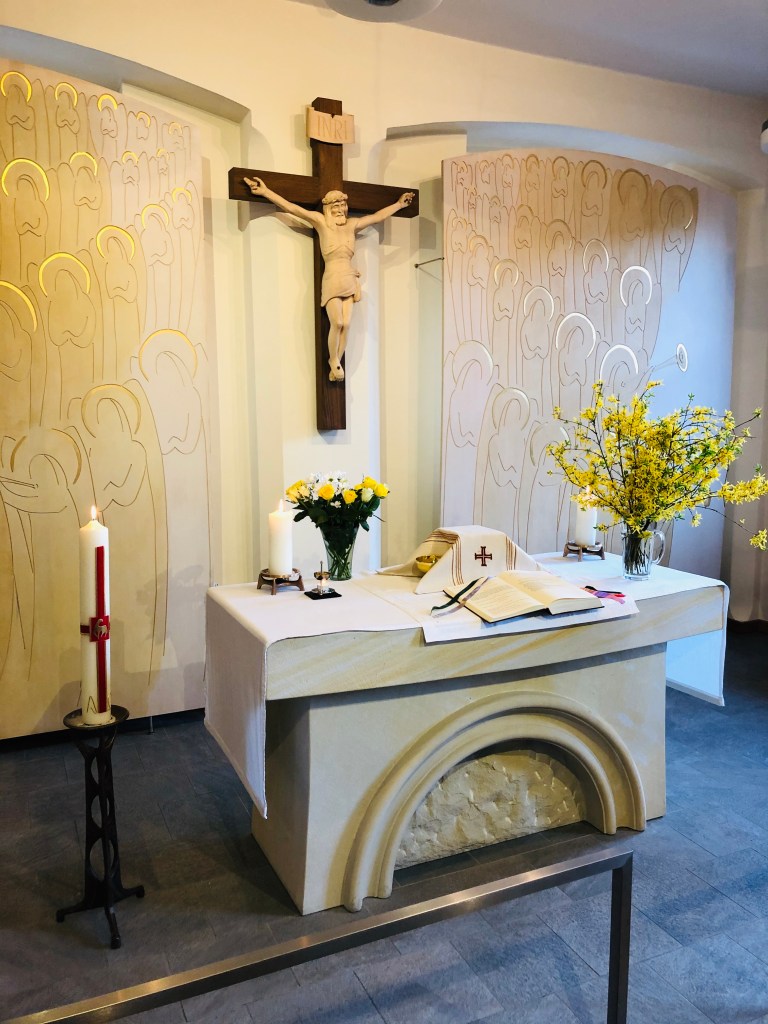
Die Kerzen brennen. Die Blumen blühen. Alle Bücher sind aufgeschlagen und der Gottesdienst beginnt gleich. Wir folgen d.v. der Festtagsliturgie, singen diese Lieder und hören diese Lesungen: Ps.118; Hes.37,1-14; 1.Kor.15,1-11; Mk.16,1-8. Here is the order in English: https://kwaweber.org/…/hallelujah-jesus-lives-reigns-forev…/
„Erschienen ist der herrlich Tag…“ von Nikolaus Herman 1560. „Christ lag in Todesbanden …“ in Martin Luthers Übersetzung von 1524 des „Victimae pashali laudes“ von Wipo um 1045. „Frühmorgens da die Sonn aufgeht…“ von Johann Heermann 1630. „Te Deum laudamus…“ in Martin Luthers Übersetzung von 1529. „Nun freut euch hier und überall …“ von Paul Gerhardt 1653.
All the world rejoices and sings: “Christ is risen. He´s risen indeed!” That´s the Easter jubilee all along – ever since he rose victorious from the dead and appeared to his disciples like Mary, then to that couple from Emmaus, to St. James, St. Thomas – the confessor – together with nearly all twelve gathered in Jerusalem and then he appeared to that crowd of well over a five hundred of whom many were still living when finally he had even appeared to St. Paul – the last and somewhat late born apostle – there on the way to Damascus.
“The risen Lord”: Lucas Cranach
These were not some brave movers and shakers, but rather intimidated people – traumatized, suffering from the terrible scenes in Jerusalem around Good Friday. People shocked to the core + when they recovered somewhat, they tried to gather their wits about them and continue with life as before IX. So, when the Easter message got to them – like those women early at the grave (Mary of Magdala; Mary, mother of James and Salomé) – they did not run with it as good news but were terrified. That´s their response to the gospel. Nothing about self-realization and clever imagination. No idea of getting fake news spreading. Rather, bewilderment, afraid and at a loss.
Still, our living Lord does not just let them go. His messengers – the angels get the message through – and He Himself goes in search for the lost, gathers them in true faith, encouraging and uplifting, informing and instructing, preaching, teaching and telling them the truth: “Don´t be afraid! See, it is I – here the bloody wounds – for You and Your salvation. Remember now, it is finished. It is done. I live and reign for good!” Once he has appeared to them, convinced them – even if some doubted for some time still even at the ascension (cf Mt.28) – he mandated them: “Go therefore into all the world – make disciples of all nations…”
St. Paul writes about this mission to the Corinthians. Many in that big city thought that liberation and salvation was just a matter of the mind – ideological/ spiritual/ philosophical. Well, in the 15th chapter he goes out of his way to underline the very bodily i.e. physical and real resurrection of the flesh (sarx!). This is not just a figment of the desperate mind, but rather the doing of the living God. It is He, who initially created heaven and earth. It is He, who has started the 2nd creation in the firstborn IX – once and for all. Behold: I make everything new! The old is past. The new has now begun – sprouting life from the cross, the dead tree, the cut off stump (Isaiah) – bearing fruit a hundredfold and in all seasons. IX – the vine, we His branches… Read the apostles argument in this resurrection chapter.
The living God and savior of the World said to His exiled and banished apostle, evangelist and bishop St. John on Patmos: “Do not be afraid! I am the first and the last, and the one who lives! I was dead, but look, now I am alive—forever and ever—and I hold the keys of death and of Hades!” (Revelation 1,17-18)
He´s risen. He´s risen indeed.
This living Christ has returned us to the living trust in the triune God, who has conquered death for us, so that we might live with him in perfect peace and happiness ever after. It´s the perfect ending – just like in any fairy tale – the only, but crucial difference being, that this is true. He – the living God – himself vouchsafes it by standing in for this in person – living, ruling and reigning for good and always.
Ever since those spiritual authorities in Jerusalem spread those rumors, that Jesus´ corpse had been stolen by his followers, people have come up with novel explanations to try and get rid of this unwanted Christ again and again. Mohammed – on impulse of satanic inspiration? – suggests in the Koran, that he never died, but was relieved off the cross prematurely by his disciples. Paul L. Maier plays masterfully with the idea of him never getting out of the grave, but that there´s still a “skeleton in God´s closet” or that he gets out later – and leaves us with “more than a skeleton” to worry about. The struggle between truth and fake news is continual – and not just on Twitter.
Throughout the world Christians will commemorate this divine breakthrough in our world – and signal with their hymns of praise and thanksgiving, that even in such difficult times of shut-downs and -ins – Jesus Christ reigns supreme. St. John knew all about it on Patmos – as did Dr. Martin Luther on the Wartburg or later on the Coburg, where he referred so sprightly to his “most beloved Confitemini” – and we will repeat words of Psalm 118 in tomorrow´s Introit too.
Wasn´t it always to be a severe challenge facing death and dying? Even for the prophet Ezekiel it was, when God asked him on that field of bones, whether there is hope of resurrection, healing and life after death? The Old Testament reading from this great prophet of long ago speaks volumes for people living in times of exile and slavery, in times after Auschwitz and during Corona. So: Nota bene et tolle lege!
That´s why we continue to pray for the saving faith in His grace and goodness:
Almighty God the Father, through Your only-begotten Son, Jesus Christ, You have overcome death and opened the gate of everlasting life to us. Grant that we, who celebrate with joy the day of our Lord´s resurrection, may be raised from the death of sin by Your live-giving Spirit; through Jesus Christ, our Lord, who lives and reigns with You and the Holy Spirit, one God, now and forever.
Collect for Easter
We confess with all the church in all adversity of this world:
I believe that I cannot by my own reason or strength believe in Jesus Christ, my Lord, or come to Him; but the Holy Spirit has called me by the Gospel, enlightened me with His gifts, sanctified and kept me in the true faith. In the same way He calls, gathers, enlightens, and sanctifies the whole Christian church on earth, and keeps it with Jesus Christ in the one true faith. In this Christian church He daily and richly forgives all my sins and the sins of all believers. On the Last Day He will raise me and all the dead, and give eternal life to me and all believers in Christ.
Explanation of the 3rd Article of the Apostolic Creed
And in this only saving faith we stand and sing with the church father, the beloved pastor, president and teacher of the Missouri Synod even at the graves of our beloved ones – as the church traditionally does faithfully on Easter morning – obeying God´s commandments and trusting His sure promises:
Go and tell his disciples – and Peter!
1. He’s risen, he’s risen, Christ Jesus, the Lord; He opened Death’s prison, The incarnate, Word. Break forth, hosts of heaven, in jubilant song While earth, sea, and mountain the paean prolong.
2. The foe was triumphant when on Calvary The Lord of creation was nailed to the tree. In Satan’s domain did the hosts shout and jeer, For Jesus was slain, whom the evil ones fear.
3. But short was their triumph, the Savior arose, And death, hell, and Satan He vanquished, His foes; The conquering Lord lifts his banner on high. He lives, yea, he lives, and will nevermore die.
4. Oh, where is your sting, death? We fear thee no more; Christ rose, and now open is fair Eden’s door. For all our transgressions His blood does atone; Redeemed and forgiven, we now are His own.
5. Then sing your hosannas and raise your glad voice; Proclaim the blest tidings that all may rejoice. Laud, honor, and praise to the Lamb that was slain; Who siteth in glory, and ever shall reign.
Well, today the table is empty. The candles are still burning, but only just. No ornaments today. No flowers. No organ. No bells, no colorful vestments either. Just the Altarbook. No Lord´s Supper today. We´ll be singing still. Yes, muted – in the sorrowful knowledge that it was “I (who) caused Your grief and sighing by evils multiplying as countless as the sands, I caused the woes unnumbered with which Your soul is cumbered, Your sorrows raised by wicked hands” (Paul Gerhardt), but confident in the Easter reality of our Lord´s victorious resurrection. No more despairing, running away or giving up either. We are assured of His triumphant conquering of sin, death and devil – as the watchword for Good Friday proclaims: “For this is the way God loved the world: He gave his one and only Son, so that everyone who believes in him will not perish but have eternal life.” (John 3,16)
Isenheimer Altar (Matthias Grünewald)
God willing, we will be singing these hymns a capella:
“Christus, der uns selig macht, kein Bös´ hat begangen…“, which is the German translation of „Patris sapientia” by Egidio of Colonna (1300) by Michael Weiße (1531).
“A Lamb goes uncomplaining forth…” Paul Gerhard (1647)
“Nimm von uns, Herr, Du treuer Gott, die schwere Straf …”, which is the German translation of “Aufer immensam” (Wittenberg 1541) by Martin Moller in 1584.
“O sacred head, now wounded…”, which is the translation of “Salve, caput cruentatum” by Arnulf of Löwen (1250) by Paul Gerhardt (1656)
The “Litany” for Good Friday.
“Christe, Du Schöpfer aller Welt… “, which is the German translation of “Rex Christe, factor omnium” (900) in Schwerin about 1875.
“O Traurigkeit, o Herzeleid!” by Friedrich von Spee and Johann Rist.
„So ruhest Du, o meine Ruhe“ by Salomo Frank 1685.
Lessons from God´s Holy Word are
Introit Psalm 22;
Old Testament from the prophet Isaiah 52,13-53,12;
Epistle of St. Paul 2. Corinthians 5,14-21 (Sermon)
Gospel from St. John chapter 19,16-30.
I believe that Jesus Christ, true God, begotten of the Father from eternity, and also true man, born of the Virgin Mary, is my Lord, who has redeemed me, a lost and condemned person, purchased and won me from all sins, from death, and from the power of the devil; not with gold or silver, but with His holy, precious blood and with His innocent suffering and death, that I may be His own and live under Him in His kingdom and serve Him in everlasting righteousness, innocence, and blessedness, just as He is risen from the dead, lives and reigns to all eternity. This is most certainly true.
Dr. Martin Luther´s explanation of the 2.Article of the Apostolic Creed
Almighty God, we ask You to look with mercy on Your family, for whom our Lord IX was willing to be betrayed and to be given over to the hands of sinners and to suffer death on the cross; who now lives and reigns with You and the Holy Spirit, one God, forever and ever.
One of my favorite holidays is Maundy Thursday. Not only because on this day at the latest the long weekend started, but also because it was an evening service – nearly as festive, dramatic and emotional as Christmas. Obviously, I don´t have as many childhood memories of this holiday as of the latter. It was after all a very churchly event – starting off with the official registration in the pastor´s office at his home during the previous week or if You were not able to make that, then a timely visit in the sacristy just before the public confessional started would do…
Take and eat…
Most communicants were dressed in their finest black outfits – for men that included black ties, socks and shoes, sometimes hats. In the Southern hemisphere this was autumn and it could be chilly enough to wear a coat even. Church would start punctually as ever with the urgent tolling of the bells calling the last stragglers to get their last smoke done and into the pews. The vestments were all white, the flowers magnificent and the organ would sound the start of the serious part…
Tonight, we´re but a little bunch – not even 12 (or 13) as at the introductory meal. It will be more like during the institution of the Passover (Sermon text Ex.12,1-14) some centuries earlier, where every family – or as many as needed to eat the prepared lamb – would gather on their own, girded and ready for the exodus from slavery. Bitter herbs to remember the hardships of the forced labor and servitude. Unleavened bread as there was no time to go into the lengthy business of sourdough and such luxuries.
The latter cup of thanksgiving to celebrate that the cup of wrath had passed us, and that God had accepted the vicarious sacrifice of the paschal lambs instead, sparing us the well-deserved punishment and rather granting us his favor + for Christ´s sake + His holy body given for us into death, so that we might live + His precious blood shed for us for the forgiveness of all our sins and that now He would flourish in us, nurture and vitalize us – just like the vine would invigorate its branches.
You see, the Lord´s Supper celebrated by the Christian Church was instituted in the framework of the Passover, but it was an innovation of our Lord, who instituted this – His sacramental Supper – in the night of his betrayal as something uniquely Christological and Soteriological. Not just an act of rememberance, but one of deliverance and justification too. He was not spared but gave himself willingly for us – vicariously – in our stead – for our salvation (Nicene Creed).
So, we Lutherans follow St. Paul´s setting for the unique Lord´s Supper as he too received it – and not as if it was a later adaptation of an ongoing Jewish rite as the Heidelberg Catechism would make us believe. Instead Dr. Martin Luther summarizes it succinctly in answering the question: What is the Sacrament of the Altar?
“The Sacrament of the Altar is the true body and blood of our Lord Jesus Christ, under the bread and wine, instituted by Christ himself, for us Christians to eat and to drink.”
Martin Luther: Small Catechism V,1
He´s got the holy apostle´s and world missionary´s backing, who writes in his first epistle to the Corinthians in the eleventh chapter:
For I received from the Lord what I also passed on to you, that the Lord Jesus on the night in which he was betrayed took bread, and after he had given thanks he broke it and said, “This is my body, which is for you. Do this in remembrance of me.” In the same way, he also took the cup after supper, saying, “This cup is the new covenant in my blood. Do this, every time you drink it, in remembrance of me.” For every time you eat this bread and drink the cup, you proclaim the Lord’s death until he comes.
1.Corinthians 11:23-26
St. Paul uses this central liturgical quotation in his argument for unity in the congregation and against the awful divisions and separations due to identarian criteria – like economics, social standing and other ideologies. The gospel lesson from St. John´s gospel on Jesus´ washing of his disciples feet (John 13,1-15.34-35) gives further credence and logical support to his theological argument. St. Paul concludes:
For this reason, whoever eats the bread or drinks the cup of the Lord in an unworthy manner will be guilty of the body and blood of the Lord. A person should examine himself first, and in this way let him eat the bread and drink of the cup. For the one who eats and drinks without careful regard for the body eats and drinks judgment against himself. That is why many of you are weak and sick, and quite a few are dead. But if we examined ourselves, we would not be judged. But when we are judged by the Lord, we are disciplined so that we may not be condemned with the world. So then, my brothers and sisters, when you come together to eat, wait for one another. If anyone is hungry, let him eat at home, so that when you assemble it does not lead to judgment. I will give directions about other matters when I come…
1.Corinthians 11:27-34
Let us sing God´s praises with Dr. Martin Luther and in unanimity with the Christian Church:
1. O Lord, we praise Thee, bless Thee, and adore Thee, In thanksgiving bow before Thee. Thou with Thy body and Thy blood didst nourish Our weak souls that they may flouish: O Lord, have mercy! May Thy body, Lord, born of Mary, That our sins and sorrows did carry, And Thy blood for us plead In all trial, fear, and need: O Lord, have mercy!
2. Thy holy body into death was given, Life to win for us in heaven. No greater love than this to Thee could bind us; May this feast thereof remind us! O Lord, have mercy! Lord, Thy kindness did so constrain Thee That Thy blood should bless and sustain me. All our debt Thou hast paid; Peace with God once more is made: O Lord, have mercy.
3. May God bestow on us His grace and favor To please Him with our behavior And live as brethren here in love and union Nor repent this blest Communion! O Lord, have mercy! Let not Thy good Spirit forsake us; Grant that heavenly-minded He make us; Give Thy Church, Lord, to see Days of peace and unity: O Lord, have mercy!
Martin Luther (1483-1546)
Let us pray:
Lord God, of Your fatherly mercy You spared not Your only Son but gave him up to death and the cross. Send Your Holy Spirit into our hearts, that we may be comforted by this grace, henceforth be on guard aainst sin, and patiently bear whatever You send us to suffer, that through Him we may live for ever with You.
One of the good things in days gone by, was that the Easter Holidays were a sure thing. Whether early or later in the year, the holidays started at least on Friday before Holy Week. That´s how it was. Sure thing, no questions. Just as the long summer break would start somewhere around the 1st Advent. Come what may. So, we children got to know at least some of the standard hymns for these seasons. Most of Lent was in school time, so the list of hymns to learn was longer, but in Advent, we´d have more time for social family singing and we´d learn more by repetition and just plain doing than memorizing during the afternoon homework session at Uelzen boarding school.
Behold – the Lamb of God
Although we sang two Advent hymns last Palm Sunday, I´ll leave those for another day. Today I´ll list the Lenten favorites of my blessed Pastor – Ernst-August Albers – which probably did more to lay the foundations of my faith in the vicarious justification of sinners through our Lord Jesus Christ than anything else.
Just take the gold standard “A Lamb goes uncomplaining forth” by Paul Gerhardt (1607-1676) with all 10 verses including Jesus shedding his blood, being tortured and crucified i.e. not blatantly purging the sacramental realism of our Lord´s Passion as the German hymnal did after the great War. The lovely discourse between Father and Son, the profound Christological magnificence, the marvelous truths of our redemption and sanctification, eschatological setting… It´s just perfect!
1 A LAMB goes uncomplaining forth, The guilt of all men bearing; ‘Tis laden with the sin of earth, None else the burden sharing; It goes its way, grows weak and faint, To slaughter led without complaint, Its spotless life to offer; Bears shame, and stripes, and wounds, and death, Anguish and mockery, and saith, “Willing all this I suffer.”
2 This Lamb is Christ, the soul’s great Friend And everlasting Savior; Him, Him God chose, sin’s reign to end And bring us to His favor. “Go forth, my Son!” He said, “and bail The children, who are doomed to hell But for Thine intercession. The punishment is great, and dread The wrath, but Thou Thy blood shalt shed, And save them from perdition.”
3 “Yea, Father, yea, most willingly I’ll bear what Thou commandest; My will conforms to Thy decree, I do what Thou demandest.” O wondrous Love! what hast Thou done! The Father offers up His Son, The Son content descendeth! O Love! O Love! how strong art Thou! In shroud and grave Thou lay’st Him low Whose word the mountains rendeth!
4 Thou lay’st him, Love, upon the cross, With nails and spear Him bruising; Thou slay’st Him as a lamb, His loss, From soul and body oozing; From body ’tis the crimson flood Of precious sacrificial blood, From soul, the strength of anguish: My gain it is; sweet Lamb to Thee What can I give, whose love to me For me doth make Thee languish?
5 Lord, all my life I’ll cleave to Thee, Thy love fore’er beholding, Thee ever, as Thou ever me, With loving arms enfolding. Yea, Thou shalt be my Beacon-light, To guide me safe through death’s dark night, And cheer my heart in sorrow; Henceforth myself and all that’s mine to Thee, my Savior, I consign, From whom all things I borrow.
6 By morn and eve my theme shall be Thy mercy’s wondrous measure; To sacrifice myself to Thee, My foremost aim and pleasure. My stream of life shall flow for Thee, Its steadfast current ceaselessly In praise to Thee outpouring; And all that Thou hast done for me, I’ll treasure in my memory, Thy gracious love adoring.
7 Enlarge, shrine of my heart, and swell, To Thee shall now be given A treasure that doth far excel The worth of earth and heaven. Away with the Arabian gold, With treasures of an earthly mold! I’ve found a better jewel. My priceless treasure, Lord my God, Is Thy most holy, precious blood, Which flowed from wounds so cruel.
8 This treasure ever I’ll employ, This ever aid shall yield me; In sorrow it shall be my joy, In conflict it shall shield me; In joy, the music of my feast, And when all else has lost its zest, This manna still shall feed me; In thirst my drink; in want my food; My company in solitude, To comfort and to lead me.
9 Death’s poison cannot harm me now, Thy blood new life bestoweth; My Shadow from the heat art Thou, When noonday’s sunlight gloweth. When I’m by inward grief opprest, On Thee my weary soul shall rest, As sick men on their pillows. Thou art my Anchor, when by woe My bark is driven to and fro On trouble’s restless billows.
10 And when Thy glory I shall see And taste Thy kingdom’s pleasure, Thy blood my royal robe shall be, And joy beyond at measure; It then shall be my glorious crown, Thus I’ll appear before the throne Of God, and need not hide me; And shall, by Him to Thee betrothed, By Thee in bridal garments clothed, Stand as a bride beside Thee.
Well, some of the other favorite hymns on the list to learn were:
„Jesus, I will ponder now…“(„Jesu Deine Passion will ich jetzt bedenken…“ 6 stanzas by Siegmund von Birken 1663.)
“Du großer Schmerzensmann, vom Vater so geschlagen…“ 6 stanzas by Adam Thebesius 1652.
„Upon the Cross extended…“(“O Welt, sieh hier Dein Leben…” 15 stanzas by Paul Gerhardt)
“O Sacred Head, now wounded…” („Salve, caput cruentatum” by Arnulf von Löwen 1250) translated into German as „O Haupt voll Blut und Wunden…“10 stanzas by Paul Gerhardt)
During the oral part of practical theology in the first theological examination Professor Dr. Wilhelm Rothfuchs gave me an unseen quote by Charles Haddon Spurgeon. I was to put it into context and evaluate it step-by-step. Thankfully, I had read quite a bit by the eloquent Helmut Thielicke, who had always been an ardent fan of Spurgeon (perhaps just to tease Werner Elert?) and in the process done his fair share of introducing this English revival preacher to a German audience via translations. Well, that worked for us too. I passed that exam – and heeded much of Spurgeon´s practical advice for preachers. Just like that down-to-earth Pope John XXIII, Spurgeon was very much in practical homiletics and gave good advice like opening up windows for fresh air. Much in line with the famous theme of Vatican II “aggiornamento”: Let the church look outside into the world – and let the world look inside the church too. Well, this morning there was a reading by Spurgeon in Dobberstein (Pg. 226-227). You might like it as much as I did. It´s on “Trust Only in God” and is quoted from his “Letters to my students” (Pg. 265)
“By all the castings down of his servants, God is glorified, for they are led to magnify him when again he sets them on their feet, and even while prostrate in the dust their faith yields him praise. They speak all the more sweetly of his faithfulness and are the more firmly established in his love. Such mature men as some elderly preachers are, could scarcely have been produced if they had not been emptied from vessel to vessel, and made to see their own emptiness and the vanity of all things round about them. Glory be to God for the furnace, the hammer and the file. Heaven shall be all the fuller of bliss because we have been filled with anguish here below, and earth shall be better tilled because of our training in the school of adversity.
The lesson of wisdom is, be not dismayed by soul-trouble. Count it no strange thing, but a part of ordinary ministerial experience. Should the power of depression be more than ordinary, think not that all is over with your usefulness. Cast not away your confidence, for it hath great recompense of reward. Even if the enemy´s foot be on your neck, expect to rise and overthrow him. Cast the burden of the present, along with the sin of the past and the fear of the future, upon the Lord, who forsaketh not his saints. Live by the day – aye, by the hour. Put not trust in frames and feelings. Care more for a grain of faith than a ton of excitement. Trust in God alone and lean not on the reeds of human help. Be not surprised when friends fail you: it is a failing world. Never count upon immutability in man: inconstancy you may reckon upon without fear of disappointment. The disciples of Jesus forsook him; be not amazed if your adherents wander away to other teachers: as they were not your all when with you, all is not gone from you with their departure. Serve God with all you might while the candle is burning, and then when it goes out for a season, you will have the less to regret. Be content to be nothing, for that is what you are. When your emptiness is painfully forced upon your consciousness, chide yourself that you ever dreamed of being full, except in the Lord. Set small store by present rewards; be grateful for earnests by the way but look for the recompensing joy hereafter. Continue with double earnestness to serve your Lord when no visible result is before you. Any simpleton can follow the narrow path in the light: faith´s rare wisdom enables us to march on in the dark with infallible accuracy, since she places her hand in that of her great Guide. Between this and heaven there may be rougher weather yet, but it is all provided for by our covenant Head. In nothing let us be turned aside from the path which the divine call has urged us to pursue. Come fair or come foul, the pulpit is our watchtower, and the ministry our warfare; be it ours, when we cannot see the face of God, to trust under the shadow of his wings.”
It´s lonely out on the Elbe flats. You´d think. First impressions deceive. The night before 20+ wild boar worked themselves through the young rape fields. The farmer´s co-op complained. We hunters should keep them out and limit their impact on the crops. So, this was to be my turn. I was glad that the wind was blowing at only about 14km and going steady from SW. That´s not too bad for these parts and promised perfect hunting conditions. This wind is supposed to carry milder air from the Mediterranean. We will know more next week.
+ I watch You even as I hear You +
No rain to talk about as yet and only sporadic traffic far off in the distance. Dogs barking in Seegrehna. Perhaps they sense the prowling wolves coming closer. Close by it was just a lonely beaver gnawing away at some old logs in the gurgling stream. The moon was half-full, high in the sky and reminding us of the Psalmist praying under similar conditions: “The Lord watches over you— the Lord is your shade at your right hand; the sun will not harm you by day, nor the moon by night.” (Ps.121:5-6) Wrapped tightly into warm stuff against the frost, I kept my ears clear though – and my nose. Wanted to catch the first warning signals be it a twig snapping or a wiff of dirty pig. I was ready for the invasion. Oh, how I longed for it. Trigger happy. I´d give them a most fitting welcome. So, let them come – all twenty of them.
As the eyes got accustomed to the dim light, the ears caught solitary bird calls from the forest. Eventually a long-eared owl started its regular hooting. Distinctive. You could not miss it. Soothing to the soul and ever so comforting to lonely creaturs out in the wilderness. Very clearly distinguishable from other owls in the German forest. Here´s a link to some more pictures of these nightly predators hunting pine forests, open meadows and tended fields.
Well, I think, they understand about social distancing. There was no answering call in response. Just that one regular cry out there in the bush. It continued all along – like clockwork. Just a break now and again before picking up pleading from another hot spot. Loved it! And in formidable cooperation, we kept the hogs out. All night long – even as my thoughts drifted with Joseph von Eichendorff to coming summer nights, which will be more balmy, but hopefully with more hunting luck: “Waidmansheil”, but not as bloodthirsty as Rammstein would like to make it out…
Auf, ihr betrübten Herzen der König ist gar nah; hinweg all Angst und Schmerzen der Helfer ist schon da. Seht, wie so mancher Ort hochtröstlich ist zu nennen, da wir ihn finden können in Nachtmahl, Tauf und Wort (Johann Rist)
Gloria, laus et honor tibi sit, Rex Christe, Redemptor, cui puerile decus prompsit Hosanna pium.
Das heißt: Ruhm und Preis und Ehre sei Dir, Erlöser und König. Jubelnd rief einst das Volk sein Hosianna Dir zu. Und singen mit Friedrich Rückert (1834) wie in der Adventszeit: „Dein König kommt in niedern Hüllen…“ und müssen doch erst wieder lernen, was die Tageslosung aus dem Johannesevangelium uns nahebringt: „So muss der Menschensohn erhöht werden, auf dass alle, die an ihn glauben, das ewige Leben haben.“ (Joh.3,14b-15).
Die dankbare Sünderin, der viele Sünden vergeben worden sind (Maria Magdalena? Maria von Bethanien), geht uns mit gutem Beispiel voran. Sie salbt unseren Herrn und aller Heiland Jesus zum Begräbnis. Sie lässt es sich viel kosten: „Eins ist not, ach Herr, dies eine lehre mich erkennen doch!“ und geht dabei mit verschwenderischer Liebe vor. Der Herr erkennt das an und verspricht, dass das unvergessen bleibt in seiner heiligen Kirche so wenig wie er das je vergessen wird. So erkennen wir wieder die Güte und Menschenfreundlichkeit unseres Herrn. Er beklagt nicht sein eigenes Schicksal, sondern freut sich an denen, die es dankbar aufnehmen und dieses Heil in ihm erkennen und mit ihren Liebesopfer preisen. Er hat der Sünderin viele Sünden vergeben, so viele, dass sie buchstäblich vor Liebe überfließt und die kostbare Narde über den Geber aller guten Gaben reichlich ausschüttet, ausgießt und ihn mit dem duftenden Salböl fürs den letzten Gang bereitet – zum Gang ans Kreuz, in den Tod und Sünde, Tod und Teufel endgültig zu besiegen. Oh, ein großer ehrwürdiger Gang – der den Lauf der Welt vom Verderben zur erlösten Seligkeit wendet. Und diese erlöste Frau tut, was wir alle doch zu gerne tun würden. Sie erweist ihrem Herrn alle Liebe und tut ihm alles Gute. Sie steht in dieser Karwoche an erster Stelle. Sie wird jetzt mit ihrer Liebestat zuerst genannt. Der Herr wird ihr das nicht vergessen. Gleich am siegreichen Ostermorgen wird er ihr erscheinen als der Auferstandene und wird sie mit Namen rufen. Sie gehört ja zu ihm und zum engsten Jüngerkreis: „Maria!“ Dagegen stehen die anderen Jünger noch im Hintergrund. Mit ihnen wird der Herr sich noch mehr und länger abgeben müssen: Versteht ihr denn immer noch nicht? Was seid ihr so trägen Herzens? Usw usw.
Das Mahl findet im Hause des vom Aussatz geheilten Simon statt. Das lässt ja letztlich das Licht Jesu auch wiederum herrlich erstrahlen und zeigt uns, wer und wie er ist. Er ist es, der diesen Leprösen geheilt und aus der einsamen Verlorenheit in die Gemeinschaft mit Gott und allen Menschen zurückgeführt hat. Rechtfertigt, heiligt, heilt und in die heilige Kirche Gottes führt. Er tut das nicht mit Gold und Silber, sondern mit seinem heiligen, teuren Blut und mit seinem unschuldigen, bitteren Leiden und Sterben. Frauen, Männer, Kinder und Alte, Sünderinnen und Sünder alle zusammen und ohne Unterschied. Keiner hat Grund zum Hochmut oder auf andere runterzuschauen, genauso wenig wie wir Grund hätten zu verzweifeln oder aufzugeben angesichts unseres Sündenelends und vielfältigen Not und tiefsten Krankheit und Schuld. Nein, alle werden wir mit hineingenommen in das Passionsgeschehen unseres Herrn. Er nimmt uns mit – Marias und Simeons – und wir gehen mit Schritt für Schritt. Die Frauen begleiten ihn auf der Via Dolorosa und ein anderer Simeon, der Afrikaner aus Kyrene darf sogar dem Heiland helfen das Kreuz tragen. Oh, ja sein Licht leuchtet hell und strahlt sogar in dieser dunklen Woche überall auf und durchbricht die Finsternis und Schatten des Todes. Denn der Herr zieht ein, demütig und von Herzen gutmütig, freundlich, geduldig und von unermesslicher Güte – uns zu erlösen, von Sünden zu befreien und ins neue Leben einzuführen. Da können wir nur dankbar einstimmen in das andauernde Hohelied der Erlösten: „Hosianna in der Höhe, gelobt sei der da kommt im Namen des Herrn. Hosianna in der Höhe!‘“
Wie schwer wiegt da die Ablehnung derer, die von Jesus nichts wissen wollen. Er tut nur Gutes und Liebes, vergibt und heilt, schont und fördert. Sie aber planen wie sie ihn los werden können, ergreifen, verraten, verdammen und schließlich töten und bei den geschändeten Missetätern den Geiern und Hyänen überlassen. Weg, weg mit ihm. Kreuzige, kreuzige ihn. Sein Blut komme auf uns und unsere Kinder!
Auch die aus dem engen Jüngerkreis um den Herrn geben sich noch besserwisserisch. Was soll die Verschwendung? Was will diese Frau? Wir können das Besser. Letztlich ist es ja verschwenderisch, weil Jesus diese Ausgabe und liebevolle Zuneigung und Hingabe nicht wert ist. Es kommt ihm nicht zu, meinen sie. Beschämend, kleinlich, geizig vielleicht auch, aber aufklärerisch bleibt das im Evangelium stehen. Die, die es wirklich besser wissen müssten, die verfehlen sich auch und immer wieder. Es ist nur der Eine, der gelitten hat wie wir – doch ohne Sünde, schuldlos und als der wahre gehorsame, geduldige leidende Gottesknecht und -sohn.
Hier werden uns die Lesungen aus dem Jesajabuch im 50 Kapitel und der Epistel des Paulus an die Philipper mit dem Christushymnus im zweiten weiterführen, dass wir erkennen, wer und wie der ist, der da vor uns steht: Ecce Homo – gesalbt von der Frau, der er viele Sünden vergeben hat und am Tisch dessen, den er vom Aussatz geheilt hat. Er ist wirklich der große Schmerzensmann, den wir anflehen: „O Jesu, laß an uns durch Dein Kreuz, Angst und Pein Dein Leiden, Kreuz und Angst ja nicht verloren sein!“ (Adam Thebesius, 1652)
Auf dieses sein großes Heils- und Wunderwerk antworten wir dankbar und vertrauensvoll mit den schönen Liedern von Paul Gerhard „Wie soll ich Dich empfangen und wie begegnen ich Dir“ und Johann Rist „Auf, auf ihr Reichsgenossen, euer König kommt heran!“ Wir tun das, weil wir wissen unser Herr lebt und er kommt auch wieder, um uns endgültig aus dieser Welt und Zeit zu erlösen und zu sich heimzuholen in sein ewiges Freudenreich. Darum flehen wir ihn an und singen: Komm Herr Jesu, ja, komme bald. Amen.
The prophet is compelled to go into the world, before the public; he must dare to fight, he must confront the enemy, he cannot escape having “enemies”. He is obliged to draw sharp lines of difference; he must point his finger directly at those who are against God. He must openly brand those who appear to him to be ungodly and expose himself to the attacks of others whom he challenges in the name of God. In a sense he anticipates the Judgement in that he calls upon the Lord God to be the judge of the present….
The priest does not need to take this way. His influence is exerted privately. The place where he works is that of brotherly and fatherly ministry in pastoral encounter. He calls people to prayer, his mission is the ministry of the pastor of souls in which heart addresses heart and conscience speaks to conscience. This may be the reason why so little is known in history concerning the work of the priestly man. Those who work in secret have no great name in public….
In one of his earliest writings, Karl Barth gave classical expression to the essence of priestliness. “To uphold God´s cause in the world and yet not wage war against the world; to love the world and yet be wholly faithful to God; to suffer with the world and be sensitive to its need, but at the same time open to the redeeming Word of salvation for which it is waiting; to lift up the world to God and to carry God down into the world; to be an advocate of man before God and a messenger of God who brings peace to men…”
To be able to be and advocate before God he is forced away from the world into solitude before God. One who is not able to subject himself to the discipline of this solitude cannot be a priest. But at the same time he must be bound to men, keep in intimate contact with them, learn to know their cares and put himself in their place. He must be able to be a brother and a father.
But above all he must know the peace, the great reconciliation with God, the reconciliation that has been effected between God and men, which also makes peace possible among us men…
Every ministry of the Word of Christ lives by the miracle of divine grace. Every ministry is a matter of the fulness from which we may draw grace upon grace, truth upon truth. Every ministry has its own peculiar task. Thus, the teacher must endeavor to know the truth in its whole breadth and insist upon it in its stringency and exactitude. It cannot be otherwise than that he should become “fundamental”, a stickler for principles; he must reckon with the insinuation that the is an orthodox pedant. With the prophet the situation is different again. He too serves the truth, but at any given time he must grasp the decisive point of the truth which is at stake at the great turning points in the history of the kingdom of God. By grasping it and holding to it one-sidedly, he lays hold on the decisive continuity of the past and foresees the fulfilment of the future. Thus he is able to link faith and hope together. “If you will not believe, surely you shall not be established,” says Isaiah – and Luther translates: “Glaubt Ihr nicht, so bleibt Ihr nicht!”. “Faith is the assurance of things hoped for, the conviction of things not seen,” reads the superscription of that great chapter of the Epistle to the Hebrews which sums up the whole of Old Testament prophecy. The Christian social worker, on the other hand, must devote himself to love. But in their work all of them are priestly, for priestliness has its place where peace is proclaimed, the peace which passes all understanding, the peace from which joy is born, which brings the presence of the Lord in the church. But this is why the “priest” too has his place and why he too must come to the fore at times, called as a “mediator” who bears witness to the great High Priest who mediated for us.” (Dobberstein Pg. 374f)
From depths of Woe: Daniel in the lion´s den; Jonah & Luther.
From the deep water I cry out to you, O Lord. O Lord, listen to me. Pay attention to my plea for mercy. If you, O Lord, were to keep track of sins, O Lord, who could stand before you? But you are willing to forgive, so that you might be honored. I rely on the Lord. I rely on him with my whole being; I wait for his assuring word. I yearn for the Lord, more than watchmen do for the morning, yes, more than watchmen do for the morning. O Israel, hope in the Lord, for the Lord exhibits loyal love, and is more than willing to deliver. He will deliver Israel from all their sins.
Buße und Beichte
1 From depths of woe I cry to Thee, In trial and tribulation; Bend down Thy gracious ear to me, Lord, hear my supplication. If Thou rememb’rest ev’ry sin, Who then could heaven ever win Or stand before Thy presence?
2 Thy love and grace alone avail To blot out my transgression; The best and holiest deeds must fail To break sin’s dread oppression. Before Thee none can boasting stand, But all must fear Thy strict demand And live alone by mercy.
3 Therefore my hope is in the Lord And not in mine own merit; It rests upon His faithful Word To them of contrite spirit That He is merciful and just: This is my comfort and my trust. His help I wait with patience.
4 And though it tarry through the night And till the morning waken, My heart shall never doubt His might Nor count itself forsaken. O Isreal, trust in God your Lord. Born of the Spirit and the Word, Now wait for His appearing.
5 Though great our sins, yet greater still Is God’s abundant favor; His hand of mercy never will Abandon us, nor waver. Our shepherd good and true is He, Who will at last His Israel free From all their sin and sorrow.