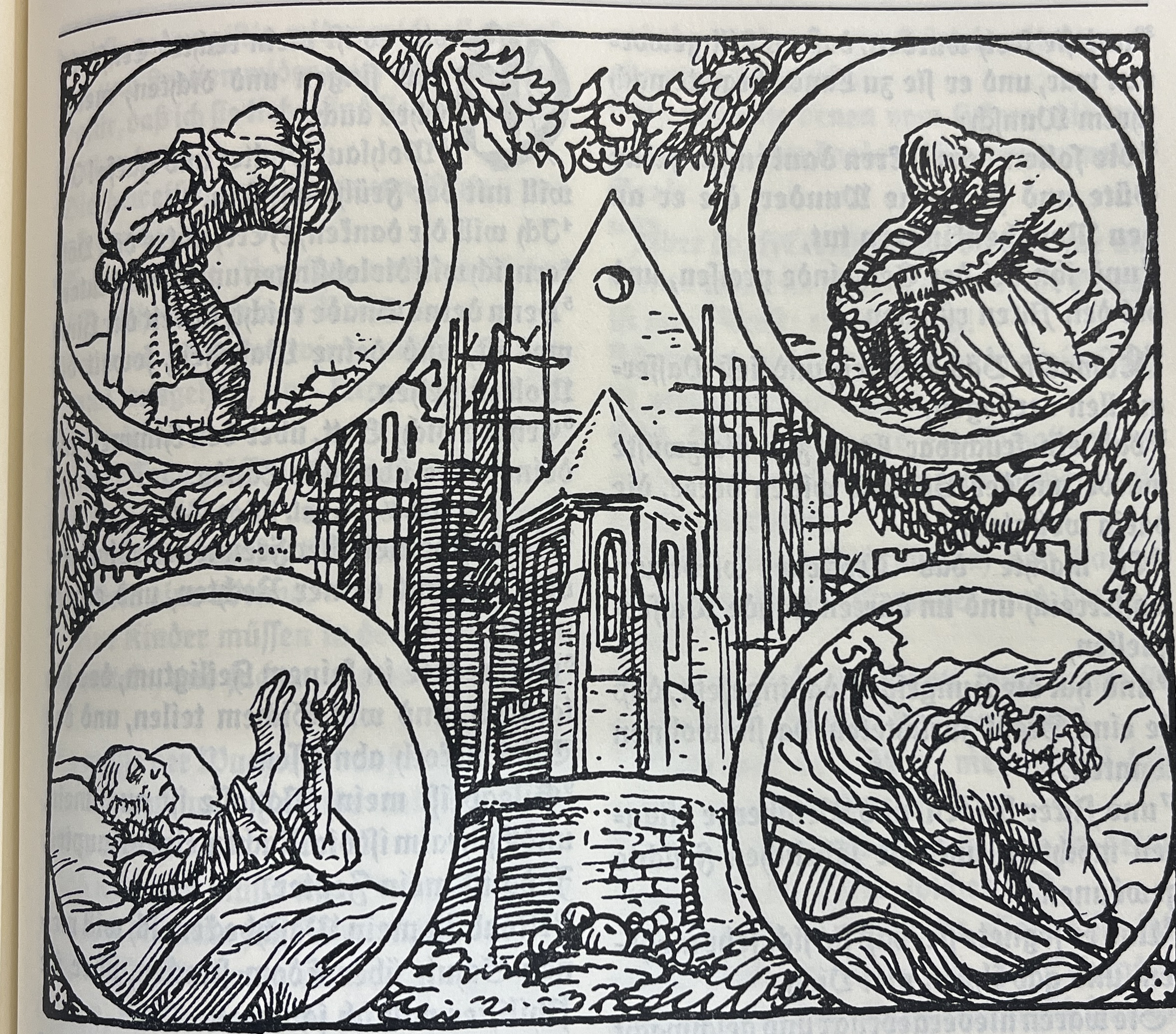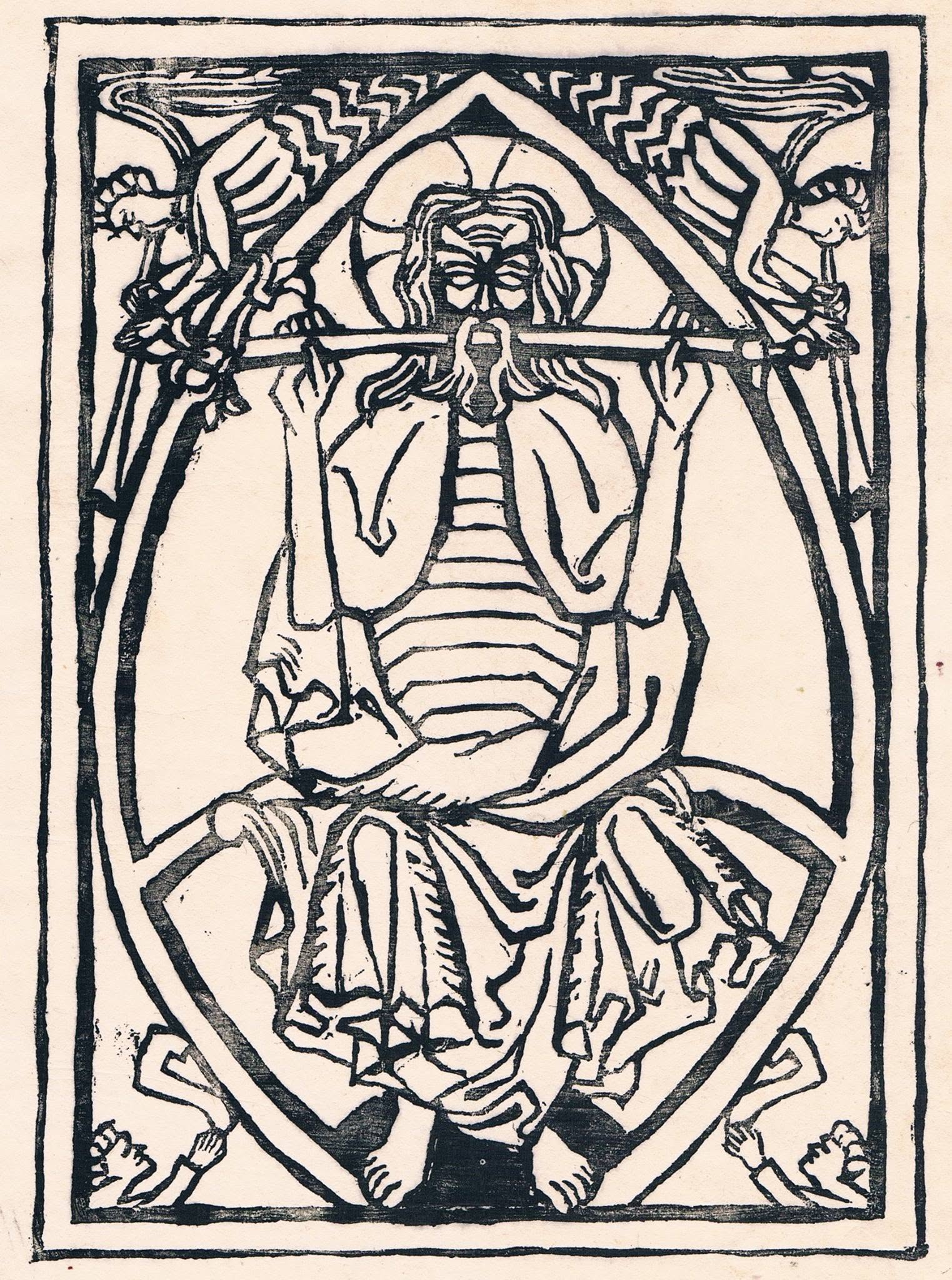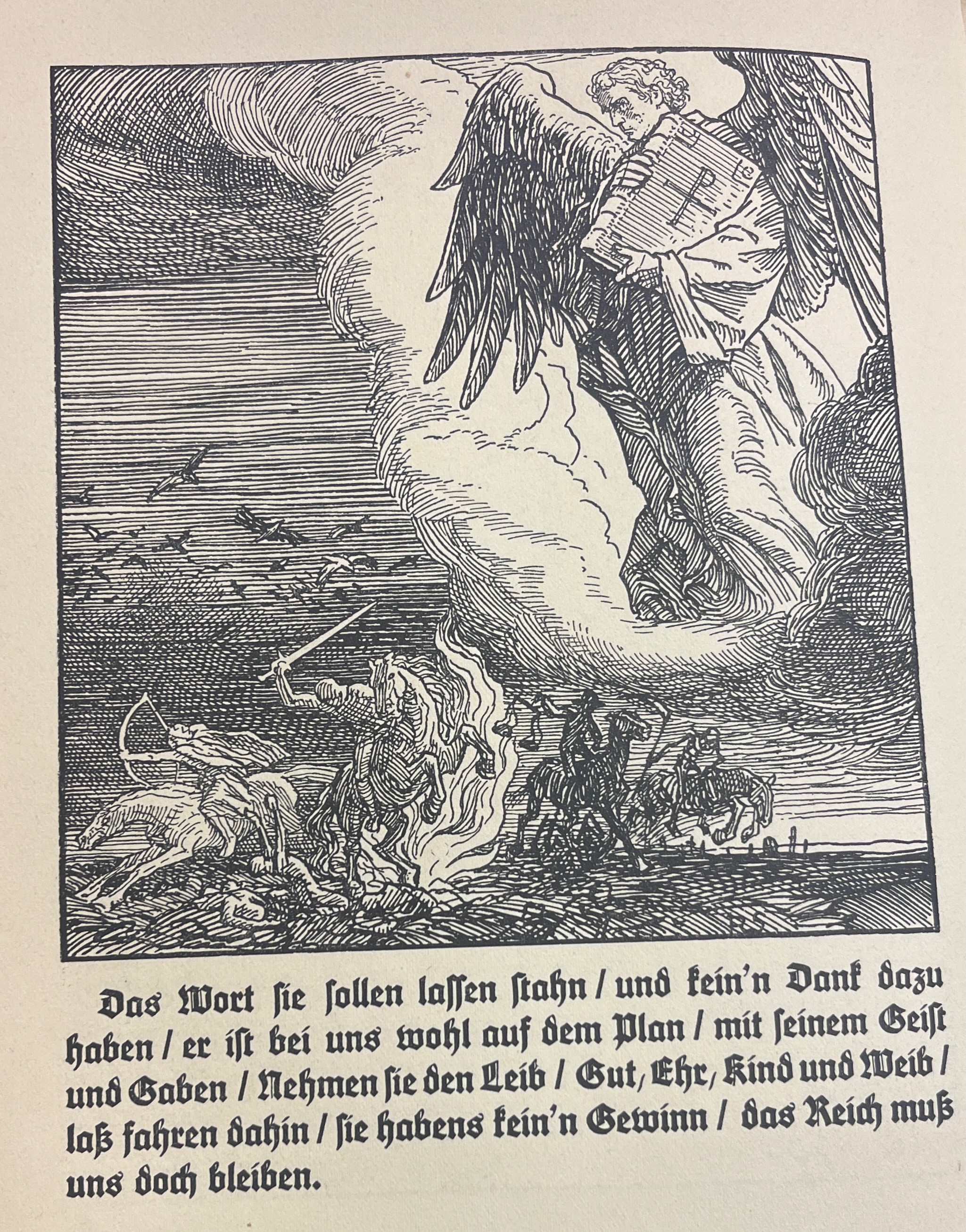
Franz Timmermann: “Fall & Redemption” (1540) in der Hamburger Kunsthalle
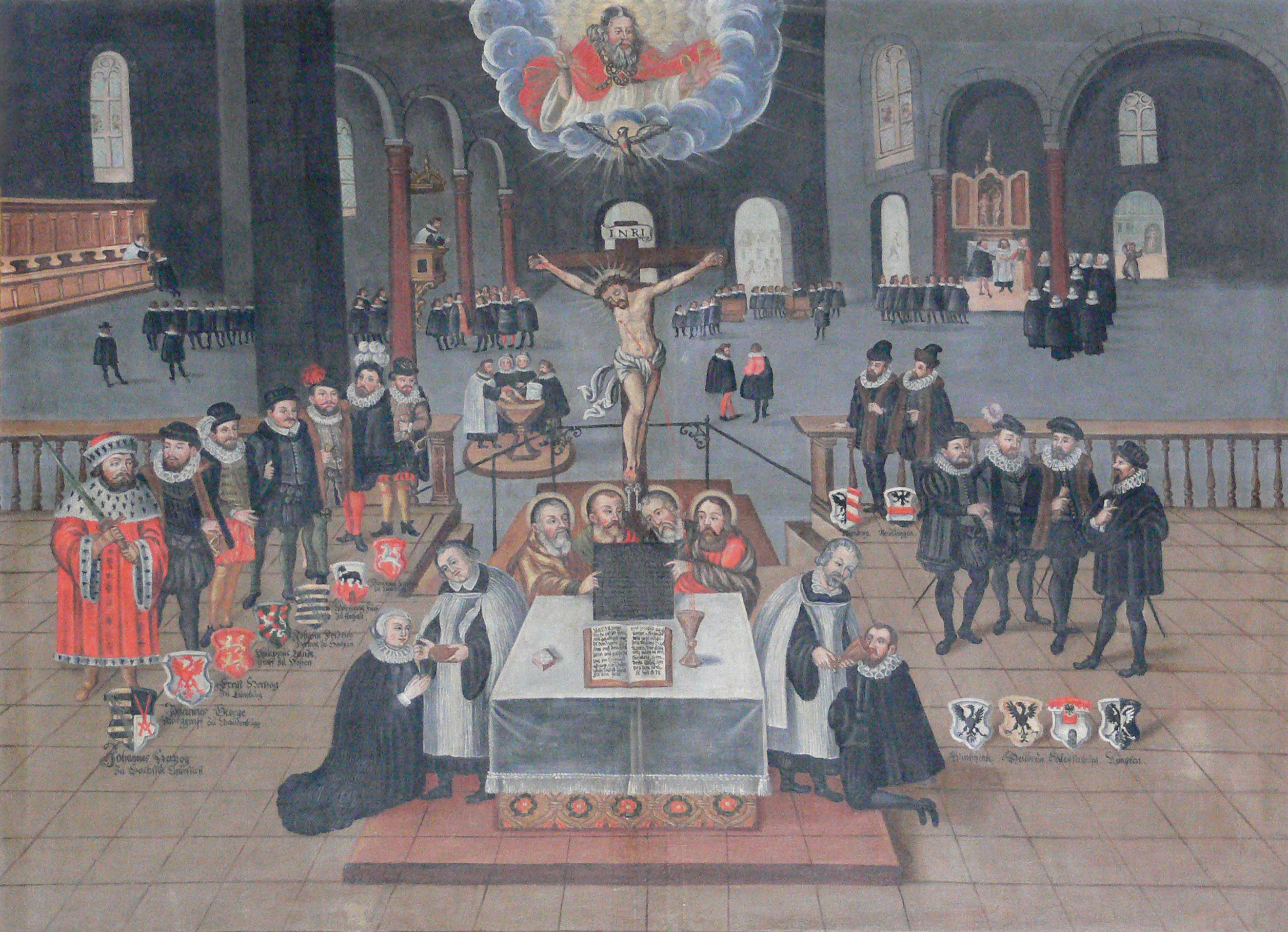
I will here briefly recount these articles of the Christian faith to which everyone is above all things to pay attention and hold fast.
The first is the law of God, which is to be preached so that one thereby reveals and teaches how to recognize sin (Rom. 3[:20] and 7[:7]), as we have often shown in our writings. However, these prophets do not understand this correctly, for this means a truly spiritual preaching of the law, as Paul says in Rom. 7[:14], and a right use of the law, as he says in 1 Tim. 1[:8].
Secondly, when now sin is recognized and the law is so preached that the conscience is alarmed and humbled before God’s wrath, we are then to preach the comforting word of the gospel and the forgiveness of sins, so that the conscience again may be comforted and established in the grace of God, etc. Christ himself teaches these two articles in such an order (Luke 24[:47]). One must preach repentance and the forgiveness of sins in his name. “And the Spirit (he says in John [16:8]) will convince the world of sin and of righteousness and of judgment.” You do not find either of these two articles in this one or any other of the false prophets. They also do not understand them, and yet these are the most important and necessary articles.
Now the third is judgment, the work of putting to death the old man, as in Romans 5; 6, and 7. Here works are concerned, and also suffering and affliction, as we through our own discipline and fasting, watching, labor, etc., or through other persecution and disgrace put to death our flesh. This putting to death is also not handled correctly by these false prophets. For they do not accept what God gives them, but what they themselves choose. They wear gray garb, would be as peasants, and carry on with similar foolish nonsense.
In the fourth place, such works of love toward the neighbor should flow forth in meekness, patience, kindness, teaching, aid, and counsel, spiritually and bodily, free and for nothing, as Christ has dealt with us.
In the fifth and last place, we ought to proclaim the law and its works, not for the Christians, but for the crude and unbelieving. For among Christians we must use the law spiritually, as is said above, to reveal sin. But among the crude masses, on Mr. Everyman, we must use it bodily and roughly, so that they know what works of the law they are to do and what works ought to be left undone. Thus they are compelled by sword and law to be outwardly pious, much in the manner in which we control wild animals with chains and pens, so that external peace will exist among the people. To this end temporal authority is ordained, which God would have us honor and fear (Rom. 13[:1]; 1 Pet. 3) [1 Pet. 2:13, 17].
However, we must see to it that we retain Christian freedom and do not force such laws and works on the Christian conscience, as if one through them were upright or a sinner. Here question are in order concerning the place which images, foods, clothing, places, persons, and all such external things, etc., ought to have. Whoever does not teach according to this order certainly does not teach correctly. From which you now see that Dr. Karlstadt and his spirits replace the highest with the lowest, the best with the least, the first with the last. Yet he would be considered the greatest spirit of all, he who has devoured the Holy Spirit feathers and all.
Therefore I beg every Christian who observes how we bicker in this matter to remember that we are not dealing with important things, but with the most trivial ones. Bear in mind that the devil is eager to spruce up such minor matters, thereby drawing the attention of the people so that the truly important matters are neglected, as long as they gape in his direction. From this each one should recognize how false and evil the spirit of Dr. Karlstadt is, who, not content to ignore and be silent concerning the great and significant articles, so inflates the least significant ones as if the salvation of the world depended more on them than on Christ himself. Also, he compels us to turn from the great important articles to minor ones, so that we with him lose time and are in danger of forgetting the main articles. Let this be the first fruit by which one is able to know this tree [Matt. 7:16–20].
Martin Luther, Luther’s Works, Vol. 40: Church and Ministry II, ed. Jaroslav Jan Pelikan, Hilton C. Oswald, and Helmut T. Lehmann, vol. 40 (Philadelphia: Fortress Press, 1999), 82–84.
News casts show Russians, who don´t know about the war in the Ukraine, nor the havoc wrecked by the Russian army as they target civilians, destroy cities, and even bomb nuclear plants. Seventy percent of all Russians are in favor of their “peace keeping mission” and “the spreading of law and order in brother´s land.” Makes me think. Reminds me of somebody, who doesn´t read the news because it is too distracting.
Solschenizyn suggested not go silently if state security comes to pick you up. Rather, make a noise so that your neighbors hear. Don´t let anyone doubt, that you are going against your will and that your captors are doing it by force. They should all know the truth about this. His warning was, because most victims of state tyranny believe that by being law-abiding and not creating a big scene, you might just win the goodwill of the powers that be. You might even pacify these false authorities coming for you in jack boots. Big mistake! Even if they come on rubber soles, they are the idiomatic snake in the grass and you will be shoved into their prison vans in a wink, whilst the brutal forces try to keep faces straight and appearances normal. The Ukraine is making a big noise. They are showing, what chaos the Russians are bringing to their lands – and that this is not their idea of peaceful coexistence.
There´s war in the UkraineThey are letting the dogs looseHow could we know?
Back in my confirmation days, my pastor told us, that living close to a concentration camp during the 2nd World War, he had seen the countless trains with loads of huddled people coming in, but never leaving. He told of the putrid smell from the smoking furnaces and the common explanation, that that was from making soap for the people. He added: “Little did we know!” Afterwards, when they were walked through the camp, many repeated: “How could we have known?” It all looked innocent enough. Rumors of the contrary were just put off as fake news. Just like those many, many Germans, who heard afterwards, what terror the Wehrmacht had wrecked beyond German borders in Poland, Ukraine, Russia to name but just three of the many, many horror stations in that world war. Goebbels never mentioned that, did he? Neither did their own husbands, fathers, sons in their cryptic letters from the war zone. It was war. But the enemy’s radio (Feindsender!) did. No small wonder, it was forbidden to listen in on the BBC. Remember, how the authorities in East Germany (GDR) forbade citizens to switch to West-TV? That was just Propaganda! Sound familiar? It´s going on even now. Russia switched off BBC etc today.
When Max du Preez exposed the torture horrors of Vlakplaas and the “Truth and Reconcilation Commission” ran revealing reports on SABC, I thought again and again: “I didn´t know that!” How could that have happened in our dearly beloved and honored home- and fatherland? That recalled the many times, when foreign criticism of Apartheid was just discounted with a “You don´t know. You can´t know. You are a foreigner!” That held true of our very own Director of Missions: Rev. Friedrich Wilhelm Hopf DD. Some discontinued reading his “Missionsblatt” – because it was far too political! Or local atrocities were relativized with other horrors far away: “See? You are not much better (or even worse!) and how can You judge us?” Local criticism was silenced with: “Don´t wash our own dirty linen in public!” Germans call them: “Nestbeschmutzer!” People who bring their own family into disrepute. Do you recognize how perpetrators stylize themselves as victims and victims, who speak out, become further brutalized, ostracized, and punished?
Well, in peace and quiet, there is room for civilized debate, pro et contra – much like Luther´s ninety five academic thesis. At first that was just a professorial plea to clarify legalistic and pastoral misunderstandings, get the gospel back on track and live happily ever after. However, when the Pope refused to listen and declared war against Luther, the cards were on the table. There was no room for debate, but high time for clarity, strong words and determined action. As long as Hitler was still in the realm of legality, opposition was difficult, but he exposed himself more and more as prime evil. Especially when he legalized evil – like the lawful extermination of Jews. Some like Sasse and Bonhoeffer saw this abomination earlier than others, but some never woke up, but revered this deceiver as their leader and savior even when there was no room left for excuses. This German tyrant had not just transgressed basic commandments of God. He legalized apostasy, homicide, total war. He put himself in God´s place and deceitfully clothed himself as an angel of peace and goodwill. The only question remaining is, how to stop this blatant perpetrator and get rid of the evil leader, democratically elected in a previously civilized country. War changes everything – and the willingness to start war on others, is a blatant rejection of all legality, civility, and humanity even. Tyrannenmord: Kill the tyrant!
Many have blamed today´s Germans, that they were so tolerant and bent over backwards giving Putin the room he craved. Just like the British in the heydays. Poland had to be attacked in those bleak September’s days, before they woke up and declared war. There was no other way to stop Hitler´s armies. Thank God they did. And thank God, the Americans joined in after Pearl Harbor. We can all lament the fact that they woke up so late, but thankfully they woke up eventually. It took Germany and NATO far too long to push back against Putin. At last the please of the Ukrainians are heard. Their valiant efforts at defending their fatherland are astonishing, but Russia is all out to kill. It´s hurting its very own motherland. It´s that simple. There is no validity in the claims, that Russia needs to appease own hurt feelings in such a barbaric way. That´s puerile nonsense like dueling or archaic “Ehrenmorde!” Grow up and get a life: It´s free.
We know, the Russians can unchain hell fire still and they´re hell bound to do it. I have my doubts, whether the Ukrainians can withstand their aggressive onslaught much longer. But there is no doubt in my mind, that Putin is a bloody tyrant. He and his grim generals have too much innocent blood on their hands already, they´ve brought crying shame on Mother Russia and endless grief on their own people, never mind the horrific war they have unchained and brought to the independent nation of Ukraine. I know, Russia can do far worse, but we can´t say that we didn´t know this. It is high time to wake up and take a stand against the evil war machine with all means at our disposal wherever we are. Otherwise, the free world, as we know it, might fall – even as we are sleeping. It could be barren emptiness functioning as dreaded Gulags. Ignorance doesn´t serve as an excuse in courts of law. It doesn´t in everyday life either. Sticking one’s head into the sand is no meaningful option. We have a responsibility to get informed and truthfully so even if it aggravates Putin, his devious generals, and terrible war machine.
My friend asks me, why I quote my granny: “Don´t trust the Russians!” Well, it´s complicated. Trust grows. So does mistrust. The easy reasons are bad experiences with Russians as neighbors and rulers – during wars and after. You know, after the war is before the war… Putin is worse than any fox (or snake!). He´s out to grow Russia even if others have to bleed. He bullies sovereign nations. Poisons his enemies not in the streets of London, but in Salisbury and in broad daylight Berlin. He locks them away in today´s Gulags with all legalities covered or at least bent to do so and moves against Ukraine whilst all watch wide eyed. Publicly declared Kiev and all of Ukraine to be his subjects, although they´ve been around longer than Moscow and historic Russia. It´s his powerplay, creating facts by force disregarding any semblance of finesse. War as final means of politics (Carl von Clausewitz). There´s nobody to stop him. He´s “walking over corpses” whilst our reporters are dumbfounded as they continue to seek some rationality in this brutal display of military force. It´s like a child complaining about the school bully, but nobody cares.
For Christmas I got this book: “Humankind. A hopeful history” by Rutger Bregman. It builds much on the same foundations as psychological courses for self-help and stress management: “You´re ok. I´m ok” (Thomas A. Harris). It strongly rejects the old narrative of “Lord of the Flies” (William Golding) and “radical evil” (Immanuel Kant). Rather, it advocates a positive outlook much along the lines of Jean-Jacques Rousseau. Opposed to Kant, Golding and a long string of others, these starry-eyed proponents underestimate original sin and highly exaggerate our good inclinations. Mostly they are just self-seeking cover-ups. Ask Jacob, Moses, David and all the others… They had their dark sides. No question. And “Original Sin” remains the second article in the Augsburg Confession. The Formula of Concord confirms that.
The Russians understand about humans. Sinful humans. Erring, tarnished, envious and even hateful. Probably more than the Chinese do as there was a Conversion of the Russ – but the Chinese have no good God, only some sorry party idols and short lived communist effigies. Their own cultural revolution made sure of getting rid of all else. It was more effective than most exorcisms. At least, the Russians have Dostoyevsky, Tolstoy, Pasternak, Solschenizyn and so on. It´s their sensitive, good and suffering side. They know a lot about human hardship, punishment, innocent suffering too. Financial hardship doesn´t weigh too much in that context. Financial boycotts could work for materialistic capitalists, but I think, they´re feeble means against hardened Russians. They know poverty. Just read their stories of hungry, ill, imprisoned and downtrodden. They know what it means to be dirt poor. Nothing. Silch. Just plenty snow, dirt and wide open spaces. So, our talk of economic sanctions doesn´t frighten them so much as us but hardens their tough resolve. Perhaps they even hope for redemption through suffering. I don´t know, if they really know about justice, truth and reconciliation as possible outcomes of secular processes and democratic power sharing. Forgiveness in the political realm? Mitigating circumstances? Perhaps, but I´m not so sure. There´s just so much wildness, tyranny, brutal force, and harsh exploitation and that´s not only natural forces, evolution through many ages and eventual survival of the fittest, but rather in their best circles and prestigious families. Just think of “War and Peace” (Tolstoy). Napoleon couldn´t break their spirit by razing Moscow, nor could general Paulus by burning down Stalingrad. They left defeated. Russians lived to tell the story. It´s their very own never-ending story. It´s their long history. Remember Moscow founding Czar Ivan the Terrible, killing his only son in a rage. I mean, they know about playing God in a very serious fashion.
They know a whole lot about dialectics. Materialism too. They say this and do the other – just like that son, who tells his father, he´ll go work in the vineyard, but then doesn´t. They don´t just know a lot about the “Dialectics of Enlightenment” (Horkheimer/Adorno) and how something, that was meant to be so good, turns out to be so bad – it is the revolt of nature. They perfected the script. That´s not just with Joseph Stalin and his killing fields in the Ukraine, but even those organized mock trials, the Gulag system and ongoing tyranny proving over decades how the revolution eats its very own children. The good become the bad. Millions died for it. Yes, “Dichter & Denker” build Auschwitz, hold themselves as “master race”, whilst degrading others as “unworthy to live” – left to kill. Afrikaaners perfect apartheid – not many years after the Boer War. The Jews do it with their Palestinian compatriots – not long after the Holocaust. But in real existing socialism such political atrocities were perfected.
All good reasons for checks and balances, sharing and even division of power. Not losing sight of the distinct possibility that things go wrong in governments. Things get out of hand as power corrupts and absolute power goes all the way. There´s just so much going seriously wrong. Too much reason for revenge, bad blood, getting one´s own back. Nobody wins the blame game. There´s always reason for revenge and to hit back. You just need a memory for these things or some imagination. It´s always a good time for containment of brutal force, resistance against evil, some natural law justice – and to prevent the winner to take it all. We Lutherans believe in the Law holding true and setting boundaries not just for the criminals, but for the justified and righteous too as even they are prone to fall short of expectations and commit terrible sin. King David, but also St. Peter are long-standing examples. The Greek tragedies confirm these stories – and Shakespeare sings the same tune.
After the walls finally came down in the last century, many of us fell for the “End of history and the last man” (Francis Fukuyama). We were just so eager to believe in such a happy ending. Leaving politics for children (“Fridays for future”). Making room for previously discriminated genders – all seventy of them and counting! We have presidential actors like Zelensky. Utterly out of their depth confronted with serious military opposition. Parliament turns into a circus with clowns like Boris taking over and playing the fool with everyone. Democratic guardians fall asleep on the job and not just sleepy Joe. Serious professionals are scarce. In Germany far too many good people have been kicked into oblivion.
So now, whilst children block highways, harbors and key points, Putin´s generals roll into the Ukraine with thousands of tanks. Whilst local activist play hide-and-seek in lofty treetops, breaking up railways and painting horrid graffiti, Russians fire rockets into all directions, challenge Beijing´s closing function for most effective distraction from ongoing atrocities. Whilst European politicians fantasize of flowering landscapes under wind turbines, Russians are pressing down on our gas taps and spend as much dirty energy as they can to expand their bulging borders for just more dreary “Lebensraum”: “Just because they can!” Whilst we consider one nutty diet after the other, Russians are nursing a megalomanic appetite by swallowing up neighbors: Who is going to stop me now? (Queen) Somebody should tell them, that this kind of thirst for more is not stilled by giving in to it. Rather it needs tough love: “Stop it!” Just ask the AA about that. Their twelve steps would probably be way beyond modern diplomats, but they could get some serious hardliners on the job. This is a tough job after alle. Presently we have a pretty cool minister of foreign affairs. She´s a pretty little girl really. However, the old men in Putin´s war office don´t look as if they could take her seriously. They´ve got real business to attend to. They are at war – not having fun and playing games for bored voters. Their call is beyond child stuff. They´ve come up through the ranks and fill that post – by being ugly, dirty fighters. It´s been that way for decades. Just ask their opponents. At least those, who are still around. I fear most of them are dead and not due to natural causes. If they do that to their own people, what do You imagine will they do with foreign enemies and aliens?
Russian tanks stuck in the mud (London Times)
So, where have all the men gone? We need men to fight the Taliban, the Iranian mullahs firing up their nuclear reactors, Islamic state terrorists. Obviously computer nerds can go a long way at disrupting the networks, but for some ops, you need fighters even behind enemy lines – marines or SAS if you can´t find a recce. I doubt if the GSG9 is up to it after the latest purges. Chinese communists pressing for national glory beyond their narrow confines. Cowing Hong Kong, hurting Taiwan and destabilizing the region – infecting the world with their mutations. Russians, who seek vindication for far too much hurt pride and deflated egos – dating back decades, even centuries. It´s one big asylum – never mind lost case. And now, they´re on the loose. Putin let his dogs out! And we? We have ended compulsory military service. Our guns don´t fire. Our tanks don´t drive. Helicopters, jets, and drones don´t fly. Ships and submarines aren´t seaworthy. Hallelujah – we have helmets and masks and lots of cake to give away. So, let them eat cake! We have bureaucrats in every office and plenty forms to prove it – instead of professional soldiers – probably fluent at singing Kumbaya and baking vegan Pizza, but who the heck is guarding the gates?
Russian President Vladimir Putin, left, chairs a Security Council meeting in the Kremlin in Moscow, Russia, Monday, Feb. 21, 2022. Putin has convened top officials to consider recognizing the independence of separatist regions in eastern Ukraine. Such a move would ratchet up tensions with the West amid fears that the Kremlin could launch an invasion of Ukraine imminently. (Sputnik, Kremlin Pool Photo via AP)Russian President Vladimir Putin, left, chairs a Security Council meeting in the Kremlin in Moscow, Russia, Monday, Feb. 21, 2022. Putin has convened top officials to consider recognizing the independence of separatist regions in eastern Ukraine. Such a move would ratchet up tensions with the West amid fears that the Kremlin could launch an invasion of Ukraine imminently. (Sputnik, Kremlin Pool Photo via AP)Russian President Vladimir Putin, left, chairs a Security Council meeting in the Kremlin in Moscow, Russia, Monday, Feb. 21, 2022. Putin has convened top officials to consider recognizing the independence of separatist regions in eastern Ukraine. Such a move would ratchet up tensions with the West amid fears that the Kremlin could launch an invasion of Ukraine imminently. (Sputnik, Kremlin Pool Photo via AP)
It´s no longer “waiting for the barbarians” (J.M. Coetzee). We´re past that stage. They are here. Knocking at the door. Forcing entry. Our best men are in hiding. Ostracized. Castrated. No balls left. So, let’s see, what the Russians are up. Anybody for some tea? They prefer Vodka straight. You want to sit down and talk? They´d rather shoot – straight too. They´ve come to clean shop. Clean all their way. Do the lists. One dead, one tick. Death row. It´s dirty, but they´re used to it. It´s for a good purpose. Creating space for their people. Room for egos to flourish. Who is going to stop them? It´s tickets for now.
The strong man in China might stand up to Russia someday yet. For now, they are sharing jokes on us. It´s just a poor joke. Ukrainians caught up in the middle. Again. Trampling fields. They had hoped for a turn for the better. No longer crazy bears foraging in their front yard. Seems as if that was wishful thinking. Isn´t there always? As long as we´re still breathing there´s hope. Hope – maybe, but not in logic, military reason or in some political party or princes. There is one, who holds all the world in His hands – even the high and mighty like Putin & Co plus the one from Beijing. The prophet Amos proclaims: “Is there one evil in the city, that the Lord doesn´t do?” To Him we continue to cry: Lord have mercy! Christ have mery! Lord have mercy!
Looking forward to this Sunday. It is “Sexagesimae” – the second Sunday before Lent):
Oh, that today You would listen as He speaks! Do not harden Your hearts.
Hebrews 3,15
An Armenian Bible, 17th century, illuminated by Malnazar
This blessed Sunday we are focused on the triune God´s holy word. The Psalm 1,19 and 119 teach us in that regard. With the Introit all believers confess:
Psalm 119,89-92.103-105.116Isaiah scrollVom Himmel hoch da komm ich her!Esra vor einem Schrank mit biblischen Büchern (Codex Amiatinus)
And the good Lord lets us hear His words through the holy prophet Isaiah, which we have in well preserved text scrolls dating back nearly 3 millenia…
Isaiah 55,8-12
The designated sermon text is from the letter to the Hebrews. There we get a strong and powerful picture of this very holy Word of God:
The Nouvi Zákon – the Lutheran New Testament in prekmurian language, by István Küzmics in 1771Gustav Vasa Bible 1541 Elector´s Bible 1641Blatt 16v, enthaltend Mk 3,26–32 EU, aus dem Codex Argenteus, einer Abschrift der WulfilabibelDie erste vollständige Bibelübersetzung von Martin Luther 1534, Druck Hans Lufft in Wittenberg, Titelholzschnitt von Meister MS. Münster Bibelmuseum
We listen up and sing with this blessed churchman´s hymn:
Thy strong word did cleave the darkness; At thy speaking it was done. For created light we thank thee While thine ordered seasons run. Alleluia! Alleluia! Praise to thee who light dost send! Alleluia! Alleluia! Alleluia without end!
Lo, on those who dwelt in darkness, Dark as night and deep as death, Broke the light of thy salvation, Breathed thine own life-giving breath. Alleluia! Alleluia! Praise to thee who light dost send! Alleluia! Alleluia! Alleluia without end!
Thy strong Word bespeaks us righteous; Bright with thine own holiness, Glorious now, we press toward glory, And our lives our hope confess. Alleluia! Alleluia! Praise to thee who light dost send! Alleluia! Alleluia! Alleluia without end!
From the cross thy wisdom shining Breaketh forth in conqu’ring might; From the cross forever beameth All thy bright redeeming light. Alleluia! Alleluia! Praise to thee who light dost send! Alleluia! Alleluia! Alleluia without end!
Give us lips to sing thy glory, Tongues thy mercy to proclaim, Throats to shout the hope that fills us, Mouths to speak thy holy name. Alleluia! Alleluia! May the light which thou dost send Fill our songs with alleluias, Alleluias without end!
God the Father, light-creator, To thee laud and honor be. To thee, Light from Light begotten, Praise be sung eternally. Holy Spirit, light-revealer, Glory, glory be to thee. Mortals, angels, now and ever Praise the holy Trinity!
A week ago Bruno and Ingrid were in a head-on-collision. Subsequently other cars crashed into them from behind. Their two children Karl (6) and Maya (2) were critically injured, and both died in ICU – Karl on Sunday and Maya this morning. Both parents are still in serious physical condition besides suffering from this trauma and loss. Please pray for them, that they don´t lose faith, but continue to trust in the one, who we know as the one, who
will shelter you with his wings; you will find safety under his wings. His faithfulness is like a shield or a protective wall!
Psalm 91,4
My parents-in-law lost their youngest son – Martin – when he was but 2 years old. He drowned in the parsonage´s fishpond on Christmas Eve. Their eldest was shot on a lovely autumn day by robbers, who came to steal his truck. They probably felt much like Adam and Eve after Abel was murdered by Cain, or Jacob, when he heard that a wild animal had killed Joseph. King David was quite distraught when his rebellious son Absalom was killed in battle, trying to oust his very father from the throne. He also went through quite some suffering, when his first-born with Batsheba dies. I reckon there´s not much worse to suffer in this world, than to bury your own child. That´s what those parents in Bethlehem went through after the killing of the holy innocents, but Joseph and Mary escaped with baby Jesus to Egypt.
“Cain flees, Adam and Eve grieve” by William Blake 1805-9“First family” “Jacob hears news of Joseph´s death” by Giobanni Andrea de Ferrari 1640
That explains the joy the bereaved experience, when their dead ones are brought back to life: The widow of Sarepta; Jacob gets to see his long lost son Joseph again in Egypt; the widow of Nain; Jairus, the ruler of the synagogue. It´s what the Lord promised through the evangelist. St. John:
God will wipe away every tear from their eyes, and death will not exist any more—or mourning, or crying, or pain, for the former things have ceased to exist.
Revelation 21,4
Magdalena Luther by Lucas Cranach srMartin Luther at the coffin of his daughter by Gustav Ferdinand Leopold König
The reformer – Dr. Martin Luther – struggled very much with the premature death of his daughter Magdalena. She was but thirteen years old. It was the 20th September 1542 – four years before he himself would die. He writes to his trusted friend Justus Jonas:
I believe the report has reached you that my dearest daughter Magdalena has been reborn into Christ’s eternal kingdom. I and my wife should joyfully give thanks for such a felicitous departure and blessed end by which Magdalena escaped the power of the flesh, the world, the Turk and the devil; yet the force of our natural love is so great that we are unable to do this without crying and grieving in our hearts, or even without experiencing death ourselves. The features, the words and the movements of the living and dying daughter remain deeply engraved in our hearts. Even the death of Christ… is unable to take this all away as it should. You, therefore, give thanks to God in our stead. For indeed God did a great work of grace when he glorified our flesh in this way. Magdalena had (as you know) a mild and lovely disposition and was loved by all… God grant me and all my loved ones and all my friends such a death – or rather such a life.
Fritz Mackensen: “Mourning family”Epitaph for Mary Elisabeth Gerhardt 28th January 1657 (Mittenwalde)P. Paul Gerhardt
P. Paul Gerhardt married Anna Maria on the 11th of February 1655. The first daughter, Maria Elisabeth, was born on the 19th of May 1656, but died half a year later already on the 28th January 1657. She was buried in Mittenwalde. The Gerhardts had four more children. Three of these died in early age: Anna Catharina, Andreas Christian and Andreas). Son Paul Friedrich was the only one, who would outlive his parents. Paul Gerhard, was hard pressed in his office of the minstry too because he wanted to remain faithful to the Lutheran confession – and not follow the unionistic pressures of the calvinistic Prussian king. One of his most beloved hymns is “Geh aus mein Herz und suche Freud...”, by which he exhorts himself to leave his own sorrowful state (curvatus in se) and seek joy in God´s creation, salvation and final consumation is a very strong admonition for us to look up towards Jesus – the only source and final goal of our salvation – and come to Him with all our sorrows, troubles and needs. Catherine Winkworth translated and compressed Paul Gerhardt´s 15 verses into but six stanzas. Try read the original – if You can. It´s worth it.
1 Go forth, my heart, and seek delight, While summer reigns so fair and bright, View God’s abundance daily; The beauty of these gardens see, Behold how they for me and thee Have decked themselves so gaily.
2 The trees with spreading leaves are blessed, The earth her dusty rind has dressed In green so young and tender. Narcissus and the tulip fair Are clothed in raiment far more rare Than Solomon in splendor.
3 The lark soars upward to the skies, And from her cote the pigeon flies, Her way to woodlands winging. The silver-throated nightingale Fills mountain, meadow, hill and dale With her delightful singing.
4 Fast grows the wheat, like waving gold, And gives delight to young and old; All nature with thanksgiving Lauds Him whose mercy measureless Vouchsafed the soul of man to bless With goods that grace his living.
5 Thy splendor, Lord, doth brightly shine And fills my heart with joy divine While here on earth abiding; What, then, may be in store for me And all who heaven’s glory see, In golden halls residing?
6 O choose me for Thy paradise, Let soul and body till I rise Still flourish, tiring never. With Thee alone will I abide, Thine honor serve, and none beside, Both here and there forever.
Looking forward to the 4th Sunday before Lent. It comes with a very promising invitation: “Come and witness God’s exploits! His acts on behalf of people are awesome.” (Psalm 66,5)
Pieter Stalpaert 1617Epitaph for Johann Stiegel by Peter Gottland (1564) JenaRembrandt van Rijn (1632)
The Introit from Psalm 107 lifts our eyes to look at those in peril on the high seas, who cry to the Lord and are saved by His gracious favor:
Give thanks to the Lord, for He is good, and His loyal love endures. Let those delivered by the Lord speak out, those whom He delivered from the power of the enemy…
Some traveled on the sea in ships, and carried cargo over the vast waters. They witnessed the acts of the Lord, His amazing feats on the deep water. He gave the order for a windstorm, and it stirred up the waves of the sea. They reached up to the sky, then dropped into the depths. The sailors’ strength left them because the danger was so great. They swayed and staggered like drunks, and all their skill proved ineffective. They cried out to the Lord in their distress; He delivered them from their troubles. He calmed the storm, and the waves grew silent. The sailors rejoiced because the waves grew quiet, and He led them to the harbor they desired. Let them give thanks to the Lord for His loyal love, and for the amazing things He has done for people. Let them exalt Him in the assembly of the people. Let them praise Him in the place where the leaders preside.
Psalm 107:1f.23-32
The Old Testament lesson from the prophet Isaiah reminds us, that we should not forget the good Lord – creator and savior of all! – but rather, put all our hope and trust in Him, who has created all and everything – even us – and continues to preserve us out of fatherly goodness and mercy all days of our life. Therefore, we should not despair, but cry to Him in every need and expect life and salvation from Him, the giver and keeper of all good.
Wake up! Wake up! Clothe Yourself with strength, O arm of the Lord! Wake up as in former times, as in antiquity. Did You not smash the Proud One? Did You not wound the sea monster? Did You not dry up the sea, the waters of the great deep? Did You not make a path through the depths of the sea, so those delivered from bondage could cross over?
Those whom the Lord has ransomed will return; they will enter Zion with a happy shout. Unending joy will crown them, happiness and joy will overwhelm them; grief and suffering will disappear. “I, I am the one who consoles you. Why are you afraid of mortal men, of mere human beings who are as short-lived as grass? Why do you forget the Lord, who made you, who stretched out the sky and founded the earth? Why do you constantly tremble all day long at the anger of the oppressor, when he makes plans to destroy? Where is the anger of the oppressor? The one who suffers will soon be released; he will not die in prison, he will not go hungry. I am the Lord your God, who churns up the sea so that its waves surge. The Lord of Heaven’s Armies is His name!
“I commission you as my spokesman; I cover you with the palm of my hand, to establish the sky and to found the earth, to say to Zion, ‘You are my people.’”
This brings up the story of the prophet Jonah, which is not listed among Sunday´s lessons, but points us dramatically to the Gospel of our Lord Jesus Christ too. We hear two accounts of our Lord calming the storms – one as recorded by the evangelist St. Matthew, which is allocated as sermon text and the other from St. Mark, as the regular Gospel. In the first, we hear of St. Peter going out to meet our Lord on the water and how the good Lord saves him from drowning, when he starts fearing the surrounding perils. Here is the text as recorded by St. Mark:
On that day, when evening came, Jesus said to his disciples, “Let’s go across to the other side of the lake.” So, after leaving the crowd, they took him along, just as he was, in the boat, and other boats were with him. Now a great windstorm developed and the waves were breaking into the boat, so that the boat was nearly swamped. Buthe was in the stern, sleeping on a cushion. They woke him up and said to him, “Teacher, don’t you care that we are about to die?” So, he got up and rebuked the wind, and said to the sea, “Be quiet! Calm down!” Then the wind stopped, and it was dead calm. And he said to them, “Why are you cowardly? Do you still not have faith?” They were overwhelmed by fear and said to one another, “Who then is this? Even the wind and sea obey him!”
Mark 4,35-41
Codex Egberti (980-993)
Immediately Jesus made the disciples get into the boat and go ahead of him to the other side, while he dispersed the crowds. And after he sent the crowds away, he went up the mountain by himself to pray. When evening came, he was there alone. Meanwhile the boat, already far from land, was taking a beating from the waves because the wind was against it. As the night was ending, Jesus came to them walking on the sea. When the disciples saw him walking on the water, they were terrified and said, “It’s a ghost!” and cried out with fear. But immediately Jesus spoke to them: “Have courage! It is I. Do not be afraid.” Peter said to him, “Lord, if it is you, order me to come to you on the water.” So he said, “Come.” Peter got out of the boat, walked on the water, and came toward Jesus. But when he saw the strong wind, he became afraid. And starting to sink, he cried out, “Lord, save me!” Immediately Jesus reached out his hand and caught him, saying to him, “You of little faith, why did you doubt?” When they went up into the boat, the wind ceased. Then those who were in the boat worshiped him, saying, “Truly you are the Son of God.”
Matthew 14,22-33
It is St. Paul, who relates this holy Gospel masterfully in his life and points out, how we too should not trust in ourselves, but in God, who raises the dead. He is the one, who delivers us from so great a risk of death, and He will deliver us – for sure. Amen. Amen. He writes:
For we do not want you to be unaware, brothers and sisters, regarding the affliction that happened to us in the province of Asia, that we were burdened excessively, beyond our strength, so that we despaired even of living. Indeed we felt as if the sentence of death had been passed against us, so that we would not trust in ourselves but in God who raises the dead. He delivered us from so great a risk of death, and he will deliver us. We have set our hope on him that he will deliver us yet again, as you also join in helping us by prayer, so that many people may give thanks to Godon our behalf for the gracious gift given to us through the help of many.
2. Corinthians 1,8-11
Isn´t that encouraging and so awesome to hear? Oh yes, it is. God´s acts on our behalf are just so awesome. Hallelujah!
That is why we join in singing the old Lutheran favorite:
1. Seek where ye may to find a way That leads to your salvation; My heart is stilled, On Christ I build, He is the one Foundation. His Word is sure, His works endure; He doth o’erthrow My every foe; Through Him I more than conquer.
2. Seek whom ye may To be your stay; None can redeem his brother. All helpers failed, This Man prevailed, The God-man, and none other. Our Servant-Lord Did help afford; We’re justified, For He hath died, The Guiltless for the guilty.
3. Seek Him alone, Who did atone, Who did your souls deliver; Yea, seek Him first, All ye who thirst For grace that faileth never. In every need Seek Him indeed; To every heart He will impart His blessings without measure.
4. My heart’s Delight, My Crown most bright, Thou, Jesus, art forever. Nor wealth nor pride Nor aught beside Our bond of love shall sever. Thou art my Lord; Thy precious Word Shall be my guide, Whate’er betide. Oh, teach me, Lord, to trust Thee!
5. Hide not from me, I ask of Thee, Thy gracious face and favor. Though floods of woe Should o’er me flow, My faith shall never waver. From pain and grief Grant sweet relief; For tears I weep, Lord, let me reap Thy heavenly joy and glory.
Georg Weissel 1590-1635 translated by Arthur P. Voss 1899-1955
Looking forward to the high feast and holiday of the Transfiguration this last Sunday after the Epiphany. We´re hearing a lot from the great prophet Moses, who points us to the one and only savior of the world, Jesus Christ. He it is, who was promised to Adam and Eve in the garden. He it is, who was promised to our father Abraham. It is He, who spoke by all the prophets in the same vein as He did to Moses. It is He, who says: “I am, who I am!”
Juan Rexach (1460): Prophet MosesVasilij Ivanovič Denisov (1862-1922): MosesChristian Rohlfs (1849-1938): Moses sees the promised land
The Old Testament lesson for tomorrow is from the second book of Moses (Exodus) chapter 3 and relates the story of the burning bush and calling of Moses:
Now Moses was tending the flock of Jethro his father-in-law, the priest of Midian, and he led the flock to the far side of the wilderness and came to Horeb, the mountain of God. There the angel of the Lord appeared to him in flames of fire from within a bush. Moses saw that though the bush was on fire it did not burn up.
So Moses thought, “I will go over and see this strange sight—why the bush does not burn up. ”When the Lord saw that he had gone over to look, God called to him from within the bush, “Moses! Moses!” And Moses said, “Here I am.” “Do not come any closer,” God said. “Take off your sandals, for the place where you are standing is holy ground.” Then he said, “I am the God of your father, the God of Abraham, the God of Isaac and the God of Jacob.” At this, Moses hid his face, because he was afraid to look at God.
The Lord said, “I have indeed seen the misery of my people in Egypt. I have heard them crying out because of their slave drivers, and I am concerned about their suffering. So I have come down to rescue them from the hand of the Egyptians and to bring them up out of that land into a good and spacious land, a land flowing with milk and honey—the home of the Canaanites, Hittites, Amorites, Perizzites, Hivites and Jebusites. And now the cry of the Israelites has reached me, and I have seen the way the Egyptians are oppressing them. So now, go. I am sending you to Pharaoh to bring my people the Israelites out of Egypt.”
But Moses said to God, “Who am I that I should go to Pharaoh and bring the Israelites out of Egypt?” And God said, “I will be with you. And this will be the sign to you that it is I who have sent you: When you have brought the people out of Egypt, youwill worship God on this mountain.” Moses said to God, “Suppose I go to the Israelites and say to them, ‘The God of your fathers has sent me to you,’ and they ask me, ‘What is his name?’ Then what shall I tell them?” God said to Moses, “I am who I am. This is what you are to say to the Israelites: ‘I am has sent me to you.’” God also said to Moses, “Say to the Israelites, ‘The Lord, the God of your fathers—the God of Abraham, the God of Isaac and the God of Jacob—has sent me to you.’ “This is my name forever, the name you shall call me from generation to generation.”
Exodus 3,1-15
The sermon text for tomorrow´s high holiday is from the same book:
When Moses came down from Mount Sinai with the two tablets of the covenant law in his hands, he was not aware that his face was radiant because he had spoken with the Lord. When Aaron and all the Israelites saw Moses, his face was radiant, and they were afraid to come near him. But Moses called to them; so Aaron and all the leaders of the community came back to him, and he spoke to them. Afterward all the Israelites came near him, and he gave them all the commands the Lord had given him on Mount Sinai. When Moses finished speaking to them, he put a veil over his face. But whenever he entered the Lord’s presence to speak with him, he removed the veil until he came out. And when he came out and told the Israelites what he had been commanded, they saw that his face was radiant. Then Moses would put the veil back over his face until he went in to speak with the Lord.”
Exodus 34,29-35
We know many great promises of our good Lord and triune God, which were recorded by His faithful servant Moses. Another outstanding one is from the fifth and final book of Moses:
The Lord your God will raise up for you a prophet like me from among you, from your fellow Israelites. You must listen to him.
Deuteronomy 18,15
And that too was wonderfully fulfilled – like all our good God´s promises – in His only begotten Son, Jesus Christ, our Lord, the only Savior of the world. In Him the fulness of God´s grace and goodness appeared (Epiphany) in the fulness of time to His people Israel and for the benefit of all the world as the prophet Isaiah foretold:
The Lord rises upon you and His glory appears over you.
Isaiah 60,2b
Tomorrow´s gospel as recorded by the holy evangelist St. Matthews relates this fulfilment and God´s confirmation of it during His glorious Transfiguration before those select holy apostles and the two outstanding prophets, whose graves were never found:
After six days Jesus took with him Peter, James and John the brother of James, and led them up a high mountain by themselves. There he was transfigured before them. His face shone like the sun, and his clothes became as white as the light. Just then there appeared before them Moses and Elijah, talking with Jesus. Peter said to Jesus, “Lord, it is good for us to be here. If you wish, I will put up three shelters—one for you, one for Moses and one for Elijah.” While he was still speaking, a bright cloud covered them, and a voice from the cloud said, “This is my Son, whom I love; with him I am well pleased. Listen to him!” When the disciples heard this, they fell facedown to the ground, terrified. But Jesus came and touched them. “Get up,” he said. “Don’t be afraid.” When they looked up, they saw no one except Jesus. As they were coming down the mountain, Jesus instructed them, “Don’t tell anyone what you have seen, until the Son of Man has been raised from the dead.
Matthew 17,1-9
Transfiguration (Crete)Epitaph für Johannes Göckerlein (Anonym: Kassel) Transfiguration (Moscow)
The great missionary to the heathens and holy apostle St. Paul writes in his second letter to the Corinthians and brings the gospel to shine amongst the Christian congregation and church, which is often hard pressed, perplexed, persecuted, struck down:
For God, who said, “Let light shine out of darkness,” made his light shine in our hearts to give us the light of the knowledge of God’s glory displayed in the face of Christ. But we have this treasure in jars of clay to show that this all-surpassing power is from God and not from us. We are hard pressed on every side, but not crushed; perplexed, but not in despair; persecuted, but not abandoned; struck down, but not destroyed. We always carry around in our body the death of Jesus, so that the life of Jesus may also be revealed in our body.” (2.Corinthians 4,6-10)
It is in His name we gather as Christian church throughout the world – called to join in with the Introit:
The Lord reigns, let the earth be glad; let the distant shores rejoice. Clouds and thick darkness surround him; righteousness and justice are the foundation of his throne.
Fire goes before him and consumes his foes on every side. His lightning lights up the world; the earth sees and trembles. The mountains melt like wax before the Lord, before the Lord of all the earth. The heavens proclaim his righteousness, and all peoples see his glory.
All who worship images are put to shame, those who boast in idols— worship him, all you gods!
Zion hears and rejoices and the villages of Judah are glad because of your judgments, Lord. For you, Lord, are the Most High over all the earth; you are exalted far above all gods. Let those who love the Lord hate evil, for he guards the lives of his faithful ones and delivers them from the hand of the wicked. Light shineson the righteous and joy on the upright in heart. Rejoice in the Lord, you who are righteous, and praise his holy name.
Psalm 97
Thomas H. Troeger (1945) summarizes the glorious experience of the Holy Transfiguration in his hymn “Swiftly pass the clouds of glory…” and puts it into the context of the Christian church and congregation – much like St. Paul does in the designated Epistle for tomorrow. See above.
Swiftly pass the clouds of glory, Heaven’s voice, the dazzling light; Moses and Elijah vanish; Christ alone commands the height! Peter, James, and John fall silent, Turning from the summit’s rise Downward toward the shadowed valley Where their Lord has fixed His eyes.
Glimpsed and gone the revelation, They shall gain and keep its truth, Not by building on the mountain Any shrine or sacred booth, But by following the Savior Through the valley to the cross And by testing faith’s resilience Through betrayal, pain, and loss.
Lord, transfigure our perception With the purest light that shines, And recast our life’s intentions To the shape of Your designs, Till we seek no other glory Than what lies past Calv’ry’s hill And our living and our dying And our rising by Your will.
Friedhof in BethelVom irdischen zum himmlischen BethelFamiliengrabstätte von Bodelschwinghs
In the late 1980´s my father-in-law installed P. Werner Köhne in Wittenberg. At that stage it was not foreseeable that I would be the successor to be installed in 1992. That´s thirty years ago this year. My father-in-law based his sermon on St.Paul´s second epistle to the Corinthians in the fourth chapter:
Therefore, since through God’s mercy we have this ministry, we do not lose heart.
2. Corinthians 4,1
Bodelschwingh-Grab auf dem Alten Friedhof in Bethel.
I´ve still got his sermon on that passage. It sounds like my father-in-law´s testament. This morning one of the readings in Dobberstein´s anthology is by Georg Merz, who takes up this comforting verse too:
Always there is one firm consolation – to know the source of our office and ministry. We have it in an order instituted by God. This order stems out of mercy. Because we have received mercy and because this happened and continues to happen, we can serve. This mercy stands not only at the beginning of our ministry, it accompanies us constantly, even in time of doubt. Only one who makes mercy in this sense the foundation of his ministry can go on working.
On the gravestone of Bodelschwingh are inscribed these words of 2. Corinthians 4,1: “Therefore, having this ministry by the mercy of God, we do not lose heart.”
And so, he instructed the young men who were to serve even where no human justification of their work might encourage them. They were made to understand that misery exists that it may bring forth the praise of God´s mercy, so that, as Paul says, the bright light which God has shone in the heart may shine in the world.
Yesterday I got invited to tea. That´s a first for me. I´m still dazed and not because there was something funny in the tea. No, just because it was the first time. Afterall, I´ve been in these parts since 2018.
You know, teatime is pretty precious for us South Africans. We´re members of the Commonwealth – and follow colonial rites with some determination. Nearly as solemnly as the Japanese do theirs. I´m sure the Queen will approve.
The custom goes way back. At home in Enhlanhleni, teatime at 10h00 was family time. Gathered around the old stone table under the weeping willow. Later, Rooibos became the teetotaler´s nightcap. Sensitive patients drink it all day with only minor side effects.
As pastor doing congregational rounds, the tried and tested ritual would always start with tea first: “With or without milk/sugar?” Sweet and/or savory sides would go without saying. We´d settle in over current affairs before getting to the “Seelsorge-bit” and closing devotions. This later part was the pastoral special. Otherwise, it was just more of the same. That´s how casual visits go down south.
Even here in Luthercity Wittenberg we Webers still pour a cup of tea. Mostly we sip that at our different desks or during democratic updates for citizens on the public broadcaster. That´s balanced (counteracted) by family devotions using the standards of the free church. That´s just ingrained.
Well, yesterday was different. This January I reached the halfway mark, plotted by Superintendent Casparik in his update for newcomers in these parts: “It takes villagers around here 10 years before they notice a newcomer in the parsonage!” You understand, why I´m so beside myself?
This local Wittenberger actually invited me into his home after just 5 years. I got green tea – nothing flat and boring, but rather aromatic, daring and calling for more. And he added his wife´s homemade fruit cake too. Now, that must mean something. I´ll figure it out still. For now, I´ll just celebrate this highwater mark and continue to invite passersby to a cup in the Old Latin School. Perhaps the treasured custom will catch on sooner or later. Yesterday´s host was today´s guest at punctual five o´clock tea. Obviously some like the idea. Until it becomes a standard pastime, we just continue to invite to our daily devotions and especially to the divine services on Sundays – with or without tea.
Sitting at my father´s table is one of my favorite memories. There was plenty of space. So that not just nine kids – with three grandmothers – enjoyed my mother´s gastronomic gifts. There was the mission secretary Hanns Gnauk, who was a long-time bachelor until he married my father´s cousin, a mission nurse in Itshelejuba, but that´s another story. Well, Hanns was a regular visitor at our 3 standard mealtimes – breakfast, lunch and supper. Having a corner-bench (Eckbank) made it possible to fit in more and more – just as needed. You just had to squeeze up a bit – like in a church pew. We did put in an extra table now and again – and sometimes we just sat outside around the fire pit. There was hardly a limit to the number of chairs then…
There were frequent guests from the mission field. Vicars, who learnt either Zulu or Tswana with my father and together with their growing family stayed in our house for as long as that language course lasted: Manfred Nietzke, Gerhard Heidenreich, Heinrich Dammann to mention some. Pastors and missionaries, who cooperated with my father in his ongoing translation projects concentrating on Sunday sermons, the Lutheran confessions, and dogmatic writings of the church.
Family and friends, who were eager to see “real Africa” in Zululand – rejoicing in views of Ncomboshe (Confluence of the Buffalo and Tugela rivers), Ukahlamba (Drakensberg), San art, Lutheran tapestries & paintings at the Swedish Mission in Rorkes Drift, traditional carvings at a Zulu wise man near Keat´s Drift, petrified forest, joining my father on his mission trips to Zulu kraals in Ngunjane etc.
Looking across the Tugela valley
There were plenty reasons to come and stay at “Enhlanhleni” (Literally: “The good place!”) Some lost their way and sought directions. Like Professor Maurach from Unisa, who together with his wife and kids became a regular too and with time a good friend of my parents. For me as a child it was home and the favorite place to be. Glorious times. Long gone!
Since those times, I´ve sat at a lot of other tables. Narrow school desks in Uelzen and Wartburg preparing for similar contraptions at university and seminary later. I´ve joined other families at their tables: Albers, Scharlachs, Straeulis, Reinstorfs, Niebuhrs, Pontows, Büttchers. They´ve made me feel at home in far off places. I´ve lived in hostels, fraternities, soldier´s quarters and many tables have made those stays comfortable and mostly even enjoyable.
Together with Angelika we´ve even come to have our own table fellowship – with family, friends and visitors. We´ve had good guests and happy times with Ackermanns, Schönes, Voges, Fehrmann, Simojoki, Buthelezi, Rao, Kleeblatts, Gevers, Fischer and so on.
Mother & wifeGood memoriesBrothers & friends
Coming to Luthercity Wittenberg was a game changer. We downsized. The circle of friends was reduced to couples and even singles. All before Covid restrictions. Thankfully, Angelika still has a regular full class of students at the school, so she doesn´t miss guests too much. It was arduous for her in the first place. In good German tradition, I go out to join this and that Stammtisch, society and association. These circles are quite as sociable as I those I recall back home. Tales told by hunters, fishermen, theologians, and other storytellers are similar everywhere, I guess.
Looking at pictures of our reformer – Dr. Martin Luther – I noticed him being depicted regularly seated at a table or standing next to one. That is, if he´s not preaching in some pulpit or lying on his deathbed. They even have some of those original tables of his here in town for all to see. There´s Luther´s table in the Wartburg, where he translated the New Testament into German during his forced exile from Wittenberg. There´s the famous table in the Marburg castle, which I visited with my brother Bishop Tswaedi some years back. It´s the site of Luther´s confession, that bread and wine are (“est”) our good Lord´s very body and blood in His sacrament given and shed for us + He chalked that on the table to uncover when challenged by intellectualist Calvyn. That´s as strong a standpoint as was Luther´s unerring conviction even in his afflictions, that he too was baptized (“baptizatus sum”). This he scrawled on his table for himself to see and have these clear words to cling to literally.
On the WartburgTheologians around the tableIn WormsFacing CajetanCalvyn, Pope & LutherIn Marburg
Luther gathered around the table in his house (The “Lutherhouse” here in Wittenberg, which still has the biggest collection of Lutheran artefacts, memorabilia, pictures and texts on site to see) with his friends and colleagues to translate the bible, to theologize with them and prepare reformational writings as were needed. Painters depict Luther with enemies around tables too, but the ones with friends dominate. We see him standing across the table of cardinal Cajetan or then at a relatively small table in Worms with his writings, refusing to recant.
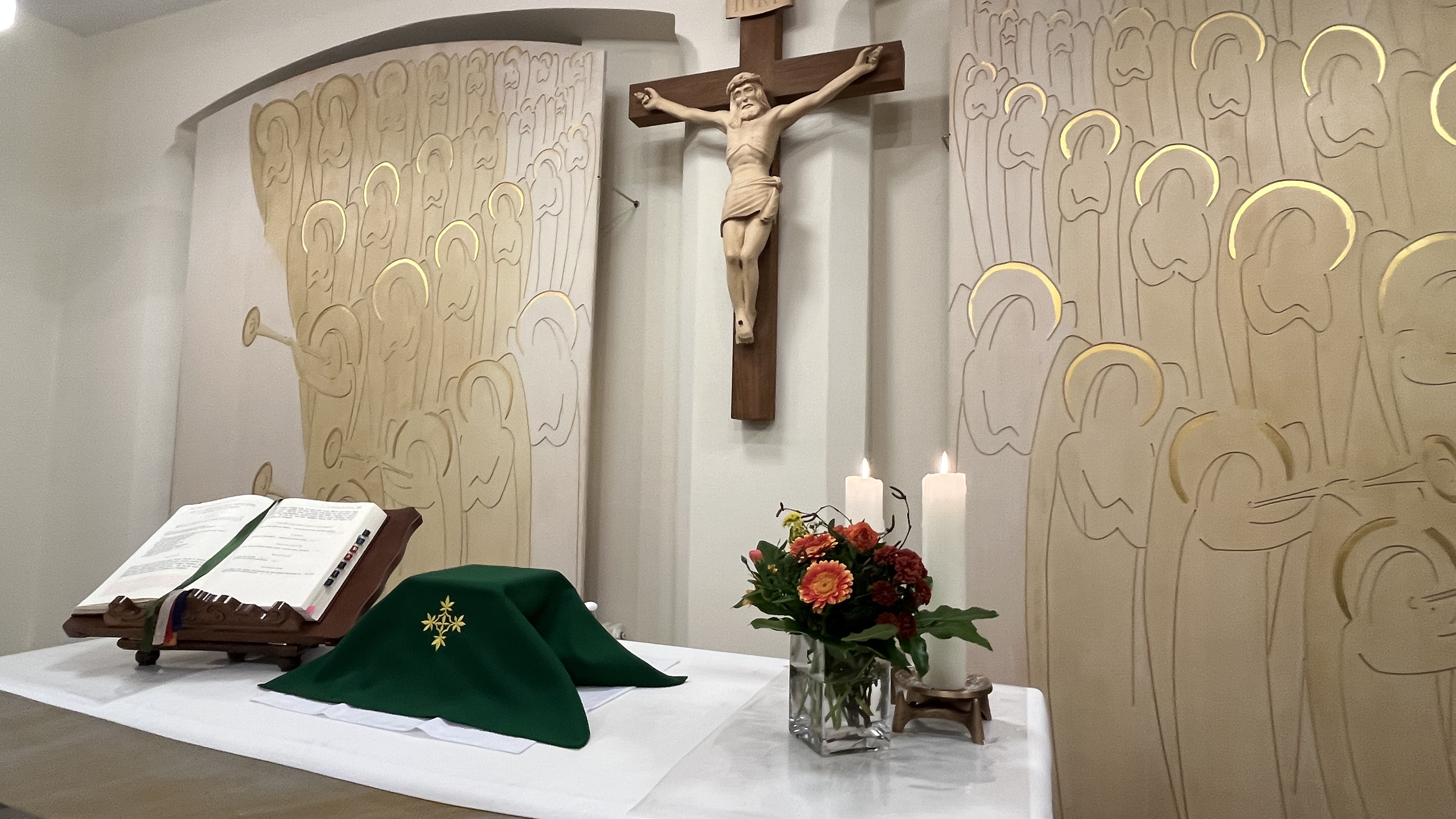
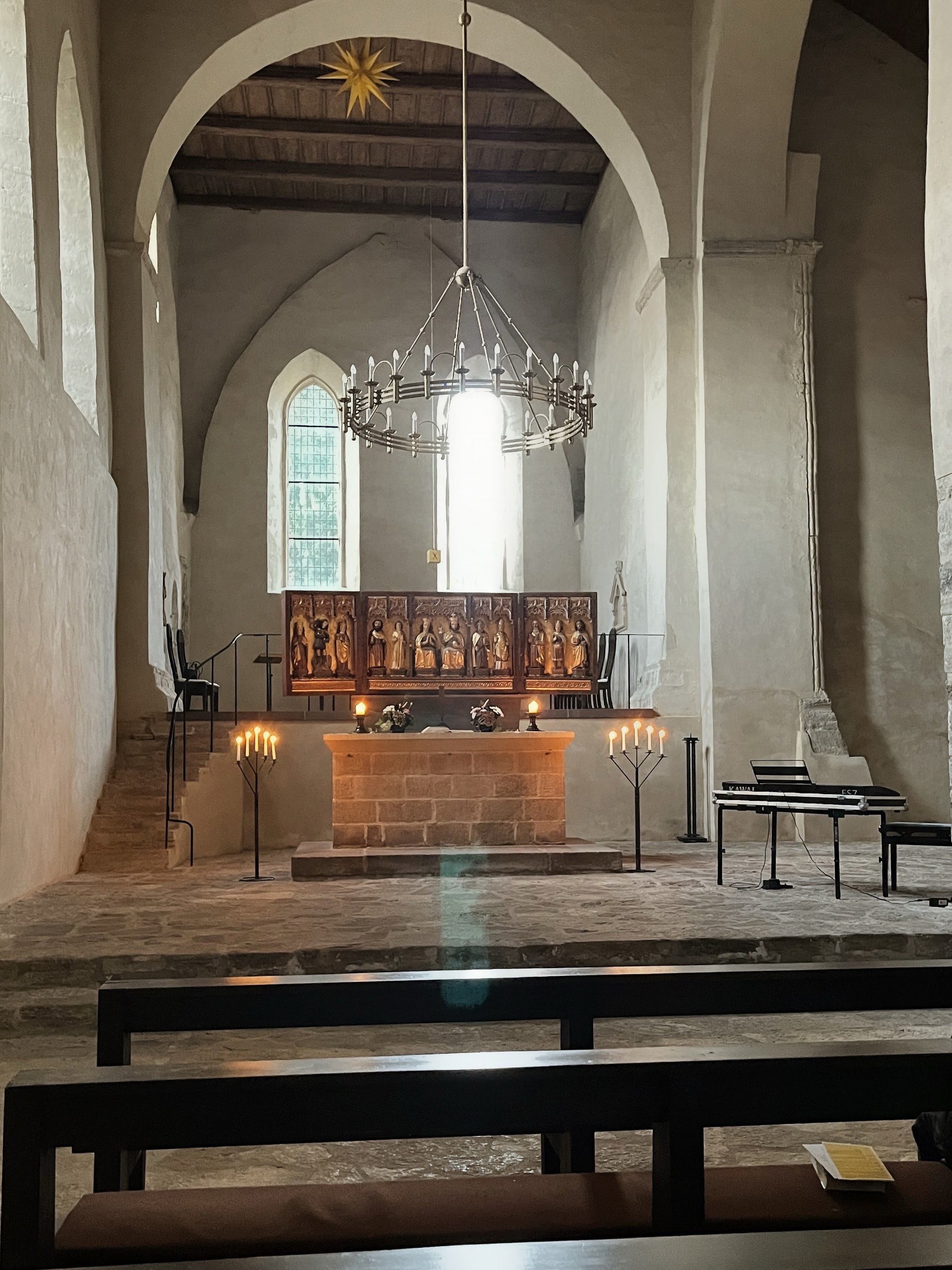
The Lucas Cranach altar in St. Mary´s depicts the Lord´s Supper at a stone table – much like our altar in the chapel of the Old Latin School – but his depiction of the same theme in St. John´s at Dessau for the epitaph for the count Joachim from 1565, shows them seated at a wooden table – much like the ones we now have in use in our foyer.
Epitaph for count Joachim (Lucas Cranach jr 1565): Last Supper
Now that the pandemic has troubled us for some years, people are starting to feel the strain. My cobbler and the local stamp-maker down the street have called it quits. So has the tattooist across the street and the “Haus des Handwerks” (House of trades) across from the Luther house. We used to meet in the last mentioned place where the “Elster gate” was every Thursdays. Sometime after 19h00 it was time for “English Stammtisch”. Local tour guides trying to up their English, foreign students learning German and keen to speak in their mother tongue, Lutherans from the States visiting Luther sites, they all frequented this oasis. Now the landlord has given up. He´s had enough. No more sitting up, with no guests pitching. Our mixed group is too small and meets far too infrequently to keep his enterprise running.
So, we´re meeting in the Old Latin School. We´ve got plenty room downstairs. We´ve got official permission to sit outside. So, we´re hoping for a good summer. We´ve even got a lovely cellar in case of bad weather or seriously late nights, but the entry is still too small to make it official and public. For now, we gather in the foyer.
We´re following Luther´s lead with his table talks – where he gathered friends and family, colleagues and students, guests, and visitors from across old Europe – sharing insights on God and the world, whilst being served good things by his dear Katie and her staff.
We´ve got some nice sturdy tables – handcrafted by a relative of one of our regular participants. The tables are made of local oak. Dark to fit. And we can stack them high with good things to invigorate all partakers in these current table talks in Wittenberg in old Lutheran tradition
RT @MelnykAndrij: „Frauen und Kinder werden massenhaft vergewaltigt. Da brechen böse, archaische Instinkte hervor: den Mann töten, die Frau… 4 hours ago
RT @McFaul: Putin is a terrorist. It is time to declare Russia a terrorist state. 4 hours ago
RT @ukraine_world: Kramatorsk today. Inscription on the missile: "For children". -- Russians shelled a missile today on Kramatorsk railway… 4 hours ago