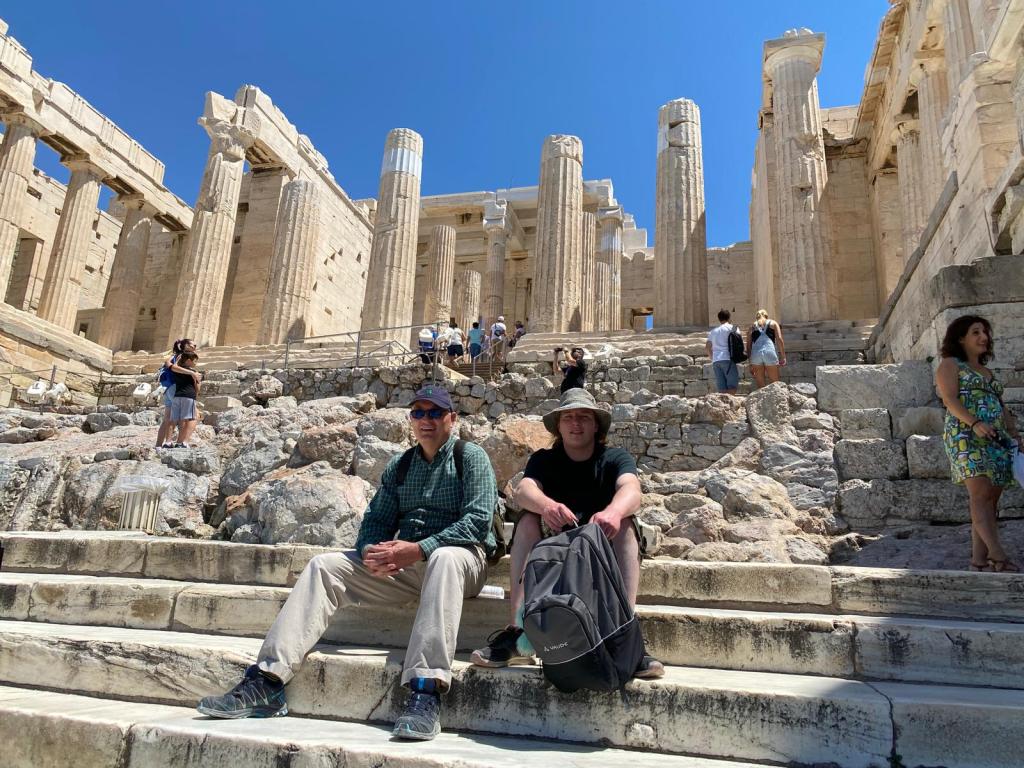
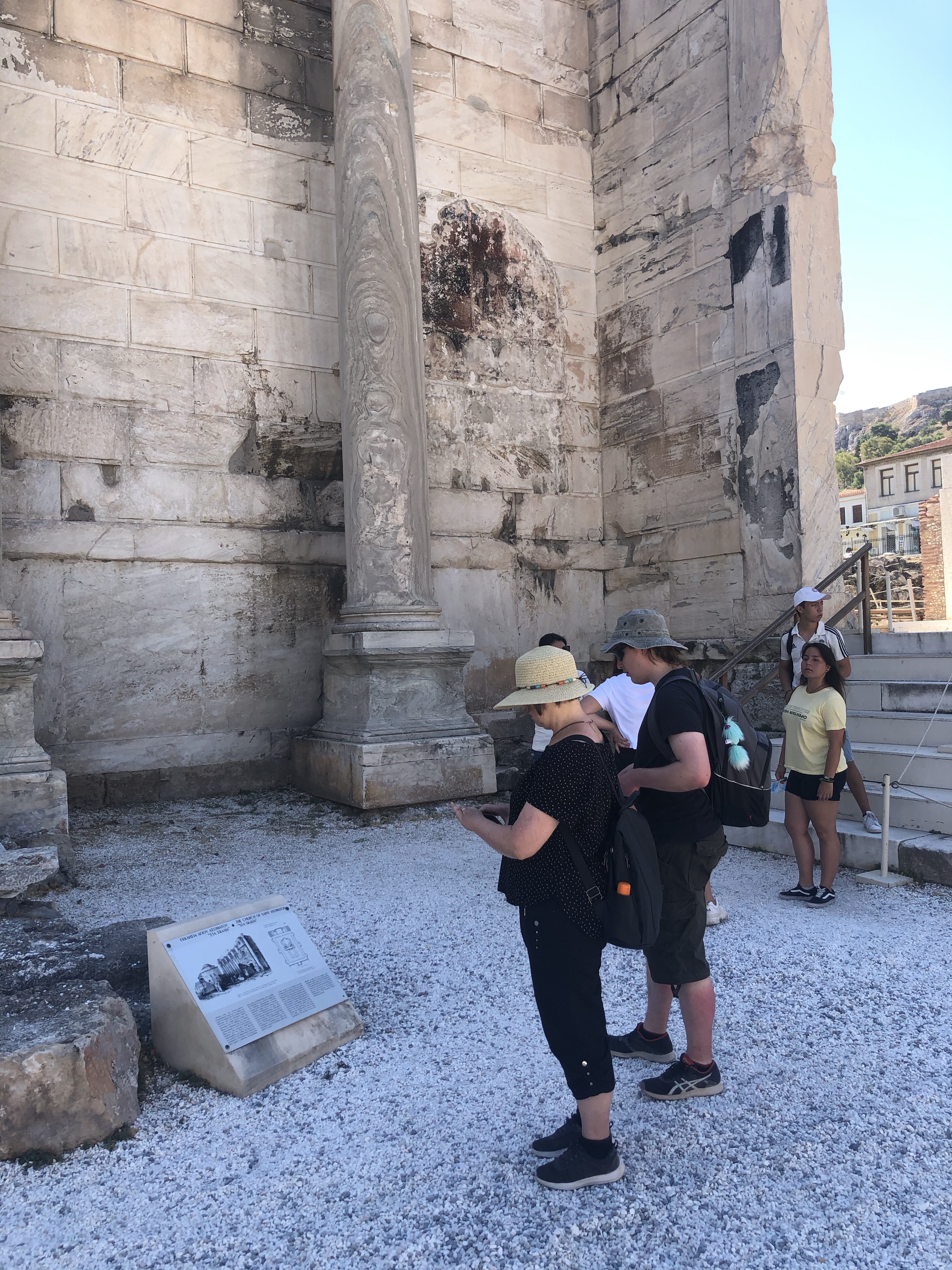
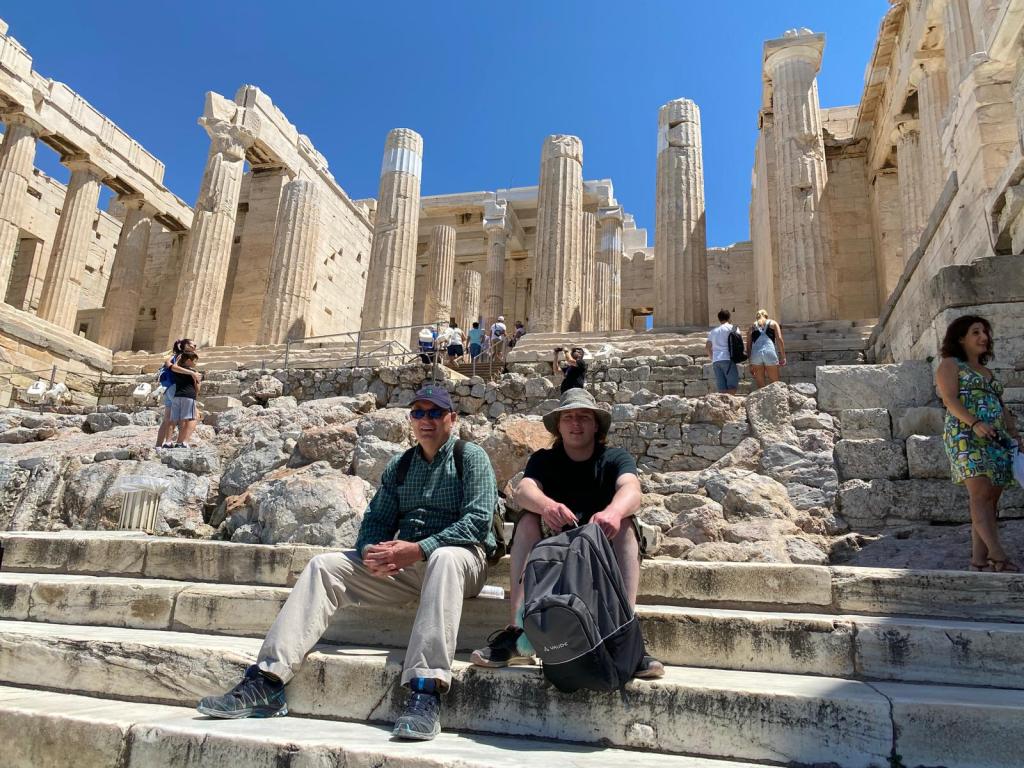
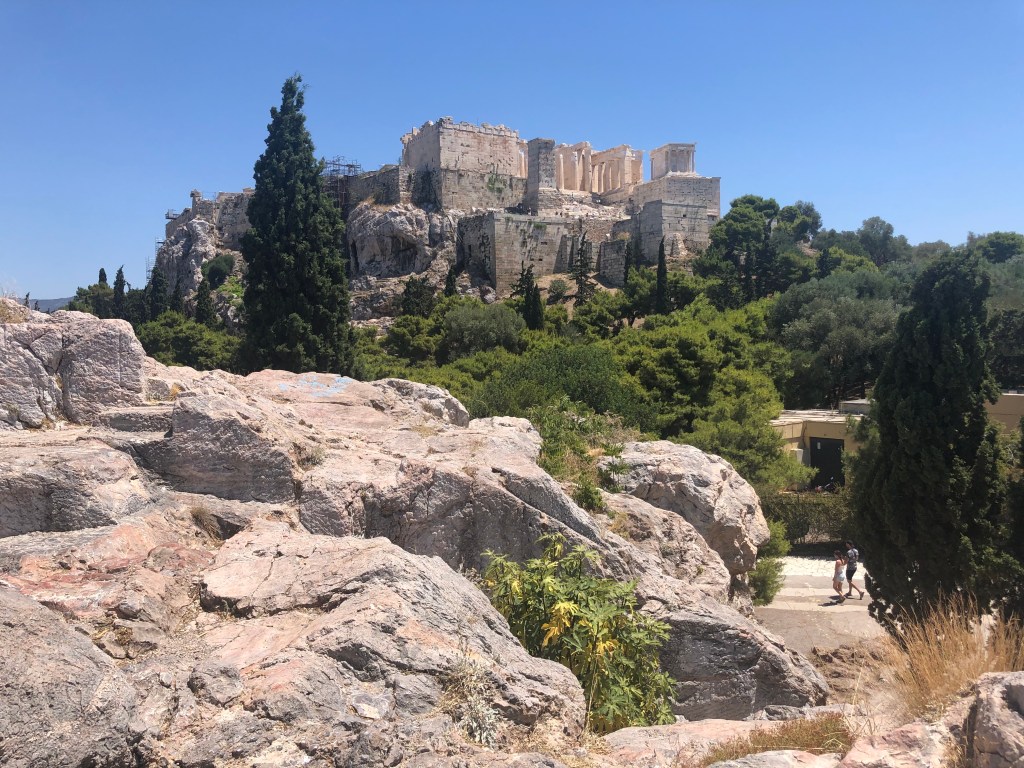
Von der Akropolis gings runter zum Areopag, dann auf die Antike und Römische Agora mit Hadrians Bibliothek und dem ganzen Touristenrummel um Monastiraki herum – bzw um die Kirche von Mitropolis. Hier war unheimlich viel los und alles schien normal zu sein, aber die Verkäufer versicherten uns, dass es alles viel zu ruhig und auch viel zu kaufunlustig war, wenn man es denn mit der Zeit vor Coronna vergleichen wollte. Uns dagegen wars immer noch Trubel und Rummel genug.
Wir machten uns im großen Bogen durch den Petralona Park und hinter der Akropolis herum – am dazugehörigen Museum und auch an Hadrians Tor, dem Olympieion und Zappeion Magaron vorbei – hin zum Panathenäen Stadion um schließlich im Nationalen Garten und dessen herrlichem Schatten etwas auszuruhen.
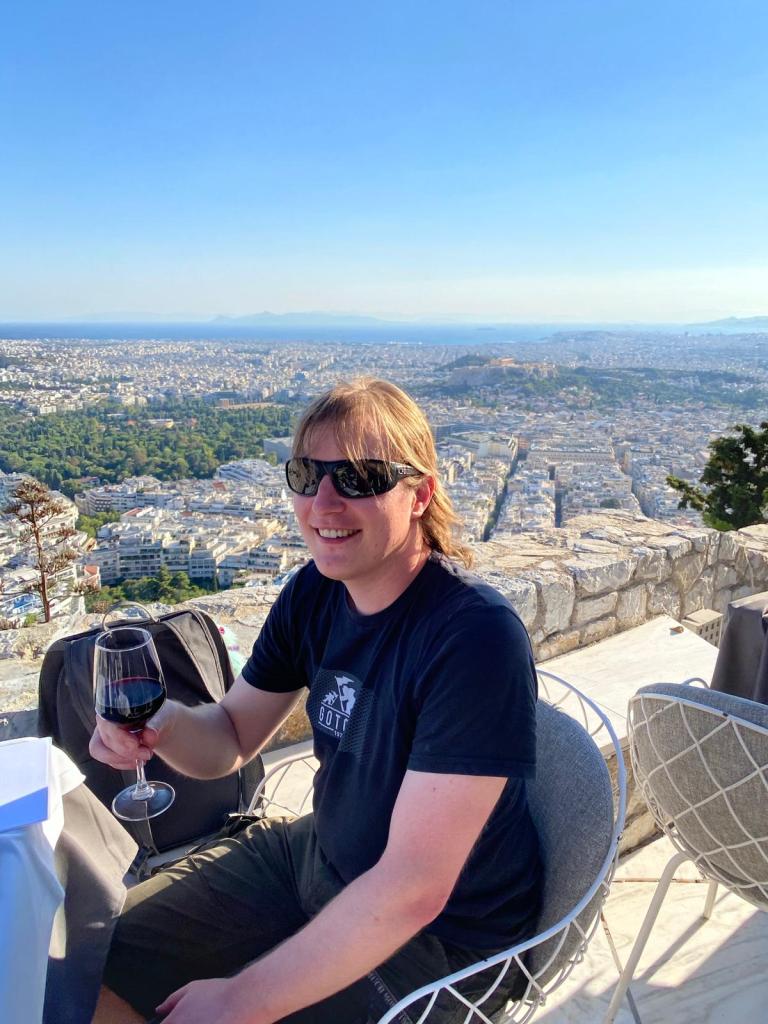
Das Byzantinisch-Christliche Museum war sicherlich ein Höhepunkt von dem wir dann noch höher zur Kapelle des Heiligen Georg aufstiegen – und dort einen herrlichen Sonnenuntergang über der Stadt erlebten nachdem wir durch das Nobelviertel um Kolonaki, Dexameni und Lykavittos geschlendert waren, um die letzten Höhenmeter mit einem Fahrstuhl zu bewältigen. Wir waren schließlich schon durch die halbe Stadt marschiert – mit riesigen Schritten und immer mit Rucksack und oft auch noch in der prallen Sonne. Das Archäologische Museum unweit von unserer Wohnung entfernt haben wir ausgiebig genossen und viele von den bedeutenden Schätzen wiedererkannt. Es ist dann aber doch noch mal was ganz anderes, es in leibhaftiger Größe da stehen zu sehen.
Zum Zoo haben wir es nicht geschafft, weil der außerhalb der Stadtgrenzen lag und als wir zum botanischen Garten wollten, fanden wir uns beim „proefplaas“ der Universität wieder mit vielen Olivenbäumen und auch Daggapflanzen, die ansonsten nicht ganz unseren von anderweitig verwöhnten und von Orten wie Windhoek und San Antonio zu hoch geschraubten Erwartungen entsprechen konnten. Dafür kamen wir aber mit der UBahn gut im Hafen von Piräus an. Dort haben wir zwar kein Schiff bestiegen, sind auch auf keine Insel gefahren, obwohl unser Wirt Basileus uns das aufs dringlichste ans Herz gelegt hatte. Wir hatten allemal genug in Athen zu bestaunen und bei dem vielen Platz in den verschiedenen Zentren, brauchten wir uns nicht auf eine einsame Insel zurückziehen.
Wenn man bedenkt, dass wir die ganze Tour durch Athen ohne Fremdenführer und allein mit Googles Hilfe geschafft haben, bleibt die Trefferquote und unsere Zufriedenheitsmarke beachtlich. Wir waren von dieser Woche in Athen mehr als angetan und haben uns riesig am guten Wetter, den tollen Aussichten ohne Smogdecke und strahlend blauem Himmel, den überhaupt nicht überlaufenen Touristenattraktionen und auch sonst ruhigen Verhältnissen gefreut. Es war eine herrliche Woche in dieser 10-Millionen Metropole.
Wir haben in Athen viele Museen besucht. Es galt den Spuren von Philosophen, Künstlern, Propheten und Aposteln nachzuspüren. Alles haben wir nicht gefunden. Nicht mal in allen Museen haben wir reingeschaut. Es war schlichteweg zu viel. In den paar Tagen haben wir uns aber genüßlich an Geschichte & Kultur in Archäologie, Philosophie, aber von Kirche & Glauben satt geguckt und müde gelaufen. Es liegt ja hier praktisch vor der Haustür und jedermann zugänglich. Man muss nur die Augen aufsperren und die Gesichtsmaske nicht allzu ernst nehmen. Um die Akropolis liegen die vielen Stätten des größten „open air“ Museums Europas – vielleicht der Welt. Es läuft ja bis über die Grenzen Griechenlands hinaus… Zu manchen Stellen gabs Zugangskontrolle, andere waren frei zugänglich. Überall in den Räumen war Maskenpflicht. Darum waren wir so gerne draußen unterwegs – trotz der gestiegenen Temperaturen.
Da waren die grossen Tempel für die alten Götter Zeus, Athena, Nike, Apollo und wie sie alle heißen. Inzwischen sind sie zerstört – nicht nur von alten Bilderstürmern – Christen, Muslimen und andere Monotheisten, aber auch von solchen, die nach billigem Baustoffen Ausschau hielten, Schatzräubern, Glücksrittern und anderen Plünderer. Über Jahrhunderte – und tausende wurde hier abgerissen, zerstückelt, zerbrochen, ab- und weggetragen um es dann anderweitig mehr oder wenig kunstfertig in sonstiger Konstellation zusammen zu schustern, bauen, meißeln, puzzeln und basteln. Bis in jüngste Vergangenheit wurden hier Steine, Brocken und Felsen je nach Bedarf entwendet. Da ist es gut, dass inzwischen strenge Regeln diesen Raubbau verhindern und heute nicht mal unscheinbare Graustücke entfernt werden dürfen. Wächter, Ordnungsmächte und ähnliche Polizisten sind überall unterwegs und auf der Hut.
Parlament, Grab des unbekannten Soldaten und das Olympieion
Wir hatten gute Gespräche mit vielen Museumsangestellten, Wärtern und Kartenverkäufern. Sie sind zum großen Teil gut unterrichtet, unterhaltsam und kommunikativ, erzählfreudig. Meist gibt es auch noch Spezialisten, wie z.B der Archäologische Fachmann im Akropolis Museum. Der ist da für besondere Fragen der Touristen. Uns reichten meist das Bodenpersonal mit allgemeiner Auskunft. Die Frauen beim Olympieion – Mutter und Tochter – hätten uns am liebsten eine lebensgroße Statue verkauft. Offensichtlich dachten sie, wir seien Nachkommen berühmter afrikanischer Häuptlinge oder Stammeskönige und könnten das mit Goldklumpen oder wenigstens klunkerhaften Edelsteinen zahlen. Nur mühselig konnten wir uns unbehelligt fort machen. Am berühmten Panathinaiko-Stadion saß ein Neffe von unserem südafrikanischen Staradvocaten George Bezos. So ging es von einem Höhepunkt zum anderen, von einem Kontakt zum nächsten.
Hadrians Tor
Manche Museen waren klar demarkiert, bei anderen wars mehr Glücksache drinnen und draußen zu unterscheiden. In der alten Akademie Platons wars fast unmöglich, aber ähnlich schwierig wars mit den alten Gefängnisruinen, wo Sokrates schließlich den verhängnisvollen Schirlingsbecher leerte. Bei Aristoteles Lyzeum wars leichter, aber richtig viel war da auch nicht zu bestaunen. Es war vor allem tiefe Fundamente und grobe Grundrisse im weitläufigen Terrain. Naja, die Fußspuren des hl Apostels Paulus waren überhaupt nicht mehr auszumachen. Dafür haben wir aber eine ganze Reihe seiner Briefe gut erhalten und in klarster und wirkungsvollster Aussagekraft.
Gleich vom ersten Tag ging es los und zwar kräftig. Wir hatten die erste Woche kein Auto, sondern machten uns zu Fuß auf den Weg. Mit „Google Maps“ waren wir ja bestens ausgerüstet, obwohl mein Telefon meist nach ein paar Stunden schon ins Pusten und Stottern kam, weil der überforderte Akku drohte auszulaufen. Dennoch fanden wir jedes Mal einen Stecker und die Möglichkeit neu aufzuladen. Das war dann später im Auto gar kein Problem mehr, außer dass die automatische Verbindung mit dem Handy gleichzeitig mit sich brachte, dass wir dieselbe Musik immer wieder hören mussten, wenn wir die Anweisungen zur Reise auch hören wollten. Da müssen wir uns noch schlau machen, wie das eine vom anderen zu unterscheiden und jeweils alleine zu nutzen möglich ist.
Wir nahmen uns die üblichen Attraktionen vor. Akropolis und Areopag, Gemüse-, Obst-, Fleisch- und Fischmarkt, Trödelmarkt und wie die vielen Verkäufergassen auch alle heißen, Parliament und Regierungssitz, der wunderbare Nationalgarten inmitten des Straßentrubels, Museen noch und nöcher, alte Tempel, neue Kirchen und ein Haus neben dem anderen, lange Straßenreihen, viele bunte Menschen und immer wieder Polizei, Militär und sogar Sicherheitstruppen, die gerade auch in unserer Straße „Marni“ Wache schoben.
Überall gab es Tavernen, Kaffeeschops und Bäckereien, sogar Supermärkte, Waschlokale, zig Bankautomaten und noch mehr kl. „Tearooms“, wo Ausländer ihre Ware feilboten – genau wie in der „Wilson-Street“ in Dundee/KZN – von Zeitung bis Zitronen und Zigaretten, Batterien, Knoblauch, Telefone und zu trinken, aber fast nirgends Butter, schließlich hat man ja Olivenöl und das nicht zu knapp. Es ist buchstäblich das Land in dem Milch und Honig fließt plus Wein, Nüsse und Orangen – frisch und in Fülle.
Es hat eine Weile gedauert, aber irgendwann hatten wir das Tagesmenu zusammen: Neben meinem regelmäßigen shot Zitrone am Morgen gabs dort nicht saure Äpfel, sondern frische und saftigste Pfirsich, Joghurt mit Honig, griechischen Salat in angelischer Perfektion abgewechselt mit gebratenem, gesottenem und gekochtem Allerlei aus Meer, Fluss, Stall, Feld und Wiesen. So ein bisschen hatte es vom gelobten Land an sich – ähnlich wie der Kap der guten Hoffnung oder das Land Gosen jenseits von Krondaal – aber schau doch mal selber in diesem herrlichen Tribut von “Bizarre Foods”
Täglich legten wir zwischen 12-20 Kilometer ab – und das fast die geschlagenen 3 Wochen. Meine kontrollierende Armbanduhr war begeistert. Täglich meldete sie: Du hast die längste, anhaltende Bewegungsreihe erfolgreich absolviert und ermahnte sofort im strengen Ton: Mach weiter so! In diesem Sinne höre ich jetzt erstmal auf und mach Morgen weiter…
Unser Tagesrythmus war nicht richtig anstrengend, aber auch nicht die ihle Entspannung. Wir wollten was sehen, mitkriegen, erleben – und da muß man ja bekanntlich sich auf und raus machen. Morgens nach dem Aufstehen und unseren gemütlichen Lese- und Schreibstunden, machten wir uns mit geschultertem Rucksack, genügend Wasser, Gesichtsmasken und Portemonnaie auf den Weg und besuchten 1-2 Sehenswürdigkeiten ehe wir dann entweder am späten Nachmittag zur Wohnung zurück oder irgendwo unterwegs zum Abendbrot einkehrten.
Wegen Coronna waren die Museen leicht zugänglich, Warteschlangen waren selten – meist nachts, wenn die Griechen von der Arbeit noch in die historischen Anlagen gingen. Die meisten Museen sind bis kurz vor Mitternacht auf und manche machen sogar volles Abendprogram, was bei den herrlichen Temperaturen nachts natürlich sinnvoll ist. So waren wir in den meisten der unzähligen Säle unter uns mit noch mehr und allgegenwärtigen Wächtern und stets wachsamen Aufpassern. Selbst auf der Akropolis, wo sich sonst riesige Menschenmengen durchwühlen, waren wir froh einige junge Paare aus Holland oder Skandinavien anzutreffen – und immer mal wieder eine bunte Familie aus Deutschland – Eltern mit Kindern. Kaum Asiaten und wenn waren die paar Inder, Japaner und Koreaner willkommene Abwechslung. Wir waren also meist unter uns. Herrlicher entspannter Urlaub in dem sonst so überlaufenen Athen, sogar auf der Akropolis.
Da waren wir unterwegs…
Angelika war hin und weg vom Dionysiustheater, das sie gerade in der Schule mit einer ihrer Klassen durchgenommen hatte – und nun stand sie leibhaftig mitten drin und staunte über die gut erhaltenen Reihen, Steine und Kulissen. Voll begeistert sammelte sie Eindrücke für die nächste Präsentation daheim in Wittenberg.
Hadrians Bogen
Dionysos Theater
Übersicht
Bittereinder: Letzte Mohikaner
An ehrwürdiger Stelle
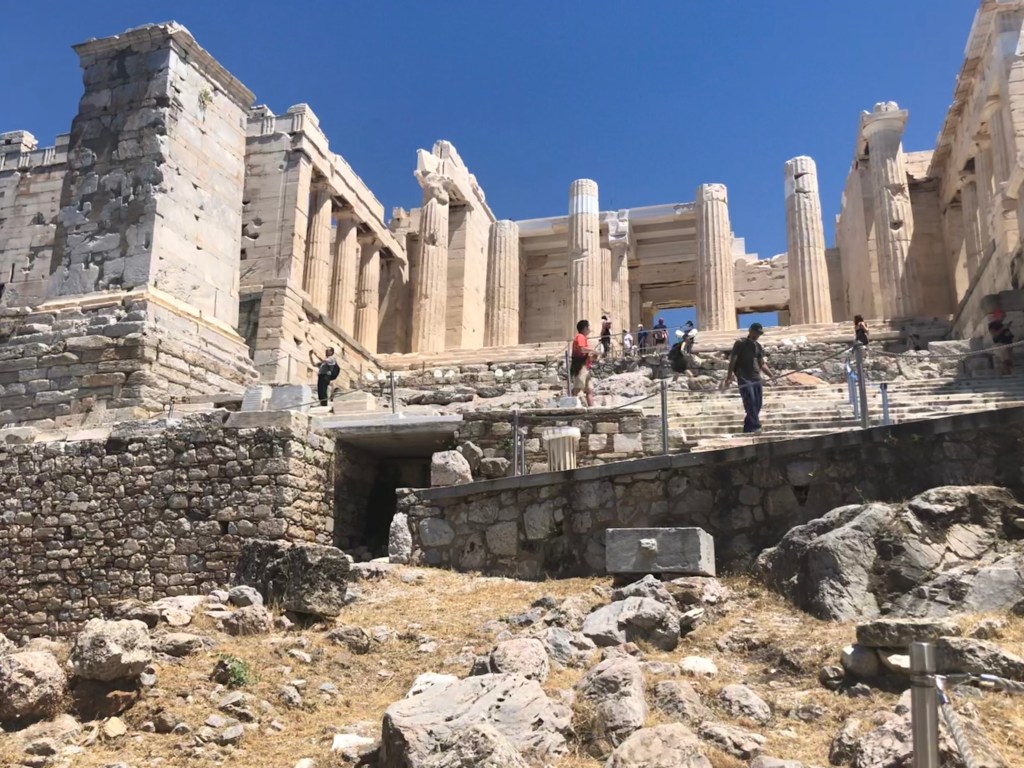
Wir machten uns immer weiter nach oben – und freuten uns an dem kühlen Lüftchen, dass sich dort oben zu einer steifen Briese entpuppte. Da mussten wir Hut und Schirm gut festklammern, damit sie nicht den Abhang in die Altstadt runter geweht wurden. Wie alle anderen machten auch wir Selfies und immer noch ein Foto – von der im Wind knatternden Flagge Griechenlands, den imposanten Säulen, Steinen und Felsbrocken. Tief beeindruckt war ich von den gestapelten Steinen da oben.
Wir waren fast alleine, wo Himmel, Meer, Luft und Feuer sich treffen
Genau wie letztes Jahr in Polen wunderte ich mich immer wieder wie mein übernommenes Vorurteil von den „faulen Griechen“ doch auf Schritt und Tritt Lügen gestraft wurde. Letztes Jahr merkte ich, dass da nichts dran ist, am Gerede über „die Polenwirtschaft“, sondern wie ein boomendes Volk im Aufbruch diesem Vorurteil widerspricht. Nicht nur die schön gepflegten Gärten überall, sondern auch die Blicke über die Mauern/Zäune in die industriellen Hinterhöfe, unterwegs in Geschäftszentren und herrlichen Straßenzügen, imposanten Wohnblocks, ausgebreiteten Parks und Anlagen spiegelten nichts von der angeblichen Mentalität dieser europäischen Nachbarn wieder. So ähnlich gings mir mit den Griechen, diesen Südländer am Mittelmeer, die sicherlich mehr orientalisch geprägt sind als die Norddeutschen, aber auch hier pulsierten Straßen vom Geschäftsleben. Menschen waren eilig mit ihren Taschen, in schicken Anzügen und auf hohen Hacken, geschminkt und schön gepflegt unterwegs – und doch gab es auch offensichtliche Armut, Bettelei, Drogenabhängige und Süchtige im Straßenbild. Viele Asiaten und Afrikaner – beinah so wie in Pretoria auf Church Square.
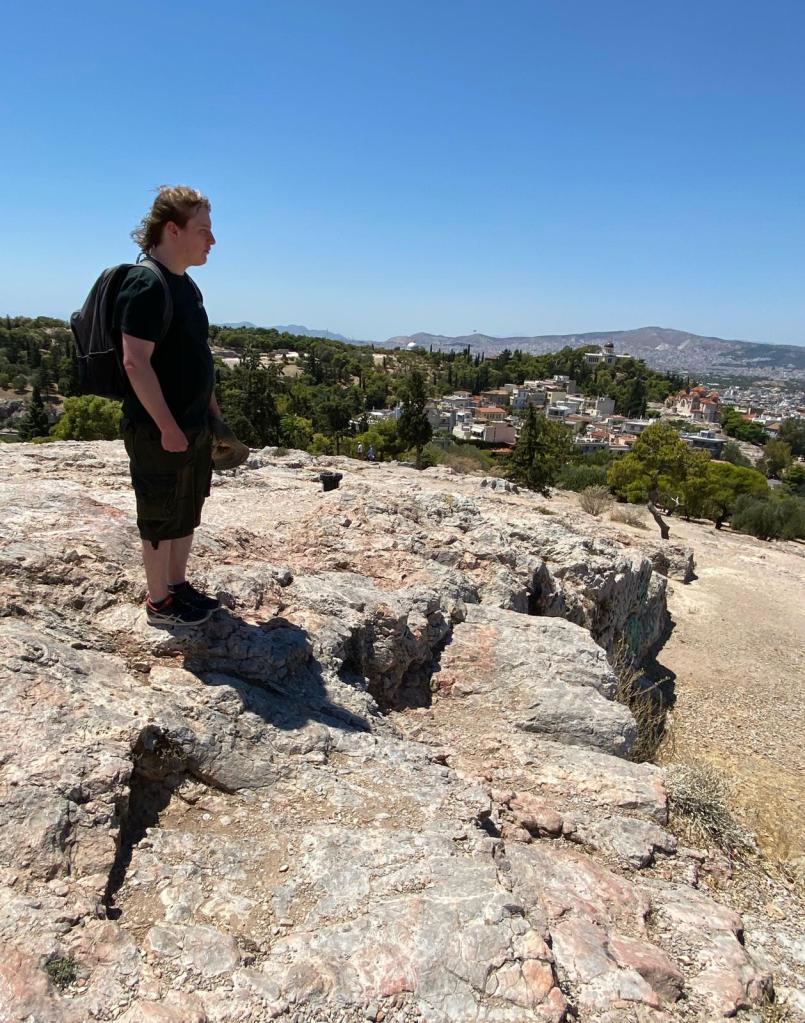
Nach dem Besuch auf der Akropolis kamen wir runter zum Areopag – und zu dem Platz, wo der hl. Apostel Paulus gepredigt haben soll. Das ist schon ein merkwürdiges Empfinden, das einen dort überfällt. Was haben die vielen Steine seither alles erlebt und wie viele Menschen verehren noch immer mit großem Ernst viele Götter und Gewalten ohne doch den einen, wahren und lebendigen Gott zu kennen! Und wenn wir nicht singen, reden, beten und rufen, dann werden die Steine es weiterhin tun… Herr, erbarme Dich + Christus, erbarme Dich + Herr, erbarme Dich über uns und Deine vielen, vielen Menschen + Auf diesem kargen Felsklotz tummelte sich allerlei Volks. Wahrscheinlich Schaulustige und christliche Besucher wie wir in jeder bunt gemischten Ansammlung überall auf der Welt finden. Es gab einen schönen Blick über die Altstadt und auch zurück zur Akropolis, aber sonst ist dort nicht viel – keine Kirche, keine Strichliste von seither Getauft und Bekehrten, keine Ansammlung von Kerzen, Registerkästen oder sonstigen statistischen Krücken, aber die lukanische Beschreibung des Geschehens aus Apostelgeschichte 17 ist dort zu sehen – beinahe könnte man meinen verewigt – auf einer großen Bronzeplatte vergleichbar mit der Thesentür in Wittenberg. Es ist eben so: „Verbum Dei manet in aeternum!“
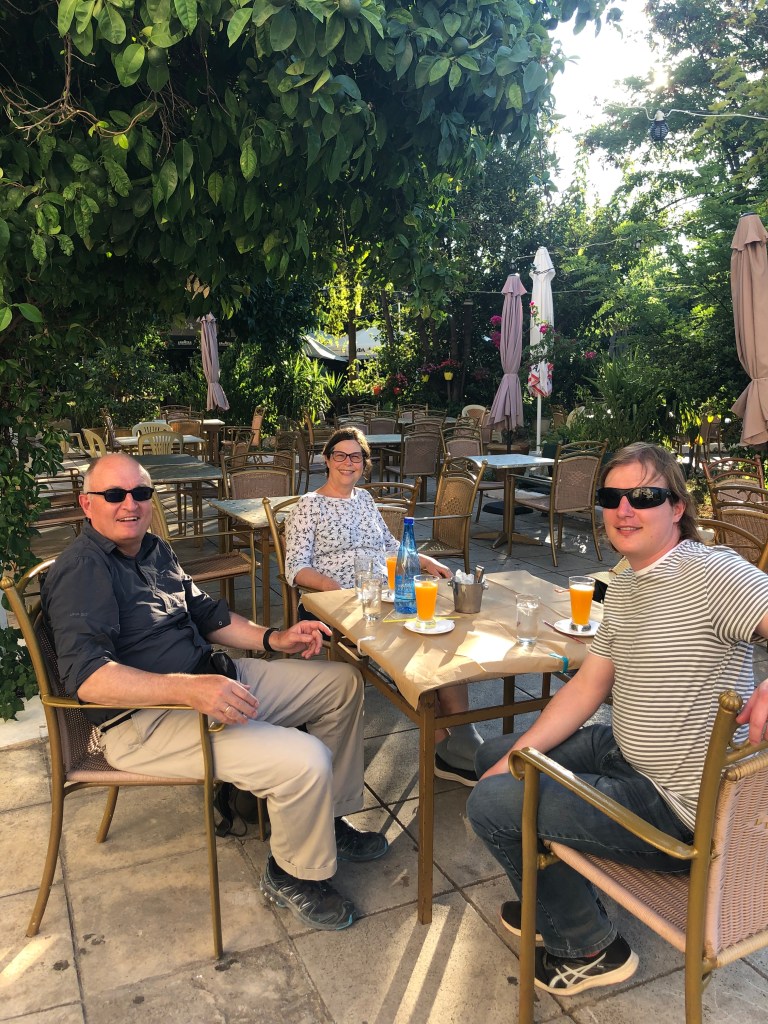
In den meisten Tavernen gab es mehr als genug Platz und stets die aufmerksamsten Kellner, die einem jeden Wunsch von den Lippen abzulesen trachteten. Die holten uns schon am liebsten von der Straße ab und bugsierten uns auf die Ehrenplätze – ganz vorne, mit bester Aussicht und je nachdem im Schatten oder besten Licht. Manchmal wurde es regelrecht traurig und vielleicht sogar etwas unheimlich, wenn eine Riege von 5-10 Kellner abwartend dastand und wir die einzigen Gäste waren. Das war übrigens nicht nur in Athen so, sondern dann später auch unterwegs. In den vielen Gesprächen mit diesen Einheimischen wurde immer wieder deutlich, wie sehr sie unter der Flaute leiden und wie ihnen die unnatürliche Ruhe nach dem bisher doch so anhaltenden Fremdenverkehr auf die Nerven ging. Wir sind angetan von der griechischen Kost. Das Essen ist frisch, überaus schmackhaft und sehr abwechslungsreich. Dazu gibt’s guten Wein, kaltes Bier oder eben den etwas gewöhnungsbedürftigen griechischen Kaffee und soviel gekühltes Wasser wie man eben haben will, frisches Brot, Olivenöl und meist auch noch einen Nachtisch „on the house“ – von Joghurt mit Honig über Wassermelone, reifen Feigen oder so.
Montagabends waren Conny & Chuck aus Riga angetanzt. Sie kamen hier verspätet an und hatten noch nicht mal zu Abend gegessen. Wir hatten erst vor um 18h00 mit Vivian beim Italiener zu speisen und dort die Aufgaben im Einzelnen durchzusprechen. Als sie dann um 21h00 auf dem Weg von Berlin anriefen, haben wir das aufgegeben. Sie sollten ja nur die Gottesdienstvertretung beherzigen und da gab es nicht so viel zu bereden. Vivian würde sich um alles sonstige kümmern und das hat sie auch gut gemacht. Nicht mal die Spanier hatte noch um diese Zeit auf und so bewirteten wir die späten Gäste schließlich im Gemeinschaftsraum mit scharfen Nudeln aus Taiwan und Angelikas Rotweinresten. Kurz vor Mitternacht war ich dann auch oben und eilig ins Bett zu kommen.
Athen bei Tag und bei Nacht – fast niemals unter 23°
Dienstag sollte es früh los gehen. Vivian wollten wir um kurz vor 5h00 abholen, damit sie den Wagen dann zurückfahren konnte, nachdem sie uns beim Flugplatz Tegel abgeladen hatte. Das verlief alles reibungslos und wir konnten trotz Coronamaßregeln die Koffer loswerden und pünktlich den Flieger besteigen. Noch ehe wir in Athen ankamen, schickte uns Vivian Bestätigung, dass das Auto bei ihr geparkt und gut im Schatten versorgt war. Angelika und ich saßen zusammen, während Christoph weiter hinten saß, damit auch er einen Fensterplatz hatte. Wir waren sommerlich angezogen, aber haben kaum erwartet, dass es dann so anhaltend warm in Athen und in Griechenland bleiben sollte. Dort gingen auch Nachts die Temperaturen selten unten 20° – wenn überhaupt und dann nur in Meteora bzw nach heiß ersehntem Regen! Selbst die fast allgegenwärtigen Klimaanlangen waren bloss auf 23° gestellt. Wir hätten sicherlich noch sparsamer packen können, aber sogar auf der Rückreise hatten wir 4kg Spielraum nicht ausgeschöpft und im Handgepäck sowieso noch mehr Platz. Das Reisen ging also leicht von statten bis auf die lästige Maske, doch auch an die haben wir uns im Laufe der Zeit gewöhnt. Hier in Wittenberg brauchen wir sie ja wirklich nur beim sporadischen Einkaufen, aber in Griechenland nutzten wir sie doch ständig bei unseren vielen Ausflügen, Spaziergängen und Wanderungen.
Über den Alpen gabs gute Aussicht, genau wie überm Balkan und in Griechenland Thessaloniki, der imposante Olymp rechts von uns wurde vom Piloten angesagt und schließlich blickten wir aufs ausgebreitet Athen. Die Landschaft war wie, wenn wir in Polokwane (Pietersburg, Limpopo) landen würden – trocken, heiß und sandig. Aber das viele Wasser und die unzähligen Olivenbäume rückten die Vorstellung zurecht und kontextualisierten das Bild im Mittelmeerraum.
Damit gings in die Stadt
Und damit das letzte Stück
Archäologisches Museum
Zufuß, per Taxi, Bus, Bahn und alles meist unweit vom Archäologischen Museum
Der Flughafen von Athen: “Eleftherios Venizelos” (ATH) ist überaus großzügig angelegt. Der Zoll machte uns keine Schwierigkeiten noch die Grenzpolizei. Wir brauchten nicht mal Geldwechsler, sondern konnten sofort zum Linienbus X96, der uns zum Syntagmaplatz fahren sollte. Fahrkarten waren schnell gekauft und ab gings durch den relativ ruhig dahinfließenden Verkehr von Athen bis dort, wo die parlamentarische Wache ihre Posten stationiert hat und alle Stunde eindrücklich auswechselt. Von dort hatte unser Vermieter Basileus uns eins der vielen gelben Taxis empfohlen, das uns zur Marti Straße 8 in unmittelbarer Nähe des Archäologischen Museums fahren sollte. Die Taxifahrerin hat das auch gepackt, obwohl ihre Englischkenntnisse minimal waren und unsere Griechischen noch schlechter.
Schon auf der Straße kam uns Basileus entgegen und schloss uns seine Wohnung auf, in der wie die erste Woche bleiben wollten. Via AirB&B haben wir das rechtzeitig gebucht und damit sind wir diese 3 Wochen gut gefahren. Die Wohnung war sparsam genug eingerichtet, hatte aber aircon, einen luftigen Balkon und problemloses WiFi. Angelika hat sogar aus der kl.Küche Wunder gezaubert und aus dem ähnlich beschränkten Badezimmer kamen wir regelmäßig nacheinander wieder sauber raus. Endlich haben wir auch mitgekriegt, dass auf dem Dach die herrlichste Aussicht über die Stadt zu haben ist. Dort haben wir dann auch sehnsüchtig den Vollmond erwartet und die schönsten Stunden mit herrlicher Rundumsicht verbracht. Wir waren schon so gespannt auf Griechenland – und konnten es kaum mehr erwarten, Athen zu erkunden. Gleich am nächsten Tag sollte das los gehen!
Drei Wochen Griechenland, das hätten wir uns vorher kaum träumen lassen. Hörte sich das doch an wie ein Märchen von ganz woanders. Doch das ist unser Urlaub in 2020 geworden – inmitten der Coronaepidemie. Schweden sollte es gewesen sein: Kühl, dunkel und weit nach Norden mit Anfahrt über Dänemark, Abstechern nach Norwegen und Finnland. Das hatten wir uns geträumt, lange schon. Waren schon eingelesen, der Wagen startklar und wir echt reiselustig. Doch davon ist nichts geworden. Die Leichtfertigkeit der Schweden in diesen ungewissen Zeiten und ihre Nachlässigkeit angesichts der rasanten Ansteckungsgefahr machte sie und ihr ganzes weites Land zum Risikogebiet und einer europäischen „No-Go-Area“. Wir hätten ja trotzdem fahren können, doch dann drohte wochenlange Quarentäne und die Aussicht war uns nicht sonderlich verlockend. Darum mußte ein anderes Ziel her.
Zuerst planten wir noch weiterhin mit dem Wagen unterwegs zu sein. Doch auch im Balkan schloßen sich die Grenzen wegen der ausbreitenden Infektionsgefahr und so war für uns so kein Hindurchkommen mehr. Schließlich kam es alles ganz anders. Wir flogen kurzerhand von Tegel nach Athen und haben die kurze Hin- und Herreise (im Vergleich mit der wochenlangen Autofahrt!) maskiert gut überstanden – zurück sogar mit Hirtenstock in der Hand, aber davon später.
Im Nachhinein hat es uns gefreut, denn so schön, vielfältig und herrlich wie Griechenland hätte es im Norden doch nicht sein können. Dort war es im Gegenteil sommerlich warm, hell leuchtend die Farben und ach so gastfreundlich den ausländischen Gästen gegenüber. Ein schönes, abwechslungsreiches und überaus interessantes Land. Es gibt viel zu tun, sehen und erfahren, denn die Geschichte reicht weit, weit zurück, aber man kann sich auch einfach herrlich entspannt in der klaren Wasserflut treiben, alles vergessen und nur noch von der Sonne bräunen lassen: “Wer die Wahl hat, hat die Qual.” Doch für Afrikaner wie wir “no big deal” – und jeder Tag brachte wieder was Neues zu entdecken und wenn es nur noch eine weitere herrliche Strandstrecke am schier endlosen Meer war – von den vielen Marmorsäulen, Heroen und Göttinnen ganz zu schweigen.
Ich hätte also liebend gerne noch bleiben können. Ja, ich könnte mir sogar vorstellen dort in einem Olivenhain am steilen Berghang mit einzelnen Feigen-, Zitronen und Nussbäumen, Wein- und Bienenstöcken, Schafen und Ziegen, Hühnern und ähnlichem Kleinvieh mit einem Ausblick übers blaue Meer bis weit über die blauen Berge am anderen Inselufer und in die schier endlosen Weiten des blauen Himmels am Steinhaus mit ausgiebigen Veranden und viel Schatten spendenden Dächern eine blau-weiße Flagge zu hissen und noch länger bei starkem Mocca zu entspannen als nur 3 Wochen.
So lange haben wir noch kaum Urlaub am Stück gemacht, aber es war super und ein wunderbares Erlebnis. Eine Woche Athen, eine auf dem Peloponnes und schließlich die letzte wieder auf dem Festland – wenigstens, wenn wir nicht gerade wieder weit hinaus ins blaue Meer geschwommen sind. Griechenland für uns nun auch ein Land der schönsten Ferien- und Sehnsuchtsträume wie inzwischen nicht nur Udo Jürgens in seinem „Evergreen“ tiriliert: „Griechischer Wein…“
Auf den kommenden Seiten beschreibe ich unsere Reise nach Griechenland und hoffe, dass Ihr etwas mitkriegt von dem schönen Land, seiner reichen Geschichte und seinen überaus reizenden und gastfreundlichen Leuten!
Dr. Martin Luther continues his commentary on Deuteronomy with this summary of chapter 15 – and it´s good reading about lending, cancelling of debt, poor people etc in this translation by Richard R. Caemmerer in Luther´s Works Volume 9:
The summary of this chapter is that the poor should not be left neglected in the land, although he also says that there will always be poor, in order that they may have someone to whom to give, either from the triennial tithes, from loans, or from some other source… Now let us talk about lending.
Moses says that repayment of a loan can be demanded before the seventh year, but that in the seventh year itself whatever loans will be found unpaid shall be canceled and given to the brother, and that by divine right. That this seventh year, however, was fixed and firmly established, just as the year of jubilee was, for restoring and canceling debts on purchases, follows from the fact that it does not begin from the day on which the loan was made but was general for the whole land and people, like the festivals were, Passover, Pentecost, and others. Truly it is a most beautiful and fair law. Would that today the rulers of the world might imitate it! Then they would have fewer questions and commotions; for people would know that suits, disputes, debts, dealings, agreements, judgments, seals, and letters would all be removed at one time and canceled in the seventh year, whether that be close or far away, and not be postponed and continued forever into endless litigation. Likewise they would be forced to be cautious not to lend so great a sum that there would be no hope of repayment before the seventh year. Nor would it be possible for wasteful and depraved people to rely on other people’s wealth, which they would gather through borrowing and agreements.
But what will you say to Christ, who in Matt. 6 and Luke 6:35 forbids to demand repayment of a loan and commands to lend without the hope of receiving equal value in return? I answer: Christ is speaking to Christians, who are above every law and do more than the laws ordain; but Moses provides laws for people in civil society, who are subject to the government and the sword, so that evildoers are curbed and the public peace is preserved. Here, therefore, the law is to be so administered that he who has received a loan pays it back, although a Christian would bear it with equanimity if such a law did not come to his aid and a loan were not repaid. Similarly, the law demands that one harm nobody, and it works vengeance on the violent; and yet the Christian endures it if he is harmed, and he does not avenge himself or seek vengeance, although he does not forbid the strictness of the avenging sword, since he knows that the sword was established for vengeance on evildoers, as Peter says (1 Peter 2:14).
Again, why is it that he permits repayment of a loan to be demanded from a stranger—even in the seventh year, that is, always—but not from a brother? Should justice and love not be observed also toward a stranger? The answer is that this, too, is according to a just principle of public order, that by some privilege citizens are honored beyond outsiders and strangers, lest everything be uniform and equal. Thus the Romans gave some cities the status of a colony, others that of a Roman city. The world has need of these forms, even if they appear to have a show of inequality, like the status of servants and maids or workmen and laborers. For not all can be kings, princes, senators, rich men, and freemen in the same manner, since the world cannot exist without persons of various and different sorts. While before God there is no respect of persons (Acts 10:34), but all are equal, yet in the world respect of persons and inequality is necessary. And the purpose of this is that evildoers be curbed and the public peace stand firm, which it cannot do when persons are equal and without distinction.
But the people of the Jews had a fuller and higher law, not only with regard to the repayment of loans but, as he says here (v. 6), with regard to lending to the Gentiles on interest and taking usury, namely, by divine authority, which establishes and permits this very thing. For He is God and the Lord of all; He takes away not only money and goods but also kingdoms and empires from whomever He wills and however He wills, and gives them to whomever He wills. If, therefore, for the sake of vengeance on the Gentiles, God wants to punish them through usury and lending, and commands the Jews to do this, the Jews do well obediently to yield themselves to God as instruments and to fulfill His wrath on the Gentiles through interest and usury. This is no different from when He commanded them to cast out the Amorites and the Canaanites. Thus if to God a husband seems worthy of having his wife or sons taken way from him, and through His Word I am ordered to do this, I am not an adulterer or a kidnaper when I carry off his wife and sons but an obedient whip of God over the godless husband.
This answers the question how the Jews were permitted to lend on interest. The answer is: It was not and is not permitted them because of their merit or by common law but through the wrath of God over the Gentiles, which He wants to fulfill through the Jews as instruments of His wrath. Nevertheless, they would not have had the right to use this permission unless they had been commanded and chosen as such instruments through a sure and manifest Word of God. They themselves were no better than any Gentiles, as I have said above; but God chose and received them only out of mercy. Thus if you view the matter properly, it is not the Jews themselves who are usurers, but God, who persecutes the Gentiles through the usury of the Jews. This was sufficiently demonstrated when He, in turn, handed over the Jews, who were disobedient to Him and sinned, to the Gentiles, not only to be burdened by usury but to be troubled by every sort of shame, a good deal more dreadfully than the Gentiles had been when He gave them over to the Jews. Thus He foretells in this book, chapter twenty-eight, and in this chapter (v. 6) He adds that they will lend to the Gentiles on this one condition, that “they hear the voice of the Lord” (v. 5). This is as though He said: If they do not hear, not only will they not lend on interest, but they will be like, or even more wretched than, the Gentiles, as it also happened.
Today, however, since the Jews have ceased to be the people of God, when the Law is abrogated, and when they through their godlessness and blasphemy have deserved the wrath of God, usury is not to be permitted them; but they are to be controlled by the laws of the people among whom they live. If you closely examine this text, moreover, it does not command them to lend on interest Nor are these words of law, but rather words of promise, when He says: “If only you will obey the voice of the Lord … you shall lend to many nations” (vv. 5–6). But the words of promise, unlike the words of the Law, are not given to man to fulfill. Fulfillment belongs to God alone, who gives them this promise. Therefore the meaning should be like this: “When you hear the voice of the Lord, then through the action of God the Gentiles will be brought into such a plight that they will pay usury even when you neither plan nor seek it; and they will be subject to you in everything, and you will rule over them with all their goods, so that you may seize, demand, and take usury as you please. It is the Lord who will subject the Gentiles to you in this way, and He will humble them through you.”
4. But there will be no poor among you.
A most beautiful order, but one that was never kept. Therefore this law of Moses also remains in words only so far as the whole people is concerned. If begging is forbidden to this people, by what right is it set up among Christians by law, as though it were something sacred? Poverty is extolled, but to the end that it may be relieved. Then spiritual poverty is praised (Matt. 5:3); but the external kind is commanded to be corrected, no differently from other disadvantages of one’s neighbor. It is amazing that those who boast of outward poverty do not also take upon themselves and acknowledge wounds, sicknesses, imprisonments, nakedness, or exile, hunger, thirst, swords, dangers, deaths, sins, the devil, and all other evils by means of new vows set up for these, just as they have done for poverty. Thus one would endure sickness; another, prison; another, hunger; another, sins or the devil. For Christ commands that these things as well as poverty be cared for and improved among our neighbors. “I was weak [He says], and you did not visit Me” (Matt. 25:43).
But instead of sickness and wounds our boasters of poverty carry about a sleek skin and stuffed flesh, worse than the profligates and harlots; instead of places of exile they have homes prouder than the palaces of kings; instead of suffering hunger they consume the storehouses of all; instead of thirst they have full cellars; instead of death they have the most pleasant and secure life. Then they sing to us the glory of enduring poverty, which the Lord has commanded to be abolished, that we might follow the example written for Christian people, in Acts (4:34): “Nor was anyone among them who lacked.” Therefore there ought to be no poverty or begging among the people of God; there should be care and concern to make any poverty and begging unnecessary, that you may know that the mendicant orders and all who display, and boast of, external poverty are disciples and servants of Satan, who rage directly contrary to the Lord and His Christ (Ps. 2:2). In like manner, there ought to be no sickness, hunger, thirst, exile, death, sin, or devil among the people of God; there should be care and concern that if any such thing happens among them, it be removed as quickly as possible and care be taken that it be not found among them. Poverty, I say, is not to be recommended, chosen, or taught; for there is always enough of that by itself, as He says (John 12:8): “The poor you always have with you,” just as you will have all other evils. But constant care should be taken that, since these evils are always in evidence, they are always opposed. You see, therefore, what the institution of the vow of poverty is, and what that whole kingdom of the papacy is.
7. If there is among you a poor man, one of your brethren.
It is the way of the world that when a law has been set up, men soon discover how it can be evaded. Hence Moses here anticipates the fraud which would happen under that law of release in the seventh year, when avarice and human hardness would think, if the year of release happens to be soon: “What shall I do? Shall I give a loan? But the year of release comes after a few months, and I shall have given it in vain, since there will be no hope of getting it back and no right to demand repayment.” Against this Moses inveighs here with amazingly sharp words, calling it a hard heart, a word of Belial, an iniquitous deed, an evil eye, finally even a sin that cries to God. Thus you can see that Moses also agrees with Christ in his instruction about lending; for he commands that the loan be given under the threat of such great sins, even if there is no hope of getting it back and no right to demand repayment. The summary, then, of this teaching is this: the poor should be cared for with love.
12. If your brother is sold to you.
Moses recalls the law of Ex. 21:2 ff and refers it to this law concerning the release of loans, because this also speaks of the poor who, under the compulsion of poverty, sold themselves and received a loan, as it were, since they made themselves debtors with their own bodies. However, he adds at this place that they are not to send him away empty-handed when he is set free. For this he gives two reasons: first, they are to remember that they, too, were slaves in Egypt; secondly, because with him the bondman has been a wage earner in a twofold sense (v. 18). This, I think, is said because the one who is sold to another inflicts double harm on himself: first, he serves another, and everything he gains accrues to his master; secondly, he meanwhile neglects his own business, and what he gains for his master he could have gained for himself. Therefore it would be most reprehensible to send him away altogether empty-handed. Hence he says: “It shall not seem hard to you” (v. 18).
Moses always adds magnificent promises. God has blessed, blesses, and will bless those who do these things, to keep them from doubting that they will be richly compensated if they either give something or lend something as Christ says (Luke 6:38): “Give, and it will be given you.” Hence also that proverb of Solomon (Prov. 19:17): “He who has pity on the poor lends to the Lord”; and again (Prov. 14:31): “He honors the Lord who has pity on the poor,” and many others. On the other hand, the Scriptures are full of threats against those who do not have pity. However, this means nothing to that deaf godlessness and unbelief which imagines that God is either joking or lying with such words, and which deserves to be robbed of the good things both of this life and of the life to come, just as that fool Nabal on Carmel withheld from David, was soon deprived of his life, and kept nothing (1 Sam. 25).
So then you are no longer foreigners and noncitizens, but you are fellow citizens with the saints and members of God’s household.
Watchword for the 7th Sunday after Trinity: Ephesians 2:19
We pray with the collect for this week:
Lord, take our bodies and our minds and make them wholly Yours. So increase Your grace in us that not our own desires but Your holy will may rule us all in all; through Jesus Christ our Lord.
Dobberstein 105
The lesson from God´s Word for this Monday in the 7th Week after Trinity:
Then Jesus left them, got back into the boat, and went to the other side. Now they had forgotten to take bread, except for one loaf they had with them in the boat. And Jesus ordered them, “Watch out! Beware of the yeast of the Pharisees and the yeast of Herod!” So they began to discuss with one another about having no bread.
When he learned of this, Jesus said to them, “Why are you arguing about having no bread? Do you still not see or understand? Have your hearts been hardened? Though you have eyes, don’t you see? And though you have ears, can’t you hear? Don’t you remember?
When I broke the five loaves for the 5,000, how many baskets full of pieces did you pick up?” They replied, “Twelve.” “When I broke the seven loaves for the 4,000, how many baskets full of pieces did you pick up?” They replied, “Seven.” Then he said to them, “Do you still not understand?”
Gospel of our Lord Jesus Christ recorded by St. Mark 8:13-21
Let us sing, thank and praise our triune God – Father, Son and Holy Ghost:
1 Sing praise to God, the highest good, The author of creation. The God of love who understood Our need for His salvation. With healing balm our souls He fills And ev’ry faithless murmur stills: To God all praise and glory!
2 What God’s almighty pow’r has made, In mercy He is keeping. By morning glow or evening shade His eye is never sleeping. Within the kingdom of His might All things are just and good and right: To God all praise and glory!
3 We sought the Lord in our distress; O God, in mercy hear us. Our Savior saw our helplessness And came with peace to cheer us. For this we thank and praise the Lord, Who is by one and all adored: To God all praise and glory!
4 He never shall forsake His flock, His chosen generation; He is their refuge and their rock, Their peace and their salvation. As with a mother’s tender hand, He leads His own, His chosen band: To God all praise and glory!
5 All who confess Christ’s holy name, Give God the praise and glory. Let all who know His pow’r proclaim Aloud the wondrous story. Cast ev’ry idol from its throne, For God is God, and He alone: To God all praise and glory!
Johann Jacob Schütz (1640-1690) translated by Frances E. Cox (1812-1897) and Catherine Winkworth (1827-1878)
Well, one of my English regulars came to excuse herself from tomorrow´s divine service. That´s just how it should be. Coming is no deal. It´s the expected normal and goes without saying but being absent is the exception and apologies are quite in order. Coming around to our little bookstore gives time for some personal talk too. Very much like the traditional “Anmeldung” in our Lutheran congregations, when church folk would knock on the pastor´s door during the week and announce their plan to come to the Lord´s table that Sunday – God willing. Obviously there´s some paperwork to be done, names recorded and such, but mainly it was about shaking hands, looking each other in the eyes, praying together to the good Lord and God, who has called us into His holy community and blessed association of forgiven saints and destined heirs of His kingdom – in Holy Baptism.
Tomorrow´s divine service has the watchword for the 7th Sunday after Trinity from the holy Apostle Paul´s epistle:
So then You are no longer foreigners and noncitizens, but you are fellow citizens with the saints and members of God’s household.”
Ephesians 2:19
That´s so special to know – and reason for joyful celebrations once again even though we are now right in the middle of the non-festive season in the church calendar. God has done great things for us with this gracious election and lasting predestination and calling to higher things. Still, He continues to be gracious and His mercy is new every morning. Yes, He continues to save, liberate, deliver and free us from all evil calamity, death, sin, the devil and all troubles, which might have befallen us. Just as Psalm 107 reiterates descriptively, depicting various stations in life, where the triune God has done this for His people with great miracles and wonders – on high seas, in deserted wastelands and other pitfalls of our sojourn – so that they might give thanks to the Lord for His loyal love and for all the amazing things, He has done for us. Not because of our own merit or worthiness, but solely for His profound goodness, great love and gracious favor:
Give thanks to the Lord, for he is good, and his loyal love endures. Let those delivered by the Lord speak out, those whom he deliveredfrom the powerof the enemy, and gathered from foreign lands, from east and west, from north and south. They wandered through the wilderness, in a wasteland; they found no road to a city in which to live. They were hungry and thirsty; they fainted from exhaustion. They cried out to the Lord in their distress; he delivered them from their troubles. He led them on a level road, that they might find a city in which to live. Let them give thanks to the Lord for his loyal love, and for the amazing things he has done for people. For he has satisfied those who thirst, and those who hunger he has filled with food.
Psalm 107:1-9
The lessons from God´s Holy Word for this Sunday underline this theme of God feeding His hungry people – right there in the barren outback. Reminding us, how He creates lavish blessings and let´s good things of life, joy and peace flourish for His people, right there in the desert, where all else failed, hunger prevailed, and death was the only sure outcome. Yes, where death was considered better than life. The Old Testament lesson tells the story of God feeding His people with Manna and quails, when they had suffered greatly and were even yearning back for the days gone by in Egyptian hardship and slavery:
The entire companyof Israelites murmured against Moses and Aaron in the wilderness. The Israelites said to them, “If only we had diedby the hand of the Lord in the land of Egypt, when we sat bythe pots of meat, when we ate bread to the full, for you have brought us out into this wilderness to killthis whole assembly with hunger!”
And the Lord spoke to Moses, “I have heard the murmurings of the Israelites. Tell them, ‘During the eveningyou will eat meat, and in the morning you will be satisfied with bread, so that you may knowthat I am the Lord your God.’”
In the evening the quailcame up and covered the camp, and in the morning a layer of dew was all around the camp. Whenthe layer of dew had evaporated, there on the surface of the wilderness was a thin flaky substance, thin like frost on the earth. Whenthe Israelites saw it, they said to one another, “What is it?” because they did not know what it was. Moses said to them, “It is the bread that the Lord has given you for food.
“This is what the Lord has commanded: ‘Each person is to gather from it what he can eat, an omerper person according to the numberof your people; each one will pick it upfor whoever lives in his tent.’” The Israelites did so, and they gathered—some more, some less. When they measured with an omer, the one who gathered much had nothing left over, and the one who gathered little lacked nothing; each one had gathered what he could eat.
Exodus 16:2-3.11-18
This was but an image of what was still to come and our good Lord´s Gospel as recorded by the holy evangelist St. John takes it further in the big bread chapter – that Jesus Christ himself is the bread from heaven born in the house of bread, He the bread of life, who feeds His own, that they no longer hunger, but are truly satisfied for good.
After thisJesus went away to the other side of the Sea of Galilee – also called the Sea of Tiberias. A large crowd was following him because they were observing the miraculous signs he was performing on the sick. So, Jesus went on up the mountainsideand sat down there with his disciples. Now the Jewish Feast of the Passoverwas near. Then Jesus, when he looked upand saw that a large crowd was coming to him, said to Philip, “Where can we buy bread so that these people may eat?” Now Jesussaid this to test him, for he knew what he was going to do. Philip replied, “200 silver coins worth of bread would not be enough for them, for each one to get a little.”One of Jesus’ disciples, Andrew, Simon Peter’s brother, said to him, “Here is a boy who has five barley loaves and two fish, but what goodare these for so many people?”
Jesus said, “Havethe people sit down.” Now there was a lot of grass in that place. So, the mensat down, about 5,000 in number. Then Jesus took the loaves, and when he had given thanks, he distributed the bread to those who were seated. He then did the same with the fish, as much as they wanted. When they were all satisfied, Jesussaid to his disciples, “Gather up the broken pieces that are left over, so that nothing is wasted.”So they gathered them up and filled twelve baskets with broken pieces from the five barley loavesleft over by the people who had eaten.
Now when the people saw the miraculous sign that Jesusperformed, they began to say to one another, “This is certainly the Prophetwho is to come into the world.” Then Jesus, because he knew they were going to come and seize him by force to make him king, withdrew again up the mountainside alone.
John 6:1-15
Satisfied in this miraculous way God´s people live in this world, knowing that they are well taken care of. They are at peace in a troubled world. They go about their daily business of listening to God´s Word as proclaimed by apostles and prophets, enjoying God´s good gifts of sacramental communion in Baptism and the Lord´s Supper and adhering faithfully to pray for all people etc. and praising God, who adds ever more to those, who have been saved from death to life – just as we hear from the early church in Jerusalem:
So those who acceptedhis messagewere baptized. They were devoting themselves to the apostles’ teaching and to fellowship, to the breaking of bread and to prayer. Reverential awecame over everyone, and many wonders and miraculous signscame about by the apostles. All who believed were together and heldeverything in common, and they began sellingtheir propertyand possessions and distributing the proceedsto everyone, as anyone had need. Every day they continued to gather together by common consent in the temple courts, breaking bread fromhouse to house, sharing their food with gladand humble hearts,praising God and having the good willof all the people. And the Lord was adding to their number every daythose who were being saved.
Acts 2:41a.42-47
Yes, the church continues to go about its daily life in this world blessed by God´s gracious presence and it is He, who equips them with love and mercy to continue with good works as long as it is day. Tomorrow´s sermon on the 13th chapter of the letter to the Hebrews gives us some indicators in just three short verses:
Brotherly love must continue. Do not neglect hospitality, because through it some have entertained angels without knowing it. Remember those in prison as though you were in prison with them, and those ill-treated as though you too felt their torment.
Hebrews 13:1-3
My current sermon outline is as follows:
God´s Hospitality: He feeds His people (graciously/miraculously) in the desert.
You are fellow citizens with the saints and members of God’s household.
Have a seat. See: It is all prepared
God´s temple right in the desert and wilderness!
There´s lots of room and there´s enough for all – big and small in the family.
He wants all to be fed & satisfied.
Go out – and invite them in! There is still room. (Gentiles: foreigners/non-citizens)
There´s more than leftovers: 12 baskets full (Israel´s 12 tribes)
The Church as holy communion of fellow citizens with the saints and members of God’s household
Still, we too often (sinfully) long for the old and past life.
Better to die outside, foreign lands and even in Egyptian captivity – and not in God´s family – but there´s no salvation outside the church i.e. God´s promised land.
Old stuff of sinful (egocentric) life more tempting/alluring than God´s new creation of communion and common good: It looks so good to eat!
Can´t share, because we have so little ourselves: What is this for so many? Hold on to what You have…
The old brother, who does not want to celebrate with his younger brother… (Lk.15)
The white supremacist, who thinks black lives don´t matter
God calls us to repentance and grants renewed faith by reminding us of
Our brother´s i.e. IX´s love for us! He left heaven to live with us on earth and draw us back to himself in holiness and righteousness.
His outstanding hospitality “Gastfreundschaft”: Zachäus, tax-collectors and sinners, Willingness to listen to the prayers of Abraham, Moses and all saints – deliverance of Lot from Sodom/Gomorrah.
Christ praying for his persecutors and tormentors, blessing his cursers/murderers.
Joseph for his brothers.
Paul praying in Philippi for the prison warden
Persecution/imprisonment of Christians China/N.Korea, Nigeria, Middle East
Burning/desecration of churches in France, USA and Constantinople
Ill-treatment: Pedophilia, domestic violence and other crimes against humanity.
Three take-aways:
Continue to love – not just temporarily, sporadic works of love – but continually – even if the times have come, where the first love of too many has cooled off, grown cold and even died down.
Continue being hospitable – even in times of social distancing; welcome those, who are often considered unwelcome – little babies, sick & dying.
Continue to draw in those pushed away – Remember kindly, helpfully and with brotherly love (Philadelphia) those imprisoned/shut-ins/hospitalized – or those ill-treated, discriminated against and side-lined etc.
In this German divine service, we plan to sing the regular hymns suggested for this 7th Sunday after Trinity. A good addition would be the old standard and hot favorite:
1 Lord Jesus Christ, You have prepared This feast for our salvation; It is Your body and Your blood, And at Your invitation As weary souls, with sin oppressed, We come to You for needed rest, For comfort, and for pardon.
2 Although You did to Heav’n ascend, Where angel hosts are dwelling, And in Your presence they behold Your glory, all excelling, And though Your people shall not see Your glory and Your majesty Till dawns the judgment morning.
3 Yet, Savior, You are not confined To any habitation; But You are present even now Here with Your congregation. Firm as a rock this truth shall stand, Unmoved by any daring hand Or subtle craft and cunning.
4 We eat this bread and drink this cup, Your precious Word believing That Your true body and Your blood Our lips are here receiving. This word remains forever true, All things are possible with You, For You are Lord Almighty.
5 Though reason cannot understand, Yet faith this truth embraces; Your body, Lord, is even now At once in many places. I leave to You how this can be; Your Word alone suffices me; I trust its truth unfailing.
6 Lord, I believe what You have said; Help me when doubts assail me. Remember that I am but dust, And let my faith not fail me. Your Supper in this vale of tears Refreshes me and stills my fears And is my priceless treasure.
7 Grant that we worthily receive Your Supper, Lord, our Savior, And, truly grieving o’er our sins, May prove by our behavior That we are thankful for Your grace And day by day may run our race, In holiness increasing.
8 For Your consoling supper, Lord, Be praised throughout all ages! Preserve it, for in ev’ry place The world against it rages. Grant that this sacrament may be A blessèd comfort unto me When living and when dying.
Dr. Martin Luther continues his commentary on Deuteronomy with this summary of chapter 14 – and it´s good reading about tithes, taxes and such laws and bylaws in this translation by Richard R. Caemmerer in Luther´s Works Volume 9, pages 138-141:
The Lord levied a threefold tithe upon this people. The one they gave once a year to the Levites, of all the fruits of the earth. The second they set apart every third year beyond that previously commanded, of all those same fruits of the earth, to be expended as though for a common chest and public alms—for the Levites and the strangers, the orphans and the widows; for He wanted no paupers to be in the land, as He says in the following chapter. Of these two tithes He speaks in this chapter. The third tithe was imposed upon the Levites, that of their tithes they would also give tithes to the priests; this is described in Leviticus. To these priests God also gave everything first-born, so that the first-born of men were redeemed with silver. Hence the ordinary income of the priests were the first-born or first fruits or tithes received from the Levites, to which were added the sacrifices and gifts of the whole people. The income of the Levites, however, were the tithes received from the people and part of the sacrifices, if they served the priests.
And would that all the other inequitable taxes were removed which today devour lands and people, and that tithes were instituted instead! If one were not sufficient, three, four, or five could be added. Thus a nation could live under its lords. This would be the most honorable and just method of income, for it would depend on the sheer goodness of God. If in a given year God were to bless richly, the people would have a rich yield, and the government rich tithes. But if He did not bless very much, the government would bear the burden equally with the subjects and would receive less. Now, however, since the annual taxes are fixed and certain and the bountiful years are few, the subjects are forced to pay the full taxes even if throughout a ten-year period or longer they do not have a single bountiful year. Yes, what is more pitiful, they are forced to pay the full taxes even if in that year they received from the land either hardly enough or not enough to pay what they owe; and this they do through a loan made elsewhere, which they use either to pay their taxes or to live on in that year.
Is this not worse than barbarity? Nay, is it not really a bestial and cruel greed? Do you, then, call these taxes just? Would you consider these laws equitable? No wonder the people are devoured and hounded from every place! What is the kingdom of Germany today but sheer tyranny? About foreign kingdoms I say nothing; I know nothing about them. I am concerned about our own. What prince or magistrate today do you think can be saved if knowingly or willingly he permits or does these things when, as a prince, he could and should help them to be otherwise? You see how little the cause of salvation impels princes here to work together in a common council, to act to the end that all taxes be wholly put away and changed into tithes (however many would be necessary), and to protect the people and rule the world with other laws. I admit, the common people are sunk in luxury and frivolity if they have plenty. But this situation should be improved by something else than unjust taxes, and a sin ought not be cured by a sin. Besides, the guilt of the corrupt people lies on the princes, who rule without law, without care, and without firmness, and strive only for taxes and lusts.
But let us return to Moses. Behold his excellent order of procedure! In the first place he deals with the yearly tithes and the yearly first-born, by which the priests and Levites are provided for. Then he deals with the triennial tithes, by which any poor are to be helped. Thus we are to understand that the ministers of the Word are to be provided for with primary concern; for through them not the belly but the heart and the spirit are fed. Then the bellies of the poor are to be cared for too. Therefore faith and the Word come before love and the good deed; and hence it is to be the first concern that faith and the Word are provided for rather than charity and the good work. But they are not provided for unless those who should teach are nourished. Yes, if faith and the Word perish, no love and good works will be left.
But law is law; men talk but do not act. For just as the people of Moses neglected this law and did not support its priests and Levites, so that these men were forced either to leave the Word and worship of God and take up some manual labor or to set up new doctrines and idolatries—for here the people richly supported its seducers and neglected the true shepherds, because they also turned away from the truth to fables—so it happens now too. No one supports the servants of the Word; for want of bread they are forced to leave the ministry and become farmers and ply trades, while the godless seducers have not only been fed but have filled the world with bishoprics and monasteries equal to the wealth of kings and princes. It is a just judgment of God that those who have not given and do not give to the minister of God and messenger of salvation one loaf of bread waste whole kingdoms and principalities on the servants of Satan and the messengers of death.
You see with what care St. Paul is concerned in 1 Cor. 9:7 ff.; 1 Tim. 5:17, Gal. 6:6, and elsewhere about the support of ministers of the Word. It is shameful for the great people of God to hear so many words regarding this very small matter from this great apostle. On the contrary, love ought so to flourish here that it would be necessary to restrain the people from giving, as in Ex. 36:5 ff.; according to the example of the Galatians, we ought (if it were possible) to pluck out our eyes for such ministers (Gal. 4:15). Hence, here, too—after he has spoken about tithes and the first-born—Moses adds: “That you may learn to fear the Lord your God always” (v. 23), namely, that to support the servants of the Word is the first and highest practice of the worship and fear of God. For how does he who fails in that support care for the Word of God? And how does he who does not care for the Word of God care for God? And he who does not care for God, how shall he fear God? Therefore to neglect and despise the servant of the Word is the same as to despise God and His Word. “He who hears you hears Me, and he who rejects you rejects Me” (Luke 10:16). This is what Moses impresses so carefully here and in so many other places: that they should not neglect the Levites, who have no other inheritance.
Now, this is what the Lord says, the one who created you, and formed you: “Don’t be afraid, for I will protect you. I call you by name, you are mine.”
Isaiah 43: 1 (Watchword for the 6th Sunday after Trinity)
We pray:
Almighty God, beloved heavenly Father, through Holy Baptism You have made us Your children and heirs of Your kingdom, grant us Your Holy Spirit, so that we, having died to sin, may live faithfully in a new life with Jesus Christ, who together with You and the Holy Spirit lives and reigns for ever and ever. Amen.
We confess:
Waken my heart, O Lord, my God; make my heart watchful to serve thee and alert to thy command. Thou hast created us full of trouble; thou hast made us strangers in this world.
Trouble me with the smallness of my work. Trouble me with the greatness of thy command. Trouble me with my unholiness and my slowness to obey. Trouble me with the time running out and every lost hour. Trouble me with my sins and the sins of all men. Trouble me with the troubles of thy church which are the work of men. Trouble me, and make me to watch continually for thy judgement. Trouble me, O Lord, and let me keep my faith in the midst of my trouble. Let me go forth desiring the coming of thy glory. Let me go forward; for thy glory shall be revealed. I thank thee that my work ends and thy work begins. Lord, I believe, help thou my unbelief. Amen.
Dobberstein Pg.49
Holy Baptism in the name of the Father, the Son + the Holy Ghost
God´s Holy Word for Saturday in the 6th week after Trinity
For this reason I kneel before the Father, from whom every family in heaven and on earth is named. I pray that according to the wealth of his glory he will grant you to be strengthened with power through his Spirit in the inner person, that Christ will dwell in your hearts through faith, so that, because you have been rooted and grounded in love, you will be able to comprehend with all the saints what is the breadth and length and height and depth, and thus to know the love of Christ that surpasses knowledge, so that you will be filled up to all the fullness of God.
Now to him who by the power that is working within us is able to do far beyond all that we ask or think, to him be the glory in the church and in Christ Jesus to all generations, forever and ever. Amen.
From St. Paul´s epistle to the Ephesians 3:14-21
We laud + praise His holy name: God Father, Son + Holy Ghost +
1We know that Christ is raised and dies no more. Embraced by death, he broke its fearful hold, and our despair he turned to blazing joy. Alleluia!
2 We share by water in his saving death. Reborn, we share with him an Easter life as living members of a living Christ. Alleluia!
3 The Father’s splendor clothes the Son with life. The Spirit’s power shakes the church of God. Baptized, we live with God, the Three in One. Alleluia!
4 A new creation comes to life and grows as Christ’s new body takes on flesh and blood. The universe, restored and whole, will sing: Alleluia!

















 Wilhelm's space