Du bist meines Lebens Leben

Ein herrlicher Tag in Wittenberg. Der verhangene Himmel verspricht endlich Regen, aber es soll erst Montag soweit sein. Dabei könnten wir einen durchdringenden Dauerregen gut gebrauchen. Wir und der Wald, die Wiesen und die Felder. Herr, erbarme Dich über uns und alle Welt +

Gestern zum „Tag der Arbeit“ hat Propst Schillhahn (Hessen) wieder mal eine sehr tröstliche Andacht geschrieben und zwar über Dt.28,2-6.11-14. Seine Ausführungen zum Segen fand ich sehr treffend. Ganz im Sinne von Psalm 63:4: „Deine Güte ist besser als Leben!“ Auch ist mir die Unterscheidung von Gottes Güte und Gnade vom äußerlichen Wohlergehen sehr wichtig, nicht nur wegen Hiob, dem leidenden Gottesknecht bei Jesaja und Jesus selbst, sondern weil es doch auch unserer Erfahrung entspricht. Die Psalmen 37 und 73 thematisieren doch gerade dieses – das Frommen Böses geschieht und die Gottlosen scheinbar mit allem durchkommen. Damit haue ich ja nicht schon wieder auf dem Tyrannen Kim Jong-un rum, sondern auf alle, die den Frommen ein Dorn im Auge sind… Aber auch das wollen wir getrost dem Herrn überlassen. Er ist Richter auf Erden und er richtet recht. Gott sei Dank haben wir IX als unseren Fürsprecher und Sühneopfer für unsere Sünde und Schuld +

Dietrich Bonhoeffer schrieb dazu schon in jungen Jahren:

Was ist unser Leben?
Alles, was wir sehen, greifen, hören, schmecken, fühlen;
alles, was uns umgibt, was wir besitzen,
woran wir gewöhnt sind, was wir lieben.
Was ist Gottes Güte?
Jedenfalls alles, was wir nicht sehen,
nicht greifen, nicht begreifen,
ja fast nicht glauben können;
etwas, was wir jedenfalls nicht besitzen,
etwas ganz Unwahrscheinliches, Jenseitiges,
über und hinter allem Geschehen Stehendes
und doch so nah und ernst uns Anregendes.
Wer möchte wagen, da frei zu wählen?
Gott selbst erkämpft sich den Sieg,
und wie etwas menschlich Unmögliches
hören wir es nur von den Lippen des Psalmisten:
Gott, du bist mein Gott.
Deine Güte ist besser denn Leben (Psalm 63, 4).

Dietrich Bonhoeffer

Heute muß ich mich nun an die Predigt zum 3. Sonntag nach Ostern (Jubilate) machen. Wieder mal ist die große Schöpfermacht unseres Gottes Thema – und wie er alles sehr gut schafft – gerecht, wohl geordnet und überaus lebensfreundlich. Wenn es so oft betont in zentralen Stellen der biblischen Botschaft hervorgehoben wird, dann kann der 1.Glaubensartikel “vom Schöpfer und seiner Schöpfung” ja nicht nur nebenbei oder völlig verdreht, verkehrt und/oder verkürzt abgetan werden! Zielt doch dieser ursprüngliche Gedankengang schon von ganz früh in der Geschichte auf die göttliche und endgültige Neuschöpfung in IX ab – das unterstreicht die paulinische Predigt auf dem Areopag in unmittelbarer Nähe der sagenhaften Akropolis (Apostelgeschichte 17) und wird uns in der epistolischen Lektion vorgelesen.

“Akropolis” von Leo von Klenze (1846)

Unserer Predigt liegt das johanneische Evangelium aus Kapitel 15 über Jesu Rede vom Weinstock zugrunde. Das erinnert mich immer wieder an Papas Ausführungen, der zu gerne auf die ehemalige Bibelarbeit meines Schweigervaters zum Thema hinwies: „Ohne IX können wir nichts tun. Ohne IX wollen wir nichts tun!“

Ich freue mich auf den Sonntag und den Anfang der neuen Woche. Offensichtlich läuft jetzt alles ziemlich zügig auf die Neueröffnung des Lebens nach Corona und die Wiederaufnahme des Normalzustandes zu. Mal sehen, ob es ein neues Leben beinhaltet oder doch nur wieder eine Wiederauflage des Gewohnten. Im Rahmen des Vorhergesagten, wird es wohl wieder das alte Lied sein. Für das Anstimmen des neuen muß man schon in die Kirche bzw das Gesangbuch aufschlagen, wo wir besingen, dass uns der auferstandene Herr in dieser österlichen Freudenzeit neues Leben, Freude und Friede die Fülle verheißt, schenkt und austeilt. Er verspricht: „Siehe, ich mache alles neu!“  

Und wir können mit seinem hl. Apostel Paulus bekennen: „Ist jemand in Christus, so ist er eine neue Kreatur; das Alte ist vergangen, siehe, Neues ist geworden.“ (2.Kor.5,17) In diesem Sinne singen wir dann das alte Gebet und Bekenntnis, dass uns Philipp Spitta (1826) mit auf den Weg gegeben hat:

1) Bei dir, Jesu, will ich bleiben,
stets in deinem Dienste stehn;
nichts soll mich von dir vertreiben,
will auf deinen Wegen gehn.
Du bist meines Lebens Leben,
meiner Seele Trieb und Kraft,
wie der Weinstock seinen Reben
zuströmt Kraft und Lebenssaft.

2) Könnt ich’s irgend besser haben
als bei dir, der allezeit
soviel tausend Gnadengaben
für mich Armen hat bereit?
Könnt ich je getroster werden
als bei dir, Herr Jesu Christ,
dem im Himmel und auf Erden
alle Macht gegeben ist?

3) Wo ist solch ein Herr zu finden,
der, was Jesus tat, mir tut:
mich erkauft von Tod und Sünden
mit dem eignen teuren Blut?
Sollt ich dem nicht angehören,
der sein Leben für mich gab,
sollt ich ihm nicht Treue schwören,
Treue bis in Tod und Grab?

4) Ja, Herr Jesu, bei dir bleib ich
so in Freude wie in Leid;
bei dir bleib ich, dir verschreib ich
mich für Zeit und Ewigkeit.
Deines Winks bin ich gewärtig,
auch des Rufs aus dieser Welt;
denn der ist zum Sterben fertig,
der sich lebend zu dir hält.

5) Bleib mir nah auf dieser Erden,
bleib auch, wenn mein Tag sich neigt,
wenn es nun will Abend werden
und die Nacht herniedersteigt.
Lege segnend dann die Hände
mir aufs müde, schwache Haupt,
sprich: “Mein Kind, hier geht’s zu Ende;
aber dort lebt, wer hier glaubt.”

6) Bleib mir dann zur Seite stehen,
graut mir vor dem kalten Tod
als dem kühlen, scharfen Wehen
vor dem Himmelsmorgenrot.
Wird mein Auge dunkler, trüber,
dann erleuchte meinen Geist,
daß ich fröhlich zieh hinüber,
wie man nach der Heimat reist.

Posted in Eastertide, Gedankensplitter, Old Latin School in Wittenberg | Tagged , , , , , , , | Leave a comment

Of “mice and men” and “lilies on the fields…”

What a glorious day in Wittenberg and it’s a holiday too. Well, not really a Holy Day of the Church, but rather one of these secular days, which celebrate the achievements of “mice and men” (John Steinbeck). I´m just not catholic enough to have realized that it´s St. Joseph´s holiday by their reading. So you´ll probably excuse me, that it didn´t feature in my plans for this week. I just have the church holidays marked on the calendar and this Friday was supposed to be just like any other one – except that my twin siblings celebrate their 52nd birthday today down in South Africa´s lockdown… I like these holidays, because they´re excellent as family time and even we pastors get to relax all day long with our loved ones. Don´t get me wrong, I like church holidays too, but they´re more like highlights of the working week – secular holidays are more like soccer games. Whereas at church there´s coffee and doughnuts, at soccer (you can change that to rugby/cricket according to the season and nation!) you get beer and biltong (jerky) Well, that´s one difference. There are more, but that again is another story…

Here in Germany 1st May is a big day for demonstrations and marches and it´s small wonder that Karl Marx pitched such high hopes on the uprising of the German nation in his days. We all know, that played out quite differently – although the socialists did have a major part in the final script. Still, not quite what the old agitator dreamt of anyway. During Corona the revolution is mainly off road and on air, but it does continue. Hot air most of it, but obviously Russians, Chinese and their multiplying minions still fantasize about world rule even as the current plague prevents public showing off of their growing mechanizations and their persistent determination to forcefully liberate (Read: “subjugate” – it´s just a question of socialist dialectics!) the world in the name of the international fraternity. The open air displays of military force and misplaced grandeur are put on hold for now, but their struggle continues: “This is the final struggle let us group together, and tomorrow “The Internationale” will be the human race.” Thank God, if there are still some, who push back and don´t let them have their way.

So, when my friend Jochen called to ask me over today for some work on our hunting installations, I was taken by surprise. It was supposed to be procedure as every day – me sitting in the bookstore – going about daily business and hopefully registering some book sales too and not just showing a pretty face. So, without much ado, I excused myself and he wondered aloud: “Are You going to the May demonstrations?” It seems, he really doesn´t know me yet – archconservative, anti-communist to the core by genetic coding, intensive training and even personal disposition too and really not much in favor to bring down the status quo by force. Just think of what Luther would have said – me joining the peasants and raucous Karlstadt in uprising? I´m far too skeptical of our human ability to save ourselves and way too much inclined to suspect things will go quite wrong if people build paradise without God and against so many, many citizens not in favor of conforming with “Koba” and tyrannical despots.

Just look at the “Corona kingdom” of late and realize how fast experts for this and that go way out to call for draconic measures making “Animal Farm” look like some preliminary funfair: No church, no travel, no toilet paper! Seems – the old socialists GDR is back with a vengeance. No, not really, but it surely has roused democrats and thinkers of all colours worldwide from their sleep: We must be vigilant. We can´t let ourselves be caught up in very real attempts to minimize human rights and religious liberties at the cost of state authoritarians and some dogmatic ideologies and passing fancies. Red warning lights are flickering all over from Hong Kong to Johannesburg and off course the Copacabana too.

Not bad, if there still are some dissident teachers like old Mister Hall – our flamboyant history teacher at WKHS – who introduced us to Steinbeck´s novel, when he should have taught us political paradigms of the ruling party instead. I don´t remember much of the prescribe curriculum of those days, probably because it´s still ingrained into my subconscious and part of flesh and blood, but I sure do recall vividly those lessons, where this my liberal arts tutor of years back sat on his desk visibly enjoying the lessons from that weathered paperback… There´s some very engaging stuff in the fast expanses of worldwide literature, especially because it runs counter to so much in our ideological givens and cultural presuppositions. So, do take up a good book and start reading. The chances are good that it might become a significant other – meaningfully challenging and prompting You to reach distant goals yet, a good companion and a friend even on any given day – never mind a working holiday. A good starting point is any best-seller list – just like the amazing ratings on Amazon. Such democratic lists work. At least for starters. You could ask trusted friends and valued persons, people you hold in high esteem. They could list 5-10 of their best reads. You might be as surprised as I was, when I first started asking my most highly valued brothers… They come up with all sorts of novelties and priceless treasures. In my life, that´s proven priceless! It goes far in taking us to far off and beautiful places even as I grow more attached to certain stations…

So, instead of waiting in vain for my new Chinese friends, who wanted to photograph some more pictures in our house, I´m just going to work straight on Sunday´s sermon, thinking about the cancelled demos in Moscow and Peking and the lock-down in SA, listining to Chopin and ever so glad I finished the painting job last night still.

Finally, we´ve still got one of the most comforting sayings of our Lord Jesus Christ as motto for this day (Herrenhuter Losung & Lehrtext) recorded in the holy gospel of the holy evangelist and apostle Saint Matthew in the 6th chapter, which fits so nicely with the lilies St.Joseph displays as his trademark of virtuous family father – a saintly figure much in need today – and not only because of last night´s episode of “The Zürich Krimi“:  “Think about how the flowers of the field grow; they do not work or spin. Yet I tell you that not even Solomon in all his glory was clothed like one of these! And if this is how God clothes the wild grass, which is here today and tomorrow is tossed into the fire to heat the oven, won’t he clothe you even more, you people of little faith? So then, don’t worry saying, ‘What will we eat?’ or ‘What will we drink?’ or ‘What will we wear?’ For the unconverted pursue these things, and your heavenly Father knows that you need them. But above all pursue his kingdom and righteousness, and all these things will be given to you as well. So then, do not worry about tomorrow, for tomorrow will worry about itself. Today has enough trouble of its own.”

So, let us continue with the hymn of Georg Neumark (1621-1681) from the LSB 750:

1 If thou but trust in God to guide thee
And hope in Him through all thy ways,
He’ll give thee strength, whate’er betide thee,
And bear thee through the evil days.
Who trusts in God’s unchanging love
Builds on the rock that naught can move.

2 What can these anxious cares avail thee,
These never-ceasing moans and sighs?
What can it help if thou bewail thee
O’er each dark moment as it flies?
Our cross and trials do but press
The heavier for our bitterness.

3 Be patient and await His leisure
In cheerful hope, with heart content
To take whate’er thy Father’s pleasure
And His discerning love hath sent,
Nor doubt our inmost wants are known
To Him who chose us for His own.

4 God knows full well when times of gladness
Shall be the needful thing for thee.
When He has tried thy soul with sadness
And from all guile has found thee free,
He comes to thee all unaware
And makes thee own His loving care.

5 Nor think amid the fiery trial
That God hath cast thee off unheard,
That he whose hopes meet no denial
Must surely be of God preferred.
Time passes and much change doth bring
And sets a bound to ev’rything.

6 All are alike before the Highest;
‘Tis easy to our God, we know,
To raise thee up, though low thou liest,
To make the rich man poor and low.
True wonders still by Him are wrought
Who setteth up and brings to naught.

7 Sing, pray, and keep His ways unswerving,
Perform thy duties faithfully,
And trust His Word; though undeserving,
Thou yet shalt find it true for thee.
God never yet forsook in need
The soul that trusted Him indeed.

Posted in Gedankensplitter, Hymns, Inside Germany, psalms and spiritual songs, Sights and pictures, Slavery, You comfort me + | Tagged , , , , , , | Leave a comment

You´re on camera with “Worms 1521”

Yesterday was a long movie shoot. At least from my perspective. Last week I had mentioned Liu Yi from Insight Studios (Hong Kong). She had inquired about the Old Latin School, looked around and bought some books – like “The Reformation” by Professor Cameron A. MacKenzie (Ft.Wayne, IN). Now she turned up with her camera team and after finishing off piles of Pizza in our common room, the work began.

“Luther in Worms” by Anton von Werner (1877)

Three stations were allocated for shooting. The first was on the stairway in front of Anton von Werner´s heroic depiction of the Diet at Worms in May 1521 painted in 1877. Heroic because it draws Dr. Luther as a tall fellow in the center of attraction. Now ideologically that might be true, but the reformer was but a shortish guy, who fitted neatly into the small pulpit now on display in the “Luther House” and although the papal nuncio Aleander did not manage to side-line the monk from Wittenberg as he had bargained for with the emperor, Luther probably was standing more to the back of the packed courtroom, which did not leave much space for breathing even. And the historic accounts don´t depict Luther as the audacious Hercules, but rather as a pale, thin and rather non-descript academic in the black dress of his Augustinian order.  The alter ego was the young emperor Charles V – just about 20 years old. That´s frightfully young on the political stage and Heinz Schilling has done a marvelous job of contrasting these two historic figures, who both were for concrete reform of the church – but in very different ways and paradigms. I am looking forward to read his recent publication concentrating on the emperor.

It is one of the many tragedies in the church, that these two figureheads did not come together in a common drive for the Reformation – although Dr. Martin Luther tried his best to convince this political agent at the very top of the empire. Right from the word “go” – the emperor was determined to force the German professor into the mold of his conceptions. It is claimed that when Luther entered the courtroom, the emperor had proclaimed to his surrounding entourage: “This monk is not going to make me a heretic!” For him the battle lines were clear.  However, Luther was no push-over. He wanted to convince the emperor of the validity of his stand, but he would not to be shoved into any foreign template, which contradicted his understanding of God´s Word as revealed to him in biblical studies of St. Paul´s letter to the Romans, the Psalms and Prophets of old, but also through his intensive search for guidance in previous publications of church councils, synods and resolutions. These studies had proven beyond doubt, that the church and its papal and episcopal leadership had failed far too often to be an absolute guide to truth in delicate matters – not just in Konstanz against Johann Huss. That´s why Luther like the prophets of old holds loud and clear: It is dangerous to follow the fickle and opportunistic whims of church politics and power, just as it is risky to follow the quirks and fads of our own heart and mind. The only gold standard and absolute norm in matters of truth and salvation is God´s revealed and written Word, which remains forever. That´s where we should focus our attention and that´s where we should expect help in all trouble and redemption for our iniquity, and finally release from our malaise.

It´s not just Luther and the emperor at Worms, but also the nobility as representatives of the German estates plus the church authorities in all their finery and fashionable reds and precious fabrics, who were trying to push the papal agenda despite this being a political conference of the stake holders in the empire. The old fox Frederick the Wise is seated next to the young and eager Phillip of Hesse. The picture is well arranged – and carries an important message: Luther at center stage – where we his supporters would like him to be. The representatives of the old order – papal authorities and the emperor are on the far left – whereas the German estates are in the background, some backing Luther, others still hesitant and waiting for the things to come. Some, like George of Saxony were fiercely determined to rot out the new heresy once and for all since the dispute in Leipzig: “Es walt die Sucht!” (“That´s the plague ruling!”)

Although the emperor wants to deal with this matter quickly, Dr. Luther is not to be rushed. Even when the political authorities push him to summarily recant his works, he does not comply. Mainly, because he was under the impression, that he would be challenged in a theological dispute concerning the veracity and validity of his writings. However, the opposition was in no way up to such a challenge. They wanted to push through their agenda by force and have Luther give in. Well, he was not that sort of guy. And in that way, he really was a hero. When he is pushed to recant, he asks for leave to consider his position and his writings. This is not cheap opportunism, but rather the workings sensitive penitent, who is well aware of his many own shortcomings, failings and even sins, but also the enormity of the task at hand to reform the corrupted church in Babylonian captivity. He knows full well that the enemies of the church would just love to see him fail and ruin God´s good work in the vineyard. That is why he asks for leave and some time for contemplation and consideration. Luther is very much alone in this. He does have theological supporters yes. He does have serious political backers too. However, they are all caught up in the old system – and don´t really know, how to get out. Luther is really on his own, but very much caught and bound in God´s Word and truth – and as such liberated to the true freedom of a Christian. And that´s why he goes on and takes his stand – on the firm foundation of God´s Holy Word. That´s where he finds his strength, his guidance, his armor and defense, his weaponry, faith and hope.   

On the next day Luther (The liberated one!) acknowledges the books on the table as his own. He is well aware that many have added, subtracted and changed his writings. Warning of such devious practices, he however, admits having written these copies and authorized the writings in question. He then divides his theological output in three piles. The first one includes those writings, which even the papal and other ecclesial and academic authorities value as good stuff. It goes without saying, that he won´t deny those, nor can anyone honestly expect him to recant those. They are too good for that. This was a clever move and proved to the assembly, that Luther was in no position to just simply recant all his works in toto. It was a much more complicated than that, mainly because his works were too differentiated for that – a truly mixed bag of beans, which had to be sorted first. First round goes to Luther – in my view.

Second pile are those writings, in which Luther criticizes negative issues in church and society. These are corruptions, mistakes and stinking stuff which most people of good will want addressed, removed and improved. Here Luther speaks out for the German estates and the broad spectrum of Humanists, who were fed up with high taxes, foreign interference, ecclesial mismanagement and other traditional handicaps. He can also take that argument as one won and another feather in his cap, because hardly anyone would dare to openly defend the obvious corruption etc.

Luther finally admits, that he has sometimes locked in battle overstepped the mark of decency and brotherly discourse. However, he asks for leniency and begs for understanding and to accept his apologies. After all, he did not do this for his own sake, but rather because of the high stakes involved. In the end, it is about God´s veracity and faithfulness and that is not child’s play, but really serious stuff concerning life and death. Therefore, Luther finally puts the third pile of contentious books at disposal with the offer, that he would gladly repent his possible mistakes and retract certain books, if and only if somebody would step up to the plate and show, where exactly he had gone wrong and missed the mark. If this could be demonstrated with clear biblical proofs, then he would gladly step back in honor of the truth:  “Unless I am convinced by the testimony of the Scriptures or by clear reason – for I do not trust either in the pope or in councils alone, since it is well known that they have often erred and contradicted themselves -, I am bound by the Scriptures I have quoted and my conscience is captive to the Word of God. I cannot and will not recant anything, since it is neither safe nor right to go against conscience. May God help me. Amen.”

This last and final argument also goes to Luther – and it is probably fair to say, that although he was still banned and the charges of heresy weren´t ever withdrawn, he carried the day and those of the catholic empire were running out. Whereas here in Worms he still stood pretty much alone – despite growing support! – a decade later in Augsburg (1530), Luther was still banned, but the Lutheran reformation was now the cause of many cities, estates, bishops, academics and common men.

That word above all earthly powers
No thanks to them—abideth;
The Spirit and the gifts are ours
Through him who with us sideth.
Let goods and kindred go,
This mortal life also:
The body they may kill:
God’s truth abideth still,
His kingdom is for ever.”

It´s not easy to just speak off the cuff and then about such serious issues to total strangers, but it worked ok this time around. Probably, because my Chinese counterpart was so interested and all ears during the entire recording. Let´s see, what comes of it.

The other filming stages were in the chapel to discuss the movement of the Lutheran confessions from Wittenberg to the ends of the world  and finally in the bookshop and looking at some of the precious books for sale there – “The Reformation” (C.A. MacKenzie), “Law and Gospel” (C.F.W. Walther) and “The Lutheran Service Book” (LCMS)…  

Posted in Gedankensplitter, Old Latin School in Wittenberg | Tagged , , , , , | Leave a comment

The Lord moves his people in marvellous ways…

It´s a gloomy day today. Finally, April lives up to its German reputation: “April, April, der weiß nicht, was er will!” For the past 29 days it´s been sunny skies all the way – and hardly a hint of a cloud anywhere. Now, at last, we´ve had some raindrops overnight. Not that the dust has really settled yet, but there were some hints of moisture on the rubbish bins and I could just make out a faint grey coloring on the cobble stones on our church yard up front. I wish, that it would really rain for a change – and not just a thundershower, but a good drenching of a few days or weeks even – for all those forests, tilled fields and meadows. We could all do with some serious dousing for a change.

Growing older gives You time to look back at this and that, but it also provides the opportunity to get to know the fate of so many other people. Every time I get to know somebody else, it is as if a new world opens up and once again so much wonderful providence and divine wisdom is revealed, that one can hardly stop being amazed at His goodness and mercy, which is new every morning. There´s not only my own history, but also that of my fathers and forefathers – overflowing with miracles and wonders. Just as Psalm 4 teaches us: “Realize that the Lord shows the godly special favor!” (v.3) or better still as Dr. Martin Luther translates this: “Erkennet doch, dass der HERR seine Heiligen wunderbar führt!” (v.4).

Back home in the old days – far, far away and long, long ago – there were not many outside my family, who shared my name. However, in Germany that is quite different. There are literally thousands of Webers and quite a number of those bear my first name too. Mostly old people – and those belonging to previous generations. The name is slowly passing away, but there was a time – back in the days of the German empire – when it was popular. No small wonder then, that even our new hometown out here in the East has a street “Wilhelm Weber Straße” named after one of the famous sons of this Lutherstadt Wittenberg. Some years back a well-travelled member of my congregation then, was convinced that this was named after me – or my fathers at least. As a South African, he didn´t realize, just how common that name was here… You´ll find those Wilhelm Weber-streets in Münster, Göttingen, Chemnitz and other places too, I´m sure.  

Well, here in Lutherstadt Wittenberg everybody knows the real Wilhelm Weber behind the story here. It is the famous all-rounder, who became famous because of his academic cooperation with Professor Gaus in Göttingen and their joint discovery of the telegraphic transmission – practically the forerunner of the iPhone. He actually went to school in the Old Latin School for two years: 1816-1817 before moving with his father to Halle after his mother had passed away during the French occupation – Napoleon was here too… So, there really is lots of history and fascinating biography wherever you go. You just need to scratch a bit on the surface – and the underlying treasures and precious stories starts to shine – brighter than most stars in the night: “Erkennet doch, dass der HERR seine Heiligen wunderbar führt!”

Looking up this name did not just bring up long lists of corresponding persons, but also streets and even “Stolpersteine” commemorating people, who share this name. In just a short time, I found three very different ones from different places and ages – a truly mixed bag of beans – a catholic priest, a communist and a Nazi defector and dentist.

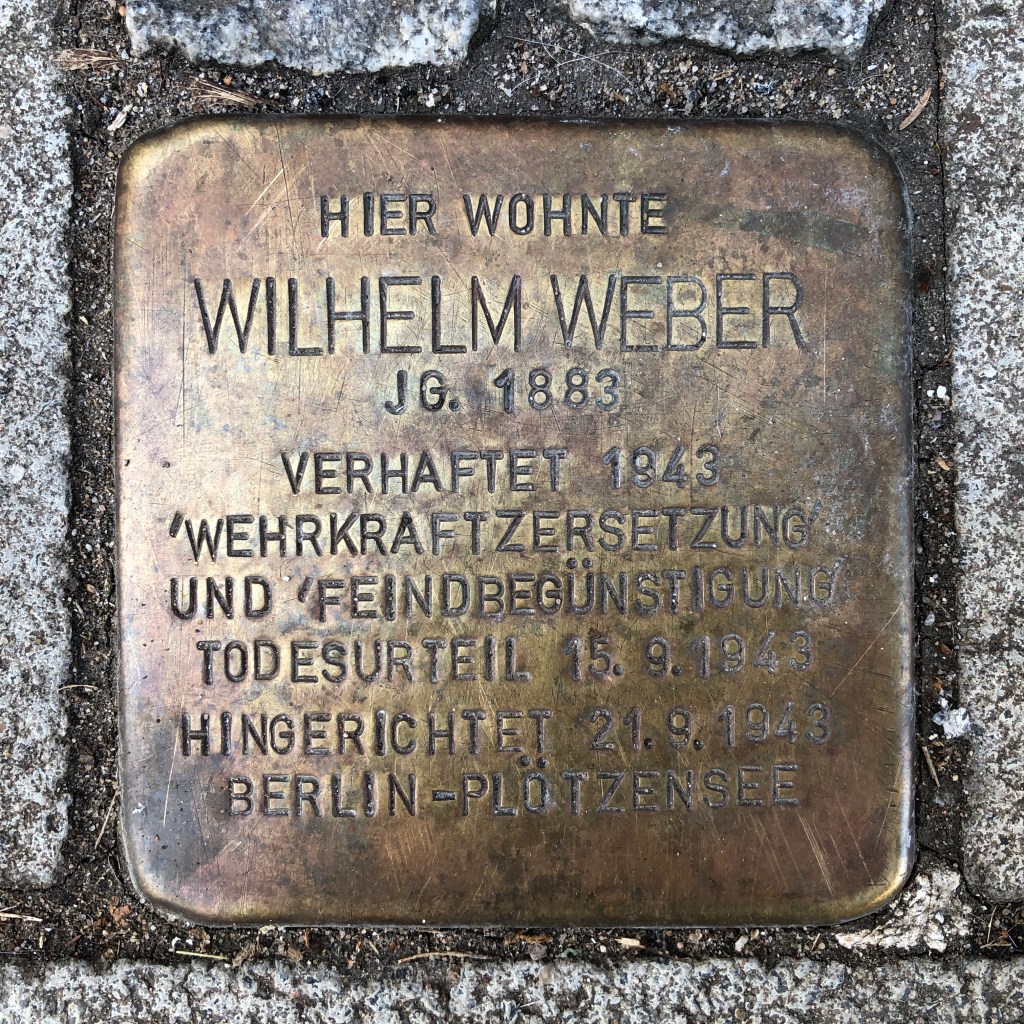
1. Hanover: This stone was laid on September 30, 2016. The inscription reads (literal translation): “Here lived Wilhelm Weber born 1883 arrested 1943 for (the treasonable offense WW) of “Wehrkraftzersetzung” (undermining military force)  und “Feindbegünstigung” (aiding the enemy).  The death sentence (proclaimed on) 15.9.1943 (and) executed on the 21.9.1943 Berlin-Plötzensee. This “Stolperstein“ for the dentist WW was moved to the Große Barlinge Street Nr. 4 on 25th September 2016. This was some form of reparation for his widow, who had previously been denied this due to his initial participation in the NSDAP.  

2. Lemgo: Here lived Wilhelm Weber *1889 a member of the Communist Party (Germany) and part of the resistance. Therefore, he was imprisoned in 1933. Eleven years later, on the 21st March 1944 he was moved to Hanover to be tried for high treason. Was killed during a bomb attack on the 26th October 1944.

3. Münster: The catholic priest Wilhelm Weber *1889 was part of the resistance and therefore arrested in 1943 and brought to the concentration camp Dachau. He survived and subsequently continued to serve as priest in his home town Bockum-Hövel, where he oversaw the renovation of the church St. Pancratius.

Coming from afar and going on in the name of our Lord, we trust and sing with Paul Gerhardt (1607-1676):

1 If God Himself be for me,
I may a host defy;
For when I pray, before me
My foes, confounded, fly.
If Christ, the head and master,
Befriend me from above,
What foe or what disaster
Can drive me from His love?

2 I build on this foundation,
That Jesus and his blood
Alone are my salvation,
My true, eternal good.
Without Him all that pleases
Is valueless on earth;
The gifts I have from Jesus 
Alone have priceless worth.

3 Christ Jesus is my splendor,
My sun, my light, alone;
Were He not my defender
Before God’s judgment throne,
I never should find favor
And mercy in His sight
But be destroyed forever
As darkness by the light. 

4 He canceled my offenses,
Delivered me from death;
He is the Lord who cleanses
My soul from sin through faith.
In Him I can be cheerful,
Courageous on my way;
In Him I am not fearful
Of God’s great Judgment Day.

5 For no one can condemn me
Or set my hope aside;
Now hell no more can claim me;
Its fury I deride.
No sentence now reproves me,
No guilt destroys my peace;
For Christ, my Savior, loves me
And shields me with His grace.

6 Who clings with resolution
To Him whom Satan hates
Must look for persecution;
For him the burden waits
Of mock’ry, shame, and losses
Heaped on his blameless head;
A thousand plagues and crosses
Will be his daily bread.

7 From me this is not hidden,
Yet am I not afraid;
I leave my cares, as bidden,
To whom my vows were paid.
Though life from me be taken
And ev’rything I own,
I trust in You unshaken
And cleave to You alone.

8 No danger, thirst, or hunger,
No pain or poverty,
No earthly tyrant’s anger
Shall ever vanquish me.
Though earth should break asunder,
My fortress You shall be;
No fire or sword or thunder
Shall sever You from me.

9 No angel and no gladness,
No throne, no pomp, no show,
No love, no hate, no sadness,
No pain, no depth of woe,
No scheming, no contrivance,
No subtle thing or great
Shall draw me from Your guidance
Nor from You separate.

10 My heart with joy is springing;
I am no longer sad.
My soul is filled with singing;
Your sunshine makes me glad.
The sun that cheers my spirit
Is Jesus Christ, my King;
The heav’n I shall inherit
Makes me rejoice and sing.

Posted in biographies and other stories, Paul Gerhardt | Tagged , , , , , , , , , | Leave a comment

OLS in April 2020

We are grateful for Your support and thank You for Your encouragement on the way + Here´s the link to our monthly circular: https://mailchi.mp/05b30669367c/the-lord-of-life-is-risen

Posted in Uncategorized | Leave a comment

The pastor: An impossible figure?

“Good Shepherd” (Vincent van Gogh)

Hermann Dietzfelbinger writes: “I was a pastor, ministering in a hospital. A patient said to me, “If you were a ditch digger, you’d have a more useful calling then you have now.” That was a long time ago, but I have not forgotten it. I thought so myself many a time as I watched the nurses performing their tasks which also needed and desired by the sick, and surgeons and doctors performing the most wonderful operations – while I stood there making miserable attempts at partial conversation. If I will only a ditchdigger! But a pastor? An impossible figure! impossible before God, the world, and even myself. For there is a tremendous gap between what is required of the pastor in his ministry and his authority and power. Does he have any authority at all? …

The pastor’s authority is based solely upon the fact that Jesus Christ ministers through him through the forgiveness of sins.

What do I have to do in my ministry? I have to preach, and we say: Preaching is God´s word. And yet I know how these sermons of mine were produced. Often, it is true, with prayer and fear and trembling; but also by dint of coffee and tobacco, sometimes in a burst of effort , very sketchily and superficially, because I had seemingly more important things to do. Strictly speaking, an impossible thing – unless Jesus Christ himself is not ashamed to accept this preaching.

In confession I have to say: Thy sins are forgiven. But I myself am a sinful man. And when I consider before God all the clumsy blunders I’ve committed and all that I have neglected, precisely in this area of confession and the forgiveness of sins, I begin to understand the ancient saying that it is a miracle if a minister be saved.

The minister stands at an open grave and utters the words of Jesus Christ: “I am the resurrection and the life; he that believed in me, though he were dead, yet shall he live.” But an earnest minister said to me, “Hardly ever, when I have spoken those words in that situation, have I even approached the reality of death around me and within myself.”

In a discussion among young people the question was asked, what did they expect of a pastor? One of them replied, “He himself must be convinced of what he says.“ And all the rest agreed. They perhaps did not know what they were saying. For who of us always believes? And who of us can guarantee our faith for evening hour? “I have prayer for thee, that Thy faith fail not“- that is what sustains us.

When we consider the church and its existence, we can only describe it as God´s great venture among us men, the venture of a divine diakonia with us, that does not balk at the utmost depths. The Church of Jesus Christ and its history, Calvin once said, is nothing but a chain of resurrections from the dead. It is also a passion history of the incarnate Son of God.   In everything that is taught and believed, loved and suffered, planned and thought in this church, Jesus Christ is venturing himself, daily repeating the washing of the feet of this church which have daily been soiled on its journey. And he must follow up everything that men do in this church, even the most shining deeds, and in some way set them straight and make something good out of them. But just because such a church rarely does exist, a church that lives by this ministry of Jesus Christ, the minister in his ministry is not merely an impossible figure, but the necessary representative, as long as God keeps his church among men.” Thus far HD – copied from Dobberstein´s Anthology “Mondays” Pg. 228-230.

Preach you the word and plant it home
to those who like or like it not.
The word that shall endure and stand
when flowers and mortals are forgot.

We know how hard, O Lord, the task
your servant bade us undertake:
to preach your word and never ask
what prideful profit it may make.

The sower sows his reckless love
scatters abroad the goodly seed,
intent alone that all may have
the wholesome loaves that all men need.

Though some be snatched and some be scorched
and some be choked and matted flat,
the sower sows; his heart cries out,
“Oh, what of that, and what of that?”

Preach you the word and plant it home
and never faint; the Harvest Lord
who gave the sower seed to sow
will watch and tend his planted word.

Martin H. Franzmann (1907-1976)


Posted in Eastertide, Gedankensplitter | Tagged , , , , , , , , , , | Leave a comment

Misericordias Domini: The Lord is my Shepherd…

BR Klassik is on air with its weekly “Laudate”. Bernhard Buttmann is playing Johann Pachelbel´s “Aria Sebaldina” on the organ. These beautiful praises are all in line with this festive Eastertide – celebrating the resurrection of our Lord Jesus Christ and his victorious reign for us and our salvation. It´s all part of our good Lord´s magnanimity and gracious favor towards sinners. That´s the name of this 2nd Sunday after Easter: “Misericordias Domini.”  Today that benevolent reign of our triune God is illustrated with the comforting imagery of the “Good Shepherd”, who keeps his own save and sound in all adversity – even in death´s dark vale (Ps.23).

This design goes far back – all the way to the first shepherd: Abel – son of Adam. Faithful, diligent and professional at his task of caring for his flock. It continues to gain contours throughout the Old Testament. Think of Abraham – blessed father in our faith – a shepherd of note. He followed God´s call, so he led his nascent congregation crisscross through the barren lands on the way to the promised homestead and fatherland continually caring, ruling, managing, guarding, protecting, feeding.  However later in this colorful history judges, chiefs, rulers, seers, prophets, wise men, priests and kings took on this task – of shepherding God´s people. King David was the epitome of this profession and Psalm 23 the essence of this task, still but a shadow of him, who was to come – the Good Shepherd – whose voice, the church hears, obeys, trusts, knows, loves and follows faithfully.

That was after many disappointments as the prophet Ezekiel points out in his 34th chapter. Due to the disloyalty, tyranny, corruption, faithlessness and uselessness of his called servants – God himself steps in and to the plate. He offers himself as the one up to the task – and accomplishes it in remarkable efficiency, sufficiency, clarity (perspicuity) and finality. All in all in a remarkable shift in imagery, that the Good Shepherd lays down his life for his sheep – becoming himself the holy Lamb of God, who offers himself as propitiation for his entrusted flock – saving them all, redeeming them, keeping them all without loss or stain – bearing them all home to the Father.

So we hear today´s sermon based on the good words written by Saint Peter – the one, who after his denial and subsequent conversion by His Lord and God´s gracious call and reinstitution: “Take care of my sheep!” took up this pastoral task of comforting, encouraging, correcting, guiding and uplifting his brethren. He writes: “Christ also suffered for you, leaving an example for you to follow in his steps. He committed no sin nor was deceit found in his mouth. When he was maligned, he did not answer back; when he suffered, he threatened no retaliation, but committed himself to God who judges justly. He himself bore our sins in his body on the tree, that we may cease from sinning and live for righteousness. By his wounds you were healed. For you were going astray like sheep, but now you have turned back to the shepherd and guardian of your souls.” (1.Pt.2,21b-25)

What a privilege to live in the Lord´s fold – even as He continues to reach out to those, who are not yet part of it – through His most Holy Word and precious Sacraments… So, let us go and hear more…

Here is the order of the divine service in German with sermon:  

Christus gelitten hat für euch und euch ein Vorbild hinterlassen, dass ihr sollt nachfolgen seinen Fußstapfen; er, der keine Sünde getan hat und in dessen Mund sich kein Betrug fand; der, als er geschmäht wurde, die Schmähung nicht erwiderte, nicht drohte, als er litt, es aber dem anheimstellte, der gerecht richtet; der unsre Sünden selbst hinaufgetragen hat an seinem Leibe auf das Holz, damit wir, den Sünden abgestorben, der Gerechtigkeit leben. Durch seine Wunden seid ihr heil geworden. Denn ihr wart wie irrende Schafe; aber ihr seid nun umgekehrt zu dem Hirten und Bischof eurer Seelen.   Lieder & Lesungen: Eingang                     156,1-4 Herr Jesu Christe, mein getreuer Hirte… Introitus                     037 (Ps.23) Hesekiel 34; 1.Petrus 2,21b-25; Joh. 10,11-16.27-30 Vor der Predigt         178 Der Herr ist mein getreuer Hirte, hält mich in seiner Hute…Nach der Predigt       156,5-7 Mein Geist und Herze wollst Du zu Dir neigen… Ausgang                    220 Eine Herde und ein Hirt!      Unser Herr Jesus Christus spricht:  Ich bin der gute Hirte. Meine Schafe hören meine Stimme, und ich kenne sie und sie folgen mir; und ich gebe ihnen das ewige Leben. (Joh.10,11a.27-28a)   Jesu Vorbild, dass wir folgen seinen Fußstapfen! Er ist der gute Hirte – wir die Schafe. Psalm 23. Bilder in den Wohnungen, Schlafgemächern und privat Räumen Er ist der gute Hirte – trotz aller bösen Hirten und Mietlingen Hes.34. Er ist der gute Hirte – wir (die Kirche) hören seine Stimme und folgen ihr… Joh.10   Ihr wart wie die irrenden Schafe… Israel in der Wüste… Irrten umher in der Wüste 40 Jahre lang! Israel in den Augen Jesu… sie waren wie Schafe, die keinen Hirten haben. Das neue Israel – die Jünger – in der Nacht, da er verraten ward… Flohen in alle Winde zerstreutDas neue Israel – die Kirche – in der Zerstreuung in alle HimmelsrichtungenDas neue Israel – die eine hl. Christenheit – in der Zerstreuung…   Nun aber seid Ihr umgekehrt…  zum Hirten und Bischof eurer Seelen! Christus gelitten hat für euch – als Lamm Gottes (Wurde einer von uns – für uns!) Er, der keine Sünde getan hat (Schuldloses Lamm) und in dessen Mund sich kein Betrug fand; (Ein Lämmlein geht und trägt die Schuld…) Er, als er geschmäht wurde, die Schmähung nicht erwiderte, nicht drohte, als er litt, es aber dem anheimstellte, der gerecht richtet; Er, der unsre Sünden selbst hinaufgetragen hat an seinem Leibe auf das Holz, damit wir, den Sünden abgestorben, der Gerechtigkeit leben. Durch seine Wunden seid ihr heil geworden. Sein stellvertretender Opfertod! Der gute Hirte gibt sein Leben für die Schafe… Denn ihr wart wie irrende Schafe; aber ihr seid nun umgekehrt zu dem Hirten und Bischof eurer Seelen.   Er der gute Hirte und Bischof unserer Seelen. Bei ihm und durch ihn sind wir gut aufgehoben zum ewigen und seligen Leben.     Der HERR ist mein Hirte, mir wird nichts mangeln. Er weidet mich auf einer grünen Aue und führet mich zum frischen Wasser. Er erquicket meine Seele.   Er führet mich auf rechter Straße um seines Namens willen. Und ob ich schon wanderte im finstern Tal, fürchte ich kein Unglück; denn du bist bei mir, dein Stecken und Stab trösten mich.   Du bereitest vor mir einen Tisch im Angesicht meiner Feinde. Du salbest mein Haupt mit Öl und schenkest mir voll ein. Gutes und Barmherzigkeit werden mir folgen mein Leben lang, und ich werde bleiben im Hause des HERRN immerdar.   (Psalm 23: Ein Psalm Davids)

Posted in Eastertide, Gedankensplitter, Predigten in der ALS, You comfort me + | Tagged , , , , , | Leave a comment

The Lord is my shepherd… (Psalm 23)

Learning German hymns by heart is way easier than memorizing Psalms – and not only because we´re stuck with Luther´s translation for good reasons and don´t have the endless choices of English speakers.  Psalms have irregular meters, don´t rhyme and follow less obvious patterns than the traditional German hymns. Their parallelisms are fascinating, but somewhat more complicated.

The one exception on our confirmation list was Psalm 23. Now that was pretty easy to memorize due to its impressive imagery. Perhaps also because we sang various versions at church and in school even. Probably it was also due to my father reading this at our family birthday devotions. For the grown-ups he added Psalm 103 as well. We continue that tradition and although we don´t have 11 or 13 readings per year, depending whether You count the grandmothers or not, there´s still 6 birthdays in our little part of the family.  

Later on in life, I found other more learnable Psalms too – and some just got stuck through habit and regular use – be it those we use during our confessional before (51; 130; 139) and after (34 and/or 103) the absolution, or be it those, which are prescribed as preaching texts in the church lectionary – like Psalm 107 – which was my task as novice in the Homiletics Seminar with Professor Manfred Seitz in Erlangen.

It´s fascinating that Dr. Martin Luther used the longest Psalm 119 as schooling tool for pastors and theologians. I assume, that besides obvious theological and material reasons, it may also be based on his pastoral concern as teacher of the church, that servants of the Word should not circumvent this huge block, but plough through it – thoroughly and consistently and without tiring – as they go about reading, praying in their lives afflicted by temptations of the devil, the world and their own sinful selves – day and night – just as patiently as cow chewing the cud – ruminating on its profound content in law, rules, precepts, statutes, commands, regulations, instructions, prescriptions etc.  

Tomorrow is the 2nd Sunday after Easter: “Misericordias Domini” – according to the German Lectionary. That´s traditionally been our “Good Shepherd´s Sunday” and good reason to have Psalm 23 as Introit. Obviously, the Eastern Orthodox churches follow a different calendar for many centuries already, but also our American brothers in the Lutheran Church Missouri Synod count this festive season differently – and also assign different themes to the various Sundays. That falls under the rich diversity of the holy Church – and is really not in serious dispute even if some would feel strongly about this. It´s not much more than a scheduling issue – adiaphora really. Nobody sees an issue of confession addressed here.

I´m happy to post Psalm 23 here – and in the language of the “New English Translation” (NET) – even if Martin Luther´s translation resonates in my mind, heart and soul. One thing I do regret a bit is, that during my student days, when I was learning the basics of the biblical languages & Latin, we were not encouraged more to learn passages by heart. With all the translations around – and the many different vernaculars and dialects even – it would have been a serious benefit to learn the biblical text off by heart. I remember that Karl Bornhäuser thought it was a basic requirement for New Testament scholars to at least know the gospel of St. Matthew and St. Paul´s letter to the Romans in the Koine original for starters – and we did get some distance with that epistle during the summer holidays of the final year at the University of Pretoria, when this was part of our “self-study”. Still, there should have been lots more Hebrew to add to this. Well, that´s probably why we wish for a long and productive life. After all, times of shutdown like now are well suited for this – even if my memory is not as reliable as before.

The Lord is my shepherd,
I lack nothing.
He takes me to lush pastures,
he leads me to refreshing water.
He restores my strength.
He leads me down the right paths
for the sake of his reputation.
Even when I must walk through the darkest valley,
I fear no danger,
for you are with me;
your rod and your staff reassure me.
You prepare a feast before me
in plain sight of my enemies.
You refresh my head with oil;
my cup is completely full.
Surely your goodness and faithfulness will pursue me all my days,
and I will live in the Lord’s house for the rest of my life.

Psalm 23 written by King David and translated into “New English”

Here´s a version of the English Hymn, which sings so wonderfully:

1 The Lord’s my Shepherd, I’ll not want;
he makes me down to lie
in pastures green; he leadeth me
the quiet waters by.

2 My soul he doth restore again,
and me to walk doth make
within the paths of righteousness,
e’en for his own name’s sake.

3 Yea, though I walk through death’s dark vale,
yet will I fear none ill,
for thou art with me; and thy rod
and staff me comfort still.

4 My table thou hast furnished
in presence of my foes;
my head thou dost with oil anoint,
and my cup overflows.

5 Goodness and mercy all my life
shall surely follow me;
and in God’s house forevermore
my dwelling place shall be.

We Germans sing it in the words of Wolfgang Meuslin and with the melody of Johann Walter (1524), but have it in our ears from the Cantata for this Sunday: BWV 112.

Posted in Eastertide, Gedankensplitter, Hymns, Old Latin School in Wittenberg, You comfort me + | Tagged , , , , , | Leave a comment

The heartbeat of our life…

Yesterday, the pastor´s convention for the SELK diocese of Saxony and Thuringia met online for hours on end. It was a very fruitful meeting all in all – especially the well-prepared exegesis of this coming Sunday´s sermon text from St. John´s gospel by Pastor Megel (Steinbach-Hallenberg) leading us right up to three well considered options for sermon outlines, but also the in-depth discussion on how to go about the divine service and celebrate the Lord´s Supper responsibly and faithfully in these sheer endless weeks of legalized social distancing.

It was very helpful to listen to the serious considerations from brothers serving in very different situations. If you consider, that it saved me about four hours travelling time to and fro – and allowed me to sleep over in my own bed – it was quite effective. Still, I missed the personal banter with friends during the lengthy sittings. No interjections, passing comments or spontaneous joking – if there is only one microphone on air at any time. It´s the control freak´s paradise and very focussed, yes, yes, but far from the vibrant exchange of personal interaction, that we pastors enjoy just as all liberated individuals in the extended community of Christian believers.

I am sure, bureaucrats love this – never mind the financial gurus – it´s cheap, it works, but it remains sterile, virtual and very close to speaking through the microphone of some window of a secured prison´s visitor´s booth. Yes, I missed shaking hands, rubbing shoulders with the brothers, hugging this and that one and breaking bread with those, who otherwise just keep their distance and remain at arm’s length like those second cousins in the otherwise close-knit Lutheran brotherhood. Superintendent Junker (Weißenfels) stressed, that this “fellowship lite” would not become the “new normal”. Thank God, it´s not yet “alternativlos!”

Isn´t it funny, how these words start creeping even into our theological vocabulary? That hit me several times yesterday. Again, and again some brother would drop these recent additions to the public discourse and use them in our ecclesial context. Some brothers are careful users of words – nearly like laying out minuscule mosaics most meticulously – whereas others paint more or less in broad strokes like old Tom Sayer with that famous whitewasher of his. Alexander Kissler (Cicero) therefore, calls on everyone to use words carefully – and not just the readers of some user manual once they notice, that they can´t get the acquired tool to work properly.

Well, coming from reading John 15 yesterday to this morning’s lesson from Dobberstein´s “Anthology” is not as far off as You might think. It´s all got to do with reading God´s Word attentively and faithfully – hearing God talking to us through the holy apostles and prophets. He gives us so many wonderful tools and devices to make us get his message. So, this morning I tried the dictate function for the first time – and it actually works well. The machine gets even my English readings – despite the foreign accent from the colonies long gone and down under. I was seriously impressed. And furthermore, I found a link on the German Bible Society´s site: https://www.academic-bible.com/en/online-bibles/about-the-online-bibles/ That is seriously brilliant. Considering, how many books and even electronic programs I have bought in the past to read these words in the original biblical wording – and here and now – it is accessible at a mouse-click for free. Hallelujah + Nota bene et tolle lege. Verbum Dei manet in aeterna. Hallelujah +

Here is a passage written by the German exegete Julius Schniewind in Dobberstein´s translation. It´s right on the mark and worth some contemplation. I think, he would have probably said – Herzstück – and indicated that it is a part of our heart and not the whole thing even as the cross in Luther´s emblem is but a part of it. Even in penning down the signs of the church in his fundamental: “On the Councils and the Church” (1539) prayer and cross are but parts of the whole… Still, Dobberstein translated it as “The heart of our ministry“ and so here is what Schniewind writes in that translation:

The pastor´s private prayer is the heart of our ministry. Paul serves God in the gospel “ἐν τῷ πνεύματί μου” (Romans 1:9), that is, in Spirit-prompted prayer. This prayer is unceasing, like breathing, and yet it has its definite hours of prayer. We know that Luther spent two hours daily in prayer. This includes the reading of the Bible: prayer originates and consists only in listening to the word. I have heard bitter complaints that in an active parish there’s no time for such meditation. Perhaps this must be overcome in faith in God, who, if we will only really hear and proclaim his Word, will give us helpers, who will relieve us of other things.

How shall we read the Bible? I follow Asmussen´s lectionary that covers the whole Bible in a year; but I am aware that this it has value chiefly in providing only the necessary knowledge of the Bible. To what extent, in this quantitative reading, do we come to the point where we really hear, where we hear the word spoken to us personally? One may choose shorter portions, such as the Bible readings which are available, despite their shortcomings. This hearing comes with practicing Luther´s principle “scriptura sui ipsius interpres” (Scripture is its own interpreter). Being at home with the Greek text of the whole New Testament gave earlier generations of ministers their power. The looking up of parallel passages in the Bible and concordance has opened up the Bible for many laymen, and for us, too, there is no better way of learning to hear, both scientifically and practically.

This listening passes over inevitably into prayer. Any application of the Word too ourselves can only be prayer. But prayer is “alert” too intercession. Ephesians 6:18f: “καὶ εἰς αὐτὸ ἀγρυπνοῦντες ἐν πάσῃ προσκαρτερήσει καὶ δεήσει περὶ πάντων τῶν ἁγίων καὶ ὑπὲρ ἐμοῦ“ (Keep alert with all perseverance, making supplication for all the saints, and also for me… RSV). And this intercession will be “alert” to the guidance of the first three petitions of the Lord´s prayer. Such intercession takes time. The concerns of our ministry, the people immediately committed to our care, the church of God, and all who serve it as pastors and teachers in the work of administration and observing love, of the people of our own country and the whole wide world: intercession takes time, and we understand how the dying Polycarp prayed for two hours in intercession and could not stop.

For such intercession there can never be any set formula. And yet it is right that we have quite generally returned to formulated prayers, especially for corporate prayer … The formulated prayer, as Bezzel said, is “the privilege of our poverty”. There are needs so bitter, some deep, that there is nothing left but a Bible verse, a hymn stanza, a psalms. But in the use of formulated prayer we must again be warned of the danger of mere quantity.  

Julius Schniewind

Together with the church let us follow Stephen P. Starke´s encouragement and sing along with all the saints worldwide:

1 Saints, see the cloud of witnesses surround us;
Their lives of faith encourage and astound us.
Hear how the Master praised their faith so fervent:
“Well done, My servant!”

2 These saints of old received God’s commendation;
They lived as pilgrim-heirs of His salvation.
Through faith they conquered flame and sword and gallows,
God’s name to hallow.

3 They call to us, “Your timid footsteps lengthen;
Throw off sin’s weight, your halting weakness strengthen.
We kept the faith, we shed our blood, were martyred;
Our lives we bartered.”

4 Come, let us fix our sight on Christ who suffered,
He faced the cross, His sinless life He offered;
He scorned the shame, He died, our death enduring,
Our hope securing.

5 Lord, give us faith to walk where You are sending,
On paths unmarked, eyes blind as to their ending;
Not knowing where we go, but that You lead us—
With grace precede us.

6 You, Jesus, You alone deserve all glory!
Our lives unfold, embraced within Your story;
Past, present, future—You, the same forever—
You fail us never!

Posted in Gedankensplitter | Leave a comment

Early in the morning – a nightingale in the woodlands

Another morning, another sunrise. Out on the Elbe flats – once again. Nights are getting shorter and you have to stay up longer or get up earlier to catch the elusive beasts of the night out in the open. I don´t care much for late sittings on some lonely hunting perch as light dwindles and sight fails. They´re not into night vision yet in Saxony-Anhalt – at least not mounted on rifles – and as this is not just about spotting, but serious stuff, the final switch back to mounted telescope for the shot is no viable option. So, long story short, I prefer getting out in the morning, even before the bus goes on its first tour, hoping that the old phrase proves true: “The early bird catches the worm.”  

Greeting some late-night revelers with “Moin, moin!” registers surprise, if not just stupor. On the parking lot I put on even more layers of warm stuff. Utensils, keys, phone and wallet are stowed in deep pockets just in case. Finally, I pull out and onto the empty streets. “Radio Brocken” blares popular tunes from times gone by. I rush past traffic lights still blacked out for the night – extra wary for late comers. I leave Martin Luther-avenue with noble flats, turn into another lined with trees, cross first over a bridge at the railways and then the big one over the “Elbe” before getting into more space and finally onto the flat lands in the “Hinterland”.

Planning this outing, I thought the hide along the “Haidelache” was perfect. It´s been my hideout before and as I´ve never been lucky there, the odds are that this would change sooner or later. My posting in the “hunting forum” shared that logic. However, as the farmer´s co-op had just put maize out in “Hermannsruh”, chances were good, that boar would invade the new plantation and wreak havoc overnight. So, my experienced colleagues suggested, I go there instead and try to catch them, before they move back into the big state forest. That´s why I didn´t pass the dairy in the end, but turned in before, circled the compound milking nearly a thousand cows daily and parked just beyond the industrial complex, right next to a game feeder and a short stretch into the farming path bordering some drainage ditch separating a ripe canola field from the freshly planted maize plot, which we were trying to protect.
Out in the East, the sky was paling. The birds were out. There´s no holding them back as Spring moves in.  I tried to be as quiet as possible. Shutting the door and loading the rifle were muffled before I shoulder the rifle and rucksack making my way down the pathway. Trying my utmost to avoid any snapping or cracking, which would go far this clear morning and might just warn ever watchful game.

Some 300 yards along the path, I got to the wooden construction (“Scherenleiter Hochsitz”), where I could mount the perch to keep a watchful eye over the area and await passing game. An advantage of having a higher shooting angle sitting up high and aiming more into the ground than standing flat on the ground and aiming far into the horizon is a “gesicherter Fangschuss”. Game doesn´t seem to register such constructions (“Jagdliche Einrichtungen”) as “human”. So, roe deer were nibbling quite fearlessly – at around 30 yards – until the pretty consistent breeze shifted whimsically and they got a whiff of me and a fright for their life. Annoyed a doe barked and the bevy moved off at speed into the ripe rape.

In the rucksack, I carry a cushion to sit on, a rolled-up blanket as back-support and a woolen one to unwrap for extra-warmth. That – and an apple plus a coffee flask – makes time pass quite comfortably on this look-out. There was no boar in sight, nor did I see any signs of them, when I got down to inspect the maize field. All was in perfect order as if smoothed over by caring hand with no irritations whatsoever. I did see some white storks fly by, crows too and some lone darting starlings. It was way too early for birds of prey – and probably to way-out for owls too.

However – and that was to be a highlight of my morning and perhaps in my hunting days – there was a nightingale in the bushes. I heard later, that they have just arrived back in these parts and are now shouting out their jubilant song with new vigor.

Untiringly the little bird went about its daily business of praising the good Lord and singing His wonders into this beautiful world of ours. I´m not an expert at identifying birds – never mind their calls – but I do have a telephone with a voice recorder. So, this morning I taped this little brown music master – and voila – my hunting friends and colleagues confirmed my hopeful guess. After checking with them, they returned with thumps-up and confirming nods: “Das ist eine Nachtigall!”

It was indeed the inconspicuous queen of variety and diva of acapella song herself – strikingly melodious, most lyrical and just so enthusiastically vibrant – as she continued to worship the creator throughout the morning. She just never tires at this. You can´t believe, how elated I was to hear her go about morning devotions in real life. In German I´d say: “Ich bin ganz aus dem Häuschen!” (Literally: “I am totally out of the little house” meaning “I am overjoyed!”) My recording is quite amateurish and here is a professional one: https://www.youtube.com/watch?v=b3iq2XrYebk

Sharing this with my mother, she related, how at the moment they were enjoying the crowned cranes on the maize fields in Welbedacht. Now, there is a bird of note. It´s the national bird of Uganda. It flouts spectacular feathers, stands tall in plumed grace and bears a crown to top it all. Yet, if You listen to its attempts at music, it’s not much to write home about. Sounds much like a chicken run or worse gaggle of geese. Compare that with the nightingale. She´s mostly solitary. She´s hardly seen, shy as she is – and if You do get ever so lucky, You´re bound to think, that´s just a poor LBJ (Little brown job), but then, when she picks up her tune and You hear her go off to sing in tremolo and hit even the highest notes without fail, rolling down and soaring up, up and even higher – well, that just makes all the difference. The drab old girl can sing!

No wonder, it has motivated artists to paint, sing and fabulate about this little Miss Grey – from the Land of the rising Sun and the Middle Kingdom right to the Danish shores and German lowlands. Just listen to the wonderful rendition of Mendelsohn in her honor: “Was Neues hat sie nie gelernt, singt alte liebe Lieder

The nightingale reminded me very much of one of my long-standing favorites – and so here goes – just like on that first Mission festival in Dreihausen (Ebsdorfergrund), where I actually sang that last stanza during the introduction 🙂

1) Jesus Christus herrscht als König,
alles wird ihm untertänig,
alles legt ihm Gott zu Fuß.
Aller Zunge soll bekennen,
Jesus sei der Herr zu nennen,
dem man Ehre geben muß.

2) Fürstentümer und Gewalten,
Mächte, die die Thronwacht halten,
geben ihm die Herrlichkeit;
alle Herrschaft dort im Himmel,
hier im irdischen Getümmel
ist zu seinem Dienst bereit.

3) Gott ist Herr, der Herr ist Einer,
und demselben gleichet keiner,
nur der Sohn, der ist ihm gleich;
dessen Stuhl ist unumstößlich,
dessen Leben unauflöslich,
dessen Reich ein ewig Reich.

4) Gleicher Macht und gleicher Ehren
sitzt er unter lichten Chören
über allen Cherubim;
in der Welt und Himmel Enden
hat er alles in den Händen,

denn der Vater gab es ihm.

5) Nur in ihm, o Wundergaben,
können wir Erlösung haben,
die Erlösung durch sein Blut.
Hört’s: das Leben ist erschienen,
und ein ewiges Versühnen
kommt in Jesus uns zugut.

6) Jesus Christus ist der Eine,
der gegründet die Gemeine,
die ihn ehrt als teures Haupt.
Er hat sie mit Blut erkaufet,
mit dem Geiste sie getaufet,
und sie lebet, weil sie glaubt.

7) Gebt, ihr Sünder, ihm die Herzen,
klagt, ihr Kranken, ihm die Schmerzen,
sagt, ihr Armen, ihm die Not.
Wunden müssen Wunden heilen,
Heilsöl weiß er auszuteilen,
Reichtum schenkt er nach dem Tod.

8) Zwar auch Kreuz drückt Christi Glieder
hier auf kurze Zeiten nieder,
und das Leiden geht zuvor.
Nur Geduld, es folgen Freuden;
nichts kann sie von Jesus scheiden,
und ihr Haupt zieht sie empor.

9) Ihnen steht der Himmel offen,
welcher über alles Hoffen,
über alles Wünschen ist.
Die geheiligte Gemeine
weiß, daß eine Zeit erscheine,
da sie ihren König grüßt.

10) Jauchz ihm, Menge heilger Knechte,
rühmt, vollendete Gerechte
und du Schar, die Palmen trägt,
und ihr Zeugen mit der Krone
und du Chor vor seinem Throne,
der die Gottesharfen schlägt.

11) Ich auch auf der tiefsten Stufen,
ich will glauben, reden, rufen,
ob ich schon noch Pilgrim bin:
Jesus Christus herrscht als König,
alles sei ihm untertänig;
ehret, liebet, lobet ihn!

(Philipp Friedrich Hiller, 1755)

I think, that eleventh stanza is a brilliant description of the nightingale´s stance. She does not make much of herself, keeps in the shadows really, but still, she´s not too bashful being in the lowest ranks and without much plumage – just as the servant, who received but one talent (Mt.25,24-28). She too has but one real talent – and that is to sing  – and so that´s what she does. Full blast! She doesn´t stop to believe faithfully. She doesn´t cease to speak her creed. Rather, she starts when the night is still dark and she continues to sing it out loud and clear: “IX is Lord and King, Hallelujah!” And she invites all and everything to praise His holy name – the living God: Father, Son and Holy Ghost + who has created us, saved us and justified us and continues to save and sanctify us until He comes again to carry us home. So we are all bound to love, fear and trust Him more than anything. He´s our Lord and our God. This sung confession of trust and confidence is a good way to start any day, don´t You think? It would even do as motto for a whole day – any day!

Posted in Eastertide, Gedankensplitter, Morning Prayer | Tagged , , , , , | Leave a comment