Looking forward to this Sunday. It is “Sexagesimae” – the second Sunday before Lent):
Oh, that today You would listen as He speaks! Do not harden Your hearts.
Hebrews 3,15
An Armenian Bible, 17th century, illuminated by Malnazar
This blessed Sunday we are focused on the triune God´s holy word. The Psalm 1,19 and 119 teach us in that regard. With the Introit all believers confess:
Psalm 119,89-92.103-105.116Isaiah scrollVom Himmel hoch da komm ich her!Esra vor einem Schrank mit biblischen Büchern (Codex Amiatinus)
And the good Lord lets us hear His words through the holy prophet Isaiah, which we have in well preserved text scrolls dating back nearly 3 millenia…
Isaiah 55,8-12
The designated sermon text is from the letter to the Hebrews. There we get a strong and powerful picture of this very holy Word of God:
The Nouvi Zákon – the Lutheran New Testament in prekmurian language, by István Küzmics in 1771Gustav Vasa Bible 1541 Elector´s Bible 1641Blatt 16v, enthaltend Mk 3,26–32 EU, aus dem Codex Argenteus, einer Abschrift der WulfilabibelDie erste vollständige Bibelübersetzung von Martin Luther 1534, Druck Hans Lufft in Wittenberg, Titelholzschnitt von Meister MS. Münster Bibelmuseum
We listen up and sing with this blessed churchman´s hymn:
Thy strong word did cleave the darkness; At thy speaking it was done. For created light we thank thee While thine ordered seasons run. Alleluia! Alleluia! Praise to thee who light dost send! Alleluia! Alleluia! Alleluia without end!
Lo, on those who dwelt in darkness, Dark as night and deep as death, Broke the light of thy salvation, Breathed thine own life-giving breath. Alleluia! Alleluia! Praise to thee who light dost send! Alleluia! Alleluia! Alleluia without end!
Thy strong Word bespeaks us righteous; Bright with thine own holiness, Glorious now, we press toward glory, And our lives our hope confess. Alleluia! Alleluia! Praise to thee who light dost send! Alleluia! Alleluia! Alleluia without end!
From the cross thy wisdom shining Breaketh forth in conqu’ring might; From the cross forever beameth All thy bright redeeming light. Alleluia! Alleluia! Praise to thee who light dost send! Alleluia! Alleluia! Alleluia without end!
Give us lips to sing thy glory, Tongues thy mercy to proclaim, Throats to shout the hope that fills us, Mouths to speak thy holy name. Alleluia! Alleluia! May the light which thou dost send Fill our songs with alleluias, Alleluias without end!
God the Father, light-creator, To thee laud and honor be. To thee, Light from Light begotten, Praise be sung eternally. Holy Spirit, light-revealer, Glory, glory be to thee. Mortals, angels, now and ever Praise the holy Trinity!
A week ago Bruno and Ingrid were in a head-on-collision. Subsequently other cars crashed into them from behind. Their two children Karl (6) and Maya (2) were critically injured, and both died in ICU – Karl on Sunday and Maya this morning. Both parents are still in serious physical condition besides suffering from this trauma and loss. Please pray for them, that they don´t lose faith, but continue to trust in the one, who we know as the one, who
will shelter you with his wings; you will find safety under his wings. His faithfulness is like a shield or a protective wall!
Psalm 91,4
My parents-in-law lost their youngest son – Martin – when he was but 2 years old. He drowned in the parsonage´s fishpond on Christmas Eve. Their eldest was shot on a lovely autumn day by robbers, who came to steal his truck. They probably felt much like Adam and Eve after Abel was murdered by Cain, or Jacob, when he heard that a wild animal had killed Joseph. King David was quite distraught when his rebellious son Absalom was killed in battle, trying to oust his very father from the throne. He also went through quite some suffering, when his first-born with Batsheba dies. I reckon there´s not much worse to suffer in this world, than to bury your own child. That´s what those parents in Bethlehem went through after the killing of the holy innocents, but Joseph and Mary escaped with baby Jesus to Egypt.
“Cain flees, Adam and Eve grieve” by William Blake 1805-9“First family” “Jacob hears news of Joseph´s death” by Giobanni Andrea de Ferrari 1640
That explains the joy the bereaved experience, when their dead ones are brought back to life: The widow of Sarepta; Jacob gets to see his long lost son Joseph again in Egypt; the widow of Nain; Jairus, the ruler of the synagogue. It´s what the Lord promised through the evangelist. St. John:
God will wipe away every tear from their eyes, and death will not exist any more—or mourning, or crying, or pain, for the former things have ceased to exist.
Revelation 21,4
Magdalena Luther by Lucas Cranach srMartin Luther at the coffin of his daughter by Gustav Ferdinand Leopold König
The reformer – Dr. Martin Luther – struggled very much with the premature death of his daughter Magdalena. She was but thirteen years old. It was the 20th September 1542 – four years before he himself would die. He writes to his trusted friend Justus Jonas:
I believe the report has reached you that my dearest daughter Magdalena has been reborn into Christ’s eternal kingdom. I and my wife should joyfully give thanks for such a felicitous departure and blessed end by which Magdalena escaped the power of the flesh, the world, the Turk and the devil; yet the force of our natural love is so great that we are unable to do this without crying and grieving in our hearts, or even without experiencing death ourselves. The features, the words and the movements of the living and dying daughter remain deeply engraved in our hearts. Even the death of Christ… is unable to take this all away as it should. You, therefore, give thanks to God in our stead. For indeed God did a great work of grace when he glorified our flesh in this way. Magdalena had (as you know) a mild and lovely disposition and was loved by all… God grant me and all my loved ones and all my friends such a death – or rather such a life.
Fritz Mackensen: “Mourning family”Epitaph for Mary Elisabeth Gerhardt 28th January 1657 (Mittenwalde)P. Paul Gerhardt
P. Paul Gerhardt married Anna Maria on the 11th of February 1655. The first daughter, Maria Elisabeth, was born on the 19th of May 1656, but died half a year later already on the 28th January 1657. She was buried in Mittenwalde. The Gerhardts had four more children. Three of these died in early age: Anna Catharina, Andreas Christian and Andreas). Son Paul Friedrich was the only one, who would outlive his parents. Paul Gerhard, was hard pressed in his office of the minstry too because he wanted to remain faithful to the Lutheran confession – and not follow the unionistic pressures of the calvinistic Prussian king. One of his most beloved hymns is “Geh aus mein Herz und suche Freud...”, by which he exhorts himself to leave his own sorrowful state (curvatus in se) and seek joy in God´s creation, salvation and final consumation is a very strong admonition for us to look up towards Jesus – the only source and final goal of our salvation – and come to Him with all our sorrows, troubles and needs. Catherine Winkworth translated and compressed Paul Gerhardt´s 15 verses into but six stanzas. Try read the original – if You can. It´s worth it.
1 Go forth, my heart, and seek delight, While summer reigns so fair and bright, View God’s abundance daily; The beauty of these gardens see, Behold how they for me and thee Have decked themselves so gaily.
2 The trees with spreading leaves are blessed, The earth her dusty rind has dressed In green so young and tender. Narcissus and the tulip fair Are clothed in raiment far more rare Than Solomon in splendor.
3 The lark soars upward to the skies, And from her cote the pigeon flies, Her way to woodlands winging. The silver-throated nightingale Fills mountain, meadow, hill and dale With her delightful singing.
4 Fast grows the wheat, like waving gold, And gives delight to young and old; All nature with thanksgiving Lauds Him whose mercy measureless Vouchsafed the soul of man to bless With goods that grace his living.
5 Thy splendor, Lord, doth brightly shine And fills my heart with joy divine While here on earth abiding; What, then, may be in store for me And all who heaven’s glory see, In golden halls residing?
6 O choose me for Thy paradise, Let soul and body till I rise Still flourish, tiring never. With Thee alone will I abide, Thine honor serve, and none beside, Both here and there forever.
Looking forward to the 4th Sunday before Lent. It comes with a very promising invitation: “Come and witness God’s exploits! His acts on behalf of people are awesome.” (Psalm 66,5)
Pieter Stalpaert 1617Epitaph for Johann Stiegel by Peter Gottland (1564) JenaRembrandt van Rijn (1632)
The Introit from Psalm 107 lifts our eyes to look at those in peril on the high seas, who cry to the Lord and are saved by His gracious favor:
Give thanks to the Lord, for He is good, and His loyal love endures. Let those delivered by the Lord speak out, those whom He delivered from the power of the enemy…
Some traveled on the sea in ships, and carried cargo over the vast waters. They witnessed the acts of the Lord, His amazing feats on the deep water. He gave the order for a windstorm, and it stirred up the waves of the sea. They reached up to the sky, then dropped into the depths. The sailors’ strength left them because the danger was so great. They swayed and staggered like drunks, and all their skill proved ineffective. They cried out to the Lord in their distress; He delivered them from their troubles. He calmed the storm, and the waves grew silent. The sailors rejoiced because the waves grew quiet, and He led them to the harbor they desired. Let them give thanks to the Lord for His loyal love, and for the amazing things He has done for people. Let them exalt Him in the assembly of the people. Let them praise Him in the place where the leaders preside.
Psalm 107:1f.23-32
The Old Testament lesson from the prophet Isaiah reminds us, that we should not forget the good Lord – creator and savior of all! – but rather, put all our hope and trust in Him, who has created all and everything – even us – and continues to preserve us out of fatherly goodness and mercy all days of our life. Therefore, we should not despair, but cry to Him in every need and expect life and salvation from Him, the giver and keeper of all good.
Wake up! Wake up! Clothe Yourself with strength, O arm of the Lord! Wake up as in former times, as in antiquity. Did You not smash the Proud One? Did You not wound the sea monster? Did You not dry up the sea, the waters of the great deep? Did You not make a path through the depths of the sea, so those delivered from bondage could cross over?
Those whom the Lord has ransomed will return; they will enter Zion with a happy shout. Unending joy will crown them, happiness and joy will overwhelm them; grief and suffering will disappear. “I, I am the one who consoles you. Why are you afraid of mortal men, of mere human beings who are as short-lived as grass? Why do you forget the Lord, who made you, who stretched out the sky and founded the earth? Why do you constantly tremble all day long at the anger of the oppressor, when he makes plans to destroy? Where is the anger of the oppressor? The one who suffers will soon be released; he will not die in prison, he will not go hungry. I am the Lord your God, who churns up the sea so that its waves surge. The Lord of Heaven’s Armies is His name!
“I commission you as my spokesman; I cover you with the palm of my hand, to establish the sky and to found the earth, to say to Zion, ‘You are my people.’”
This brings up the story of the prophet Jonah, which is not listed among Sunday´s lessons, but points us dramatically to the Gospel of our Lord Jesus Christ too. We hear two accounts of our Lord calming the storms – one as recorded by the evangelist St. Matthew, which is allocated as sermon text and the other from St. Mark, as the regular Gospel. In the first, we hear of St. Peter going out to meet our Lord on the water and how the good Lord saves him from drowning, when he starts fearing the surrounding perils. Here is the text as recorded by St. Mark:
On that day, when evening came, Jesus said to his disciples, “Let’s go across to the other side of the lake.” So, after leaving the crowd, they took him along, just as he was, in the boat, and other boats were with him. Now a great windstorm developed and the waves were breaking into the boat, so that the boat was nearly swamped. Buthe was in the stern, sleeping on a cushion. They woke him up and said to him, “Teacher, don’t you care that we are about to die?” So, he got up and rebuked the wind, and said to the sea, “Be quiet! Calm down!” Then the wind stopped, and it was dead calm. And he said to them, “Why are you cowardly? Do you still not have faith?” They were overwhelmed by fear and said to one another, “Who then is this? Even the wind and sea obey him!”
Mark 4,35-41
Codex Egberti (980-993)
Immediately Jesus made the disciples get into the boat and go ahead of him to the other side, while he dispersed the crowds. And after he sent the crowds away, he went up the mountain by himself to pray. When evening came, he was there alone. Meanwhile the boat, already far from land, was taking a beating from the waves because the wind was against it. As the night was ending, Jesus came to them walking on the sea. When the disciples saw him walking on the water, they were terrified and said, “It’s a ghost!” and cried out with fear. But immediately Jesus spoke to them: “Have courage! It is I. Do not be afraid.” Peter said to him, “Lord, if it is you, order me to come to you on the water.” So he said, “Come.” Peter got out of the boat, walked on the water, and came toward Jesus. But when he saw the strong wind, he became afraid. And starting to sink, he cried out, “Lord, save me!” Immediately Jesus reached out his hand and caught him, saying to him, “You of little faith, why did you doubt?” When they went up into the boat, the wind ceased. Then those who were in the boat worshiped him, saying, “Truly you are the Son of God.”
Matthew 14,22-33
It is St. Paul, who relates this holy Gospel masterfully in his life and points out, how we too should not trust in ourselves, but in God, who raises the dead. He is the one, who delivers us from so great a risk of death, and He will deliver us – for sure. Amen. Amen. He writes:
For we do not want you to be unaware, brothers and sisters, regarding the affliction that happened to us in the province of Asia, that we were burdened excessively, beyond our strength, so that we despaired even of living. Indeed we felt as if the sentence of death had been passed against us, so that we would not trust in ourselves but in God who raises the dead. He delivered us from so great a risk of death, and he will deliver us. We have set our hope on him that he will deliver us yet again, as you also join in helping us by prayer, so that many people may give thanks to Godon our behalf for the gracious gift given to us through the help of many.
2. Corinthians 1,8-11
Isn´t that encouraging and so awesome to hear? Oh yes, it is. God´s acts on our behalf are just so awesome. Hallelujah!
That is why we join in singing the old Lutheran favorite:
1. Seek where ye may to find a way That leads to your salvation; My heart is stilled, On Christ I build, He is the one Foundation. His Word is sure, His works endure; He doth o’erthrow My every foe; Through Him I more than conquer.
2. Seek whom ye may To be your stay; None can redeem his brother. All helpers failed, This Man prevailed, The God-man, and none other. Our Servant-Lord Did help afford; We’re justified, For He hath died, The Guiltless for the guilty.
3. Seek Him alone, Who did atone, Who did your souls deliver; Yea, seek Him first, All ye who thirst For grace that faileth never. In every need Seek Him indeed; To every heart He will impart His blessings without measure.
4. My heart’s Delight, My Crown most bright, Thou, Jesus, art forever. Nor wealth nor pride Nor aught beside Our bond of love shall sever. Thou art my Lord; Thy precious Word Shall be my guide, Whate’er betide. Oh, teach me, Lord, to trust Thee!
5. Hide not from me, I ask of Thee, Thy gracious face and favor. Though floods of woe Should o’er me flow, My faith shall never waver. From pain and grief Grant sweet relief; For tears I weep, Lord, let me reap Thy heavenly joy and glory.
Georg Weissel 1590-1635 translated by Arthur P. Voss 1899-1955
Looking forward to the high feast and holiday of the Transfiguration this last Sunday after the Epiphany. We´re hearing a lot from the great prophet Moses, who points us to the one and only savior of the world, Jesus Christ. He it is, who was promised to Adam and Eve in the garden. He it is, who was promised to our father Abraham. It is He, who spoke by all the prophets in the same vein as He did to Moses. It is He, who says: “I am, who I am!”
Juan Rexach (1460): Prophet MosesVasilij Ivanovič Denisov (1862-1922): MosesChristian Rohlfs (1849-1938): Moses sees the promised land
The Old Testament lesson for tomorrow is from the second book of Moses (Exodus) chapter 3 and relates the story of the burning bush and calling of Moses:
Now Moses was tending the flock of Jethro his father-in-law, the priest of Midian, and he led the flock to the far side of the wilderness and came to Horeb, the mountain of God. There the angel of the Lord appeared to him in flames of fire from within a bush. Moses saw that though the bush was on fire it did not burn up.
So Moses thought, “I will go over and see this strange sight—why the bush does not burn up. ”When the Lord saw that he had gone over to look, God called to him from within the bush, “Moses! Moses!” And Moses said, “Here I am.” “Do not come any closer,” God said. “Take off your sandals, for the place where you are standing is holy ground.” Then he said, “I am the God of your father, the God of Abraham, the God of Isaac and the God of Jacob.” At this, Moses hid his face, because he was afraid to look at God.
The Lord said, “I have indeed seen the misery of my people in Egypt. I have heard them crying out because of their slave drivers, and I am concerned about their suffering. So I have come down to rescue them from the hand of the Egyptians and to bring them up out of that land into a good and spacious land, a land flowing with milk and honey—the home of the Canaanites, Hittites, Amorites, Perizzites, Hivites and Jebusites. And now the cry of the Israelites has reached me, and I have seen the way the Egyptians are oppressing them. So now, go. I am sending you to Pharaoh to bring my people the Israelites out of Egypt.”
But Moses said to God, “Who am I that I should go to Pharaoh and bring the Israelites out of Egypt?” And God said, “I will be with you. And this will be the sign to you that it is I who have sent you: When you have brought the people out of Egypt, youwill worship God on this mountain.” Moses said to God, “Suppose I go to the Israelites and say to them, ‘The God of your fathers has sent me to you,’ and they ask me, ‘What is his name?’ Then what shall I tell them?” God said to Moses, “I am who I am. This is what you are to say to the Israelites: ‘I am has sent me to you.’” God also said to Moses, “Say to the Israelites, ‘The Lord, the God of your fathers—the God of Abraham, the God of Isaac and the God of Jacob—has sent me to you.’ “This is my name forever, the name you shall call me from generation to generation.”
Exodus 3,1-15
The sermon text for tomorrow´s high holiday is from the same book:
When Moses came down from Mount Sinai with the two tablets of the covenant law in his hands, he was not aware that his face was radiant because he had spoken with the Lord. When Aaron and all the Israelites saw Moses, his face was radiant, and they were afraid to come near him. But Moses called to them; so Aaron and all the leaders of the community came back to him, and he spoke to them. Afterward all the Israelites came near him, and he gave them all the commands the Lord had given him on Mount Sinai. When Moses finished speaking to them, he put a veil over his face. But whenever he entered the Lord’s presence to speak with him, he removed the veil until he came out. And when he came out and told the Israelites what he had been commanded, they saw that his face was radiant. Then Moses would put the veil back over his face until he went in to speak with the Lord.”
Exodus 34,29-35
We know many great promises of our good Lord and triune God, which were recorded by His faithful servant Moses. Another outstanding one is from the fifth and final book of Moses:
The Lord your God will raise up for you a prophet like me from among you, from your fellow Israelites. You must listen to him.
Deuteronomy 18,15
And that too was wonderfully fulfilled – like all our good God´s promises – in His only begotten Son, Jesus Christ, our Lord, the only Savior of the world. In Him the fulness of God´s grace and goodness appeared (Epiphany) in the fulness of time to His people Israel and for the benefit of all the world as the prophet Isaiah foretold:
The Lord rises upon you and His glory appears over you.
Isaiah 60,2b
Tomorrow´s gospel as recorded by the holy evangelist St. Matthews relates this fulfilment and God´s confirmation of it during His glorious Transfiguration before those select holy apostles and the two outstanding prophets, whose graves were never found:
After six days Jesus took with him Peter, James and John the brother of James, and led them up a high mountain by themselves. There he was transfigured before them. His face shone like the sun, and his clothes became as white as the light. Just then there appeared before them Moses and Elijah, talking with Jesus. Peter said to Jesus, “Lord, it is good for us to be here. If you wish, I will put up three shelters—one for you, one for Moses and one for Elijah.” While he was still speaking, a bright cloud covered them, and a voice from the cloud said, “This is my Son, whom I love; with him I am well pleased. Listen to him!” When the disciples heard this, they fell facedown to the ground, terrified. But Jesus came and touched them. “Get up,” he said. “Don’t be afraid.” When they looked up, they saw no one except Jesus. As they were coming down the mountain, Jesus instructed them, “Don’t tell anyone what you have seen, until the Son of Man has been raised from the dead.
Matthew 17,1-9
Transfiguration (Crete)Epitaph für Johannes Göckerlein (Anonym: Kassel) Transfiguration (Moscow)
The great missionary to the heathens and holy apostle St. Paul writes in his second letter to the Corinthians and brings the gospel to shine amongst the Christian congregation and church, which is often hard pressed, perplexed, persecuted, struck down:
For God, who said, “Let light shine out of darkness,” made his light shine in our hearts to give us the light of the knowledge of God’s glory displayed in the face of Christ. But we have this treasure in jars of clay to show that this all-surpassing power is from God and not from us. We are hard pressed on every side, but not crushed; perplexed, but not in despair; persecuted, but not abandoned; struck down, but not destroyed. We always carry around in our body the death of Jesus, so that the life of Jesus may also be revealed in our body.” (2.Corinthians 4,6-10)
It is in His name we gather as Christian church throughout the world – called to join in with the Introit:
The Lord reigns, let the earth be glad; let the distant shores rejoice. Clouds and thick darkness surround him; righteousness and justice are the foundation of his throne.
Fire goes before him and consumes his foes on every side. His lightning lights up the world; the earth sees and trembles. The mountains melt like wax before the Lord, before the Lord of all the earth. The heavens proclaim his righteousness, and all peoples see his glory.
All who worship images are put to shame, those who boast in idols— worship him, all you gods!
Zion hears and rejoices and the villages of Judah are glad because of your judgments, Lord. For you, Lord, are the Most High over all the earth; you are exalted far above all gods. Let those who love the Lord hate evil, for he guards the lives of his faithful ones and delivers them from the hand of the wicked. Light shineson the righteous and joy on the upright in heart. Rejoice in the Lord, you who are righteous, and praise his holy name.
Psalm 97
Thomas H. Troeger (1945) summarizes the glorious experience of the Holy Transfiguration in his hymn “Swiftly pass the clouds of glory…” and puts it into the context of the Christian church and congregation – much like St. Paul does in the designated Epistle for tomorrow. See above.
Swiftly pass the clouds of glory, Heaven’s voice, the dazzling light; Moses and Elijah vanish; Christ alone commands the height! Peter, James, and John fall silent, Turning from the summit’s rise Downward toward the shadowed valley Where their Lord has fixed His eyes.
Glimpsed and gone the revelation, They shall gain and keep its truth, Not by building on the mountain Any shrine or sacred booth, But by following the Savior Through the valley to the cross And by testing faith’s resilience Through betrayal, pain, and loss.
Lord, transfigure our perception With the purest light that shines, And recast our life’s intentions To the shape of Your designs, Till we seek no other glory Than what lies past Calv’ry’s hill And our living and our dying And our rising by Your will.
Friedhof in BethelVom irdischen zum himmlischen BethelFamiliengrabstätte von Bodelschwinghs
In the late 1980´s my father-in-law installed P. Werner Köhne in Wittenberg. At that stage it was not foreseeable that I would be the successor to be installed in 1992. That´s thirty years ago this year. My father-in-law based his sermon on St.Paul´s second epistle to the Corinthians in the fourth chapter:
Therefore, since through God’s mercy we have this ministry, we do not lose heart.
2. Corinthians 4,1
Bodelschwingh-Grab auf dem Alten Friedhof in Bethel.
I´ve still got his sermon on that passage. It sounds like my father-in-law´s testament. This morning one of the readings in Dobberstein´s anthology is by Georg Merz, who takes up this comforting verse too:
Always there is one firm consolation – to know the source of our office and ministry. We have it in an order instituted by God. This order stems out of mercy. Because we have received mercy and because this happened and continues to happen, we can serve. This mercy stands not only at the beginning of our ministry, it accompanies us constantly, even in time of doubt. Only one who makes mercy in this sense the foundation of his ministry can go on working.
On the gravestone of Bodelschwingh are inscribed these words of 2. Corinthians 4,1: “Therefore, having this ministry by the mercy of God, we do not lose heart.”
And so, he instructed the young men who were to serve even where no human justification of their work might encourage them. They were made to understand that misery exists that it may bring forth the praise of God´s mercy, so that, as Paul says, the bright light which God has shone in the heart may shine in the world.
Yesterday I got invited to tea. That´s a first for me. I´m still dazed and not because there was something funny in the tea. No, just because it was the first time. Afterall, I´ve been in these parts since 2018.
You know, teatime is pretty precious for us South Africans. We´re members of the Commonwealth – and follow colonial rites with some determination. Nearly as solemnly as the Japanese do theirs. I´m sure the Queen will approve.
The custom goes way back. At home in Enhlanhleni, teatime at 10h00 was family time. Gathered around the old stone table under the weeping willow. Later, Rooibos became the teetotaler´s nightcap. Sensitive patients drink it all day with only minor side effects.
As pastor doing congregational rounds, the tried and tested ritual would always start with tea first: “With or without milk/sugar?” Sweet and/or savory sides would go without saying. We´d settle in over current affairs before getting to the “Seelsorge-bit” and closing devotions. This later part was the pastoral special. Otherwise, it was just more of the same. That´s how casual visits go down south.
Even here in Luthercity Wittenberg we Webers still pour a cup of tea. Mostly we sip that at our different desks or during democratic updates for citizens on the public broadcaster. That´s balanced (counteracted) by family devotions using the standards of the free church. That´s just ingrained.
Well, yesterday was different. This January I reached the halfway mark, plotted by Superintendent Casparik in his update for newcomers in these parts: “It takes villagers around here 10 years before they notice a newcomer in the parsonage!” You understand, why I´m so beside myself?
This local Wittenberger actually invited me into his home after just 5 years. I got green tea – nothing flat and boring, but rather aromatic, daring and calling for more. And he added his wife´s homemade fruit cake too. Now, that must mean something. I´ll figure it out still. For now, I´ll just celebrate this highwater mark and continue to invite passersby to a cup in the Old Latin School. Perhaps the treasured custom will catch on sooner or later. Yesterday´s host was today´s guest at punctual five o´clock tea. Obviously some like the idea. Until it becomes a standard pastime, we just continue to invite to our daily devotions and especially to the divine services on Sundays – with or without tea.
Sitting at my father´s table is one of my favorite memories. There was plenty of space. So that not just nine kids – with three grandmothers – enjoyed my mother´s gastronomic gifts. There was the mission secretary Hanns Gnauk, who was a long-time bachelor until he married my father´s cousin, a mission nurse in Itshelejuba, but that´s another story. Well, Hanns was a regular visitor at our 3 standard mealtimes – breakfast, lunch and supper. Having a corner-bench (Eckbank) made it possible to fit in more and more – just as needed. You just had to squeeze up a bit – like in a church pew. We did put in an extra table now and again – and sometimes we just sat outside around the fire pit. There was hardly a limit to the number of chairs then…
There were frequent guests from the mission field. Vicars, who learnt either Zulu or Tswana with my father and together with their growing family stayed in our house for as long as that language course lasted: Manfred Nietzke, Gerhard Heidenreich, Heinrich Dammann to mention some. Pastors and missionaries, who cooperated with my father in his ongoing translation projects concentrating on Sunday sermons, the Lutheran confessions, and dogmatic writings of the church.
Family and friends, who were eager to see “real Africa” in Zululand – rejoicing in views of Ncomboshe (Confluence of the Buffalo and Tugela rivers), Ukahlamba (Drakensberg), San art, Lutheran tapestries & paintings at the Swedish Mission in Rorkes Drift, traditional carvings at a Zulu wise man near Keat´s Drift, petrified forest, joining my father on his mission trips to Zulu kraals in Ngunjane etc.
Looking across the Tugela valley
There were plenty reasons to come and stay at “Enhlanhleni” (Literally: “The good place!”) Some lost their way and sought directions. Like Professor Maurach from Unisa, who together with his wife and kids became a regular too and with time a good friend of my parents. For me as a child it was home and the favorite place to be. Glorious times. Long gone!
Since those times, I´ve sat at a lot of other tables. Narrow school desks in Uelzen and Wartburg preparing for similar contraptions at university and seminary later. I´ve joined other families at their tables: Albers, Scharlachs, Straeulis, Reinstorfs, Niebuhrs, Pontows, Büttchers. They´ve made me feel at home in far off places. I´ve lived in hostels, fraternities, soldier´s quarters and many tables have made those stays comfortable and mostly even enjoyable.
Together with Angelika we´ve even come to have our own table fellowship – with family, friends and visitors. We´ve had good guests and happy times with Ackermanns, Schönes, Voges, Fehrmann, Simojoki, Buthelezi, Rao, Kleeblatts, Gevers, Fischer and so on.
Mother & wifeGood memoriesBrothers & friends
Coming to Luthercity Wittenberg was a game changer. We downsized. The circle of friends was reduced to couples and even singles. All before Covid restrictions. Thankfully, Angelika still has a regular full class of students at the school, so she doesn´t miss guests too much. It was arduous for her in the first place. In good German tradition, I go out to join this and that Stammtisch, society and association. These circles are quite as sociable as I those I recall back home. Tales told by hunters, fishermen, theologians, and other storytellers are similar everywhere, I guess.
Looking at pictures of our reformer – Dr. Martin Luther – I noticed him being depicted regularly seated at a table or standing next to one. That is, if he´s not preaching in some pulpit or lying on his deathbed. They even have some of those original tables of his here in town for all to see. There´s Luther´s table in the Wartburg, where he translated the New Testament into German during his forced exile from Wittenberg. There´s the famous table in the Marburg castle, which I visited with my brother Bishop Tswaedi some years back. It´s the site of Luther´s confession, that bread and wine are (“est”) our good Lord´s very body and blood in His sacrament given and shed for us + He chalked that on the table to uncover when challenged by intellectualist Calvyn. That´s as strong a standpoint as was Luther´s unerring conviction even in his afflictions, that he too was baptized (“baptizatus sum”). This he scrawled on his table for himself to see and have these clear words to cling to literally.
On the WartburgTheologians around the tableIn WormsFacing CajetanCalvyn, Pope & LutherIn Marburg
Luther gathered around the table in his house (The “Lutherhouse” here in Wittenberg, which still has the biggest collection of Lutheran artefacts, memorabilia, pictures and texts on site to see) with his friends and colleagues to translate the bible, to theologize with them and prepare reformational writings as were needed. Painters depict Luther with enemies around tables too, but the ones with friends dominate. We see him standing across the table of cardinal Cajetan or then at a relatively small table in Worms with his writings, refusing to recant.
The Lucas Cranach altar in St. Mary´s depicts the Lord´s Supper at a stone table – much like our altar in the chapel of the Old Latin School – but his depiction of the same theme in St. John´s at Dessau for the epitaph for the count Joachim from 1565, shows them seated at a wooden table – much like the ones we now have in use in our foyer.
Epitaph for count Joachim (Lucas Cranach jr 1565): Last Supper
Now that the pandemic has troubled us for some years, people are starting to feel the strain. My cobbler and the local stamp-maker down the street have called it quits. So has the tattooist across the street and the “Haus des Handwerks” (House of trades) across from the Luther house. We used to meet in the last mentioned place where the “Elster gate” was every Thursdays. Sometime after 19h00 it was time for “English Stammtisch”. Local tour guides trying to up their English, foreign students learning German and keen to speak in their mother tongue, Lutherans from the States visiting Luther sites, they all frequented this oasis. Now the landlord has given up. He´s had enough. No more sitting up, with no guests pitching. Our mixed group is too small and meets far too infrequently to keep his enterprise running.
So, we´re meeting in the Old Latin School. We´ve got plenty room downstairs. We´ve got official permission to sit outside. So, we´re hoping for a good summer. We´ve even got a lovely cellar in case of bad weather or seriously late nights, but the entry is still too small to make it official and public. For now, we gather in the foyer.
We´re following Luther´s lead with his table talks – where he gathered friends and family, colleagues and students, guests, and visitors from across old Europe – sharing insights on God and the world, whilst being served good things by his dear Katie and her staff.
We´ve got some nice sturdy tables – handcrafted by a relative of one of our regular participants. The tables are made of local oak. Dark to fit. And we can stack them high with good things to invigorate all partakers in these current table talks in Wittenberg in old Lutheran tradition
Liebe Wittenberger Festgäste am heutigen 100-jährigen Kirchweihjubiläum (16. Dezember 2021)
Euer Pastor Helmut Paul hat mir „etwas über Steine“ aufgegeben. Darum das Thema: „Wenn Steine reden könnten…” Wenn sie es könnten, hätten sie uns viel zu sagen – gerade hier auf dem Wittenberger Kirchplatz. Weil sie es aber nicht können, bleibt uns nichts anderes übrig als unsere Erinnerungen zu teilen und in Worte zu fassen, was uns die Alten sungen und was der frommen Väterschar uns erzählte, überlieferte und bezeugte.
Beim FestvortragAuf dem FestplatzPastor Helmut Paul im FestgottesdienstHundertjähriges Kirchweihjubiläum in Wittenberg (Mpumalanga)
Es liegen hier viele Steine auf dem Kirchhof. Viele wurden erst in den letzten zwanzig Jahren hinzugefügt wie die vielen Pflastersteine, die den Platz zwischen Kirche und Halle heute gleichmäßig bedecken. Ich behalte, wie alles Grasfläche war – und davor gabs sogar noch eine kl. Einzäunung mit Pforten, um den Zugang zum Kirchplatz zu ermöglichen.
Bei der Schule liegen große Findlinge aufgestapelt. Renate und Uwe Conrad haben deren Bedeutung in der Wittenberger Chronik (1992 S. 174) erklärt. Es sind die alten Steine von Bergen, wo unsere Gemeinde in 1892 gegründet wurde. Steine von der Kirche, vom Pfarrhaus und von der Schule. Sandra Paul hat das gemalt (Ebd. S.184)
Unter der alten Kapelle und Kirchhalle (heute Jugendzentrum) liegen Feldsteine vom Hügel auf der Südostseite der Kirche – hinter der Schule. Auf dem Friedhof sind Grabsteine, die seit 1902 jeder ein mehr oder weniger langes Lebenslied anstimmen können auch wenn sie nur sehr spärlich die Eckdaten des betroffenen Lebens angeben – wie z.B. „Dieser war auch mit dem Jesus von Nazareth“ (Luka 22,56) auf dem Grab von Pastor und Missionar Christoph Johannes.
Oder auch die vielen gebrannten und vermauerten Ziegelsteine, die in leuchtendem Rot der hiesigen Erde das Bild unserer Kirche prägen.
Es gibt aber auch Sorgensteine, die unsere Gemeinde geprägt haben. Kleine, die stören, plagen und verletzen wie der kl. Stein im Laufschuh, der nicht schnell genug rausgeholt wird, sondern sein Störfaktor länger ausüben kann.
Große, wie der, der Gerhard Schnackenberg damals beim Jugendausflug auf den Weißen Berg überrascht, überrollt und zerquetscht hat.
Das sind solche Steine, von denen Paul Gerhardt singen lehrt: „Quält Dich ein großer Sorgenstein, Dein Jesus wird ihn heben… es kann ein Christ bei Kreuzespein in Freud und Wonne leben. Wirf Dein Anliegen auf den Herrn und sorge nicht, Er ist nicht fern, weil er ist auferstanden.“
Natürlich sollten wir auch an solchen Festtagen auch die nicht vergessen, die als lebendige Steine in den Bau der einen heiligen christlichen Kirche eingebaut und festgefügt wurden schon längst in ihrer Heiligen Taufe, wo der Herr IX selber sie aus dem Reich des Todes in das seines himmlischen Vaters herübergeholt und dort in seinen hl. Leib, die Kirche, als lebendige Glieder eingefügt.
Er das Haupt, wir seine Glieder. Er der Eckstein, der alles trägt und hält und ineinanderfügt und miteinander verbindet durch seinen Geist und Gaben, mit seinem Wort und Sakrament – der Gemeinschaft der Heiligen an den Heiligen Dingen (communio Sanctorum).
Es ist die Kirche, in der Gott sei Dank gilt: „die Vergebung der Sünden, die Auferstehung von den Toten und ein ewiges Leben.“ Und sie wird ewig bleiben – dank seiner Güte und Allmacht! – genauso wie sein Wort bleibt in Ewigkeit (Verbum Dei manet in aeterna) und wir es am Antipendium an der Kanzel heute ablesen konnten.
Wenn jemand hundert Jahre alt wird, ist das beachtlich. Das gilt auch für eine christliche Gemeinde und Kirche. Es ist keineswegs selbstverständlich. Das wissen die Wittenberger, deren erste Kirche bereits nach kurzer Zeit – nicht mal ein Jahrzehnt war vergangen – im Burenkrieg (1899-1902) von den Engländern niedergebrannt wurde – mitsamt Pfarrhaus und Schule.
Unsere Kirche im Jahr 1921 fertiggestellt und eingeweiht, durfte bestehen bleiben, erweitert werden und wachsen und zunehmen – mit Ablegern in Panbult, Piet Retief, Salem, Mahamba, Itshelejuba, Vryheid und Pongola – um nur einige zu nennen. Einige wie Salem sehen der Mutterkirche zum Verwechseln ähnlich. Und trugen viel Frucht, einige vierzigfältig, andere sechzigfältig und andere sogar hundertfältig.
Ich habe in meiner Zeit keinen 100-jährigen Geburtstag in Wittenberg gefeiert – außer Weihnachten natürlich. Als ich hier 1992 ordiniert und eingeführt wurde, war die Kirche gerade siebzig Jahre alt und die Gemeinde gute neunzig. Das wurde mit der besagten Chronik gefeiert, die Hauptlehrer Oswald Paul initiiert hat und in meiner Pfarramtszeit zustande kam. Inzwischen ist diese so schöne von vielen geliebte und heute herrlich gefeierte Wittenberger Kirche am vergangenen Donnerstag hundert Jahre alt geworden: „Sie ist mir lieb, die werte Magd und kann ihrer nicht vergessen…“ (Martin Luther 1535)
In meiner Familie werden am Geburtstag die Psalmen 103 und 23 gebetet. Den ersten Psalm kennen wir alle aus dem Beichtgottesdienst, der hier sonntäglich stattfindet: „Lobe den Herrn meine Seele und vergiß nicht, was Er Dir Gutes getan hat…“ Das ruft all das Gute in Erinnerung, was der Herr auch hier in dieser Kirche und durch sie an uns gewendet hat und seine süße Wundertat, gar teuer hat Er es erworben – Jahr ein Jahr aus, jahrzehntelang, ja bereits ein Jahrhundert lang. Da kommt viel Gutes Zusammen. Das können die Steine hier bezeugen, Steine, die über Jahre, Jahrzehnte und ein ganzes Jahrhundert lang gesammelt, gestapelt, aufgestellt, aufgebaut und eingefügt wurden.
1914 wurden Kirchbaupläne gemacht, aber wegen des Kriegsbeginns kamen sie vorerst nicht zur Ausführung. Der neugotische Stil ist bekannt von der Großen Kreuzkirche in Hermannsburg oder St.Lorenz (Frankenmuth, Michigan). Wenn das neue Vorbild der lutherischen Frauenkirche in Dresden von Georg Bähr (1726-143) sich durchgesetzt hätte, sähe die Kirche anders aus.
14 von 23 von den Familien waren dafür (60%). Der Kostenvoranschlag in 1914 betrug 1, 500 Pfund. In 1921 waren die Unkosten bis 4, 000 Pfund explodiert – trotz erheblicher Eigenleistung. Der Architekt P. Thomson arbeitete eng mit Missionssuperintendent Johannnes und Kirchenvorsteher Böhmer zusammen. Trotz Rinderpest und anderer Herausforderungen ging das Werk voran und wurde 1921 vorerst fertiggestellt. 1937 kam dann der Südflügel dazu. 1967 der Nordflügel und die Sakristei hinter dem Altarraum.
Viele Gemeindeglieder haben Hand angelegt und dieses Gotteshaus gebaut. Vom Steine brennen bis zum Turmaufsatz und der handgefertigten Rosette am Turm. Bleifenster wurden von der Jugend gestiftet und aus den USA bestellt. Sie wurden für 260 Pfund erworben, per Schiff verfrachtet und dann bis Moolman mit der Bahn abgeliefert und von dort mit Ochsenkarren abgeholt. Das Taufbecken und die vasa sacra wurden ebenfalls von der Jugend geschenkt. Der Wechselbildaltar wurde von der Firma Klasen in Molzen durch den südafrikanischen Gesellen Georg Hillermann angefertigt und dann auch auf dem Seeweg usw bis Wittenberg transportiert. Heidi Weber ne Filter hat zwei zusätzliche Bilder gemalt zu Weihnachten mit der heiligen Familie und für die Passionszeit mit dem leidenden Gottesknecht am Kreuz. Die Glocke war 1910 aus Kaiserslautern bestellt und in Betrieb genommen worden. 1921 wurde sie in den neuen Glockenturm umgehängt. Psalm 117 bleibt ihr Ehrenkranz.
Wenn wir jetzt überlegen, was der Herr Gutes getan hat (Psalm 103) in dieser unserer Kirche, dann ist es sicher nicht verkehrt, wenn wir uns in ihren Mittelpunkt – vorne am Altar – platzieren, wo Pastor Helmut Paul heute morgen der Gemeinde in gewohnter Weise gegenübertrat.
Hier, wo zwei oder drei in Jesu Namen versammelt sind, ist der gute Hirte mitten unter uns. Hier seine Hütte und sein Platz bei den Menschen. Er, der lebendige Herr und auferstandene Heiland ruft uns siegreich von jenseits seines Grabes zu: „Ich lebe und Ihr sollt auch leben!” Und weiter: “Siehe, ich war tot und siehe ich lebe und habe die Schlüssel der Hölle und des Todes. Darum fürchtet Euch nicht. Friede sei mit Euch.”
Dort am Taufstein macht er sich den Täufling zu eigen. Eröffnet ihm Leben und Seligkeit. Schafft Neues aus dem Nichts und vergibt Sünden, schenkt Leben und Seligkeit indem er den Täufling mit sich in seinen Tod begräbt und herausholt – ein neuer Mensch, der in Gerechtigkeit und Heiligkeit vor Gott ewig leben soll (vgl. Röm.6) Es wird gesät verweslich, aber wird auferstehen unverweslich. Und die Gemeinde singt beglückt und reichlich beschenkt: „Lasset mich voll Freuden sprechen: Ich bin ein getaufter Christ, der bei menschlichen Gebrechen, dennoch ein Kind Gottes ist…“
Auf der Beichtbank hört der reumütige Sünder, der müde ist und beladen von Sünde, Welt und vielem Bösen das heilige Evangelium wie Ihm durch den Beichtiger zugesprochen wird: „Dir sind Deine Sünden vergeben. Gehe hin in Frieden!“ Aber auch das andere: „Der Gott des Friedens heilige Euch durch und durch und Euer Geist samt Seele und Leib möge bewahrt werden unversehrt und unsträflich bis dass Er kommt. Getreu ist Er, der Euch ruft, Er wird es auch tun.“ Da singt die Gemeinde dann befreit und geheiligt: „Jesus nimmt die Sünder an… mich hat er auch angenommen!“
Am Altar kniend schmeckt der begnadete Sünder immer wieder wie freundlich und gnädig der leibhaftig gegenwärtige Herr ist, wenn dieser ihm Seinen Leib und Blut mit dem Mund essen und trinken läßt – als impago/padkos (Christoph Johannes): „Für Dich gegeben und vergossen zur Vergebung der Sünden… Das stärke und behalte Dich zum ewigen Leben durch IX unseren Herrn.“ Darum singt die Gemeinde getrost und zuversichtlich: „Ich leb indes in dir vergnüget und sterb ohn alle Kümmernis. Mir g’nüget, wie mein Gott es füget; ich glaub und bin es ganz gewiss: Mein Gott, mein Gott, aus Gnad durch Christi Blut machst du’s mit meinem Ende gut.“
Hier am Altar wird ihr Bitten und Klage vor Gott laut. Er hört ihr Loben und Danken, ihre Fürbitten und Bittgesängen: Litanei, Te Deum, Agnus Die, Magnificat, Nunc dimittis, Gloria und Kyrie… Die große Doxologie und das große Halleluja auch. Hier lernen die Kinder im Unterricht in das Singen, Beten, Bekennen und Danken der Gemeinde einzustimmen. Davon geprägt singen die Alten auch noch im Altenheim wie Malchen Böhmer und Hilda Martin damals in Piet Retief, aber auch die vielen anderen Zuhause und wo wir sonst noch auf dem Weg zur ewigen Heimat sind.
Weihnachten leuchtet am Altar die Krippe mit Maria und dem kl. Kind in der Krippe in dunkel rot-braunen Tönen gemalt von Heidi Weber geborene Filter und die Gemeinde singt bewegt: „Ich steh an Deiner Krippe hier o Jesus Du mein Leben!“
In der Passionszeit steht dann das dunkle Kreuz mit dem Gekreuzigten vor der Gemeinde dort im Altar und die Gemeinde singt betroffen: „Ich will hier bei Dir stehen, verachte mich doch nicht. Von Dir will ich nicht gehen, wenn Dir Dein Herze bricht, wenn Dein Haupt wird erblassen im letzten Todesstoß alsdann will ich Dich fassen in meinem Arm und Schoß!“ Sie weiß, das tat ER für mich + Da bist Du selig worden +
Am Ostermorgen, wenn das erste Bild im Altar wieder in hellem rosa, weiß und herrlich erstrahlt singt die Gemeinde dann erlöst: „Das ist mir anzuschauen ein rechtes Freudenspiel; nun soll mir nicht mehr grauen vor allem, was mir will entnehmen meinen Mut zusamt dem edlen Gut, so mir durch IX aus Lieb erworben ist.“ (Paul Gerhardt 1647)
Von der Kanzel hören sie Sonntag für Sonntag aus der Fülle des Wortes Gottes von seiner süßen Wundertat, die Er so teuer für uns und um unserer Seligkeit willen durchgesetzt hat. Da hören sie von dem Grund, der allein in IX gelegt ist (1.Kor.3,11), vom Eckstein, in dem alle Verheißungen Gottes ihr Ja und Amen finden, vom Stein, der von den Weisen und Großen dieser Welt verworfen wurde, aber von Gott zum Eckstein bestimmt wurde.
Unser Herr und Heiland ruft uns zu: „Wer diese meine Rede hört und tut sie, der gleicht einem klugen Manne, der sein Haus auf Fels baute…(Mt.7) Selig ist, wer sich nicht an Ihm ärgert. Darum ist es auch angemessen, keinen von diesen Kleinsten zu ärgern. Sonst wäre es besser dass dem entgegen handelnden ein Mühlstein um den Hals gehängt und man ihn im Meer wo es am tiefsten ist, ersäufen würde. Richtet aber nicht, denn nur wer selbst ohne Sünde ist, darf hier Steine werfen. Vorsicht – wir leben alle in Glashäusern. Wir vergessen zu leicht, dass schon immer drei Finger auf uns selber zeigen, wenn wir auf den anderen einen Finger zeigen.
Wir als Menschen stehen aber alle in Gefahr „uns einen Namen machen zu wollen…“ (Turmbau zu Babel). Wie oft sind wir von Prachtbauten geblendet wie damals die Jünger in Jerusalem und der Herr sie auf den Grund der Tatsachen zurückbringen mußte: „Nicht ein Stein wird hier auf dem anderen bleiben…“
Ich war schon oft versucht mich an den Bauten dieser Welt zu verlieren: St. Peter’s in Rom, St. Paul’s in London, der Kölner Dom. Doch es gilt: „Himmel und Erde werden vergehen, aber Gottes Wort bleibt in Ewigkeit.“ (Verbum Dei manet in aeternum“ (VDMA).
Darum Land, Land höre des Herren Wort… etliches fiel auf den Weg, anderes unter die Dornen, anderes auf den Fels, aber einiges brachte viel Frucht 40, 60 und hundertfältig.
Gottes Wort in Gesetz und Evangelium… rein und lauter. Gottes Wort als Hammer, der Felsen zerschlägt, schöpferisch aus Nichts alles machen kann. So Er spricht, so geschieht es. Er schafft, was Er will zu Seiner Zeit und auf Seine Weise. Er sitzt im Regiment und führet alles wohl. So schafft Er sich auch immer wieder eine Kirch auf Erden: „Preis, Lob und Dank sei Gott dem Herren, der Seiner Menschen Jammer wehrt und sammelt draus zu Seinen Ehren sich eine ewge Kirch auf Erd, die Er von Anfang schön erbauet als seine auserwählte Stadt, die allezeit auf Ihn vertrauet und tröst sich solcher großen Gnad“ (Petrus Herbert 1566)
Uns ist das der große Trost auf Erden, dass der Herr die Seinen nicht läßt, sondern tut was Ihm gefällt und ihnen zum ewigen Leben in der Seligkeit mit Ihm dient und förderlich ist. Er schenkt, erhält und bewahrt uns im rechten, einigen und seligmachenden Glauben durch sein hl. Evangelium von dem wir singend bekennen und von Ihm erbitten: „Herr, Dein Wort die edle Gabe, diesen Schatz erhalte mir, den ich zieh es aller Habe und dem größten Reichtum für. Wenn Dein Wort nicht mehr soll gelten, worauf soll der Glaube ruhen. Mir ist nichts um tausend Welten, aber um Dein Wort zu tun.“ (Nikolaus Graf von Zinzendorf 1725)
Das ist kein plötzlicher Einfall, sondern lebenslanger Prozess, wie der Reformator Dr. Martin Luther in seinem Testament festhält. Wer Bauer sein will, muss fünf bis zehn Jahr mit Vergil die Schafe und Rinder hüten. Wer erfolgreich Politik treiben will, soll mit Cicero zehn bis zwanzig Jahre das Gemeinwohl regieren. Wer aber Gottes Wort recht verstehen und begreifen will, muss mindestens hundert Jahre mit den Aposteln und Propheten der Kirche als Pastor und Bischof dienen und dann schlußendlich mit dem Reformator bekennen: Wir sind Bettler, das ist wahr.
So steht die hundertjährige Kirche hier in Wittenberg als Zeugin da, dass wir Gottes Wort und Sakrament reichlich empfangen haben – hundert Jahre lang durch ihre treuen Amtsträger, Kirchenvorsteher und Gehilfen und der ganzen Gemeinde.
Dabei ist es allein Gottes Güte und Gnade zu verdanken, dass wir nicht gar aus sind, sondern noch heute gar fröhlich loben und danken für alle Seine Güte, die wir von Seiner großen väterlichen Treue völlig unverdient und allein aus Gnaden empfangen haben. Ja, so wie es der großen Heidenmissionar und Apostel St. Paulus ins Bewusstsein ruft: „Freuet Euch! Und abermals sage ich Euch freuet Euch. Der Herr ist nahe! Laßt Eure Lindigkeit allen kundwerden – am meisten aber den Glaubensgenossen.
Wittenberg kennt Gastfreundschaft. Mein Schwiegervater hat in den Jahren seines Dienstes hier wiederholt festgestellt: „Sie nehmen uns auf wie den Apostel Paulus!“ Das ist ja keine neue Sache. Schon der Vikar Georg Schulz hat damals von Eurer Gastfreundschaftlichkeit geschwärmt. Auch seine Frau Elisabeth geborene Harms hat in T. Olly Schnackenberg eine liebe „Stiefmutter“ bekommen.
Als ich heute von der Kirche zur Halle gehe, ruft mir Eure Pastorenfrau Gisela Paul zu: Sage Angelika, sie hatte recht. Damals wollte ich nicht nach Wittenberg, aber sie hat mir zugesichert, es kommt die Zeit, dann wirst Du hier nicht wieder weg wollen, weil es so schön ist und die Leute so lieb. Es ist so gekommen.” Und das hat in Wittenberg lange Tradition.
Wittenberg hat aber nicht nur an sich selbst gedacht beim Kirchweihfest, sondern hat schon damals in 1921 am Tag nach der Kirchweih Missionsfest gefeiert. In hundert Jahren habt Ihr nicht nur Eure Kirche ausgebaut und schön ausgebreitet, sondern eben auch Ableger gelegt, Kirchen gepflanzt und Kirchen außerhalb gegründet und unterstützt: Salem, Panbult, Piet Retief, Pongola, Itshelejuba, Mahamba, Mabola, KwaWeber und wie sie alle heißen.
Viele Pastoren und Missionare stammen aus dieser Gemeinde. Ihr habt viele Pastoren großgezogen und immer treu und fleißig – und wenn sie weltweit ausgezogen sind wie Gerald Paul, der heute lutherischer Lehrer auf den West Indischen Inseln ist, dann habt ihr sie weiter begleitet und unterstützt.
Dabei möchte ich besonders die Dekane der LCSA hervorheben – Isaachar Dube (Eben Ezer) und Aaron Ntuli (Pella), die aus dieser Gegend stammen und sich auch noch bis ins Alter daran erinnerten, dass sie hier in der Kirche ihre Anfänge hatten.
Heute lehrt Mbongeni Nkambule am Seminar in Pretoria zusammen mit Heinz Hiestermann. Beide stammen von Bakenkop bzw Sandbank. Die alten Meulkes haben fleißig mitgebetet, gefördert – genauso wie T.Therese Niebuhr und ihr Mann Friedrich Niebuhr das auf Anhalt getan haben.
Pastor Bheki Ngobese von Salem ist heute als einer der ganz wenigen Gäste von außerhalb. Schön, das Ihr das möglich gemacht habt. Ihr wart schließlich auch die erste FELSiSA Gemeinde, die den neu gewählten Bischof der LCSA Dr. David Tswaedi als Gastprediger zum Missionsfest aufgenommen habt.
Wie die Alten so wißt auch ihr es genau, daß Kirche und Mission zusammengehören. Es ist der eine Herr der Kirche, der hier am 16. Dezember 1921 Einzug gehalten hat und der damals schon zugesichert hat: „Fürchtet Euch nicht. Siehe, ich bin bei Euch alle Tage bis an der Welt Ende!“
Er ist es aber auch, der fortfährt: „Darum geht hin in alle Welt. Machet zu Jüngern alle Völker. Taufet sie auf den Namen des Vaters, des Sohnes und des Hl.Geistes. Ja, lehrtet sie halten alles, was ich Euch befohlen habe.“
Darum wurde damals einen Tag nach dem Kirchweihfest gleich am 17. Dezember 1921 Missionsfest gehalten. Schöner kann ich es mir gar nicht vorstellen. Ja, Dr. Gustav Niebuhr hat viel davon geredet, was alles besser und schöner werden soll – mit den Sitzkissen und Büchern und so weiter – aber eins ist klar, der wahre Glaube, die echte Liebe und ewige Hoffnung sind Wittenbergern niemals fremd gewesen. Im Gegenteil, sie haben davon ein volles und gerütteltes Maß von ihrem Herrn und Heiland empfangen und immer auch eine große Portion davon für ihre Mitmenschen übrig.
Als ich damals in der Pretoria Jugend überzeugt war, schon fast im christlichen Paradies zu sein, da hat meine liebe Cousine Margrit Albers ne Niebuhr zu mir gesagt: „Pretoria ist schön, aber Wittenberg ist noch tausendmal schöner!“ Ich kannte die Wittenberger nur als die großen, starken Männer, die am Jugendtag das Tauziehen gewannen: Alfi und Ehrenfried Niebuhr, Sixy und Tom Böhmer, Laban Meyer oder Karl und Johann Weber heute. Nun, wir Pretorianer haben sie damals in den frühen 80 Jahren weggezogen, aber das nur nebenbei. Ich bin dankbar, dass ich die Wittenberger persönlich kennenlernen durfte. Hier hat meine Familie ein Zuhause gefunden – und nicht nur ein geistliches zu dem ich heut zurückkehren durfte mit großer Dankbarkeit und Freude. Ich habe hier viele liebe Menschen, lebendige Steine im Bau Gottes – der hl. Christlichen Kirche – lieben und schätzen gelernt. Und ich bin dankbar für die Gelegenheit heute mit Euch unseren lieben Gott, unseren Schöpfer und Erlöser zu loben und zu preisen für all das Gute, dass Er an uns gewendet hat und seine süße Wundertat, gar teuer hat er’s erworben. Bitte seht es mir nach, was ich verschuldet, versäumt und verbrochen habe. Gerne würde ich es wieder gut machen. Ich befehle Euch und alles, was Ihr seid und habt als Wittenberger der väterlichen Treue unseres himmlischen Vaters an. Er gebe Euch den Frieden der höher ist als alle Vernunft und bringe Euch dahin, wo Ihr auch seht, was Ihr schon hier auf Grund seiner Verheißung geglaubt habt.
Wir Webers beten ja am Geburtstag zum 103. Psalm auch den 23. Dort heißt es und das trifft auch für uns als Wittenberger zu: „Er schenket mir voll ein. Gutes und Barmherzigkeit werden mir folgen mein Leben lang und ich werde bleiben im Hause des Herrn immerdar.“
Ja, wenn man am Altar dieser Kirche steht und den aaronitischen Segen spendet, geht der Blick auf den Gottes Acker da draußen im Westen der Kirche, wo gesät wird verweslich, aber auferstanden unverweslich. Meine erste Aussegnung war von O. Reinhold Hiestermann. Sein Bruder war alt als ich mich damals verabschiedete und sagte, er habe nur noch einen Umzug vor und zwar in die kl. Box – der Sarg. Wir wissen, es wird nur noch besser, denn unser Herr ist uns bereits voran gegangen und hat uns unsere Stätte bereitet in der ewigen Stadt Gottes, die aus den prächtigsten Steinen gemacht ist und wo Er, das Gottes Lamm, das der Welt Sünde trägt, der heilige Mittel-, Angel- und Fixpunkt ist von dem alles getragen, gehalten, gefestigt und verbunden ist und bleibt. (Lese Offenbarung 21, 10ff).
Es gilt: „Es ist besser Torhüter am Hause Gottes zu sein als zu wohnen in der Gottlosen Hütten.“ Wie gut, dass wir, die wir hier keine bleibende Statt haben, wissen unsere Heimat ist im Himmel. Dahin ist unser Sinn gerichtet – zu unserem Herrn und Heiland Jesus Christus, Er das Haupt, wir seine Glieder.
Darum beten wir zum Schluß: „Allmächtiger Herre Gott, wir bitten Dich, gib Deiner Gemeinde Deinen Geist und göttliche Weisheit, daß Dein Wort unter uns laufe und wachse und mit aller Freudigkeit, wie sich’s gebührt, gepredigt und Deine heilige christliche Gemeinde dadurch gebessert werde, auf daß wir mit beständigem Glauben Dir dienen und im Bekenntnis Deines Namens bis an unser Ende verharren. Durch Jesus Christus, Deinen Sohn, unseren Herrn. Amen. (LKG 35) und wie mein Schwiegervater immer nach der Christenlehre gebetet hat: „Erhalte uns Herr im rechten Glauben noch fernerhin bis an das End und laß uns nicht die Schätze rauben, Dein heilig Wort und Sakrament.“ (Friedrich Konrad Hiller 1711)
„Can You get us a copy?” That´s how this story started. A colleague from St. Louis was looking for the second volume of Bizer´s: “Light on my path”. It´s got daily lessons from the Old and New Testament in Hebrew and Greek with some lexical & grammatical help. It´s out of print, but German secondhand shops still carry it. So, in next to no time Klaus Busenius got the little booklet to me. It was just 3,90€ to Luthercity Wittenberg all the way from Lüdenscheid.
At the Post Office a friendly official informed me at the first counter that parcels to the United States cost 55€. It´s a uniform price for parcels – irrespective of size and weight. It´s got something to do with Corona too. That´s hefty compared with the book´s price tag of just over 10€. So, I returned and checked with FedEx (48€) and DSL (52€) before I got clearance from St. Louis: “Do it!”
Back at the Post Office I landed at the next counter. An old man (my age!), who just moved to Wittenberg served me. After listening to my Litany on exorbitant postage, he asked, what I was sending. “A book!” “So, that´s paper, isn´t it?” “Yes.” “Well, let´s send it as a letter. You´ll have to write the address on the box. That sticker won´t do. And don´t write Your return address down below. Write it in the top left corner. Computers are stupid. They will take the address at the very bottom as the mailing goal. Then You might have Your parcel back tomorrow already.” Said and done. Nothing extraordinary. “That costs 3,70€!” Mailage was 3,70€. That´s 20cents less than to Lüdenscheid out in Germany´s West, but who was I to complain. The guys in St.Louis wouldn´t mind either. Greeting the friendly official at the first counter on the way out, I felt great, but she could not see my big smile – after all it was covered by the mask still required in public places.
This reminds me of a story years back in Piet Retief, (LSB 609) I got to pick up postage. That day I received a notification in my post box 758, that there was a parcel of books to be picked up at the counter. The official informed me, that I owed R2,750.00 in taxes for the imported books. That too was way more than the books were worth and so I refused to take the parcel. The official didn´t argue but put the parcel up on the shelf and I left for home. Pretty down in the dumps. Some weeks later, I was at the post office once again. Again, I had to pick something up at the counter. I saw that my parcel was still up on the shelf. I asked the official behind the counter about it. He took it down, saw my name and address and handed it to me for nothing. This time I left with a broad smile for all to see. It was still the time before masks and other plagues.
When I told my mother, she replied: “That´s why we talk about tax-collectors and sinners in one breath!” Well, the bells of St. Mary are tolling and it´s time for the morning prayers.
The peace of the Lord be with You + Let us sing and pray as we ponder the Gospel:
You see, at just the right time, when we were still sinners, Christ died for the ungodly.
Romans 5,6
1 Jesus sinners doth receive; Oh, may all this saying ponder Who in sin’s delusions live And from God and heaven wander! Here is hope for all who grieve: Jesus sinners doth receive.
2 We deserve but grief and shame, Yet His words, rich grace revealing, Pardon, peace, and life proclaim; Here our ills have perfect healing. Firmly in these words believe: Jesus sinners doth receive.
3 Sheep that from the fold did stray No true shepherd e’er forsaketh; Weary souls that lost their way Christ, the Shepherd, gently taketh In His arms that they may live: Jesus sinners doth receive.
4 I, a sinner, come to Thee With a penitent confession. Savior, mercy show to me; Grant for all my sins remission. Let these words my soul relieve: Jesus sinners doth receive.
5 Oh, how blest it is to know: Were as scarlet my transgression, It shall be as white as snow By Thy blood and bitter passion: For these words I now believe: Jesus sinners doth receive.
6 Now my conscience is at peace; From the Law I stand acquitted. Christ hath purchased my release And my ev’ry sin remitted. Naught remains my soul to grieve: Jesus sinners doth receive.
7 Jesus sinners doth receive; Also I have been forgiven; And when I this earth must leave, I shall find an open heaven. Dying, still to Him I cleave: Jesus sinners doth receive.
Some days are just special – even more than others. Today was such a day. I got up full of last night´s good meeting with those young English teachers from the States (Ohio, Carolina & Nebraska – if I remember correctly). We guys from Wittenberg: Micheline, Thomas and Vaclav were thrilled to have native speakers amongst us for a change. And to top things off, we were at the new venue for “English Stammtisch” in our Old Latin School. A perfect round number one. Looking forward to the next one next week.
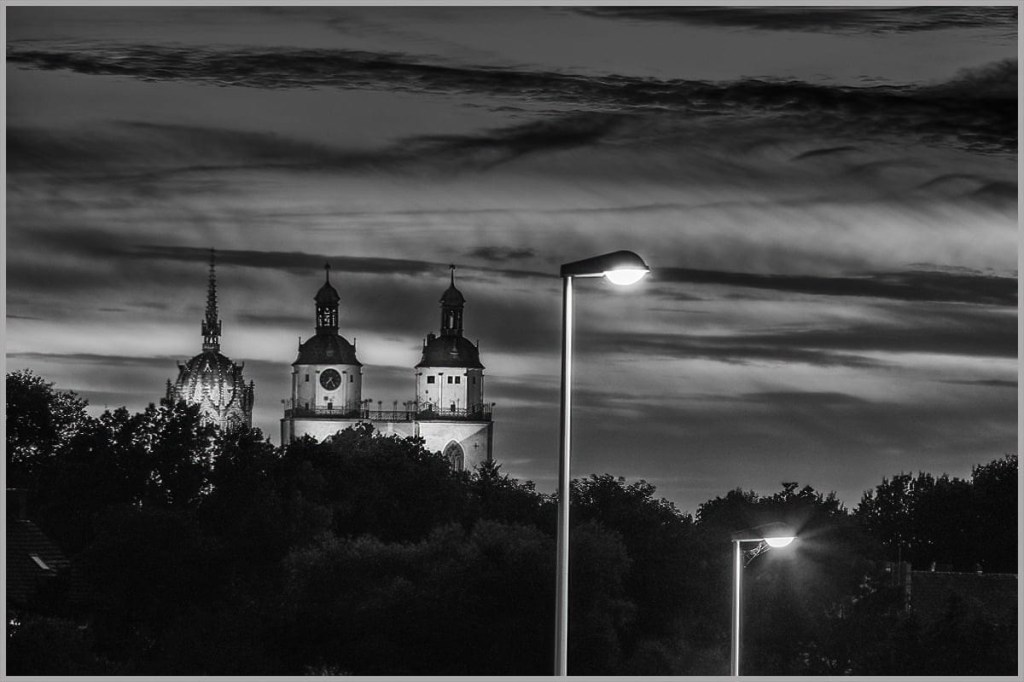
Wittenberg´s steeples from the East (Photo: Thomas Sickert)
So, when I got off to my running start, it was as if there was some bounce in my step. The cold didn´t matter. It was just 5° and the little moon that was left, threw only sparse light on our “Swan lake” (Schwanenteich), where Vietnamese do aerobics in the early hours. This time around, there were no vicious dogs, barking hoarsely and pulling at their short chains. That was another reason to the thankful but it didn´t add more bounce. I was already going as fast as I could.
Back in the Old Latin School and after cleaning up, going through meditations and chapel liturgies, I opened the big doors. I was out to see old St. Marys, greet the rising sun and rejoicing in another new day. This time around, there was a lone man reading our signpost. He´s a member of “SELK: Berlin Central”. His pastor (Rev. Johann Hillermann) had told him about our place and impressed on him, that he should check us out, when in the Luther city. So, there he was. I didn´t know his story yet, but invited him in. St. Mary´s only opens at 10h00, sometimes only at 11h00 in these days of Corona. So, there was plenty time. It was only just itching towards 8h00. Coffee would do perfectly in that cold and a little bit of milk too please if I may. Quickly we got talking and, in the end, – some two hours later and in good time for St. Marys – I had won a friend, made a few book sales, and heard some of the best news this week.
He sang the praises of their independent Lutheran congregation in the middle of Berlin – right where the wall used to divide East and West. He was a convert – and had joined the SELK once he moved from W. Germany to the capital. He spoke so highly of this Lutheran congregation and of his faithful pastor, that I recognized it as a good option if looking for a confessional church home in those secular parts. Even as the papers are full of declining churches in most places and we hear of dwindling congregations too often and far too much of less and less pastors – it was a tonic to hear of this faithful church in the middle of Berlin, where I already know the hotspots for Lutherans: Zehlendorf (P.Büttner) and Steglitz (P. Martens). Now, I´ve got even more reason to believe there´s truth in the local saying: “Aller guten Dinge sind drei!” (All good things are three!)
Well, my guest enjoyed his short visit in the Old Latin School and not just in the chapel. He looked all around and has promised to return with his family to stay over longer and visit our Sunday church service too. That was a wonderful start to the day and now looking back it just got better but that´s another story. So – be our guest – and pop in at the Old Latin School. There´s always something to cheer You up and calling You to join in our good God´s praises like Isaac Watts does for some time already: