
 I will make an everlasting covenant with you! (Isaiah 55:3 NIV)
We do not want you to become lazy, but to imitate those who through faith and patience inherit what has been promised. (Hebrews 6:12 NIV)
I will make an everlasting covenant with you! (Isaiah 55:3 NIV)
We do not want you to become lazy, but to imitate those who through faith and patience inherit what has been promised. (Hebrews 6:12 NIV)
 Here is the proposed program for the launch today in the auditorium of the Merensky library at the University of Pretoria: Launch of the Tswana Book of Concord
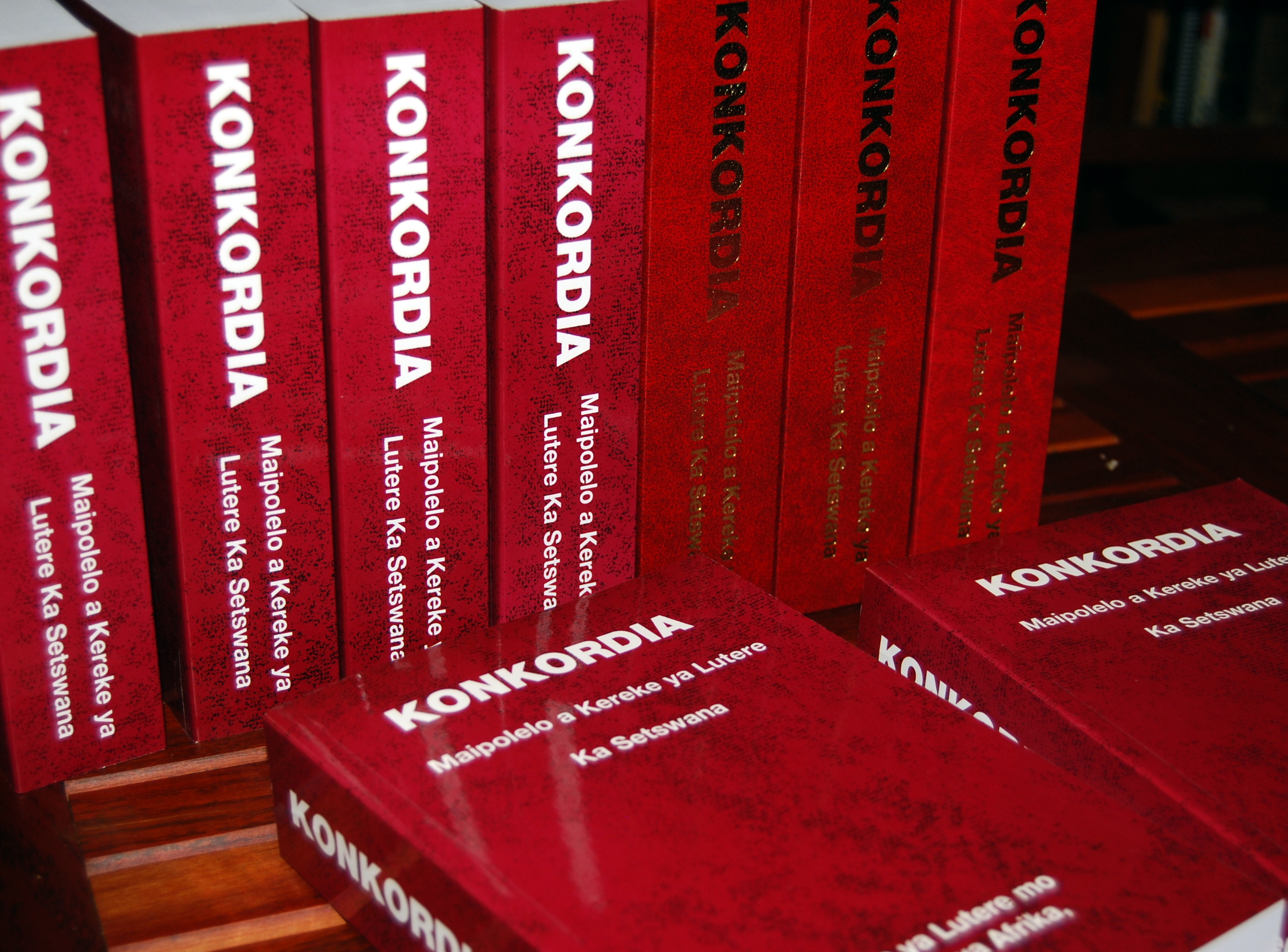 Here’s a short introduction for the launch of the Tswana Book of Concord today at the auditorium of the Merensky library: Foreword to the Book of Concord in SeTswana
 Dear friends, I urge you, as aliens and strangers in the world … live such good lives among the pagans (1Pe 2:11-12 NIV)
We really should dare to live a pure Christian life and to be true aliens and pilgrims in this world. This obedience should be holy to us! As slaves of Christ, but as such the only truly free people in this world, we should value this obedience more than any civil liberty offered in worldly spheres. Never should we use this Christian freedom as a cover-up for evil or wrongdoing, which would oppose God’s holy will and strive for libertarian self-realization. We aught to be content and burden nobody. Patiently enduring hardships and even suffering unjustly through the powers that be.
We want to take the liberty to dedicate ourselves totally to our Lord and saviour Jesus Christ, being his only in our sojourning and pilgrimage. Not taking into serious consideration and account the worldly hatred enflamed against us and not afraid of shame and discrimination. We commit all of this to him, who is gracious and who has promised that the meek shall inherit the earth.
We bow our knees before you Father of our Lord Jesus Christ. Grant strength to your children to lead faithful lives away from false pretence and dedicated to and sanctified in your truth. Dwell in our hearts. Let us realize, what we have in you. Grant that holy works will praise you; sanctify, bless and complete your most holy word in us through the power of your Holy Spirit. Amen. (Hermann Bezzel)
Blessed are those faithful hearts, who practice patience and peace, who carry shame and hurt, gladly making way to others and not pursuing their own legitimate cause, but rather commit it to the living God and eternal judge. The good Lord will take care of them here and there.
Lord, you reign at all times and control my life and destiny so that I too will be saved eternally by your grace and goodness. Dear father help me that I trust your Son confidently and go about my calling with passion as encouraged and motivated by your most Holy Spirit. (David Denicke, 1603-1680)
This is a rather free translation of Wilhelm Löhe’s devotion for Friday after the third Sunday after Easter: Jubilate. It is found on Pg. 185 in Lob sei Dir ewig, o Jesu! (Eternal Praise to you o Jesus!) edited by A. Schuster and published in the Freimund Verlag, Neuendettelsau 1949.
 The LORD is righteous in all his ways and loving toward all he has made. (Psalm 145:17 NIV)
St. Paul writes: I am being confident of this, that he who began a good work in you will carry it on to completion until the day of Christ Jesus. (Philippians 1:6 NIV)
 For it is commendable if a man bears up under the pain of unjust suffering because he is conscious of God. But how is it to your credit if you receive a beating for doing wrong and endure it? But if you suffer for doing good and you endure it, this is commendable before God. (1Pe 2:19-20 NIV)
If I speak of the pilgrims patience, then I do that being conscious that this virtue is not mentioned explicitly by St. Peter in this context. However it is very well understood throughout. If one considers a faithful conduct of Christians among the pagans which is supposed to be God pleasing then this conduct would naturally include patience too. If the Christians are to obey human ordinances for God’s sake so that they would thus silence the false accusations of their adversaries, then this would only be possible with a considerable amount of patience.
The necessity of patience becomes most clear in the demands set for slaves. “But if you suffer for doing good and you endure it, this is commendable before God.” Here suffering is addressed – more than patience – yet the one goes hand in hand with the other. Can you suffer without being patient? I doubt it. In this enduring suffering patience is included. That is why I think that patience summarizes our epistle quite well. Patience crowns all suffering and enduring – and is a vital prerequisite for the life of pilgrims.
You, o Lord, grant strength to your people – as you especially empower the weak to endure suffering patiently. Grant me a rich measure of your pure, good and quiet Spirit, so that I can bear what needs to be borne when and where you demand it. In peaceful rest, but also in stormy seas your will be done. You can grant rest in peace and quite, but you can also sustain and carry us safely through the most tempestuous times and ages. Grant that I find sure hold and anchor in you – my Lord and my God. (Karl Rudolf Hagenbach, 1801-1874)
This is a rather free translation of Wilhelm Löhe’s devotion for Thursday after the third Sunday after Easter: Jubilate. It is found on Pg. 184 in Lob sei Dir ewig, o Jesu! (Eternal Praise to you o Jesus!) edited by A. Schuster and published in the Freimund Verlag, Neuendettelsau 1949.
 The LORD is my light and my salvation– whom shall I fear? (Psalm 27:1 NIV)
Jesus replied, “You of little faith, why are you so afraid?” (Matthew 8:26 NIV)
 Toyohiko Kagawa (賀川 豊彦 Kagawa Toyohiko?, 10 July 1888 – 23 April 1960) was a Japanese Christian pacifist, Christian reformer, and labour activist. Kagawa wrote, spoke, and worked at length on ways to employ Christian principles in the ordering of society and in cooperatives. His vocation to help the poor led him to live among them. He established schools, hospitals, and churches. From wikipedia. Read more here: http://en.wikipedia.org/wiki/Toyohiko_Kagawa
 The Church commemorates one of the first Lutheran composers, who died this day in 1570. Read more about him here: http://www.bach-cantatas.com/Lib/Walter-Johann.htm.
 THE RESIDENCES OF STELLENBOSCH
By Dave Steward, Executive Director of the FW de Klerk Foundation
The proposed policy of the University of Stellenbosch regarding the admission of students to university residences raises questions not only about the future of Afrikaans at Stellenbosch but also about the future of South Africa as a multilingual and multicultural society.
In terms of the proposals, admission to residences would be based on two core criteria: merit and the need to promote diversity on the campus. Originally, the policy contemplated an ideal residence profile that would be 35% brown, 20% black, 40% white and 5% Indian – in which 45% of students would be Afrikaans-speaking; 40% would be English-speaking and 15% would speak other languages.
The original formula was rejected by elements within the University community who announced their intention of opposing it via a motion at the next meeting of the University convocation – comprised of former Stellenbosch students – which took place on 11 April. They initially argued that the policy was unconstitutional because it unfairly discriminates against people on the basis of language and culture and because it contravenes the right of people who belong to a specific language or cultural community to “use their language and participate in their culture.”
The University authorities reacted to the debate with several amendments to the original policy – most importantly by removing the racial and language targets. The University administration evidently wants a mandate to determine diversity targets itself – while others within the University community insist that targets should be set by the University council. Those opposing the policy felt it should be scrapped as it was vague and transferred all meaningful authority – regarding the admission of students to university residences – to the university administration.
At the convocation meeting on Thursday, 11 April, their motion – which had been amended by its proponents – was rejected by 120 votes against 116. A subsequent motion by the supporters of the policy was accepted: “The University of Stellenbosch deserves the support of the convocation for all initiatives that strive to create a more inclusive institution.”
The University council will now have to take a final decision on the policy.
However, the council must contend with many competing pressures. Although the University is autonomous it is under pressure because of the unrepresentative demographic profile of its students and staff – specifically regarding “the colour distinctions that we inherited from the apartheid era.” It “acknowledges its contribution towards the injustices of the past and is committed to appropriate redress and development initiatives”.
On the other hand, the University is also under pressure from a significant proportion of alumni, students and staff to retain a special place for Afrikaans on the campus. The officials who drafted the residence admission policy had to take all these factors into consideration and also ensure that merit was rewarded. Hence the policy it originally produced with its vision of integrated and multilingual residences in which Afrikaans would still have a 45% share.
The trouble – as everybody knows – is that in any institution where Afrikaans-speakers are reduced to a minority, English very soon becomes the dominant language. Sooner, rather than later, the outcome of the University’s residence admission policy would be the disappearance of Afrikaans-language residences and the further erosion of the once Afrikaans character of the university.
Those who oppose such an outcome are, according to Prof Pierre De Vos, “whipping up racial and jingoistic sentiments”. They are “white” South African beneficiaries of “past unfair racial discrimination” who are trying “to protect their unearned privileges by fighting to retain the status quo.”
However, the ability to use one’s language and practise one’s culture are rights – and not privileges.
Our Constitution makes ample provision for the multilingual and multicultural nature of our society. It establishes 11 official languages and requires that they should enjoy “parity of esteem”. It recognises everyone’s right to education in the language of their choice – including single medium institutions – subject to certain conditions. Everyone has the right to “use the language and to participate in the cultural life of their choice” and persons belonging to cultural, religious or linguistic communities “may not be denied the right to form, join and maintain cultural religious and linguistic associations and other organs of civil society.”
Multiculturalism and multilingualism cannot survive without publicly supported institutions in which communities can practise their cultures and use their languages. Such institutions cannot – and should not – exclude anyone on the basis of race, but they should not, however, be subject to racial or language quotas. The application of national racial demographics to all institutions in the private and public sectors – in line with the ANC’s National Democratic Revolution ideology – would impose majority domination throughout society and sound the death knell for diversity.
Is it really “jingoistic” for Afrikaans-speaking students in a province where Afrikaans is the majority language to want at least some residences – on a non-racial basis – where Afrikaans will be the predominant language? Students who prefer culturally integrated English language residences – along the lines of the University’s proposed model – should have the freedom to choose that option. Such an approach would promote diversity on the campus far more effectively than the de facto imposition of English on everyone.
What do the language and cultural rights in the Constitution mean if there is no place for publicly-supported Afrikaans institutions in a province in which Afrikaans is the majority language? What is the value of the University’s commitment to Afrikaans – if there is no place on campus for non-racial Afrikaans language residences? This is not about the completely acceptable idea that Stellenbosch must be an “inclusive institution”: it deals with the question of whether there will be room for non-racial, predominantly Afrikaans residences at Stellenbosch.
We agree with the alumni who opposed the new policy: these decisions should not be taken by the diktat of University officials – but rather by the University council. The council must also take this opportunity to offer a clear, unambiguous indication of how it views the future of Afrikaans at Stellenbosch.

