Herrenhuter readings for Thursday, the 21st May 2015

Mary and Martha

The Lord our God promises: “I will guide thee with mine eye.” (Psalm 32:8 KJV) And Martha had a sister called Mary, which also sat at Jesus’ feet, and heard his word. (Luke 10:39 KJV)

This is a delightful promise of our God. No harsh barking of commands. No reprimands. No punishment. Rather the loving and caring heavenly Father keeping a close eye on his children that on earth do dwell – not to catch them out, but rather to guide them graciously in the ways of peace and truth, in the ways that lead to streams of living water and not into the abyss of eternal condemnation. It’s like the loving mother, who takes her little toddling daughter by the hand and leads her safely across the playground and later on teaches her as she’s growing up to navigate the busy streets of life.

Our heavenly Father does not dismiss us for good after we graduate from confirmation or high school. No, he continues to guide us with his eyes even as we grow up and go about our daily callings – in good and in bad times. He does this best and most appropriately and clearly through the means of his most Holy Word. That’s his divine will and most precious gospel for us and our salvation. It’s all written down, so that we would have the sure confidence of the foundation of our faith in his blessed promises: “Thy word is a lamp unto my feet, and a light unto my path.” (Psa 119:105 KJV) It’s what we believe, learn, preach, teach and confess as the 3rd use of the Law – the sure guide on our way through life, but also in death and dying. This use is predominantly for those, who believe in Christ – like Mary, Martha and Lazarus did – and who want to live according to God’s holy will and please him in the daily business. It gives them direction and boundaries in life – especially in a time, when pluralism is promoted and seemingly all roads lead to Rome and all cats are deemed grey.

Our Lord and God has compassionate eyes and a caring heart for the people of this world. The evangelist St. Matthew describes this in the 9th chaper: “When he (Jesus) saw the crowds, he had compassion on them, because they were harassed and helpless, like sheep without a shepherd.” (verse 36) However he does not just leave them to their own devices, but helps and finds good shepherds (pastors) to take care of them: “Then he said to his disciples, “The harvest is plentiful but the workers are few. Ask the Lord of the harvest, therefore, to send out workers into his harvest field.” (37-38 NIV)

Even in the darkest of hours, he – our Lord Jesus Christ – looked with favour on those around him. Praying to his Father for those, who had tortured, crucified and utimately would kill him: “Father – forgive them for they know not, what they are doing!” Granting forgiveness, life and salvation to the murderer hanging there with him:  “Today you will be with me in paradise!” Taking care and granting family to his very own: “Mother behold your son – and son behold your mother!”

Just before his ascension he raised the eyes of his disciples from the ground to the horizon and beyond: “All authority in heaven and on earth has been given to me. Therefore go and make disciples of all nations, baptizing them in the name of the Father, the Son and the Holy Spirit and teaching them everything I’ve entrusted to you. And behold, I am with you until the very end of the age.”

1. Lord, your Word this heavenly treasure, grants us grace and life for sure. Therefore I prefer its blessings way beyond all earthly things. Should your Word not longer carry, we’d be lost and without hope. I’m not searching for vain pleasures, but for lasting life with you.

2. Halelujah, yes and Amen! Lord, look kindly on your child. Let your eye just keep and guide me to be faithful in your Word. Let me always serve you gladly, whilst obeying your command busy in my daily calling as behoves a child of yours.

(Melody: “Herr, Dein Wort die edle Gabe“)

Posted in Herrenhuter Readings | Tagged , , , , , , , , , , , , | Leave a comment

Lutheran Order of service in isiZulu, seTswana and English

pentecost-icon

The Lutheran Order of Service for the Holiday of Pentecost  is available here in isiZulu, seTswana and English too. Today it comes with a sermon based on God’s Word from the Holy Gospel of St. John in the 14th chapter verses 23-27 written by Rev. Dr. Karl Böhmer (LTS in Tshwane, GP) in English (Sermon for Pentecost) and translated by my father Rev. E.A.W.Weber DD (Welbedacht, KZN) into isiZulu (wz1530150524 umkhosi wokubkhumbula ukuthululwa kukaMoya oNgcwele) and seTswana (wt1530150524 wa kgomareletso ya Mowa o o Boitshepo).

The readings for Pentecost are:

  • Old Testament:       Numbers 11:11-12.14-17.24-25
  • The Epistle:            Acts 2:1-18
  • The Gospel:            St. John 14:23-27
  • Psalm:                    118:24-26a.27.29

The liturgical colour is red.

May you have a very blessed weekend and have time to meditate on the watchword for Pentecost: Not by might, nor by power, but by my spirit, saith the LORD of hosts. (Zec 4:6 KJV)

A collect for Pentecost: Almighty and everlasting God, You fulfilled Your promise by sending the gift of the Holy Spirit to unite disciples of all nations in the cross and resurrection of Your Son, Jesus Christ. By the preaching of the Gospel spread this gift to the ends of the earth; through the same Jesus Christ, our Lord, who lives and reigns with You and the Holy Spirit, one God now and forever. (LSB Altar Book Pg.901)

If you are called to preach this weekend, may the triune God give you joy and strength, wisdom, knowledge and insight – and the true words and pictures to preach his holy will faithfully according to his most precious revelation of his will and promises in both the Old and New Testament! However if you are not preaching, but listening – then listen as if God is talking to you + His precious gospel is “the power of God for the salvation of everyone who believes.” (Rom 1:16 NIV)

We thank the Lutheran Heritage Foundation for supporting the distribution of hard-copies of these orders of worship and sermons throughout Southern Africa. If you also want a copy please do not hesitate to subscribe by writing to EAWWeber@bundunet.co.za.

Posted in Lutheran Order of service | Tagged , , , , , , , , , , , , , , | Leave a comment

Sermon on 1.Cor.2:12-16

Kirche_Fenster.II.6

Professor Dr. Edward Kettner, longstanding Professor for Lutheran Dogmatics at the Concordia Seminary in Edmonton, Canada, is teaching an intensive course on Christology at the Lutheran Theological Seminary in Tshwane these two weeks. Part of his work load is to preach on Wednesdays during the Confessional service. Today the prescribed lesson for the sermon was from St. Paul’s first letter to the Corinthians in the second chapter the verses 12-16. You can read the sermon here: 1Cor2,11,May2015b

Posted in Sermon | Tagged , , , , , , , , , , , , , , , | Leave a comment

Synodalbericht der Lutherischen Kirchenmission

Himmelfahrt Mb

Verkündigung unter Menschen, die von Christus nichts wissen
SELK: Synodalbericht der Lutherischen Kirchenmission

Bergen-Bleckmar/Hermannsburg, 20.5.2015 – selk – Den Auftrag braucht die Kirche nicht zu suchen – sie hat ihn von Jesus Christus erhalten: “Unsere Aufgabe (liegt) in der Verkündigung und Ausbreitung des Evangeliums an und zu Menschen, die von Christus noch nicht oder nicht mehr wissen”, schreibt Roger Zieger, Missionsdirektor der Lutherischen Kirchenmission (LKM) der Selbständigen Evangelisch-Lutherischen Kirche (SELK), in seinem Bericht für die 13. Kirchensynode der SELK, die vom 8. bis zum 14. Juni in Hermannsburg tagen wird. Die LKM hat ihren Sitz in Bergen-Bleckmar (Kreis Celle).

Derzeit arbeiten im Auftrag der LKM Mitarbeitende in Belgien, Botswana, Südafrika, Brasilien und Deutschland. In Deutschland sind dies Hugo Gevers, der in Leipzig als Missionar tätig ist, und Missionar Holger Thomas, der in Cottbus-Döbbrick Dienst tut. In Afrika geschieht die Arbeit in Kooperation mit den Schwesterkirchen, der Freien Evangelisch-Lutherischen Synode in Südafrika und der Lutherischen Kirche im Südlichen Afrika vor Ort. “Zusammen mit den genannten Partnern finden wir unsere Aufgabengebiete auf dem afrikanischen Missionsfeld. Diese Konstellation ist wichtig, weil alles andere heute koloniales Verhalten wäre”, schreibt der Missionsdirektor.

In seinem “Ausblick” weist er darauf hin, dass in Zukunft eine noch engere Verknüpfung von Kirche, Mission und Diakonie wichtig sei. Er könne sich vorstellen, neben “theologischen Missionaren” in Zukunft auch “diakonische Missionare” einzusetzen, schreibt Zieger. Allerdings: “Die finanziellen Mittel dafür zu finden, wird eine Herausforderung sein.” Im letzten Jahr hatte die LKM ihren Haushalt mit einem Plus abschließen können. Dies auch dank der zusätzlichen Spenden, die über die Bausteinsammlung der SELK für die Renovierungsarbeiten am Missionshaus in Bleckmar eingegangen waren. Da die LKM auf Spenden angewiesen ist, ist der enge Kontakt zu den Spendenden und Gemeinden weiterhin ein zentrales Thema. “Hier müssen wir in manchen Gegenden Deutschlands noch Wege finden, um Interesse an der Mission zu wecken”, heißt es in dem Bericht.

Anlässlich der 13. Kirchensynode der SELK wurden die Werke, Kommissionen und Beauftragten der Kirche turnusgemäß gebeten, einen Bericht über den Zeitraum seit der letzten Kirchensynode (2011) vorzulegen. Die Berichte sind auf www.selk.de (Synode 2015) abrufbar.
——————–
Ein Bericht von selk_news /
Redaktion: SELK – Gesamtkirche /
selk_news werden herausgegeben von der Kirchenleitung
der Selbständigen Evangelisch-Lutherischen Kirche (SELK),
Schopenhauerstraße 7, 30625 Hannover,
Tel. +49-511-557808 – Fax +49-511-551588,
E-Mail selk@selk.de
—> Informationen aus Kirche und Gemeinden in Wort und Bild
auch unter “SELK-Aktuell” auf http://www.selk.de

© SELK 2015
Um den Newsletter zu verlassen, schreiben Sie eine Mail an:
mailto:leave-selk_news-6489695M@kbx.de
————————————————————————

Posted in Lutherische Mission | Tagged , , , , , , , , , , , , | Leave a comment

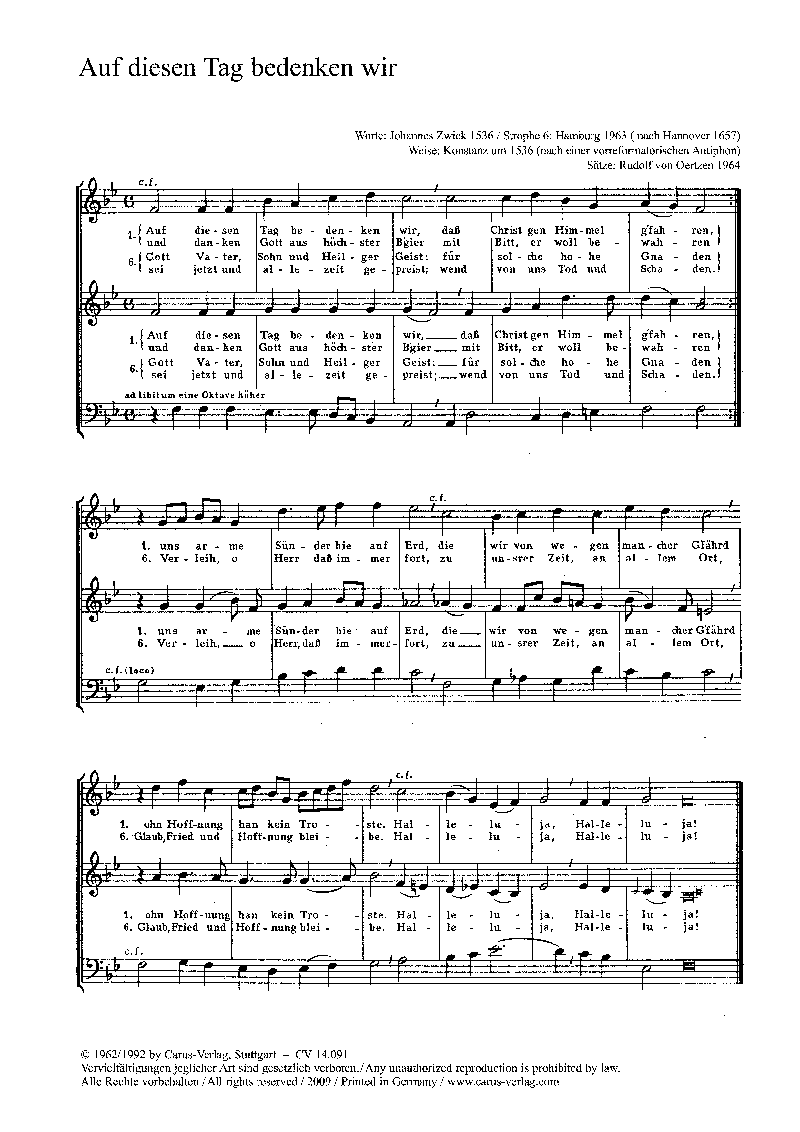
Auf diesen Tag bedenken wir …

Auf diesen Tag bedenken wir

1. Auf diesen Tag bedenken wir,
Daß Christ gen Himm’l g’fahren,
Und danken Gott aus höchst’r Begier,
Mit Bitt, er woll bewahren
Uns armen Sünder hie auf Erd,
Die wir von wegen manch’r G’fährd’
Ohn Hoffnung han kein’ Troste. Hallelujah, Hallelujah.

2. Drum sei Gott Lob, der Weg ist g’macht,
Uns steht der Himmel offen.
Christus schließt auf mit großer Pracht,
Vorhin war alls verschlossen.
Wer’s gläubt, des Herz ist freudenvoll,
Dabei er auch sich doch rüsten soll,
Dem Herren nachzufolgen. Hallelujah, Hallelujah.

3. Wer nicht folgt und sein’n Willen tut,
Dem ists nicht ernst zum Herren;
Denn er wird auch vor Fleisch und Blut
Sein Himmelreich versperren:
Am Glauben liegts; wird der sein echt,
So wird auch gwiß das Leben recht
Zu Gott im Himm’l gerichtet. Hallelujah, Hallelujah.

4. Solch Himmelfahrt fäht in uns an,
wenn wir den Vater funden,
Und fliehen stets der Welte Bahn,
Thun uns zu Gottes Kindern;
Die sehn hinauf, er sieht herab,
An Treu und Lieb geht ihn’ nichts ab,
Bis sie zusammenkommen. Hallelujah, Hallelujah.

5. Dann wird der Tag erst freudenreich,
Wenn uns Gott zu sich nehmen,
Und seinem Sohn wird machen gleich,
Wie wir denn jetzt bekennen,
Da wird sich finden Freud’ und Muth
In ewigkeit beim höchsten gut:
Gott helf, daß wir’s erlangen! Hallelujah, Hallelujah.

Johannes Zwick um 1536

Posted in Hymns, Lieder | Tagged , , , , , , , , , , , , , | Leave a comment

One of Luther’s sermons for the Lord’s Ascension (Mark 16:14-20)

Himmelfahrt1

A Sermon by Martin Luther; taken from his Church Postil, 1523.

[The following sermon is taken from volume III:182-194 of The Sermons of Martin Luther, published by Baker Book House (Grand Rapids, MI). It was originally published in 1907 in English by Lutherans in All Lands Press (Minneapolis, MN), as The Precious and Sacred Writings of Martin Luther, vol. 12. This e-text was scanned and edited by Richard P. Bucher, it is in the public domain and it may be copied and distributed without restriction.]

  1. We are to consider today the article of faith in which we say: “I believe in Jesus Christ, who ascended into heaven and sitteth at the right hand of God the Father.” Our Gospel lesson briefly reviews the story of this ascension. But Luke treats the matter at greater length and writes, The Lord gathered all the disciples together, fully forty days after his resurrection, just as he had often shown himself to them, and spoke with them and gave them commandment what they should do; and as they were assembled together and spake with him out at Bethany, whither he had led them, some asked him, saying: “Lord, dost thou at this time restore the kingdom to Israel?” And he said unto them: “It is not for you to know times or seasons, which the Father hath set within his own authority. But ye shall receive power, when the Holy Spirit is come upon you: and ye shall be my witnesses both in Jerusalem, and in all Judea and Samaria, and unto the uttermost part of the earth.” And when he had said these things, he blessed them and bade them good night and departed from them and was taken up while they beheld him, and a cloud received him out of their sight. And as they stood there, gazing after him, gaping at the heavens, behold, there came and stood hard by them two men in white apparel, who said: “Ye men of Galilee, why stand ye looking into heaven? This Jesus, who was received up from you into heaven, shall so come in like manner as ye beheld him going into heaven.” Hereupon they returned from Bethany, from the mount of Olives, to Jerusalem and assembled in the upper room of the house where they were abiding, and continued with one accord in prayer, with the women, and Mary the mother of Jesus. This is the story of our Lord Jesus Christ’s ascension. Now let us consider the Gospel.
  2. In the first place, there are in this Gospel two parts: one where the Lord commands the apostles to preach the Gospel in all the world; the other, treating of his ascension. We shall pass over the beginning of the text, where the Lord reproves their unbelief and hardness of heart, and take up the part where he says: “Go ye into all the world and preach the Gospel to the whole creation.” Here you have in English what the Gospel really is, to wit: “He that believeth and is baptized, is saved.” In these words all is comprehended; he that has them, has the Gospel.
  3. CHRIST’S MISSIONARY COMMISSION TO HIS DISCIPLES TO PREACH THE GOSPEL.
  4. We have often said heretofore that the Gospel, properly speaking, is not something written in books, but an oral proclamation, which shall be heard in all the world and shall be cried out freely before all creatures, so that all would have to hear it if they had ears; that is to say, it shall be preached so publicly that to preach it more publicly would be impossible. For the Law, which was of old, and what the prophets preached, was not cried out in all the world before all creatures, but it was preached by the Jews in their synagogues. But the Gospel shall not be thus confined; it shall be preached freely unto all the world.
  5. There is no need, therefore, of commenting on the text as some have done, and saying that omnis creatura (every creature) means a man. For there is no indication in these words that the Gospel shall be preached to men alone, but it shall be cried out before the whole creation, so that earth shall not have a nook or corner into which it shall not penetrate before the last day. Such is the counsel of God, wherein he has decreed that even they who cannot read and have not heard Moses and the prophets shall, nevertheless, hear the Gospel.
  6. What is the Gospel? It is these words which the Lord speaks: “He that believeth and is baptized shall be saved.” We have often said–and I think we ought to thoroughly understand it by this time–that the Gospel cannot suffer us to preach works, however good and great these may be; for it seeks to pluck us down from our presumption and to set and plant us solely upon God’s mercy, that his work and grace alone may be extolled. Therefore, it suffers us not to rely upon our works. For one of these two must perish: if I stand upon God’s grace and mercy, I do not stand upon my merit and works; and, vice versa, if I stand upon my works and merit, I do not stand upon God’s grace. For, “if it is by grace,” says St. Paul, Rom 11, 6, “it is no more of works: otherwise grace is no more grace.” I cannot say that God owes me a reward, but I must confess that he has given it to me entirely as a free gift.
  7. Hence, he that would preach the Gospel must cast aside all works that are calculated to make men just, and suffer nothing to remain but faith, or I must believe that God, without any merit of mine and regardless of all my works, has granted me his grace and eternal life, so that I am constrained to thank him and say: I rejoice, praise and thank God that he has freely and out of pure grace given me this most excellent boon. Likewise that the Gospel is, as Scripture says, nothing more nor less than a declaration of the honor, praise and glory of God. As we read in Ps 19, 1-2: “The heavens declare the glory of God; and the firmament sheweth his handiwork. Day unto day uttereth speech, and night unto night sheweth knowledge.” Therefore, we must preach in a way that the glory and praise will be given to God and not to ourselves. Now, there is no greater praise and glory that we can give to God than this, that we confess that he, out of pure grace and mercy, takes away from us sin, death, and hell, and gives his beloved Son for us, and all his treasures to us. Such a confession must give glory and honor and praise to him alone.
  8. And this is the trend of all those passages in the prophets where God boasts that he will establish a preaching that will show forth his praise; as when he says in Is 43, 21: “The people which I formed for myself, that they might set forth my praise.” As if to say: You hypocrites do no more than praise yourselves in your hearts and thus my praise must perish; for you make me a stern judge and an unfriendly God, so that secretly the people hate me and think within themselves: Ah, if we but had another God, one that would not require so much of us; such a one we would love. Therefore, I will form for myself another people, which shall know me and love me. When they see that I will not regard their works but will give them every good thing freely, their hearts will teem with joy and will never weary of my praise.
  9. Therefore, beware of glossing the text and seeking to improve upon the words of Christ. Our doctors and colleges have tried to better them and have said these words must be understood thus: “He that believeth” (understand: and doeth good works), “shall be saved.” Who authorized them to make that insertion? Do you think the Holy Spirit was too stupid to make it? Thus they have utterly obscured, yea, perverted, this precious statement with their insertion. Therefore, take heed and let no one make an insertion for you, but abide by the text as it reads and understand it thus: “He that believeth shall be saved” without his merit, without any works. Why? For this reason: because God has caused to be preached and proclaimed unto us that he had his Son Jesus Christ come and take away sin and all evil. For he saw that we were not able to do it, that it was an impossibility for us to blot out sin with our works and powers. Otherwise he could have saved himself the trouble and expense of delivering up his own Son to suffer and die; and he has this preached to us in the Gospel.
  10. Now what does such preaching call for? It calls for this, that I believe in it, for in no other way can I apprehend it. If you write it in a book, it will be of no use to any man, though you indulge in much thinking about it. Again, you may preach and speak about it, or hear it; it will be to no purpose. You must believe it and confidently rely upon it that the thing is as the Gospel says, that not your works but the Lord Jesus Christ’s death and resurrection takes away your sin and death. This you can not attain to except by faith.
  11. Again, Christ says: “He that disbelieveth,” even though he be baptized, “shall be damned.” These words, too, you must allow to remain just as they are. For he does not say thus: He that disbelieves and does evil works besides; but, without any varnish he says: If thou hadst the chastity of all virgins, the sufferings of all martyrs, and, to be concise, if thou hadst all the works that ever were done by all the saints–if thou hadst all these in a heap, yet, if faith were lacking, all would be lost.
  12. Therefore, this is the passage whereby all cloistery, priest-craft, monkery and nunnery is overthrown; for it is a lost case. Do what you will, the sentence is already passed and the decree is already gone forth: If thou disbelieve thou art condemned already. Thus heavily and mightily do these two sentences butt against all doctrine and doing that are founded upon the works and powers of man.
  13. Now, place the two side by side, and you can rightly conclude: Where there is faith, there cannot be so many sins, but they will surely be swallowed up and exterminated by faith; where there is unbelief, you will never be able to do good works enough to blot out the least sin. Little, therefore as sin can stand in the presence of faith, so little can good works abide with unbelief. Therefore, nothing is needed, in order to do good works, but faith; and nothing more is required, in order to do sin and evil works, than unbelief. Thus it follows that he who believes has no sin and does nothing but good works; on the other hand, he who does not believe, verily, does no good work, but all he does is sin.
  14. Therefore I say, however, you cannot have committed so many sins, neither is Satan such an invincible enemy of yours, but that all is taken away and forgiven as soon as you begin to believe. For through faith you have Christ as your own treasure, who was given to you for the very purpose of taking away sin; and who will be so bold as to condemn Christ? For this reason, no sins can remain, however great they may be, if you believe. Thus, you are then God’s dear child and all is well, and whatever you do is all right. If you do not believe, you are damned, all you may do to the contrary notwithstanding; for since you have not Christ, it is impossible for you to blot out a single sin.
  15. Now, since there is no other means for taking away sin than Christ, you might ask: How is it then, that we are nevertheless required to do good works; if as you say, all depends upon faith? I reply: Where faith is genuine it cannot exist without good works. just as, on the other hand, where there is unbelief there can be no good work. Hence, if you believe, there must necessarily follow from your faith naught but good works. For, as faith brings you salvation and eternal life, so it also brings you good works; they cannot be restrained. Just as a living person cannot refrain from moving about, eating and drinking and laboring, it being impossible that such activities should cease while he lives, no one need command and drive him to do such works but–spare his life and he’ll do them; just as all this is true in the physical life, so nothing more is required, in order that good works may be done, than faith. Only believe, and you will do all of your own accord.
  16. Thus, there is no need of your demanding good works of him who believes, for faith teaches him all that; and, being done in faith, all he does is well done and all are good and precious works, however insignificant they may seem. Faith is such a noble thing that it ennobles the whole man. Now, it is not possible for a man to live on earth and not have anything to do. Hence all such works as are done by faith are precious works. On the other hand, where there is unbelief, a man cannot be without works, either; therefore, such works are likewise all sin. Christ is not there, therefore all is lost. Hence, the statement of St. Paul to the Romans, 14, 23: “Whatsoever is not of faith is sin.” As though he would say, on the contrary: Whatsoever is of faith is all grace and righteousness; that is a foregone conclusion. Hence, there is no need of asking whether good works shall be done, for they come of themselves, unbidden. Such is also the sense of the Psalmist, Ps 25, 10: “All the paths of Jehovah are lovingkindness and truth.” That is to say, when God works and creates faith in us, all that we do is lovingkindness, and all is truth; that is, all is done sincerely and not from hypocrisy. It follows, however, on the other hand, that all the ways of men are not lovingkindness but sheerest wrath, not truth but mere sham and hypocrisy, because they spring from unbelief.
  17. Beware, then, lest under any circumstances you gloss the text, and say: Faith alone is not sufficient; works, also, are necessary in order to justify. For it is sufficiently clear from what we have said that works contribute nothing to this end. Nothing does any harm but unbelief. Works are not sufficient. If faith were present, all would be well. Therefore, as works contribute nothing toward the evil in unbelief, so in faith they contribute nothing toward the good; but unbelief alone corrupts all works and faith makes all works good.
  18. But there is still one more thing here, that Christ says: “He that believeth and is baptized shall be saved.” Here you might say: I perceive, then, that baptism is also required. To be sure it is, but baptism is not a work that we do. It is to be coupled, however, with faith, because God would not have faith to be hidden in the heart, but would have it burst forth and manifest itself to the world. For this reason, he ordained such outward signs, by means of which everyone may show and confess his faith, to the end that we may come to the holy cross. For, if faith were to be kept as a secret, hidden in the heart, we would be pretty sure of not having to bear the cross or to follow Christ; if the world knew not that we believed, we would not be persecuted.
  19. In the second place, we would never be the means of leading a soul to repentance and faith if we did not openly confess the Gospel and observe an external sign whereby men might know who and where the Christians are. Now, God has so ordained that our faith should be manifested before the heathen; hence, whosoever is a Christian and has received baptism, is in danger of his life among the heathen and unbelievers. It is necessary that we receive baptism if we are Christians; or, if that is beyond our reach, that we say, at least: I sincerely desire to be baptized.
  20. Moreover, the sign of baptism is given us also to show that God himself will help us, and that we should be certain of his grace, and that everyone be able to say: Hereunto did God give me a sign, that I should be assured of my salvation, which he has promised me in the Gospel. For he has given us the Word, that is, the written document; and beside the Word, baptism, that is the seal. So faith, which apprehends the Word, may be strengthened by the sign and seal.
  21. But you see no work of man in this transaction; for baptism is not my work but God’s. He that baptized me stands in God’s stead and does not the work of a man, but rather it is God’s hand and work. God is the real worker. Therefore, I may and should say: God, my Lord, baptized me himself, by the hand of a man. Of this I may boast, and on this I am to rely, and say: God, who will not and cannot lie, has given me this sign to assure me that he is gracious to me and willing to save me and has through his Son given me all that he has. Thus, on our side there is nothing but faith alone; and on his side, only the Word and the sign. But we have dwelt upon this matter often enough and there is no need of enlarging upon it now.
  22. The following portion of our text speaks of the signs that shall accompany them that believe. We will not discuss these either at present, but pass on to the other part that we Have chosen to consider, and that treats of Christ’s ascension.
  23. In passing, be it said, however: We must not suppose that the signs here mentioned by Christ are all the signs that believers will do, neither must we imagine that all the Christians will do them; but Jesus means: All Christians can and may do the signs. Or, if I believe, then am I able to do them; I have the power. Through faith I obtain so much that nothing is impossible to me. If it were necessary and conducive to the spreading of the Gospel, we could do easily the signs; but since it is not necessary, we do not do them. For Christ does not teach that Christians practice the spectacular, but he says they have the power and can do these things. And we have many such promises throughout the Scriptures; for example, in Jo 14, 12, where Christ says: “He that believeth on me, the works that I do shall he do also; and greater works than these shall he do.” Therefore, we must allow these words to remain and not gloss them away, as some have done who said that these signs were manifestations of the Spirit in the beginning of the Christian era and that now they have ceased. That is not right; for the same power is in the church still. And though it is not exercised, that does not matter; we still have the power to do such signs.
  24. CHRIST’S ASCENSION INTO HEAVEN.
  25. Now we must consider the ascension of the Lord Jesus Christ. In the first place, it is easily said and understood that the Lord ascended into heaven and sits at the right hand of God. But they are dead words to the understanding if they are not grasped with the heart.
  26. We must, therefore, conceive of his ascension and Lordship as something active, energetic and continuous, and must not imagine that he sits above while we hold the reins of government down here. Nay, he ascended up thither for the reason that there he can best do his work and exercise dominion. Had he remained upon earth in visible form, before the people, he could not have wrought so effectually, for all the people could not have been with him and heard him. Therefore, he inaugurated an expedient which made it possible for him to be in touch with all and reign in all, to preach to all and be heard by all, and to be with all. Therefore, beware lest you imagine within yourself that he has gone, and now is, far away from us. The very opposite is true: While he was on earth, he was far away from us; now he is very near.
  27. Reason cannot comprehend how this can be. Therefore it is an article of faith. Here one must close his eyes and not follow his reason, but lay hold of all by faith. For how can reason grasp the thought that there should be a being like ourselves, who is all-seeing and knows all hearts and gives all men faith and the Spirit; or that he sits above in heaven, and yet is present with us and in us and rules over us? Therefore, strive not to comprehend, but say: This is Scripture and this is God’s Word, which is immeasurably higher than all understanding and reason. Cease your reasoning and lay hold of the Scriptures, which testify of this being– how he ascended to heaven and sits at the right hand of God and exercises dominion. Let us examine some Scripture bearing upon this matter.
  28. In the first place, Ps 8, 4-6 says of Christ: “What is man, that thou visitest him? For thou hast made him but little lower than God, and crownest him with glory and honor. Thou makest him to have dominion over the works of thy hands; thou hast put all things under his feet.” Here the prophet speaks to God concerning a man and marvels that God humbled, for a time, that man, when he suffered him to die, humbled him to the extent that it seemed as if God were not with him. But after a little while God exalted him, so that all things must obey him, both in heaven and on earth. To these words we must hold, to these words we must cling, in these words we must believe; for reason will not submit nor adapt itself to them, but says they are lies. Now, if all things are to be subject to this being and to fall at his feet, he must sit where he can look into the whole world, into heaven and hell and every heart; where he can see all sin and all righteousness, and can not only see all things, but can rule accordingly.
  29. Hence, these are majestic and powerful words. They afford the heart great comfort, so that they who believe this are filled with joy and courage and defiantly say: My Lord Jesus Christ is Lord over death, Satan, sin, righteousness, body, life, foes and friends. What shall I fear? For while my enemies stand before my very door and plan to slay me, my faith reasons thus: Christ is ascended into heaven and become Lord over all creatures, hence my enemies, too, must be subject to him and thus it is not in their power to do me harm. I challenge them to raise a finger against me or to injure a hair of my head against the will of my Lord Jesus Christ. When faith grasps and stands upon this article, it stands firm and waxes bold and defiant, so as even to say: If my Lord so wills that they, mine enemies, slay me, blessed am I; I gladly depart. Thus you will see that he is ascended into heaven, not to remain in indifference, but to exercise dominion; and all for our good, to afford us comfort and joy. This is one passage.
  30. Furthermore, in the second Psalm, verses 7 and 8, we read that God says to Christ: “Thou art my son; this day have I begotten thee. Ask of me and I will give thee the nations for thine inheritance, and the uttermost parts of the earth for thy possessions.” Here you see again that Christ is appointed of God a Lord over all the earth. Now, if he is my friend and I am persuaded that he died for me and gave me all things and for my sake sits in heaven and watches over me, who then can do aught to me? Or if any man should do aught, what harm can come of it?
  31. Furthermore, David says again in the 110th Psalm, verse 1: “Jehovah saith unto my lord, sit thou at my right hand, until I make thine enemies thy footstool.” And further on, in verses 5, 6, 7: “The Lord at thy right hand will strike through kings in the day of his wrath. He will judge among the nations, he will fill the places with dead bodies; he will strike through the head in many countries. He will drink of the brook in the way; therefore will he lift up the head.”
  32. Again in still another Psalm, David says (Ps 68, 18): “Thou hast ascended on high, thou hast led away captives; thou hast received gifts among men, yea among the rebellious also, that Jehovah God might dwell with them.” And all the prophets took great pains to describe Christ’s ascension and his kingdom. For, as his sufferings and death are deeply founded in the Scriptures, so are also his kingdom, his resurrection and ascension. In this manner we must view the ascension of Christ. Otherwise it will afford us neither pleasure nor profit. For what good will it do you if you merely preach that he ascended up to heaven and sits there with folded hands? This is what the prophet would say in the Psalm: Christ is ascended on high and has led captivity captive. That is to say, not only does he sit up there but he is also down here. And for this purpose did he ascend up thither, that he might be down here, that he might fill all things and be everywhere present; which thing he could not do had he remained on earth, for here in the body he could not have been present with all. He ascended to heaven, where all hearts can see him, where he can deal with all men, that he might fill all creation. He is present everywhere and all things are filled with his fulness. Nothing is so great, be it in heaven or on earth, but he has power over it, and it must be in perfect obedience to him. He not only governs and fills all creation (that would not help my faith any nor take away my sins), but also has led captivity captive.
  33. This captivity some have interpreted to mean that he delivered the sainted patriarchs out of the stronghold of hell; but that interpretation does not benefit our faith any either, for it is not particularly edifying to faith. Therefore, we must simply understand the matter thus: that he means that captivity which captures us and holds us captive. I am Adam’s child, full of sin and foully besmirched; therefore, the law has taken me captive, so that I am fettered in conscience and sentenced to death.
  34. From this captivity no one can free himself, save only that one man Christ. What did he do? He made sin, death, and Satan his debtors. Sin fell upon him as though it would vanquish him, but it lost the day; he devoured sin. And Satan, death, and hell fared the same way. But we are unable to do this unless he be present to aid us. Alone, we must needs perish. But he, since he had done no sin and was full of righteousness, trod under foot Satan, death and hell, and devoured them, and took everything captive that fain would capture us, so that sin and death no longer can do harm.
  35. This, then, is the power he causes to be preached, that all who believe in him are released from captivity. I believe in him by whom sin, death, and all things that afflict us, were led captive. It is a pleasing discourse, and full of comfort, when we are told that death is taken away and slain, so that it is no longer felt. However, it affords pleasure and comfort only to those who believe it. You will not find release from captivity in your works, fastings, prayers, castigations, tonsures, and gowns, and whatever more things you may do; but only in the place where Christ sits, whither he ascended and whither he led captivity with him. Hence, he who would be freed from sin and delivered from Satan and death, must come thither where Christ is. Now, where is he? He is here with us, and for this purpose did he sit down in heaven, that he might be near unto us. Thus, we are with him up there and he is with us down here. Through the word he comes down and through faith we ascend up.
  36. So, we see everywhere in the Scriptures that faith is such an unspeakably great thing that we can never preach about it sufficiently nor reach it with words. It cannot be heard and seen, therefore it must be believed. Such is the nature of faith that it feels nothing at all, but merely follows the words which it hears, and clings to them. If you believe, you have; if you believe not, you have not. In this wise must we understand this article of faith, that Christ is ascended into heaven and sitteth at the right hand of God.
Posted in Sermon | Tagged , , , | Leave a comment

Psalm 47 zum Himmelfahrtsfest

Wochenpsalm

Himmelfahrt

Psalm 47

Ihr Völker alle, klatscht in die Hände, *
jauchzt Gott mit fröhlichem Jubel!

Denn ehrfurchtgebietend ist der HERR, der Höchste, *
ein großer König über die ganze Erde.

Völker beugt er unter uns, *
Nationen unter unsre Füße.

Er erwählt uns unsern Erbteil, *
den Stolz Jakobs, den er liebgewann. (+)

Gott fährt auf unter Jauchzen, *
der HERR beim Schall der Posaune.

Singt unserm Gott, ja singt ihm, *
singt unserm König, ja singt ihm!

Denn Gott ist König der ganzen Erde, *
singt ihm zu Ehren mit Psalmen!

Gott ist König über die Völker, *
Gott sitzt auf seinem heiligen Thron.

Die Fürsten der Völker sind versammelt, *
als Volk des Gottes Abrahams!

Denn Gott gehören die Starken der Erde, *
ja, er ist hoch erhaben. +

Aus: Evangelisches Tagzeitenbuch, 4. Aufl. 1998

Posted in Gottesdienst | Tagged , , | Leave a comment

Sermon on 1.Tim.2,1-6a (Rogate)

FullSizeRender

Pastor Thomas Beneke preached on his induction in the Lutheran Church at Newcastle (KZN) last Sunday. He chose the epistle for the 5th Sunday after Easter: Rogate with the theme “Prayer”. He has kindly agreed to share it here: 1. Timotheus 2, 1-7 Rogate Einführung Newcastle

Posted in Lutheran Church in Southern Africa | Tagged , , , , , , | Leave a comment

Lutheran Order of service in isiZulu/seTswana

Ascension1

The Lutheran Order of Service for Exaudi (Sixth Sunday after Easter) is available here in isiZulu and seTswana too. Today it comes with a sermon based on God’s Word from the Holy Gospel of St. John in the 15th  and 16th chapter written by my father Rev. E.A.W.Weber DD (Welbedacht, KZN) in isiZulu (wz1529150517 Eksawudi) and seTswana (wt1529150517 Eksaudi).

The readings for Exaudi are:

  • Old Testament:      Jeremiah 31:31-34
  • The Epistle:            Ephesians 3:14-21
  • The Gospel:            St. John 15:26-16:4
  • Psalm:                     27:1.8-9b

The liturgical colour is white

May you have a very blessed weekend and have time to meditate on the watchword for this sixth Sunday after Easter called Exaudi: And I, if I be lifted up from the earth, will draw all men unto me. (Joh 12:32 KJV)

A collect for Exaudi: O King of glory, Lord of hosts, uplifted in triumph far above all heavens, leave us not without consolation  but send us the Spirit of truth whom You promised from the Father; for You live and reign with Him and the Holy Spirit, one God now and forever. (LSB Altar Book Pg.900)

If you are called to preach this weekend, may the triune God give you joy and strength, wisdom, knowledge and insight – and the true words and pictures to preach his holy will faithfully according to his most precious revelation of his will and promises in both the Old and New Testament! However if you are not preaching, but listening – then listen as if God is talking to you + His precious gospel is “the power of God for the salvation of everyone who believes.” (Rom 1:16 NIV)

We thank the Lutheran Heritage Foundation for supporting the distribution of hard-copies of these orders of worship and sermons throughout Southern Africa. If you also want a copy please do not hesitate to subscribe by writing to EAWWeber@bundunet.co.za.

Posted in Lutheran Order of service | Tagged , , , , , , , , , , , , | Leave a comment

Lutheran Order of service in isiZulu/seTswana

Himmelfahrt

The Lutheran Order of Service for the high Holiday of Christ’s Ascension to heaven is available here in isiZulu and seTswana too. Today it comes with a sermon based on God’s Word from the Holy Gospel of St. Luke in the 24 chapter the verses (44-49) 50-53 written by missionary Rev. K-G Tiedemann in isiZulu (wz1528150514 ngomkhosi wokukhumbula ukwenyuka kweNkosi) and translated as usual into seTswana (wt1528150514 moletlo wa go gopola tlhatlogo ya Morena) by my father Rev. E.A.W.Weber DD (Welbedacht, KZN).

The readings for this high Holiday of Christ’s Ascension to heaven are:

  • Old Testament:       1 Kings 8:22-24.26-29
  • The Epistle:            Acts 1:3-4 (5-7) 8-11
  • The Gospel:            St. Luke 24 (44-49) 50-53
  • Psalm:                    47:2.6.8-9

The liturgical colour is white

May you have a very blessed Ascension Holiday and have time to meditate on the watchword for this day: And I, if I be lifted up from the earth, will draw all men unto me. (Joh 12:32 KJV)

A collect for Ascension: Almighty God, as Your only-begotten Son, our Lord Jesus Christ, ascended into the heavens, so may we also ascend in heart and mind and continually dwell there with Him, who lives and reigns with You and the Holy Spirit, one God now and forever. (LSB Altar Book Pg.899)

If you are called to preach this weekend, may the triune God give you joy and strength, wisdom, knowledge and insight – and the true words and pictures to preach his holy will faithfully according to his most precious revelation of his will and promises in both the Old and New Testament! However if you are not preaching, but listening – then listen as if God is talking to you + His precious gospel is “the power of God for the salvation of everyone who believes.” (Rom 1:16 NIV)

We thank the Lutheran Heritage Foundation for supporting the distribution of hard-copies of these orders of worship and sermons throughout Southern Africa. If you also want a copy please do not hesitate to subscribe by writing to EAWWeber@bundunet.co.za.

Posted in Lutheran Order of service | Tagged , , , , , , , , , | Leave a comment