LÖHE ON EPHESIANS 4:3

unity005Make every effort to keep the unity of the Spirit through the bond of peace. (Eph 4:3 NIV)

What keeps us from believing that we are already experiencing the dawn of glory for our Church? The Lord is amongst us! Don’t we feel and know it? Let us be unified, brothers and let our unity be in the ancient truth and the joy in the Lord be our strength! Let us represent the holy Christian Church in the centre of denominations with dignity, love and holy devotion! Let us recognize the responsibility and task of our Church with regards to missions and carry her torch into all the lands and to all people. Let us be unified in this mission. Let us be one in this world. One message and teaching, one in practice as teachers, one in praise and worship. Let us strive for this unity. We have all reason to do this. Unity was the strength of the twelve apostles. Unity makes us strong too. Our Unity is in the almighty word of the Almighty, who has conquered all foes. We vie for unity as we are looking forward to the joy of Jerusalem as long as we live. We are rejoicing in loving unity even as it signals to the world, that we are his disciples. Never has he left our Church wanting to be a blessing in this world as we share his gospel and gifts in the world but our lack of unity. One God! One Lord! One Faith! One Baptism! One Origin! One way! One Entry! What will we miss? Praise to God, who will help us and promote his cause!    (Wilhelm Löhe)

Almighty God! Let your entire Church here on earth be more unified in your Spirit and in the truth and in the recognition of your dearly beloved son Jesus Christ. Grant that the disciples of your son Jesus Christ will grown in love towards all people. Grant that prejudice and false passions are overcome and that the will to peace and brotherhood will spread more and more. Grant that we recognise more and more what your way and goal is with humanity in our time. Let your blessing be with all, that promote the coming of your kingdom, the growth of your Even in the last night and before you died, you taught your followers the power of your love. Remind your Church, which so easily splits up and divides, that your last thoughts and care were unity of your members and disciples! (Nikolaus Ludwig Graf von Zinzendorf + 1700-1760)  

This is a translation of Wilhelm Löhe’s devotion for Wednesday after Laetare (4th Sunday in Lent). The prayer was translated rather literally and not poetically. Both are found on Pg. 141 in Lob sei Dir ewig, o Jesu!   (Eternal Praise to you o Jesus!) edited by A. Schuster and published in the Freimund Verlag, Neuendettelsau 1949.

Posted in Meditations by P.Wilhelm Löhe (Translation) | Tagged , , , , , , , | Leave a comment

Herrenhuterreadings for Wednesday, the 13th March 2013

Alter WeinstockThose who are planted in the house of the LORD, will flourish in the courts of our God. They will still bear fruit in old age, they will stay fresh and green … (Psalm 92:13-14 NIV)

But the seed on good soil stands for those with a noble and good heart, who hear the word, retain it, and by persevering produce a crop. (Luke 8:15 NIV)

Posted in Losung & Lehrtext | Tagged , , , , , , , , , , , | Leave a comment

Friedrich Hauschildt: Lutherische Bekenntnisse (Zeitzeichen)

Umfassender Horizont

Warum die Bekenntnisse des 16. Jahrhunderts für Lutheraner auch heute noch wichtig sind

Friedrich Hauschildt

Müssten die Bekenntnisschriften der Reformationszeit durch ein aktuelles Bekenntnis ergänzt werden? Und sind die innerprotestantischen Unterschiede zwischen Lutheranern und Reformierten durch die Leuenberger Konkordie von 1973 überholt? Mit diesen Fragen setzt sich Friedrich Hauschildt auseinander, der im EKD-Kirchenamt das Amt der Vereinigten Evangelisch-Lutherischen Kirche Deutschlands (VELKD) leitet.

Symbolische Darstellung des Augsburger Bekenntnisses, um 1656. Foto: akg-images

Symbolische Darstellung des Augsburger Bekenntnisses, um 1656. Foto: akg-images

Lutheraner sind zu sehr auf die historischen Bekenntnisse aus dem 16. Jahrhundert fixiert. Sie versäumen darüber das aktuelle Bekennen in der Gegenwart”. So oder so ähnlich lautet ein Vorwurf, der nicht selten zu hören ist. “Warum messt Ihr Bekenntnissen, die über vierhundert Jahre alt sind, eine so fundamentale Bedeutung zu?”, werden Lutheraner gefragt. Hermann Barth, Altpräsident des EKD-Kirchenamtes, hat diese Sicht auf eine suggestive Wendung gebracht: “Bindung ans Bekenntnis ohne Bildung von Bekenntnis ist Hohn aufs Bekenntnis.” Treffen diese kritischen Anfragen wirklich das herkömmliche lutherische Verständnis von Bekenntnis? Vielleicht ist es hilfreich, sich Aspekte eines umfassenderen Verständnisses von Bekenntnis klarzumachen, um auf diesem Hintergrund genauer zu erfassen, welche Pointe sich mit dem lutherischen Verständnis eines Lehrbekenntnisses verbindet.

In der Debatte über das Bekenntnis gilt häufig dem Phänomen des aktuellen Bekennens die erste Aufmerksamkeit. Bekennen meint dann, in einer konkreten Situation, nicht selten wenn der Glauben von Anderen angegriffen wird, seinem Glauben einen authentischen Ausdruck zu verleihen. Wenn Helmuth James Graf von Moltke gegenüber dem ihn anbrüllenden Nazirichter Roland Freisler ruhig und bestimmt zu den christlichen Hintergründen seines Mitwirkens am Widerstand steht, haben wir es mit einem beeindruckenden Bekenntnis höchster Authentizität zu tun. Als Martin Luther in Worms vor dem Kaiser stand, setzte er mit seinem Bekenntnis um der Wahrheit willen sein Leben aufs Spiel. Und der Osloer Bischof Eivind Berggrav (1884-1959) hat während der deutschen Besetzung Norwegens gezeigt, wie es im 20. Jahrhundert in bewusst lutherischer Tradition zu Bekenntnisakten dieses Typs kommen konnte.

Bevor wir zum charakteristisch lutherischen Verständnis eines Lehrbekenntnisses kommen, ist es hilfreich, sich noch eine weitere Spielart zu vergegenwärtigen. Schon im Neuen Testament finden sich bekenntnishafte Formulierungen, die weniger einer singulären dramatischen Situation entstammen, wenn sie sich auch in solchen Situationen bewährt haben, sondern eher einen generalisierenden, zusammenfassenden Charakter haben. Sie bringen Glaubenserfahrungen vieler Menschen auf eine Kurzformel, zum Beispiel: “Christus ist mein Herr”.

Diese Wendungen eigneten sich als symbolum, als Erkennungszeichen. Sie wurden bei der Taufe wiederholt. Sie sind geeignet, dass Menschen mit unterschiedlichen Erfahrungen in sie einstimmen und sich darin ihrer Zusammengehörigkeit im Glauben versichern. Das geschieht etwa beim gemeinsamen Sprechen des Apostolikums im Gottesdienst.

Die lutherischen Bekenntnisse, die den Gegenstand der eingangs genannten Kritik darstellen, bilden nun einen dritten Typ von Bekenntnis, der eine ganz spezifische Funktion erfüllt. Die Bekenntnisse, die in den lutherischen Bekenntnisschriften gesammelt sind, sind Lehrbekenntnisse: Sie beschreiben die Vorgaben, denen Verkündigung, Lehre und Unterweisung in den lutherischen Kirchen verpflichtet sind. Sie sind nicht unmittelbarer Ausdruck des Glaubens eines Einzelnen, sondern Norm der Verkündigung. Sie benennen die inhaltliche Grundvorgabe der Verkündigung, sind nicht als unmittelbare Verkündigung gedacht, sondern als Richtlinie für diese. Sie beanspruchen, so etwas wie die summarische Bündelung zu sein, geben das Zentrum der Schrift an, “was Christum treibet”. Sie haben ihren Ort nicht in der Situation von Bekennen oder Verleugnen, sondern im prüfenden Nachdenken über eine sachgemäße Verkündigung. Aber warum bedarf es der Formulierung eines solchen Zentrums? Wird damit nicht ein einseitiges Prinzip über die Heilige Schrift in ihrer Fülle gesetzt?

Martin Luther hat eine bemerkenswerte Erfahrung gemacht: Natürlich kannte er als Mönch die Schrift in- und auswendig. Aber sie blieb ihm in bestimmter Hinsicht doch verschlossen. Es hat sich ihm dann bekanntlich – wie er es in der Vorrede zu den lateinischen Werken von 1545 beschrieb – der Sinn der ganzen Heiligen Schrift von Römer 1,17 her oder besser gesagt, von der Einsicht in die gerechtmachende Gerechtigkeit Gottes, erschlossen.

Wir müssen also nicht nur die Heilige Schrift in ihrer vorliegenden Gestalt kennen, sie muss sich uns auf die rechte Weise, nämlich als Evangelium erschließen.

Die Bekenntnisse verstehen sich als die Hinführung zum rechten Verständnis der Schrift. Sie helfen zur Bewältigung einer Situation, die auch heute das Grundproblem des Menschen ausmacht: die Anfechtung des Sünders vor Gott. Der Vorgang der Kommunikation des Evangeliums stellt sich nur dann ein, wenn man in bestimmter Weise und unter Beachtung bestimmter Inhalte die Schrift liest und auslegt. Wer so an die Schrift herangeht, dem wird sich zeigen: Das ist keine von außen an die Schrift herangetragene Perspektive, es ist der Schlüssel, der der Schrift selbst entspricht.

Unser Zugang zur Schrift, zum Evangelium, kann in Geschäftigkeit, Gleichgültigkeit, Gewohnheit vergessen oder überdeckt werden oder in Anpassung an den Zeitgeist verloren gehen. Das Bekenntnis hat den Sinn, diesen Zugang, die angemessene Perspektive offen, bewusst, lebendig zu halten. Denn die Einsicht in die Mitte der Schrift, die lebendige Kommunikation des Evangeliums ist keine Selbstverständlichkeit. Die Verkündigung bedarf vielmehr des beständig orientierenden Hinweises auf dieses Zentrum.

Die lutherischen Kirchen fühlen sich diesem Zugang verpflichtet. Deshalb haben sie dem Bekenntnis kirchenordnenden Rang zugebilligt. Die Selbststeuerung der Kirche bezieht sich auf das Bekenntnis und dessen lehrhafte Auslegung. Pastoren und Mitarbeiter werden auf Schrift und Bekenntnis verpflichtet. In Zeiten, in denen fundamentalistische Lesarten der Schrift Zulauf finden, leuchtet es vielleicht ein, an einer Lesart festzuhalten, die das Evangelium in den Mittelpunkt stellt.

Aktualisierung der Grundentscheidungen

Warum aber reden Lutheraner von der relativen Abgeschlossenheit der Bekenntnisse? Weil sie die Erfahrung gemacht haben, dass neue bekenntnisähnliche Texte wie die Barmer Theologische Erklärung der Bekennenden Kirche von 1934 die reformatorischen Bekenntnisse nicht ablösen, ersetzen, überwinden. Sie stellen vielmehr nur Aktualisierungen oder Präzisierungen der Grundentscheidungen dar, die sich in den reformatorischen Bekenntnissen erschlossen haben.

Das Profil des lutherischen Verständnisses kann man sich auch dadurch deutlich machen, wenn man es mit dem reformierten kontrastiert. Denn dieses setzt deutlich einen anderen Akzent. Karl Barth beschrieb es so: “Ein reformiertes Glaubensbekenntnis ist die von einer örtlich umschriebenen Gemeinschaft spontan und öffentlich formulierte, für ihren Charakter nach außen bis auf weiteres maßgebende und für ihre eigene Lehre und Leben bis auf weiteres richtungsgebende Darstellung der der allgemeinen christlichen Kirche vorläufig geschenkte Einsicht von der allein in der Heiligen Schrift bezeugten Offenbarung Gottes in Jesus Christus.” Im reformierten Verständnis ist das Bekenntnis also eine “Gelegenheitshandlung”, und es drängt damit auf einen unabschließbaren progressus fidei.

Mir machen zwei allgemeinere Überlegungen das lutherische Verständnis plausibel. Natürlich hat das aktuelle Bekennen, das Bekenntnis in einer bestimmten Situation – vor Kaiser und Reich wie bei Martin Luther, angesichts der nazistischen Verblendung wie 1934 oder gegenüber spöttischen Reden am Stammtisch – eine große Bedeutung. Aber je aktueller eine Aussage ist, je stärker ist sie mit einer bestimmten Situation verbunden, desto schneller veraltet sie und ist nicht ohne weiteres übertragbar. Übertragbar wird sie erst dann, wenn die situationsvarianten und die situationsinvarianten Züge unterschieden, aber nicht getrennt werden. Je aktueller, je situationsgebundener ein Bekenntnis ist, desto schwieriger ist es, dieses auf eine andere Situation, einen anderen Ort und eine andere Zeit zu übertragen. So ist es kein Zufall, dass die Barmer Theologische Erklärung in Skandinavien relativ wenig Widerhall gefunden hat. Denn die Einstellung zu dem, was in Deutschland “natürliche Theologie” genannt wird, ist dort signifikant anders.

Das lutherische Verständnis von Bekenntnis fokussiert sich auf die situationsinvarianten Züge. Es will sich nicht vom aktuellen Bekennen suspendieren, sondern im aktuellen Bekennen einem klaren Maßstab folgen. Hier werden Grundsätze formuliert, die für das aktuelle Glaubenszeugnis in den verschiedenen Situationen und über die Zeiten hinweg eine orientierende Wirkung haben.

Der kanadische Philosoph Charles Taylor hat verschiedentlich hervorgehoben: All unsere Einzelaussagen mit Geltungsanspruch stehen in einem umfassenderen, uns häufig gar nicht ausdrücklich bewussten Denkhorizont, der den Einzelaussagen erst Bedeutsamkeit verleiht. Die Verpflichtung, von unserem Glauben Rechenschaft abzulegen, schließt die Verpflichtung ein, auch diesen umfassenden Denk- und Glaubenshorizont zu thematisieren. Von welchen Annahmen, von welcher Gewissheit gehe ich in meinem Denken und Glauben aus?

Für mich ist das Bekenntnis der Raum, in dem diese Voraussetzungen ausdrücklich werden, in dem “das Unbestimmbare bestimmt” (Niklas Luhmann) wird.

Die lutherischen Lehrbekenntnisse werden von Kritikern und gelegentlich auch von Befürwortern gesetzlich missverstanden, als ob die wortgetreue Rezitation deren Sinn wäre. Doch das ist ein Missverständnis. Mir ist das an der Unterscheidung von Lehrgestalt und Lehrintention klar geworden, die der Rostocker Theologe Friedrich Brundstäd (1883-1944) in seiner “Theologie der lutherischen Bekenntnisschriften” vornahm. Danach ist für uns die Intention des Bekenntnisses verpflichtend. Und wer die Intention eines Bekenntnissatzes verstanden hat, wird zu Reformulierungen in der Lage sein.

In der Debatte um das Bekenntnis wird immer wieder auf die Leuenberger Konkordie von 1973 verwiesen, mit dem Unterton, nach Leuenberg verliere die Bindung an das Bekenntnis ihr Gewicht. Diese Einigung von Lutheranern und Reformierten trete gewissermaßen an die Stelle der alten Bekenntnisse. Und die lutherische Art der Bekenntnisbindung sei dadurch überholt.

Diese Auffassung zeigt ein Missverständnis der Leuenberger Konkordie. Gleich zweimal, in den Artikeln 30 und 37, bekräftigt sie ausdrücklich die Bindung der einzelnen Kirchen an ihr Bekenntnis. Die Pointe der Konkordie besteht gerade darin, dass sie Kirchen unterschiedlichen Bekenntnisses den Weg zur Gemeinschaft eröffnet. Eine Kirchengemeinschaft darauf zu gründen, dass man zuvor die Unterschiede ausgeräumt, eingeebnet oder vergleichgültigt hat, ist keine Kunst. Leuenberg ermöglicht dagegen Gemeinschaft unter bleibend Verschiedenen. Die Unterschiede bleiben, aber sie haben ihre trennende, Streit auslösende Kraft verloren. Wie in einer guten Ehe oder Freundschaft werden sie als Bereicherung erlebt. Wer das begriffen hat, lässt Unterschieden den ihnen zukommenden Raum.

Die Entschließung, die die Generalsynode und die Bischofskonferenz der Vereinigten Evangelisch-Lutherischen Kirche Deutschlands zur Leuenberger Konkordie fassten, hält diese Einsicht fest: “Besonders wichtig erscheint uns …, dass die Konkordie als zwischenkirchliche Vereinbarung die verpflichtende Geltung der Bekenntnisse in den einzelnen Kirchen unangetastet lässt und sich selbst nicht als ein neues Bekenntnis versteht, sondern als eine Feststellung von Gemeinsamkeiten, die sich aus den geltenden Bekenntnissen unter Berücksichtigung des gegenwärtigen Standes in den beteiligten Kirchen ergeben. Damit ist eindeutig erklärt, dass die Konkordie weder als übergeordnetes Bekenntnis noch als hermeneutischer Schlüssel der Bekenntnisse verstanden werden kann. Sie erkennt vielmehr an, dass die beteiligten Kirchen wie bisher ihren Bekenntnissen oder Traditionen verpflichtet bleiben, dass diese Verpflichtung ihnen aber den Weg in die Kirchengemeinschaft nicht versperrt.”

Wenn die lutherischen Kirchen an der Bedeutung der Bekenntnisse aus dem 16. Jahrhundert festhalten, folgen sie nicht einem bloßen Traditionalismus. Sie haben vielmehr die Erfahrung gemacht, damit jenen Horizont zu artikulieren, vor dem sich in immer neuer Auslegung die biblischen Schriften und die jeweilige Wirklichkeit in ihrer Bedeutsamkeit und ganzen Tiefe erschließen.

Posted in Lutheran World | Tagged , , , | Leave a comment

Union – Bekenntnis – kirchliche Identitaet (SELK Info)

sasse„Union, Bekenntnis und kirchliche Identität 1817-2017“ Theologisches Kolloquium zwischen der UEK und der SELK

Wittenberg, 11.3.2013 – selk – Knapp 40 Delegierte, unter ihnen Bischof Martin Schindehütte, Leiter des Amtes der Union Evangelischer Kirchen (UEK | Hannover) und Bischof Hans-Jörg Voigt von der Selbständigen Evangelisch-Lutherischen Kirche (SELK | Hannover) trafen sich zu einer theologischen Fachtagung vom 26. bis zum 28. Februar in den Räumen der Leucorea in Wittenberg, einem Universitätsstandort der Martin-Luther-Universität Halle-Wittenberg.

Ausgangspunkt der Tagung unter dem Thema „Union, Bekenntnis und kirchliche Identität 1817-2017“ war ein Gespräch zwischen Bischof Schindehütte und Bischof Voigt über die 200. Wiederkehr des Beginns der Kirchwerdung unierter und selbstständig „alt“lutherischer Kirchen im Jahr 2017. Zum Reformationsjubiläum 1817 hatte König Friedrich Wilhelm III. zur Vereinigung von lutherischen und reformierten Gemeinden in Preußen aufgerufen. Als er in den Folgejahren alle Gemeinden auf eine gemeinsame Gottesdienstordnung verpflichten wollte, widersetzten sich lutherische Pfarrer und Gemeinden. Die später so genannten „Altlutheraner“ waren zwischen 1830 und 1840 staatlichen Zwangsmaßnahmen ausgesetzt, wie jahrelanger Inhaftierung von Pfarrern, schweren Bußgeldzahlungen bis hin zum Einsatz von Polizei und Militär. Ihre kirchliche Reorganisation ist ein frühes Beispiel für die Gestaltung eines bekenntnisbestimmten Kirchentums ohne staatskirchliche Rahmenbedingungen. Auch in der damals entstandenen Evangelischen Kirche der Union (EKU) brach – nicht zuletzt in Anbetracht dieses Widerstands – die Frage nach dem Bekenntnis neu auf. Auch die Frage nach den Grenzen des landesherrlichen Kirchenregiments ließ sich nicht mehr abweisen.

In 16 Referaten erörterten Fachleute aus beiden Kirchen Aspekte dieser Geschichte und ihrer Nachwirkungen bis heute. Weitgehend unerforscht ist beispielsweise die auffällige Nähe zwischen Gemeinden der Bekennenden Kirche und altlutherischen Gemeinden in der Zeit der nationalsozialistischen Zwangsherrschaft. Dazu konnten eine Reihe von Beispielen präsentiert werden. Die Tagung begann mit zwei Vorträgen zu der Predigt, die der Präsident der Ostberliner Kirchenkanzlei, Franz-Reinhold Hildebrandt, im Jahr 1967 aus Anlass des 150-jährigen Bestehens der EKU gehalten hat. In dieser Predigt, deren Text erst vor einigen Jahren veröffentlicht wurde, hatte sich Hildebrandt im Namen der EKU für die staatlichen Repressionen gegenüber den „Altlutheranern“ entschuldigt.

Bischof Schindehütte äußerte sich dankbar für die Offenheit des Austauschs. Auf diese Weise hätten sich gegenseitige Zuschreibungen aufgelöst; aber auch die Unterschiede in manchen Auffassungen seien präziser fassbar geworden. „Dieses Gespräch eröffnet eine gute Perspektive für einen weiteren theologischen Dialog“, meinte Schindehütte am Ende der Tagung. Der leitende Geistliche der SELK, Bischof Voigt, zeigte sich beeindruckt und bewegt von der Intensität der gegenseitigen Wahrnehmung, die auch kontroverstheologische Themen zwischen beiden Kirchen klar und offen zur Sprache brachte. „Es ist nun geplant, die Ergebnisse der Konsultation in einem Tagungsband (http://www.edition-ruprecht.de/katalog/titel.php?id=398) zu sichern und weiteren Kreisen zugänglich zu machen“, kündigte Voigt an. Die bilaterale Arbeitsgruppe werde zudem aus den zahlreichen Vorschlägen der Konferenzteilnehmer zur Weiterarbeit nächste Schritte zu erarbeiten haben.
——————–
Ein Bericht von selk_news /
Redaktion: SELK – Gesamtkirche /
selk_news werden herausgegeben von der Kirchenleitung
der Selbständigen Evangelisch-Lutherischen Kirche (SELK),
Schopenhauerstraße 7, 30625 Hannover,
Tel.             +49-511-557808       – Fax +49-511-551588,
E-Mail selk@selk.de
—> Informationen aus Kirche und Gemeinden in Wort und Bild
auch unter „SELK-Aktuell“ auf http://www.selk.de

© SELK 2012
Um den Newsletter zu verlassen, schreiben Sie eine Mail an:
mailto:leave-selk_news-6489695M@kbx.de
————————————————————————

Posted in Lutheran World | Tagged , , , , , | Leave a comment

LÖHE ON HEBREWS 12:22

Heavenly JerusalemBut you have come to Mount Zion, to the heavenly Jerusalem, the city of the living God.  (Heb 12:22 NIV)

We proceed from the light streaming forth from the heavenly Jerusalem. The city of God is the mother of us all, at least insofar as we believe and have not cut the original ties to her. From her we have our life and we rush back towards her to be rejoined with her. What gives us wings of light, that we reach home there? In this life we have already come to Mount Zion and to the heavenly Jerusalem, because the letter to the Hebrews addresses the Church here on earth and concedes as much. However we are still at the foot of this mountain, but its peak and the city on it are still hidden from our view, we don’t see yet. The closer we get and the higher we advance, the more we just see a few steps ahead – if that much. We don’t know how close we are to the summit until we stand at the cities gates and they open up for us granting us the blessed view on the centre of the City: the living God Jesus Christ + in whom we have here believed by the grace of the triune God.

Oh Lord, who will bring us to the gates and who will open up for us? Lord, the burden of the law take from our shoulders. Grant us wings, the drive and the Spirit of the gospel – us and thousands more, and let your Church, which is called lonesome here on earth, bring forth children – beautiful and manifold as the stars of the heavens and the sand of the coastlines – o Lord and God + Amen + (Wilhelm Löhe)

What great delight, what lovely light will reign in Christ’s garden! What lovely sounds by countless angelic bands singing Hallelujahs in pure intonation.

Oh that I would be there by now, waving my palms and singing your psalms honouring you on the throne o God! Then with melodies of angelic hosts I’d praise your name with thousand glorious psalms.

Elect me into your paradise and let body and soul flourish until at last we depart home so that I shall serve only you and your honour – here and eternally. Amen (Paul Gerhardt + 1607-1676)  

This is a translation of Wilhelm Löhe’s devotion for Tuesday after Laetare (4th Sunday in Lent). The prayer was translated rather literally and not poetically. Both are found on Pg. 140 in Lob sei Dir ewig, o Jesu!   (Eternal Praise to you o Jesus!) edited by A. Schuster and published in the Freimund Verlag, Neuendettelsau 1949.

Posted in Meditations by P.Wilhelm Löhe (Translation) | Tagged , , , , , , | Leave a comment

Herrenhuter readings for Tuesday, the 12th March 2013

IX der gekreuzigteBlessed is he whose transgressions are forgiven, whose sins are covered. (Psalm 32:1 NIV)

In Jesus Christ we have redemption, the forgiveness of sins. (Colossians 1:14 NIV)

Posted in Losung & Lehrtext | Tagged , | Leave a comment

Professor John T. Pless’s Trip Report

DSC_0011

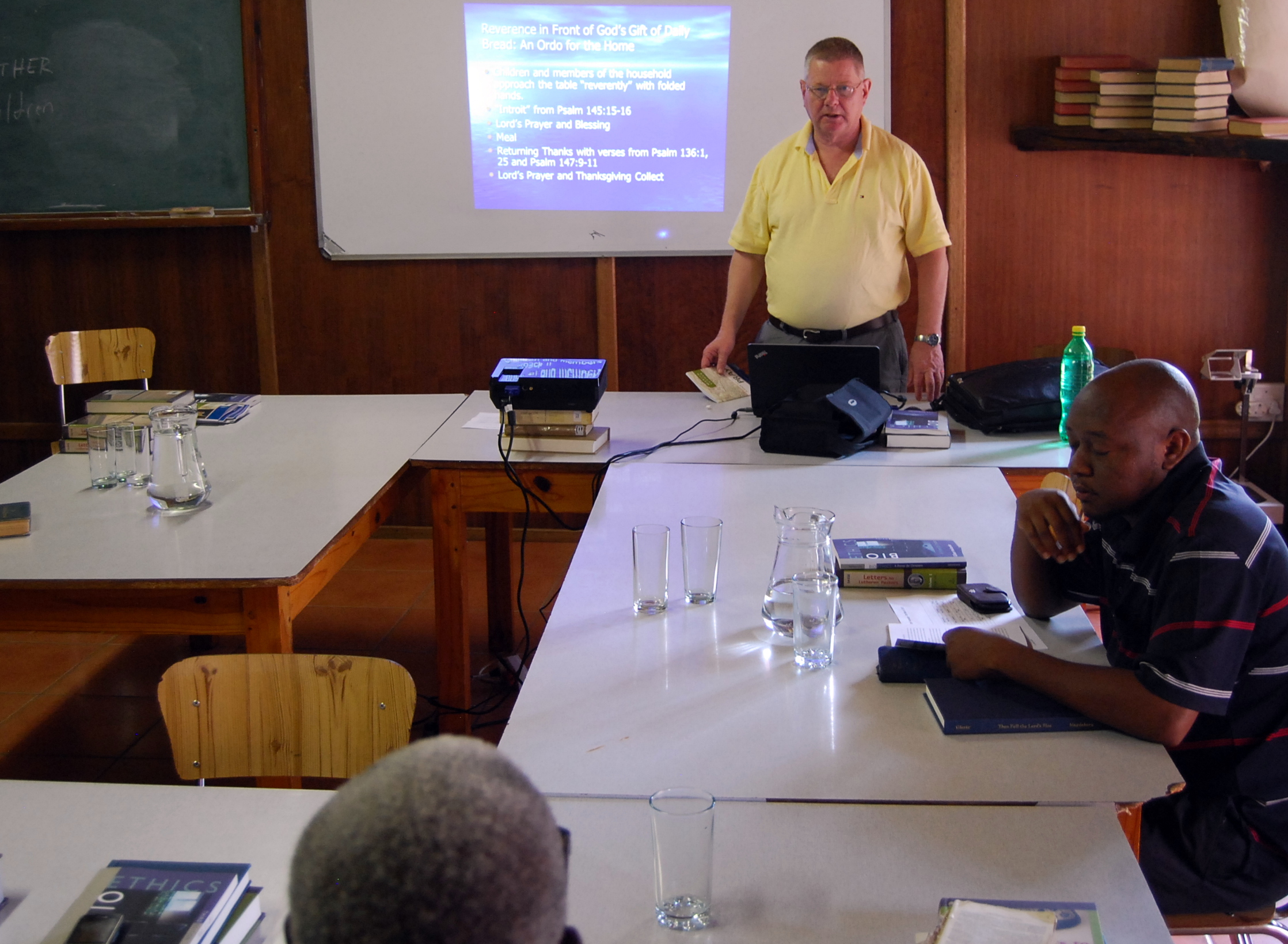
Teaching Trip to Lutheran Theological Seminary, Tshwane (Pretoria), South Africa: 23 February- 9 March 2013


First of all, I am thankful for those whose financial support made this trip possible.  I am grateful to Pastor Gerald Paul and the people of Trinity Lutheran Church in Great Falls, Montana for covering the cost of the airline ticket to South Africa. Without their generosity it would have not been possible for me to travel to LTS for this course. President Timothy Scharr and the Southern Illinois District covered the cost of thirty copies of Letters to Lutheran Pastors by Hermann Sasse which were used as a textbook for the class and distributed to other South African pastors and LTS students and faculty. Pastor Wade Johnston of Magdeburg Press donated ten copies of Then Fell the Lord’s Fire by Bo Giertz which was also used in the class. With funds from several additional individuals and congregations we were also able to purchase copies of Luther’s A Simple Way to Pray and Bioethics: A Primer for Christians by Gilbert Meilaender to use in the class.

Second, I deeply appreciate the hospitality of Dr. Carl and Deaconess Deborah Rockrohr at whose home I stayed for the first part of my visit. Likewise, I am grateful for the hospitality of Dr. and Mrs. Wilhelm Weber who took me in when the Rockrohrs had to leave Pretoria to be with their son, Ted, who had to undergo emergency surgery. The friendship of all these dear brothers and sisters in Christ is cherished and it certainly is a very positive benefit to my time in South Africa.

I taught an “ordination course” made up of advanced students and LCSA pastors who were able to be with us for all or portions of the course. A total of 16 men participated in the class which met for four hours each day. This course was designed as a “topics” course giving us flexibility to cover a variety of topics:

  • Luther’s understanding of the Catechism as a prayer book
  • The life and work of Bo Giertz
  • Women’s ordination in global perspective
  • The life and work of Hermann Sasse
  • Werner Elert on “Truth and Unity”
  • The life and work of Dietrich Bonhoeffer
  • Biomedical Ethics

The course provided an opportunity to give the students a theological sampler. Some of the most interesting discussion grew out of reading Sasse’s 1951, “Mary and the Pope” in Letters to Lutheran Pastors.  Sasse’s careful parsing out of the development of the Marian cult leading up to the papal declaration of the dogma of Mary’s Assumption in 1950, led to a lively and clarifying discussion of syncretism. Students were fascinated with Sasse’s insights into the way that Mary became a replacement for the female deities of antiquity in such a way that the Marian cult became “A pagan religion in Christian guise” (372). Rome’s assertion of the continuum between nature and grace in contrast to the Lutheran law/gospel approach leaves Rome open to a syncretistic approach to missions. This led to a very fruitful discussion of missions and so-called contextualization.

In the discussion, I posed the question to the African students, “Would it be an opportunity for Christian witness if in an African village in a time of famine or drought, a Lutheran pastor would join with a Roman Catholic priest, an African Independent Church minister, a Muslim cleric, an animist shaman, and an Anglican priest to each pray in his own way for rain or crops at a community prayer vigil?” The students quickly recognized this not as a witness for Christ but a confusion of competing belief systems. Perhaps American Lutherans could learn a few things about the danger of syncretism from our African brothers.

Readings from Sasse nicely flowed into a discussion of an essay by Werner Elert on “Truth and Unity.” We used this piece from Elert to get at issues of church fellowship which of necessity must be fellowship grounded in the truth of the Gospel and Sacraments in the way of Augsburg Confession, Article VII.  The ordination of women into the pastoral office destroys church fellowship. Here the essay by Bo Giertz, “To Believe as the Apostles” led us into a careful study of I Corinthians 14:33-38 and I Timothy 2:11-15. We were able to resource African students for issues that they are even now facing in their own context from the ever-present Lutheran World Federation. The study of these topics might also serve as a catalyst for graduate work. This is already the case with Frank Prince Kaine who is working on a Master’s thesis at the University of Pretoria on “the place of women in the Lutheran Church in Africa.” Perhaps a PhD candidate from Africa might work with the implications of Sasse’s theology for African Lutheranism. This could be a promising topic especially given the influence of F. W. Hopf , Sasse’s friend, on Lutheran missions in South Africa.

With a donation from Bethany Lutheran Church in Naperville, Illinois, I was able to take another batch of books for the growing library at LTS. This time the following volumes were added to the collection:

  • Corzine, Jacob and Wolfmueller, Bryan. Theology is Eminently Practical
  • Giertz, Bo. Then Fell the Lord’s Fire: Ordination Sermons and Essays on Pastoral Theology

And Practice

  • Keener, Craig. Miracles (2 Volume Set)
  • Mextaxas, Eric. Bonhoeffer: Pastor, Martyr, Prophet, and Spy
  • Sasse, Hermann. Letters to Lutheran Pastors- Volume I
  • Schuchard, Bruce. Concordia Commentary on I-III John
  • Strark’s Prayer Book
  • Vatja, Vilmos. Luther on Worship: An Introduction
  • Walther, C. F. W. Church and the Office of the Ministry

On my last trip, also with funds from Bethany Lutheran Church, we able to complete the library’s collection of Luther, Gerhard, Bonhoeffer, and the catechetical works of Albrecht Peters in English. These books along with the above-mentioned titles are now being processed for the library by our new German volunteer, Tobias Schmidt-Dahl.

The building which houses the library is nearly out of space for additional books. In discussion with Dr. Weber, he suggested that an expansion of the building could be completed for $20, 000. This could be a good project for an American donor. I am suggesting it to the Saint Philip Lutheran Mission Society for consideration.

On this trip as on others, I had the opportunity to consult with LTS students who are working on Master’s theses at the University of Pretoria. This time, it was Eric Macben, a student from Uganda who is preparing a thesis proposal on “Freedom in the Letter to the Galatians.” Eric’s advisor is an advocate of the so-called “New Perspective on Paul” so we had an opportunity to work through some of those issues and I provided him with a bibliography to balance what he is receiving at the University . We will also add the Stephen Westerholm’s Perspectives Old and New: The ‘Lutheran’ Paul and His Critics and similar titles to the LTS library next trip as the New Perspective appears to be very popular among the Reformed biblical scholars at the University of Pretoria.

There are two LCSA pastors who whose blessing to the church and seminary would be enhanced if they had the opportunity for doctoral work at Concordia Theological Seminary: Rev. Nathan Mntambo and Rev. M. John Nkambule.

In addition to teaching, I preached three times while in South Africa. On  both Wednesdays, I preached for the Confessional Service at the seminary’s Chapel of Saint Timothy. On Sunday, March 3, I preached for the Divine Service at the Evangelical-Lutheran Church of Arcadia which meets on the seminary campus. About 150 people were present for the Service of this growing congregation. Included in the congregation are several American families whose work brings them to Pretoria. Rev. Nathan Mntamco of the seminary faculty also serves as the called pastor of the congregation. After the Service I enjoyed a braai at the home of Mike and Cindy Rodewald .  Dr. Rodewald serves as the Area Director of LCMS work in Africa. I appreciate his welcoming me to South Africa and the encouragement which he gives to those who serve here.

On my last evening in Pretoria, I hosted a braai for the students in the course. It is good to have social occasions like this for the students enabling me to get to know them better outside the classroom setting.

Dr. Weber presented me copies with the Setswana translation of the Book of Concord for the CTS library, for Dr. Rast and Dr. Schulz. Published with the assistance of the Lutheran Heritage Foundation, the influence of the Lutheran Confessions in the Setswana language could be far-reaching. The book will be unveiled at a convocation in Pretoria on April 26 and its appearance marks a very significant milestone in the life of the LCSA.  The revised edition of the Setswana hymnal is also now in print. The revised hymnal includes updated hymn texts, new hymns, as well as Luther’s Small Catechism.

While LTS faces many challenges, it remains a very crucial part of a strong, confessional Lutheran witness not only in South Africa but over the whole of Africa. It is worthy of ongoing support by the LCMS and by individuals and congregations in the USA. I am very pleased with the progress that the Saint Philip Lutheran Mission Society headed up by Pastor Jesse Burns is making in developing further financial support. I am honored to have a small part in the work at LTS and I’m willing to make periodic trips to teach there as long as Dr. Weber finds this helpful and funding can be secured.

God willing it, I will return to South Africa in November over our Thanksgiving Break (November 16-29) to teach another short course and speak for the LCSA General Pastoral Conference.

Prof. John T. Pless

3. 10. 2013


Posted in LTS in Tshwane | Tagged , , , , , , , , , , , , , , , , , , , , , | Leave a comment

+ Matthias Flacius Illyricus 1575

Matthias Flacius IllyricusToday the Church commemorates the death of one of his highly gifted theologians from Istria, Croatia. Read more about him here: http://en.wikipedia.org/wiki/Matthias_Flacius

Posted in Histories, biographies and other stories | Tagged , | Leave a comment

LÖHE ON GALATIANS 4:26

tree_of_jesseBut the Jerusalem that is above is free, and she is our mother. (Gal 4:26 NIV)

The Church is like a tree with countless branches. Consider this, dear reader. Tell me: Where is the root of this tree and where does it draw its juice of life from? All trees are grounded in some foundation. Where is the ground in which the Church is rooted? Its roots are in Heaven and its branches are on earth. The roots are in the celestial Jerusalem, the branches are here, where we’re on pilgrimage. The triumphant Church is already in incomprehensible glory of eternal life and that’s the goal of the militant Church, which now is the light of the world. All Christians dispersed around the globe are beams of this light – or flares or just glomming wicks – but they originate from the true light of Christ and are on their way back to this source of light too.

O God of Sabaoth, Lord of hosts, return and look down from the heavens, look up and visit your vine. You have planted it, keep it upright and flourishing. You have elected it and you have permitted it to spread its branches worldwide. Protect and shield it!

We pray also for your sheep and all belonging to your herd. Let no one, pluck them from your hand. Let your holy Word, that bright and unchangeable light, shine brightly into the world. Provide help with your outstretched arm and keep your holy Christian Church throughout the punches and blows it receives, so that you may continue to have a people, who know you, who honor and worship you always + Comfort us, o God our savior and put off your displeasure from us. Guard and keep your Church, that depends entirely on you. Do this for your names sake, so that it will not be discredited. Do it for Christ’s sake – your dearly beloved Son and our Lord and God + Amen. (Wilhelm Löhe)

Preserve your holy Church, that you have ransomed with your holy blood and that you have entrusted to yourself, the Church, that is plummeted violently by the aggressive dragon. You be her buttress and sanctuary so that even if the entire world creaks and breaks, she will be preserved safe and sound in your good care!

Preserve us Lord as your holy inheritance, your treasured heirloom; tear apart, destroy and shatter all that opposes your authority, honour and name. Let your law keep, protect and guide us, grant us your heavenly bread, let your ornamentation dress us, heal us by your vicarious suffering, death and resurrection. (Adam Gretgen + 1660)  

This is a translation of Wilhelm Löhe’s devotion for Monday after Laetare (4th Sunday in Lent). The prayer was translated rather literally and not poetically. Both are found on Pg. 139 in Lob sei Dir ewig, o Jesu!   (Eternal Praise to you o Jesus!) edited by A. Schuster and published in the Freimund Verlag, Neuendettelsau 1949.

Posted in Meditations by P.Wilhelm Löhe (Translation) | Tagged , , , , , , , , | Leave a comment

Herrenhuter readings for Monday, the 11th March 2013

praying handsBut I pray to you, O LORD, in the time of your favor; in your great love, O God, answer me with your sure salvation. (Psalm 69:13 NIV)

Devote yourselves to prayer, being watchful and thankful. (Colossians 4:2 NIV)

Posted in Losung & Lehrtext | Tagged , , , , , , , , , | Leave a comment