Exaudi: Hear me, O Lord, when I cry out.

The Lord is my light and my salvation.
I fear no one.
The Lord protects my life.
I am afraid of no one.

When evil men attack me to devour my flesh,
when my adversaries and enemies attack me, they stumble and fall.
Even when an army is deployed against me, I do not fear.
Even when war is imminent, I remain confident.

 I have asked the Lord for one thing— this is what I desire!
I want to live in the Lord’s house all the days of my life,
so I can gaze at the splendor of the Lord and contemplate in his temple.

He will surely give me shelter in the day of danger;
he will hide me in his home.
He will place me on an inaccessible rocky summit.
Now I will triumph over my enemies who surround me.
I will offer sacrifices in his dwelling place and shout for joy.
I will sing praises to the Lord.

Hear me, O Lord, when I cry out.
Have mercy on me and answer me.
My heart tells me to pray to you,
and I do pray to you, O Lord.
Do not reject me.
Do not push your servant away in anger.
You are my deliverer.
Do not forsake or abandon me,
O God who vindicates me.
Even if my father and mother abandoned me,
the Lord would take me in.

Teach me how you want me to live, Lord;
lead me along a level path because of those who wait to ambush me.
Do not turn me over to my enemies, for false witnesses who want to destroy me testify against me.
Where would I be if I did not believe I would experience the Lord’s favor in the land of the living?
Rely on the Lord!
Be strong and confident!
Rely on the Lord!

Psalm 27 by King David

Tomorrow is the 6th Sunday after Easter, which is called “Exaudi” from verse 7 in Psalm 27: Hear me,O Lord, when I cry out. Have mercy on me and answer me. (Exaudi, Domine, vocem meam, qua clamavi ad te…). This Sunday is like an Advent Sunday for Pentecost. All and everything is focused on the promise of our good Lord and Savior Jesus Christ to send His advocate to us, so that He would lead and guide us in all truth, revealing all that IX himself had taught his disciples. In perfect unison with the Father and the Son, the Comforter does not teach on and of His own, but rather takes from the Son and the Father, giving in surplus whatever serves the edification of the flourishing faithful and promotes God´s holy Christian Church, drawing all and everyone towards Himself from the very ends of the earth. That´s His good and gracious will for us and our salvation +

This promise came first to the people in exile (Jeremiah 31,31-34). It has uplifted and maintained the faithful in dire straits – far off from home – in the diaspora, on their migrations, flights and sheer endless meanderings – looking forward to experience the Lord’s favor in the land of the living. Oh, how they longed to live in the Lord’s house all the days of their life, so they could gaze at the splendor of the Lord and contemplate in his temple…

Finally our good Lord himself confirmed these high hopes and desperate yearnings of His people – on the night in which he was betrayed (John 16,5-15) and then again, when He sent them back to Jerusalem to await the fulfilment of His blessed testament with them. On Pentecost this was fulfilled, so that we stand praying with the holy Apostle (Eph.3,14-21) between the holiday of our Lord´s Ascension and the pentecostal Feast -already singing His praises even while still waiting, but already celebrating Church even as we are still in transit:

Christ rose to heaven, What did he send us hither? The Holy Ghost as Comforter To keep us faithful, safe and sound. Kyrieleis!

Hallelujah, Hallelujah! Hallelujah!

So, let us all rejoice and sing, Christ comforts us most graciously. Kyrieleis!

Here´s my sermon and the hymns & lessons for the divine service in German:

  • Outline
    • Eingang                     101 Heilger Geist, Du Tröster mein …   
    • Introitus                     042 (Ps.27) Jeremia 31,31-34 (Predigt); Eph3,14-21; Joh16,5-15
    • Vor der Predigt         90 Christ fuhr gen Himmel…
    • Nach der Predigt      107 Schmückt das Fest mit Maien …
    • Ausgang                    102 Freut euch, ihr Christen alle…       

Posted in Uncategorized | Leave a comment

Luther on tour from Torgau to Zwickau

Getting back from the Wartburg, Luther had his plate full in Wittenberg pushing back on the radical efforts by Karlstadt & Co. He managed these challenges with aplomb. Peace and quiet returned to the troubled town – and that mainly due to the calming influence of Luther´s sermons. Competently he addressed the issues at hand, showing how Christian liberty goes hand in glove with Christian responsibility. However, Luther was never just one-track-mind. His many talents challenged him on many fronts plus he was open to challenges from all over. Not only was he constantly confronted by more or less able opponents, but close friends and a growing band of allies sought out his spiritual advice and theological insight as they faced terra incognita going about building churches and Lutheran missions cut loose from their previous moorings in papal decrees and sans legal scaffolding. They were building anew based solely on gospel foundations. The subsequent structures were to express this evangelical base. It was tough going. Thank God for the prophetic leadership of the reformer.

In the middle of April 1522 Altenburg pressed Luther with a double-pronged petition. Firstly to help selecting an appropriate preacher/pastor/bishop where catholic priests were unwilling to convert. Such unrepentant followers of the papel course were dismissed and new, suitable followers of the new way were sought as congregational pastors. Secondly, Luthers guidances was not just requested in writing, but personally. They wanted him to address them on the pressing issues facing the congregation. They trusted Luther in their efforts to free themselves from papal bonds and to walk free as Christians according to the biblical message in law and gospel.

A similar request was also put forward by the congregation in Borna. So, Luther undertook extended preaching tours and public relations stints to various towns, starting off close to his home base at Torgau and finally going to Zwickau, which were morphing into important reformational centers in electoral Saxony.

Although Luther favored Gabriel Zwilling as pastor for Altenburg, he could not get through with this suggestion as the elector doubted his suitability still due to the candidate´s part in the Wittenberg riots in cohorts with the rebel Karlstadt. In the end Wenzeslaus Linck – an Augustinian vicar – was installed by Georg Spalatin, who would later – after the most unfortunate demise of the elector – move permanently to this post himself. Both are seen on the front of the beautiful church “Brüderkirche” – together with Luther and the Holy Trinity. This church has a moving history – right into our own times.

Everywhere people thirst for the gospel. From all ends they plead for pastors.

Martin Luther to Spalatin 26th July 1522

That is why Luther dedicated a lot of his time and energy to have faithful pastors called to these outposts of the church in gospel mission. He published crucial documents in this time like the foundational paper with lasting practicalities for the pastoral office and Lutheran ministry:

THAT A CHRISTIAN ASSEMBLY OR CONGREGATION HAS THE RIGHT AND POWER TO JUDGE ALL TEACHING AND TO CALL, APPOINT, AND DISMISS TEACHERS, ESTABLISHED AND PROVEN BY SCRIPTURE

First, it is necessary to know where and what the Christian congregation1 is, so that men do not engage in human affairs (as the non-Christians were accustomed to do) in the name of the Christian congregation. The sure mark by which the Christian congregation can be recognized is that the pure gospel is preached there. For just as the banner of an army is the sure sign by which one can know what kind of lord and army have taken to the field, so, too, the gospel is the sure sign by which one knows where Christ and his army are encamped. We have the sure promise of this from God in Isaiah 55[:10–11], “My word” (says God) “that goes forth from my mouth shall not return empty to me; rather, as the rain falls from heaven to earth, making it fruitful, so shall my word also accomplish everything for which I sent it.” Thus we are certain that there must be Christians wherever the gospel is, no matter how few and how sinful and weak they may be.2 Likewise, where the gospel is absent and human teachings rule, there no Christians live but only pagans, no matter how numerous they are and how holy and upright their life may be.

Thus it undeniably follows that bishops, religious foundations, monasteries, and all who are associated with them have long since ceased to be Christians or Christian congregations, even though they have claimed they are more entitled to this name than anyone else. For whoever recognizes the gospel sees, hears, and understands that even today they insist on their human teachings, have driven the gospel far away from themselves, and are still driving it away. That is why one should consider pagan and worldly what these people do and pretend.

Second, in this matter of judging teachings and appointing or dismissing teachers or pastors, one should not care at all about human statutes, law, old precedent, usage, custom, etc., even if they were instituted by pope or emperor, prince or bishop, if one half or the whole world accepted them, or if they lasted one year or a thousand years. For the soul of man is something eternal, and more important than every temporal thing. That is why it must be ruled and seized only by the eternal word; for it is very disgraceful to rule consciences before God with human law and old custom. That is why this matter must be dealt with according to Scripture and God’s word; for God’s word and human teaching inevitably oppose each other when the latter tries to rule the soul. This we shall prove clearly with regard to our present discussion, in this manner:

Human words and teaching instituted and decreed that only bishops, scholars, and councils should be allowed to judge doctrine. Whatever they decided should be regarded as correct and as articles of faith by the whole world, as is sufficiently proven by their daily boasting about the pope’s spiritual law.3 One hears almost nothing from them but such boasting that they have the power and right to judge what is Christian or what is heretical. The ordinary Christian is supposed to await their judgment and obey it. Do you see how shamelessly and foolishly this boasting, with which they intimidated the whole world and which is their highest stronghold and defense, rages against God’s law and word?

Christ institutes the very opposite. He takes both the right and the power to judge teaching from the bishops, scholars, and councils and gives them to everyone and to all Christians equally when he says, John 10[:4], “My sheep know my voice.” Again, “My sheep do not follow strangers, but flee from them, for they do not know the voice of strangers” [John 10:5]. Again, “No matter how many of them have come, they are thieves and murderers. But the sheep did not listen to them” [John 10:8].

Here you see clearly who has the right to judge doctrine: bishops, popes, scholars, and everyone else have the power to teach, but it is the sheep who are to judge whether they teach the voice [i.e., the words] of Christ or the voice of strangers. My dear, what can these water bubbles4 say against it, with their feet scraping,5 “Councils, councils! One must listen to the scholars, the bishops, the crowd; one must look at the old usage and custom”? Do you think the word of God should yield to your old usage, custom, and bishops? Never! That is why we let bishops and councils decide and institute whatever they please; when God’s word is on our side we—and not they—shall judge what is right or wrong and they will have to yield to us and obey our word.6

Here I think you can indeed see clearly enough how much trust should be placed in those who deal with souls by means of human words. Who cannot see that all bishops, religious foundations, monasteries, universities, and everything belonging to them rage against this clear word of Christ? They shamelessly take away the judgment of teaching from the sheep and annex it to themselves through their own law and blasphemy. That is why they should certainly be regarded as murderers and thieves, as wolves and apostate Christians, for they are openly convicted here not only of denying God’s word but also of opposing and acting against it. Such action was quite appropriate for the Antichrist and his kingdom, according to the prophecy of St. Paul, 2 Thessalonians 2[:3–4].

Christ says again, Matthew 7[:15], “Beware of the false prophets, who come to you in sheep’s clothing but are inwardly ravenous wolves.” You see, here Christ does not give the judgment to prophets and teachers but to pupils or sheep. For how could one beware of false prophets if one did not consider and judge their teaching? Thus there cannot be a false prophet among the listeners, only among the teachers. That is why all teachers and their teaching should and must be subject to the judgment of the listeners.

Again, the third passage is from St. Paul, 1 Thessalonians 5[:21], “Test everything but hold fast to that which is good.” You see, here he does not want to have any teaching or decree obeyed unless it is examined and recognized as good by the congregation hearing it. Indeed, this examination is not the concern of the teachers; rather, the teachers must first state what is to be examined. Thus here too the judgment is taken from the teachers and given to the Christian pupils. There is a radical difference between Christians and the world: in the world the rulers command whatever they please and their subjects accept it. “But among you,” says Christ, “it should not be so.” Instead, among Christians each person is the judge of the other person; on the other hand, he is also subject to the other person.7 However, the spiritual tyrants have made a worldly power out of Christendom.

The fourth passage is again from Christ, Matthew 24[:4–5], “Take heed that no one leads you astray. For many will come in my name, saying, ‘I am the Christ,’ and they will lead many astray.” To sum up, do we really need to quote any more sayings? All of St. Paul’s warnings, Romans 16[:17–18], 1 Corinthians 10[:14], Galatians 3, 4, and 5, Colossians 2[:8], and elsewhere, and all the sayings of the prophets in which they teach us to avoid human teaching,8 do nothing but take the right and power to judge all doctrine away from the teachers and with a stern decree impose it on the listeners instead, on pain of losing their soul. Accordingly, they not only have the power and the right to judge everything that is preached, they also have the duty to judge, on pain of [incurring] the disfavor of Divine Majesty. Thus we see in what an un-Christian way the tyrants treated us when they took this right and obligation from us and made it their own. For this alone they richly deserve to be driven out of Christendom and to be chased away as wolves, thieves, and murderers who rule over us and teach us things contrary to God’s word and will.

Thus we conclude that wherever there is a Christian congregation in possession of the gospel, it not only has the right and power but also the duty—on pain of losing the salvation of its souls and in accordance with the promise made to Christ in baptism—to avoid, to flee, to depose, and to withdraw from the authority that our bishops, abbots, monasteries, religious foundations, and the like are now exercising. For it is clearly evident that they teach and rule contrary to God and his word. This first point is established certainly and firmly enough, and one should depend upon it, that it is a divine right and a necessity for the salvation of souls to depose or to avoid such bishops, abbots, monasteries, and whatever is of their government.

Second, since a Christian congregation neither should nor could exist without God’s word, it clearly follows from the previous [argument] that it nevertheless must have teachers and preachers who administer the word. And since in these last accursed times the bishops and the false spiritual government neither are nor wish to be teachers—moreover, they want neither to provide nor to tolerate any, and God should not be tempted to send new preachers from heaven—we must act according to Scripture and call and institute from among ourselves those who are found to be qualified and whom God has enlightened with reason and endowed with gifts to do so.

For no one can deny that every Christian possesses the word of God and is taught and anointed by God to be priest, as Christ says, John 6[:45], “They shall all be taught by God,” and Psalm 45[:7], “God has anointed you with the oil of gladness on account of your fellows.”9 These fellows are the Christians, Christ’s brethren, who with him are consecrated priests, as Peter says too, 1 Peter 2[:9], “You are a royal priesthood so that you may declare the virtue of him who called you into his marvelous light.”10

But if it is true that they have God’s word and are anointed by him, then it is their duty to confess, to teach, and to spread [his word], as Paul says, 1 Corinthians 4 [2 Cor. 4:13], “Since we have the same spirit of faith, so we speak,” and the prophet says in Psalm 116[:10], “I came to believe, therefore I speak.” And in Psalm 51[:13], he [God] says of all Christians, “I will teach the ungodly your ways, and sinners will return to you.” Here again it is certain that a Christian not only has the right and power to teach God’s word but has the duty to do so on pain of losing his soul and of God’s disfavor.

If you say, “How can this be? If he is not called to do so he may indeed not preach, as you yourself have frequently taught,” I answer that here you should put the Christian into two places. First, if he is in a place where there are no Christians he needs no other call than to be a Christian, called and anointed by God from within. Here it is his duty to preach and to teach the gospel to erring heathen or non-Christians, because of the duty of brotherly love, even though no man calls him to do so. This is what Stephen did, Acts 6–7, even though he had not been ordered into any office by the apostles. Yet he still preached and did great signs among the people. Again, Philip, the deacon and Stephen’s comrade, Acts 8[:5], did the same thing even though the office of preaching was not commanded to him either. Again, Apollos did so too, Acts 18[:25]. In such a case a Christian looks with brotherly love at the need of the poor and perishing souls and does not wait until he is given a command or letter from a prince or bishop. For need breaks all laws and has none. Thus it is the duty of love to help if there is no one else who could or should help.

Second, if he is at a place where there are Christians who have the same power and right as he, he should not draw attention to himself. Instead, he should let himself be called and chosen to preach and to teach in the place of and by the command of the others.11 Indeed, a Christian has so much power that he may and even should make an appearance and teach among Christians—without a call from men—when he becomes aware that there is a lack of teachers, provided he does it in a decent and becoming manner. This was clearly described by St. Paul in 1 Corinthians 14[:30], when he says, “If something is revealed to someone else sitting by, let the first be silent.” Do you see what St. Paul does here? He tells the teacher to be silent and withdraw from the midst of the Christians; and he lets the listener appear, even without a call. All this is done because need knows no command.

If then St. Paul says here that anyone from the midst of the Christians may come forward if there is a need and calls him through such a word of God, and tells the other to withdraw and deposes him by the power of his word, how much more right does a whole congregation have to call someone into this office when there is a need, as there always is, especially now! For in the same passage St. Paul gives every Christian the power to teach among Christians if there is a need, saying, “You can all prophesy one by one, so that all may learn and all be admonished” [1 Cor. 14:31]. Again, “You should earnestly desire to prophesy, and do not forbid speaking in tongues; but all things should be done decently and in order” [1 Cor. 14:39–40].

Let this passage be your sure foundation, because it gives such an overwhelming power to the Christian congregation to preach, to permit preaching, and to call. Especially if there is a need, it [this passage] calls everyone with a special call—without a call from men—so that we should have no doubt that the congregation which has the gospel may and should elect and call from among its members someone to teach the word in its place.

But if you say, “Did not St. Paul command Timothy and Titus to institute priests12 [1 Tim. 4:13; Titus 1:5], and do we not read, Acts 14[:23], that Paul and Barnabas instituted priests among the congregations? (Therefore, the congregation cannot call anyone, nor can anyone draw attention to himself and preach among Christians; rather, one must have permission and authorization from bishops, abbots, or other prelates who represent the apostles)” I answer that if our bishops, abbots, etc., did represent the apostles, as they boast, one opinion would certainly be to let them do what Titus, Timothy, Paul, and Barnabas did when they instituted priests, etc. But since they represent the devil and are wolves who neither want to teach the gospel nor suffer it to be taught, they are as little concerned with instituting the office of preaching or pastoral care among Christians as the Turks or the Jews are. They should drive asses and lead dogs.

Moreover, if they were really decent bishops who wanted to have the gospel and wanted to institute decent preachers, they still could not and should not do so without the will, the election, and the call of the congregation—except in those cases where need made it necessary so that souls would not perish for lack of the divine word. For in such a need, as you have heard, not only may anyone procure a preacher, be it through pleas or the power of worldly authority, but he should also hurry to the scene himself and make an appearance and teach if he can—for need is need and has no limits—just as everyone should hurry to the scene of a fire in town and not wait until asked to come.

Otherwise, if there is no such need and if there are those who have the right, power, and grace to teach, no bishop should institute anyone without the election, will, and call of the congregation. Rather, he should confirm the one whom the congregation chose and called; if he does not do it, he [the elected man] is confirmed anyway by virtue of the congregation’s call. Neither Titus nor Timothy nor Paul ever instituted a priest without the congregation’s election and call. This is clearly proven by the sayings in Titus 1[:7] and 1 Timothy 3[:10], “A bishop or priest should be blameless,” and, “Let the deacon be tested first.” Now Titus could not have known which ones were blameless; such a report must come from the congregation, which must name the man.

Again, we even read in Acts 4 [6:1–6] regarding an even lesser office, that the apostles were not permitted to institute persons as deacons without the knowledge and consent of the congregation. Rather, the congregation elected and called the seven deacons, and the apostles confirmed them. If, then, the apostles were not permitted to institute, on their own authority, an office having to do only with the distribution of temporal food, how could they have dared to impose the highest office of preaching on anyone by their own power without the knowledge, will, and call of the congregation?

But since in our times there is the need, but no bishop, to provide evangelical preachers, the examples from Titus and Timothy are invalid. Instead, one must call [a preacher] from among the congregation, regardless of whether or not he is confirmed by Titus. For those under Titus’ care would and should have done the same thing if Titus had not wanted to confirm him, or if there had been no one else to institute preachers. That is why this time is very different from the time of Titus when the apostles ruled and wanted to have true preachers. Now our tyrants only want to have wolves and thieves.

Why do these raging tyrants condemn us for such electing and calling? They themselves do and must do the same thing. Not one of them is ever instituted pope or bishop by the power of someone; rather, he is elected and called by his chapter13 and then confirmed by others—the bishops by the pope as their supreme head, and he, the pope himself, by the cardinal of Ostia14 as by his inferior. And even if one of them were not confirmed, he would still be bishop and pope. Thus I ask the dear tyrants: if bishops are made by the election and call of their own congregation, and if the pope is pope without confirmation by any other authority and by election alone, why should not a Christian congregation, too, make a preacher by its call alone? For they [the tyrants] regard the episcopal and papal estate as higher than the office of preaching! Who gave them this right and took it from us, especially since our calling has Scripture on its side, but their calling is nothing but a mere human trifle without Scripture, with which they rob us of our rights? They are tyrants and knaves who deal with us just as the devil’s apostles should.

That is why there is still a custom in some places of having worldly authorities such as councilmen and princes institute and pay preachers themselves in their towns and castles, just as they please and without the permission or authorization of the bishops and popes.15 And no one interfered, even though (I fear) they did not do it out of a [correct] understanding of their Christian rights. Rather, they did it because the spiritual tyrants despised and underestimated the office of preaching and made a great separation between it and the spiritual government, even though it is the highest office, on which all others depend and from which they follow. On the other hand, where there is no office of preaching, none of the others can follow. For John says, John 4[:2], that Jesus did not baptize, he only preached. And Paul boasts, 1 Corinthians 1[:17], that he was not sent to baptize but to preach.

Therefore, whoever has the office of preaching imposed on him has the highest office in Christendom imposed on him. Afterward he may also baptize, celebrate mass, and exercise all pastoral care; or, if he does not wish to do so, he may confine himself to preaching and leave baptizing and other lower offices to others—as Christ and all the apostles did, Acts 4 [6:4]. Thus it becomes evident that our present-day bishops are spiritual idols and not bishops. For they leave the highest office of the word, which should be their own, in the hands of the very lowest [orders], namely, chaplains, monks, and mendicants.16 They also leave the lower offices such as baptizing and other pastoral care to them. In the meantime, however, they administer confirmation, consecrate bells, altars, and churches which are neither Christian nor episcopal duties and which they themselves invented. They are perverted and blind masks and true child-bishops.17

Translated by Eric W. and Ruth C. Gritsch
“Luther Works” Volume 39

He did not write the influential paper, but penned an introduction to it, signalling his approval: “Fraternal communion of the common chest for the congregation at Leisnick 1523”.

Posted in Martin Luther and the Reformation | Tagged , , , , , , | Leave a comment

Though great our sins, yet greater still Is God’s abundant favor

The Old Testament lesson for the 5th Sunday after Easter (Rogate)

The Lord spoke to Moses, “Go quickly, descend, because your people, whom you brought up from the land of Egypt, have acted corruptly. They have quickly turned aside from the way that I commanded them—they have made for themselves a molten calf and have bowed down to it and sacrificed to it and said, ‘These are your gods, O Israel, which brought you up from the land of Egypt.’”

Then the Lord said to Moses, “I have seen this people. Look what a stiff-necked people they are! So now, leave me alone so that my anger can burn against them and I can destroy them, and I will make from you a great nation.”

But Moses sought the favor of the Lord his God and said, “O Lord, why does your anger burn against your people, whom you have brought out from the land of Egypt with great power and with a mighty hand? Why should the Egyptians say, ‘For evil he led them out to kill them in the mountains and to destroy them from the face of the earth’? Turn from your burning anger and relent of this evil against your people. Remember Abraham, Isaac, and Israel your servants, to whom you swore by yourself and told them, ‘I will multiply your descendants like the stars of heaven, and all this land that I have spoken about I will give to your descendants, and they will inherit it forever.’” Then the Lord relented over the evil that he had said he would do to his people.

Exodus 32,7-14

1    From depths of woe I cry to Thee,
In trial and tribulation;
Bend down Thy gracious ear to me,
Lord, hear my supplication.
If Thou rememb’rest ev’ry sin,
Who then could heaven ever win
Or stand before Thy presence?

2    Thy love and grace alone avail
To blot out my transgression;
The best and holiest deeds must fail
To break sin’s dread oppression.
Before Thee none can boasting stand,
But all must fear Thy strict demand
And live alone by mercy.

3    Therefore my hope is in the Lord
And not in mine own merit;
It rests upon His faithful Word
To them of contrite spirit
That He is merciful and just;
This is my comfort and my trust.
His help I wait with patience.

4    And though it tarry through the night
And till the morning waken,
My heart shall never doubt His might
Nor count itself forsaken.
O Israel, trust in God your Lord.
Born of the Spirit and the Word,
Now wait for His appearing.

5    Though great our sins, yet greater still
Is God’s abundant favor;
His hand of mercy never will
Abandon us, nor waver.
Our shepherd good and true is He,
Who will at last His Israel free
From all their sin and sorrow.

Martin Luther 1483-1546

Collect for this Sunday before the Ascension of our Lord

God, our heavenly Father, through Your Son You have promised us the Holy Spirit. Send down upon us that Spirit, that He may teach us to show forth Your praise, not only here on earth in weakness, since we know Your power and glory only from afar, but also in power and glory on that day when, united with the choir of angels, we shall see You face to face; through Jesus Christ, Your Son, our Lord.

Dobberstein Pg.94

A song for the Sabbath day

It is fitting to thank the Lord,
and to sing praises to your name, O Most High.
It is fitting to proclaim your loyal love in the morning,
and your faithfulness during the night,
to the accompaniment of a ten-stringed instrument and a lyre,
to the accompaniment of the meditative tone of the harp.
For you, O Lord, have made me happy by your work.
I will sing for joy because of what you have done.
How great are your works, O Lord!
Your plans are very intricate!
The spiritually insensitive do not recognize this;
the fool does not understand this.
When the wicked sprout up like grass,
and all the evildoers glisten,
it is so that they may be annihilated.

But you, O Lord, reign forever.
Indeed, look at your enemies, O Lord.
Indeed, look at how your enemies perish.
All the evildoers are scattered.
You exalt my horn like that of a wild ox.
I am covered with fresh oil.
I gloat in triumph over those who tried to ambush me;
I hear the defeated cries of the evil foes who attacked me.
The godly grow like a palm tree;
they grow high like a cedar in Lebanon.
Planted in the Lord’s house,
they grow in the courts of our God.
They bear fruit even when they are old;
they are filled with vitality and have many leaves.
So they proclaim that the Lord, my Protector,
is just and never unfair.

Psalm 92
Posted in Eastertide, Lectionary etc | Tagged , , , , , | Leave a comment

Ask and it will be given to You +

Some days just start off better than others – and what a great start to this 5th Sunday after Easter (Rogate) it has been. Good news from the top Lutheran Seminary in the World (CS St.Louis) and they´re just going to get better: “Nothing is going to stop them (!) now…” (Queen) and they´re probably quite comfortable singing the ongoing chorus: “Try to catch me – if you can!” (Steven Spielberg). Well, that news has made my day and I´m not even at the best part yet, because it´s Sunday and we are ready for church and just full of great expectations to hear, see and taste the friendliness of our God.

The candles are burning, the table is set, and the biblical lessons are just such a treat – full of the triune God´s goodness and grace from beginning to end – Psalm 95; Ex32,7-14; 1Ti2,1-6 and Lk11,5-13. We´re going to concentrate on the “Our Father”, but look specifically at Moses pleading vicariously for his/God´s people and get comfort from Jesus´prayer on the cross: “Forgive them for they know not, what they do!” We will be looking at the long list, which we Christians have praying for this world and all its people (1.Ti2,1-6) while remembering, that God wants all people to be saved and come to the knowledge of truth. Finally, Jesus´ parable of the inopportune friend knocking after midnight. That´s a whole bag full of goodness and truth – and then I´ve not even touched on the hymns yet.

There too we´ve got one pearl strung up one after the other on this beautiful lineup of old Psalms, Christian hymns and Lutheran specialties.

  • Ablauf des Gottesdienst:
    • Eingang                     105,1.5-8.13 Zeuch ein zu Deinen Toren…   
    • Introitus                     040 (Ps.95) Ex32,7-14; 1Ti2,1-6; Lk11,5-13 (Bittende Freund)
    • Nach der Predigt       241,1-9 Vater unser im Himmel …
    • Gebet                         „Vater unser“ (Rimsky Korsakov)
    • Lied zur Bereitung:   154 Jesus Christus unser Heiland, der von uns den Gotteszorn…
    • Ausgang                    227 Nun lasst uns Gott dem Herren Dank sagen und ihn ehren…      

The theme is set with Paul Eber´s moving plea:

1 When in the hour of deepest need
We know not where to look for aid;
When days and nights of anxious thought
No help or counsel yet have brought.

2 Then is our comfort this alone
That we may meet before Your throne;
To You, O faithful God, we cry
For rescue from our misery.

3 For You have promised, Lord, to heed
Your children’s cries in time of need
Through Him whose name alone is great,
Our Savior and our advocate.

4 And so we come, O God, today
And all our woes before You lay;
For sorely tried, cast down, we stand,
Perplexed by fears on ev’ry hand.

5 O from our sins, Lord, turn Your face;
Absolve us through Your boundless grace.
Be with us in our anguish still;
Free us at last from ev’ry ill.

6 So we with all our hearts each day
To You our glad thanksgiving pay,
Then walk obedient to Your Word,
And now and ever praise You, Lord.

That´s the song the German peasants sing on the evening before Dr. Martin Luther makes his confessional stand at the Diet of Worms (1521) – at least according to the great film with Joseph Fiennes and the brilliant Sir Peter Ustinov. You can´t watch that scene without being deeply moved by this critical turning point in history. Yes, and we´ll be singing this today full of confidence, trust and joy, because we have the promise of our God: “God deserves praise, forhe did not reject my prayer or abandon his love for me.” (Psalm 66:20 NET) I pray, that Your Sunday will be a very blessed one too. May the triune God and Father, Savior and Comforter of all mankind bless and keep You in the true and saving faith – through Jesus Christ our Lord and God. Amen.

Posted in Eastertide, Lutheran World | Tagged , , , , , , , | Leave a comment

It´s about the 1st commandment…

It´s the holiday of St. Sophia of Rome, who was martyred under Diocletian – or St. Sophia of Milan, who mourned the martyrdom of her three daughters Faith, Hope and Charity  – not to be confused with the Hagia Sophia (Holy Wisdom), nor with the old Miss Sophie venerated in modern Germany on Old Year´s eve or beautiful Sophia Loren, who is revered worldwide just years ago.  

That´s now the final holiday of the “Ice Saints” – and according to those old farmer´s rules (“Bauernregel”) you´re free to plant now, because no more frost is to be expected this season: “Before Boniface no summer, after Sophie no frost” or “Frost can come to pass until Sophies past”. Yes, “old cold Sophie kills all things off!” Even today the vineyards around Salle-Ustrut complain bitterly, because the late frost of this past week has destroyed up to 80% of their prospective crop. No small wonder, there´s not much love lost on this “Ice Queen“, whom the Solvenians call: „Pissing Sophie“ (Slovenia)

When leaves have fallen And skies turned into grey. The night keeps on closing in on the day A nightingale sings his song of farewell You better hide for her freezing hell

Within Temptation – Ice Queen

Obviously, some will not blame the Saints for the lost crop, illness or other calamity, but rather the Government, the Chinese, Bill Gates or even some deep fried bat on an exotic menu. Conspiracy theories are running wild. Not just in the internet, but also in the regular media: Von bösen Mächten wundbar geborgen… Obviously, we want to know, who is at fault, because things were running so smoothly before. Remember, things were always better in the good old past? Oh, yes – our wonderful youth – and then consider that of our grandparents: Practically paradise! But even in their days, people were trying to figure out, why bad things happen to good people. There must be someone to blame, surely. Those questions and accusations go back a long way – way beyond figuring out, who was responsible for the “Spanish flu” (1918) or the “Black Death” during the Middle Ages. Igmar Bergman gives us a good go: “The Seventh Seal“

Just look at the Psalms 37 and 73 for example. These really are ancient issues. The German philosopher Leibnitz coined the term “theodicy” – trying to justify God´s benevolence in light of apparent global imperfections – and that was before the “Earthquake of Lissabon” (1755), which shattered more than just Portuguese confidences on “All Saints”. Here a European capital – master of the seas! – centre of Catholic missions and faith – destroyed on that great holiday. The christian world – occident – that was gaining rapid confidence by so-called Enlightenment after perceived Dark and Middle Ages also because of engineering prowess and aparent conquering of the world. Yes, they wanted to build heaven on earth – never mind just a tower of Babel – “We can!” As long as we just work out the proper relationships between cause and effect, follow the rules and keep focussed. One things leads to another – and everyone gets what he deserves. But even the biblical narratives of Cain & Abel, Joseph and his brothers, king Saul and David are not so simple on 2nd reading. Neither are our European foundational epics Illiad and Odyssey, which were to quickly forgotten by the new narrative of prospective world dominiation by modern man. These stories go a long way to show how weakly united even closed battle ranks with a common enemy are, and how fallible and weak even the best friendships prove. Not much support for a united front to dominate the world there! I dare say, that has not changed much.

In the past a long-time favorite was to blame the Jews.  Just read the book “Esther” and how Haman tries to not just get rid of his nemesis Mordechai, but all Jews – blaming them for this and that going wrong in the kingdom.  It´s like a recurring plot and not just in violent pogroms of the East hinted at in Fiddler on the roof or bestselling Lion Seeker . Even Martin Luther goes and blames his stiff, cold neck on the bad breeze from the Jewish ghetto on his final mission. That´s just plain crazy, but some people take this kind of grumpy blame game serious. It´s nuts! The trouble is, that people get burnt for this kind of “smelling out” and people die because of some kangaroo court – just think of the “Visit!”, “Count of Mt. Christo”, “Lord of the flies” or if you prefer – Martin Luther banned for life without due process or conviction, just by the logics of any witch-hunt or blame game gone wrong.  

Well, ok, sometimes and at first glance, you can make out the perpetrator pretty easily. The issues seem pretty much straight forward. Very much like the start of any “Tatort” or reading another of Agatha Christie´s many novels. However, as You get into the matter, things become complicated. Terrible, unexpected, hidden alliances become apparent, compliances, coincidences and complexities muddle things, accidents happen, surprise surprise. It´s harder to fix blame and quite often you just get: “A series of very unfortunate events!”

In times like this it is appropriate to acknowledge our limitations. We´re not in control. Nor is anybody else of this world. Even the really big guys with lots of clout have far too many dissidents and sceptics in their closest ranks – never mind the very real enemies snapping at their heals, yapping at the gates and constantly breeching borders. There´s no unity to speak of in any of these worldly houses of power – never mind any central control room. That´s the unique reserve of the heavenly court, where our Lord IX sits firmly enthroned at the right hand of the Father – ruling and reigning for our benefit.  He´s in control. That´s the 1st basic rule of faith. That questions every conspiracy theory – or at least the notion, that somebody or something else – besides God – could be in control. These authorities and dominions – call them what you want – they have all been brought to boot and under control of our Lord – the one and only living God – King of kings, Lord of lords – the Lord of hosts – he alone – the triune God: Father, Son and Holy Ghost. Therefore,

Do not trust in princes, or in human beings, who cannot deliver. Their life’s breath departs, they return to the ground. On that day their plans die.

How blessed is the one whose helper is the God of Jacob, whose hope is in the Lord his God, the one who made heaven and earth the sea, and all that is in them, who remains forever faithful, vindicates the oppressed, and gives food to the hungry. The Lord releases the imprisoned.

Psalm 146:3-7

The 1st commandment holds us firm and steady in these tossing times:

You shall have no other gods. What does this mean?  We should fear, love, and trust in God above all things.  

Martin Luther, Small Catechism

Thus, for example, the heathen who put their trust in power and dominion elevated Jupiter as the supreme god; the others, who were bent upon riches, happiness, or pleasure, and a life of ease, Hercules, Mercury, Venus or others; women with child, Diana or Lucina, and so on; thus every one made that his god to which his heart was inclined, so that even in the mind of the heathen to have a god means to trust and believe. But their error is this that their trust is false and wrong for it is not placed in the only God, besides whom there is truly no God in heaven or upon earth. Therefore the heathen really make their self-invented notions and dreams of God an idol, and put their trust in that which is altogether nothing. Thus it is with all idolatry; for it consists not merely in erecting an image and worshiping it, but rather in the heart, which stands gaping at something else, and seeks help and consolation from creatures, saints, or devils, and neither cares for God, nor looks to Him for so much good as to believe that He is willing to help, neither believes that whatever good it experiences comes from God.

Martin Luther, Large Catechism, The First Commandment

So, don´t be afraid. There is no need to fear this or that. All these worldly powers and authorities are conquered by the risen Christ. He is Lord of all. He has shown you his love by giving himself for you into death – and he has risen again from the dead, so that you too might live in a new life – in righteousness and holiness as is pleasing to God – trusting Him in all His goodness. He does all things well. You can rely on that, because He is trustworthy and faithful – now and always. That makes us sing confidently and joyfully with Hans Adolf Brorson (1694-1764) in the translation by Ditlef G. Ristad (1863-1938) and taught by our friend, brother and pastor Daniel Preus in days gone by:

I walk in danger all the way.
The thought shall never leave me
That Satan, who has marked his prey,
Is plotting to deceive me.
This foe with hidden snares
May seize me unawares
If I should fail to watch and pray.
I walk in danger all the way.

I pass through trials all the way,
With sin and ills contending;
In patience I must bear each day
The cross of God’s own sending.
When in adversity
I know not where to flee,
When storms of woe my soul dismay,
I pass through trials all the way.

And death pursues me all the way,
Nowhere I rest securely;
He comes by night, he comes by day,
He takes his prey most surely.
A failing breath, and I
In death’s strong grasp may lie
To face eternity today
As death pursues me all the way.

I walk with angels all the way,
They shield me and befriend me.
All Satan’s power is held at bay
When heavenly hosts attend me;
They are my sure defense,
All fear and sorrow, hence!
Unharmed by foes, do what they may,
I walk with angels all the way.

I walk with Jesus all the way,
His guidance never fails me.
Within his wounds I find a stay
When Satan’s power assails me;
And by his footsteps led,
My path I safely tread.
No evil leads my soul astray;
I walk with Jesus all the way.

My walk is heavenward all the way;
Await, my soul, the morrow,
When God’s good healing shall allay
All suffering, sin, and sorrow.
Then, worldly pomp, be gone!
To heaven I now press on.
For all the world I would not stay;
My walk is heavenward all the way.

Posted in Gedankensplitter | Tagged , , , , , , , , , | Leave a comment

Another day, another saint…

Martin Luther already complained about the number of holidays – just as he complained against too many fixed hours of prayer – without giving time and space to some honest work. Well, in this week of the “Ice Saints” (Eisheilige) and today the holiday of St. Boniface of Tarsus. He is the 2nd last in this row and patron saint of the latter “apostle of the Germans”. The first was martyred in a pot of molten pitch – there in Tarsus, the latter by hotheaded Friesians years later.

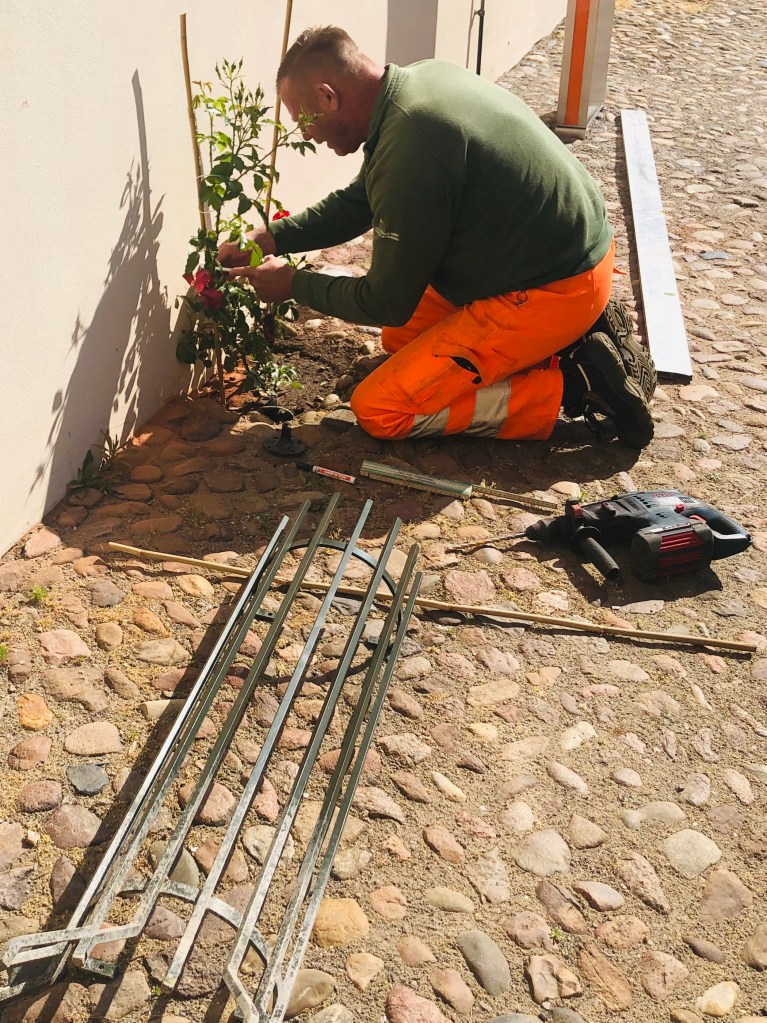
Well, we still have icy weather – despite glorious sunshine. Outside a proper steel frame has been fixed for the Old Latin School´s own “red rose”. Hallelujah.  And I´m looking forward to another interview by my new friends from Hong Kong later. So for now we rejoice in the Lord and sing His praises for all the Saints…

1 For all the saints who from their labors rest,
who thee by faith before the world confessed,
thy name, O Jesus, be forever blest.
Alleluia! Alleluia!

2 Thou wast their rock, their fortress, and their might;
thou, Lord, their captain in the well-fought fight;
thou, in the darkness drear, their one true light.
Alleluia! Alleluia!

3 O may thy soldiers, faithful, true, and bold,
fight as the saints who nobly fought of old,
and win with them the victor’s crown of gold.
Alleluia! Alleluia!

4 O blest communion, fellowship divine,
we feebly struggle, they in glory shine;
yet all are one in thee, for all are thine.
Alleluia! Alleluia!

5 And when the fight is fierce, the warfare long,
steals on the ear the distant triumph song,
and hearts are brave again, and arms are strong.
Alleluia! Alleluia!

6 The golden evening brightens in the west;
soon, soon to faithful warrior cometh rest;
sweet is the calm of paradise the blest.
Alleluia! Alleluia!

7 But lo! there breaks a yet more glorious day;
the saints triumphant rise in bright array;
the King of glory passes on his way.
Alleluia! Alleluia!

8 From earth’s wide bounds, from ocean’s farthest coast,
through gates of pearl streams in the countless host,
singing to Father, Son, and Holy Ghost,
Alleluia! Alleluia!

William W. How (1823-1897)
Posted in Gedankensplitter, Inside Germany, Saints of the church | Tagged , , , | Leave a comment

Savior, like a shepherd lead us…

When our good Lord – the very Good Shepherd – saw the multitudes, he had compassion on them,

because they were bewildered and helpless, like sheep without a shepherd. Then he said to his disciples, “The harvest is plentiful, but the workers are few. Therefore ask the Lord of the harvest to send out workers into his harvest-ready fields.

Mt.9:36-38

This admonition of our Lord has been heeded over centuries – and the triune God has answered this prayer of His Holy Christian Church according to His unfailing gracious favor, mercy and kindness. We praise Him for that and pray that He will continue to send out workers into His global harvest.

And those called in the name of our good Lord to serve His people faithfully as pastors, bishops, teachers, evangelists and missionaries are well advised to rejoice in their precious calling, which is truly wonderful, lovely and most helpful and uplifting – thanks to the divine consecration of this holy office of being shepherds of our good Lord´s flock as J.H. Jowett writes:

It is our God-appointed office to lead men and woman who are weary and wayward, exultant or depressed, eager or indifferent, into “the secret place of the Most High”. We are to help the sinful to the fountain of cleansing, the bond slaves to the wonderful songs of deliverance. We want to help the halt and the lame to recover their lost nimbleness. We are to help the broken-winged into the healing light of “the heavenly places in Christ Jesus.” We are to help the sad into the sunshine of grace. We are to help the buoyant to clothe themselves with “the garment of praise.” We are to help redeem the strong from the atheism of despair. We are to help little children to see the glorious attractiveness of God, and we are to help the aged realize the encompassing care of the Father and the assurance of the eternal home.

J.H. Jowett quoted in Doberstein Pg. 351

We, as members of the Holy Christian Church, continue to sing and plead the Good Shepherd himself with prayers and petitions:

1 Savior, like a shepherd lead us,
Much we need Thy tender care;
In Thy pleasant pastures feed us,
For our use Thy folds prepare:
Blessèd Jesus, blessèd Jesus,
Thou hast bought us, Thine we are;
Blessèd Jesus, blessèd Jesus,
Thou hast bought us, Thine we are.

2 We are Thine, do Thou befriend us,
Be the guardian of our way;
Keep Thy flock, from sin defend us,
Seek us when we go astray:
Blessèd Jesus, blessèd Jesus,
Hear, O hear us when we pray;
Blessèd Jesus, blessèd Jesus,
Hear, O hear us when we pray.

3 Thou hast promised to receive us,
Poor and sinful though we be;
Thou hast mercy to relieve us,
Grace to cleanse, and pow’r to free:
Blessèd Jesus, blessèd Jesus,
Early let us turn to Thee;
Blessèd Jesus, blessèd Jesus,
Early let us turn to Thee.

4 Early let us seek Thy favor,
Early let us do Thy will;
Blessed Lord and only Savior,
With Thy love our bosoms fill:
Blessèd Jesus, blessèd Jesus,
Thou hast loved us, love us still;
Blessèd Jesus, blessèd Jesus,
Thou hast loved us, love us still.

Dorothy Ann Thrupp (1779-1847)
Posted in Eastertide, Gedankensplitter | Tagged , , , , , , | Leave a comment

The summons of death comes to all of us…

Luther´s return from the Wartburg was risky business, but the theological doctor, pastor and professor foresaw worse if he´d remain hidden in exile and not address the serious issues in Wittenberg, but let the riot run loose. In Wittenberg things were getting out of hand. Luther´s colleagues, Karlstadt and Zwilling, who both did not have authorization to preach, had despite this lack of authorization taken over a leading role in the rebellion and were driving radical reform and iconoclasm despite growing protests from various quarters.

Although Martin Luther actually shared many of the theological concerns of these mavericks, he adamantly opposed their forceful uprising. He was painfully aware that timid consciences and hesitant believers could hastily be pressed into dramatic actions which could have unforeseen and even negative consequences and which they would afterwards regret, especially if they were not done out of faithful conviction and just motives. Luther put all emphasis on faith. This he wanted to gain and promote by transparent argumentation and evangelical motivation, but rejected forceful intimidation and populist short-term gains. He saw the decisive tool for reform and church edification in preaching and teaching of Christian freedom, which would take into account the consequences for my neighbor and the fruits for fellow human beings. After all, he was a close follower of the apostle´s teaching as we find spelt out in St. Paul´s letter to the Romans in the 14th chapter in taking cogniscience of the weak in faith.

So, although the elector foresaw lots of trouble and feared that he would not be able to protect the reformer as effectively in Wittenberg as in exile on the Wartburg, Luther came anyway. Luther was convinced, that in the end, he could protect the elector and all politicians better through the gospel work he was doing, than other way round. He also had a strong and definite calling. Not only was he called to serve as Doctor of theology and thus had a responsibility to colleagues and students at the university in Wittenberg, but he also had a definite, public and proper call as preacher and teacher of the city church. The elector kept this letter by the local parish to Luther from publication for political reasons, but Luther knew about it and mentions it in his first sermon on Invocavit. The political considerations were to prevent the emperor any excuse to press for the forceful extradition of the reformer – and Luther cooperated – at least partly. He did not teach at the university until 1524! Luther used the bible translation as an excuse for his “forced sabbatical” at the university, but he saw his main purpose and calling to preach the gospel truth in St. Marys. So, he really did put the gospel on a lampstand – and did the work of a preacher with determination, dedication – and great success. His preaching turned that place around – from hedious and destructive revolt back to constructive reform!

He preached on the prescribed gospel lesson on Sunday mornings and at noon he would do cursory sermons on certain books of the bible – like the letters by St. Peter and also by St. James (!), but also for many years on Genesis. Georg Rörer and Stephan Roth wrote many of those freeliy spoken sermons down, so that we have most of his sermons in written form even today. Although Luther himself wanted people to read the bible more than anything else and he himself feared, that people would misunderstand, misinterpret and misquote him, he reluctantly agreed to have his sermons be duplicated – and they sure did spread like wild fires.

Martin Brecht quotes Albert Burer, who describes Luther´s pleasant persona on the pulpit which he experienced first-hand in student days: “His facial expression was kind, good hearted and cheerful. His voice was sweet und harmonious – and his manner of speaking was impressive and convincing.” (Pg. 64) If You look at the portrait by Lucas Cranach painted in the years 1522-1524 it looks quite in line with that student´s description: What a friendly, kind and handsome young man Luther was!

The Invocavit sermons are a good example of Luther´s profound homiletic mastery. His latter catechism sermons prove that too. They brought about change to Wittenberg, turned the enthusiastic revolution and populist uprising back into patient, enduring and hard-working reform. It was going to be an ongoing struggle – teaching that Christian freedom goes hand-in-hand with responsibility and loving care for one’s neighbor and not just liberty at all costs. Luther did not dodge thorny issues, but addressed them head on as they came up. Masterfully and successfully he guided the congregation and town back from rebellion into ongoing reform – proving himself not only a brilliant theologian, but also a true pastor and bishop of the church.  Thank God for that!

Here now the first sermon – preached by Luther in Wittenberg on Invocavit 1522 – read in German and then in the English translation by John W. Dobberstein:

The summons of death comes to us all, and no one can die for another. Every one must fight his own battle with death by himself, alone. We can shout into another’s ears, but every one must himself be prepared for the time of death, for I will not be with you then, nor you with me. Therefore every one must himself know and be armed with the chief things which concern a Christian. And these are what you, my beloved, have heard from me many days ago.

In the first place, we must know that we are the children of wrath, and all our works, intentions, and thoughts are nothing at all. Here we need a clear, strong text to bear out this point. Such is the saying of St. Paul in Eph. 2 [:3]. Note this well; and though there are many such in the Bible, I do not wish to overwhelm you with many texts. “We are all the children of wrath.” And please do not undertake to say: I have built an altar, given a foundation for masses, etc.

Secondly, that God has sent us his only-begotten Son that we may believe in him and that whoever trusts in him shall be free from sin and a child of God, as John declares in his first chapter, “To all who believed in his name, he gave power to become children of God” [John 1:12]. Here we should all be well versed in the Bible and ready to confront the devil with many passages. With respect to these two points I do not feel that there has been anything wrong or lacking. They have been rightly preached to you, and I should be sorry if it were otherwise. Indeed, I am well aware and I dare say that you are more learned than I, and that there are not only one, two, three, or four, but perhaps ten or more, who have this knowledge and enlightenment.

Thirdly, we must also have love and through love we must do to one another as God has done to us through faith. For without love faith is nothing, as St. Paul says (1 Cor. 2 [13:1]): If I had the tongues of angels and could speak of the highest things in faith, and have not love, I am nothing. And here, dear friends, have you not grievously failed? I see no signs of love among you, and I observe very well that you have not been grateful to God for his rich gifts and treasures.

Here let us beware lest Wittenberg become Capernaum [cf. Matt. 11:23]. I notice that you have a great deal to say of the doctrine of faith and love which is preached to you, and this is no wonder; an ass can almost intone the lessons, and why should you not be able to repeat the doctrines and formulas? Dear friends, the kingdom of God,—and we are that kingdom—does not consist in talk or words [1 Cor. 4:20], but in activity, in deeds, in works and exercises. God does not want hearers and repeaters of words [Jas. 1:22], but followers and doers, and this occurs in faith through love. For a faith without love is not enough—rather it is not faith at all, but a counterfeit of faith, just as a face seen in a mirror is not a real face, but merely the reflection of a face [1 Cor. 13:12].

Fourthly, we also need patience. For whoever has faith, trusts in God, and shows love to his neighbor, practicing it day by day, must needs suffer persecution. For the devil never sleeps, but constantly gives him plenty of trouble. But patience works and produces hope [Rom. 5:4], which freely yields itself to God and vanishes away in him. Thus faith, by much affliction and persecution, ever increases, and is strengthened day by day. A heart thus blessed with virtues can never rest or restrain itself, but rather pours itself out again for the benefit and service of the brethren, just as God has done to it.

And here, dear friends, one must not insist upon his rights, but must see what may be useful and helpful to his brother, as Paul says, Omnia mihi licent, sed non omnia expediunt, “ ‘All things are lawful for me,’ but not all things are helpful” [1 Cor. 6:12]. For we are not all equally strong in faith, some of you have a stronger faith than I. Therefore we must not look upon ourselves, or our strength, or our prestige, but upon our neighbor, for God has said through Moses: I have borne and reared you, as a mother does her child [Deut. 1:31]. What does a mother do to her child? First she gives it milk, then gruel, then eggs and soft food, whereas if she turned about and gave it solid food, the child would never thrive [cf. 1 Cor. 3:2; Heb. 5:12–13]. So we should also deal with our brother, have patience with him for a time, have patience with his weakness and help him bear it; we should also give him milk-food, too [1 Pet. 2:2; of. Rom. 14:1–3], as was done with us, until he, too, grows strong, and thus we do not travel heavenward alone, but bring our brethren, who are not now our friends, with us. If all mothers were to abandon their children, where would we have been? Dear brother, if you have suckled long enough, do not at once cut off the breast, but let your brother be suckled as you were suckled. I would not have gone so far as you have done, if I had been here. The cause is good, but there has been too much haste. For there are still brothers and sisters on the other side who belong to us and must still be won.

Let me illustrate. The sun has two properties, light and heat. No king has power enough to bend or guide the light of the sun; it remains fixed in its place. But the heat may be turned and guided, and yet is ever about the sun. Thus faith must always remain pure and immovable in our hearts, never wavering; but love bends and turns so that our neighbor may grasp and follow it. There are some who can run, others must walk, still others can hardly creep [cf. 1 Cor. 8:7–13]. Therefore we must not look upon our own, but upon our brother’s powers, so that he who is weak in faith, and attempts to follow the strong, may not be destroyed of the devil. Therefore, dear brethren, follow me; I have never been a destroyer. And I was also the very first whom God called to this work. I cannot run away, but will remain as long as God allows. I was also the one to whom God first revealed that his Word should be preached to you. I am also sure that you have the pure Word of God.

Let us, therefore, let us act with fear and humility, cast ourselves at one another’s feet, join hands with each other, and help one another. I will do my part, which is no more than my duty, for I love you even as I love my own soul. For here we battle not against pope or bishop, but against the devil [cf. Eph. 6:12], and do you imagine he is asleep? He sleeps not, but sees the true light rising, and to keep it from shining into his eyes he would like to make a flank attack—and he will succeed, if we are not on our guard. I know him well, and I hope, too, that with the help of God, I am his master. But if we yield him but an inch, we must soon look to it how we may be rid of him. Therefore all those have erred who have helped and consented to abolish the mass; not that it was not a good thing, but that it was not done in an orderly way. You say it was right according to the Scriptures. I agree, but what becomes of order? For it was done in wantonness, with no regard for proper order and with offense to your neighbor. If, beforehand, you had called upon God in earnest prayer, and had obtained the aid of the authorities, one could be certain that it had come from God. I, too, would have taken steps toward the same end if it had been a good thing to do; and if the mass were not so evil a thing, I would introduce it again. For I cannot defend your action, as I have just said. To the papists and blockheads I could defend it, for I could say: How do you know whether it was done with good or bad intention, since the work in itself was really a good work? But I would not know what to assert before the devil. For if on their deathbeds the devil reminds those who began this affair of texts like these, “Every plant which my Father has not planted will be rooted up” [Matt. 15:13], or “I have not sent them, yet they ran” [Jer. 23:21],2 how will they be able to withstand? He will cast them into hell. But I shall poke the one spear into his face, so that even the world will become too small for him, for I know that in spite of my reluctance I was called by the council to preach. Therefore I was willing to accept you as you were willing to accept me, and, besides, you could have consulted me about the matter.

I was not so far away that you could not reach me with a letter, whereas not the slightest communication was sent to me. If you were going to begin something and make me responsible for it, that would have been too hard. I will not do it [i.e., assume the responsibility]. Here one can see that you do not have the Spirit, even though you do have a deep knowledge of the Scriptures. Take note of these two things, “must” and “free.” The “must” is that which necessity requires, and which must ever be unyielding; as, for instance, the faith, which I shall never permit any one to take away from me, but must always keep in my heart and freely confess before every one. But “free” is that in which I have choice, and may use or not, yet in such a way that it profit my brother and not me. Now do not make a “must” out of what is “free,” as you have done, so that you may not be called to account for those who were led astray by your loveless exercise of liberty. For if you entice any one to eat meat on Friday, and he is troubled about it on his deathbed, and thinks, Woe is me, for I have eaten meat and I am lost! God will call you to account for that soul. I, too, would like to begin many things, in which but few would follow me, but what is the use? For I know that, when it comes to the showdown, those who have begun this thing cannot maintain themselves, and will be the first to retreat. How would it be, if I brought the people to the point of attack, and though I had been the first to exhort others, I would then flee, and not face death with courage? How the poor people would be deceived!

Let us, therefore, feed others also with the milk which we received, until they, too, become strong in faith. For there are many who are otherwise in accord with us and who would also gladly accept this thing, but they do not yet fully understand it—these we drive away. Therefore, let us show love to our neighbors; if we do not do this, our work will not endure. We must have patience with them for a time, and not cast out him who is weak in faith; and do and omit to do many other things, so long as love requires it and it does no harm to our faith. If we do not earnestly pray to God and act rightly in this matter, it looks to me as if all the misery which we have begun to heap upon the papists will fall upon us. Therefore I could no longer remain away, but was compelled to come and say these things to you.

This is enough about the mass; tomorrow we shall speak about images.

The First Sermon, March 9, 1522, Invocavit Sunday1

Lord of our life, and God of our salvation,
Star of our night, and hope of ev’ry nation,
Hear and receive thy church’s supplication,
Lord God Almighty.

See round thine ark the hungry billows curling,
See how thy foes their banners are unfurling;
Lord, while their darts envenomed they are hurling,
Thou canst preserve us.

Lord, thou canst help when earthly armor faileth;
Lord, thou canst save when sin itself assaileth;
Christ, o’er thy Rock nor death nor hell prevaileth:
Grant us thy peace, Lord:

Peace in our hearts, our evil thoughts assuaging,
Peace in thy church, where brothers are engaging,
Peace, when the world its busy war is waging:
Calm thy foes’ raging.

Grant us thy help till backward they are driven;
Grant them thy truth, that they may be forgiven;
Grant peace on earth, or, after we have striven,
Peace in thy heaven.

Matthäus Apelles von Löwenstern (1594-1648)
Posted in Histories, Martin Luther and the Reformation, Sermon | Tagged , , , , , | Leave a comment

Church of God, elect and glorious…

Well, two tramps dropped in this morning. Funny guys. Friendly too. The one was dressed up in clerical vestments. I presume, Karlstadt looked something like that. Not shaved, green stole even in this festive Eastertide and without collar, but blue shirt sticking out brazenly though his impressive grey mane probably covered a whole multitude of sins (cf. 1. Pt.4,8) still. That was the German bloke. The other – shortish, bad teeth, but wide grin, good hiking shoes – spoke English (or was it Irish?). Both looking for a baker or coffee shop. They had made their way from the station, but as it was just after 6h00, they had not struck it lucky yet. It´s no longer freezing, but at 3° it´s prudent to find a warm place to thaw out the night´s frost. So, they walked into the wide-open doors of our bookshop. There was nobody at the desk. I was busy in the chapel.

Well, it was a lively meeting once we did meet. They obviously had a whole repertoire of scenes to play out – pastoral, political, cultural and plain witty too. They were both so quick to respond, quick to test, quick to laugh, quick to pick up any cue on offer being as sober as the early hour would suggest (cf. Acts 2). So, we had our fun warm-up sparring together. I made no sales. They didn´t book a room either, but I´m sure, they will return in good time even if only to try more quirks and inklings in their impressive range. Well, on these cold days of the Ice Saints (11-15th May) it´s good to find a place like the Old Latin School, that´s open for all and everyone even early in the chilly morning.  You can look forward to warmer days as the local farmer´s wisdom assures, that frost is unlikely after the holiday of Servatius:

“Servaz muss vorüber sein, willst vor Nachtfrost sicher sein.”

Bauernregel

Today is the holiday of St. Servatius of Tongeren – a special saint from Armenia – working in Germany during the 4th century. That´s why the legend, that he baptized Attila the Hun in the 5th century is probably just a fable just like his illustrious family tree linking him to John the Baptist and thus even to our good Lord and Saviour. However, he was firmly on the side of St. Athanasius during that bishop´s exile in Trier. Like him and other faithful Trinitarian theologians, St. Servatius fought actively against the heretic Arians. That sure is a reason to recap this history today and hope to travel to Maastricht to see the legacy of this Saint one of these days for myself, once travel restrictions are lifted.

Until then we will wait patiently, count our many blessings and continue to rejoice in our good Lord, who calls people like Servatius to make them pillars of faith for generations to come. We sing and praise Him for His Holy Church – elect and glorious – from all nations and throughout the ages:

1 Church of God, elect and glorious,
holy nation, chosen race;
called as God’s own special people,
royal priests and heirs of grace:
know the purpose of your calling,
show to all his mighty deeds;
tell of love which knows no limits,
grace which meets all human needs.

2 God has called you out of darkness
into his most marvellous light;
brought his truth to life within you,
turned your blindness into sight.
Let your light so shine around you
that God’s name is glorified;
and all find fresh hope and purpose
in Christ Jesus crucified.

3 Once you were an alien people,
strangers to God’s heart of love;
but he brought you home in mercy,
citizens of heaven above.
Let his love flow out to others,
let them feel a Father’s care;
that they too may know his welcome
and his countless blessings share.

4 Church of God, elect and holy,
be the people he intends;
strong in faith and swift to answer
each command your master sends:
royal priests, fulfil your calling
through your sacrifice and prayer;
give your lives in joyful service
sing his praise, his love declare.

James E Seddon (1915 – 1983)
Posted in Gedankensplitter, Histories, biographies and other stories, Sights and pictures | Tagged , , , , , | Leave a comment

What to look for in the gospels…

After his grandstand at the diet in Worms before emperor Charles V the banned and kidnapped Luther was banished on the Wartburg (1521). Not one to let an opportunity to spread the gospel go by, he got cracking and down to serious work – the most memorable and impressive was his translation of the Greek New Testament in just 11 weeks.

Although there were 14 German translations of the NT by 1520 – time was ripe for another one. The new movement was kickstarted by Luther´s new insights into the Bible and especially the theology of St. Paul, the Psalms and prophets of old. He used the Greek edition published by Erasmus of Rotterdam, knew the Vulgate by heart, and carried a Hebrew version of the Psalms with him, when he secretly ventured back into Wittenberg under cover – during the riots led on by the enthusiasts Karlstadt and Zwilling. However, ML wanted everyone to read the bible itself – not just have the masses follow some lead of loose cannons and theological renegades and wise cracks. He valued God´s Word much too highly for such misuse. “Die Anfechtung lehrt auf´s Wort achten!” Temptation, persecution and opposition led him back into the Word for truth, guidance and divine support as his later description of theology based on David´s Psalm 119 would summarize: “Oratio meditatio tentatio faciunt theologum” – and this also made him praise the devil and his many enemies as excellent tutors, because they led him back into the Holy Scriptures.

Melanchthon and Spalatin supported him in various ways during the translation. Sadly, the latter couldn´t come up with a map of Palastine as planned. So in the end Melchior Lotter jr published this bestseller for the editors Cranach and Düring – and the finished book was ready before the 21st of September 1522. Luther didn´t make any money with this, but the publishers nursed an ever-growing purse. ML not even got sufficient free copies to distribute. That was somewhat unfair and even got ML upset – according to his biographer Brecht.

Luther´s translation was topnotch. Not only was it intelligible, it was a literary highlight and most suitable for loud reading. He had an ear for the language and was able to touch people’s hearts and minds too.  He gave a number of notations along with the text – much like the Lutheran Study Bible (CPH) does today. Every book was introduced most helpfully by Luther – and this cast a very special light on the text. It was to promote IX – as savior of the world and redeemer of sinners – that was his overall criteria and benchmark. His introduction to the St.Paul´s letter to the Romans is still a classic reflection of the Christian doctrine of Justification of sinners by grace through faith alone. A number of woodcuts illustrate passages – many of them the visions in the Revelation of St. John. The book was a clear winner – and although more than 3000 were printed in September and next edition was required in December already. This enabled corrections, alterations and improvements too – and made ML a best-seller for ages to come.

The Old Testament translation was an even bigger task and far greater challenge. For economic reasons (i.e. to make it cheaper and affordable) ML wanted to divide this into three parts. In the end it became four. The Pentateuch was ready by mid-December 1522. The 2nd part (Joshua – Esther) was ready a year later and then the work on the 3rd part started. This was hard going. Especially Job challenged the Reformer. He comments: “Job would be just as unhappy with me than with his old friends, but he should at least appreciate that now his writings were comprehensible.” (cf. Brecht II, Pg.62). In Autumn 1523 the poetic books were published. The final version with the prophets was only done by the end of 1532. That´s after nearly a decade. As in the NT – ML´s introductions to the various parts and books of the bible are remarkable studies in theology and worth special and lasting attention.  

Here is Martin Luther´s brief instruction on what to look for and expect in the Gospels. First as a reading in German – but also in the English translation by E. Theodore Bachmann. It is ML´s introduction his “Wartburg Postille”: Model sermons on the epistles and gospels of the church year. The venerable Dr. Martin Luther writes:

It is a common practice to number the gospels and to name them by books and say that there are four gospels. From this practice stems the fact that no one knows what St. Paul and St. Peter are saying in their epistles, and their teaching is regarded as an addition to the teaching of the gospels, in a vein similar to that of Jerome’s introduction. There is, besides, the still worse practice of regarding the gospels and epistles as law books in which is supposed to be taught what we are to do and in which the works of Christ are pictured to us as nothing but examples. Now where these two erroneous notions remain in the heart, there neither the gospels nor the epistles may be read in a profitable or Christian manner, and [people] remain as pagan as ever.
One should thus realize that there is only one gospel, but that it is described by many apostles. Every single epistle of Paul and of Peter, as well as the Acts of the Apostles by Luke, is a gospel, even though they do not record all the works and words of Christ, but one is shorter and includes less than another. There is not one of the four major gospels anyway that includes all the words and works of Christ; nor is this necessary. Gospel is and should be nothing else than a discourse or story about Christ, just as happens among men when one writes a book about a king or a prince, telling what he did, said, and suffered in his day. Such a story can be told in various ways; one spins it out, and the other is brief. Thus the gospel is and should be nothing else than a chronicle, a story, a narrative about Christ, telling who he is, what he did, said, and suffered—a subject which one describes briefly, another more fully, one this way, another that way.
For at its briefest, the gospel is a discourse about Christ, that he is the Son of God and became man for us, that he died and was raised, that he has been established as a Lord over all things. This much St. Paul takes in hand and spins out in his epistles. He bypasses all the miracles and incidents [in Christ’s ministry] which are set forth in the four gospels, yet he includes the whole gospel adequately and abundantly. This may be seen clearly and well in his greeting to the Romans [1:1–4], where he says what the gospel is, and declares, “Paul, a servant of Jesus Christ, called to be an apostle, set apart for the gospel of God which he promised beforehand through his prophets in the holy scriptures, the gospel concerning his Son, who was descended from David according to the flesh and designated Son of God in power according to the Spirit of holiness by his resurrection from the dead, Jesus Christ our Lord,” etc.
There you have it. The gospel is a story about Christ, God’s and David’s Son, who died and was raised and is established as Lord. This is the gospel in a nutshell. Just as there is no more than one Christ, so there is and may be no more than one gospel. Since Paul and Peter too teach nothing but Christ, in the way we have just described, so their epistles can be nothing but the gospel.
Yes even the teaching of the prophets, in those places where they speak of Christ, is nothing but the true, pure, and proper gospel—just as if Luke or Matthew had described it. For the prophets have proclaimed the gospel and spoken of Christ, as St. Paul here [Rom. 1:2] reports and as everyone indeed knows. Thus when Isaiah in chapter fifty-three says how Christ should die for us and bear our sins, he has written the pure gospel. And I assure you, if a person fails to grasp this understanding of the gospel, he will never be able to be illuminated in the Scripture nor will he receive the right foundation.
Be sure, moreover, that you do not make Christ into a Moses, as if Christ did nothing more than teach and provide examples as the other saints do, as if the gospel were simply a textbook of teachings or laws. Therefore you should grasp Christ, his words, works, and sufferings, in a twofold manner. First as an example that is presented to you, which you should follow and imitate. As St. Peter says in 1 Peter 4, “Christ suffered for us, thereby leaving us an example.” Thus when you see how he prays, fasts, helps people, and shows them love, so also you should do, both for yourself and for your neighbor. However this is the smallest part of the gospel, on the basis of which it cannot yet even be called gospel. For on this level Christ is of no more help to you than some other saint. His life remains his own and does not as yet contribute anything to you. In short this mode [of understanding Christ as simply an example] does not make Christians but only hypocrites. You must grasp Christ at a much higher level. Even though this higher level has for a long time been the very best, the preaching of it has been something rare. The chief article and foundation of the gospel is that before you take Christ as an example, you accept and recognize him as a gift, as a present that God has given you and that is your own. This means that when you see or hear of Christ doing or suffering something, you do not doubt that Christ himself, with his deeds and suffering, belongs to you. On this you may depend as surely as if you had done it yourself; indeed as if you were Christ himself. See, this is what it means to have a proper grasp of the gospel, that is, of the overwhelming goodness of God, which neither prophet, nor apostle, nor angel was ever able fully to express, and which no heart could adequately fathom or marvel at. This is the great fire of the love of God for us, whereby the heart and conscience become happy, secure, and content. This is what preaching the Christian faith means. This is why such preaching is called gospel, which in German means a joyful, good, and comforting “message”; and this is why the apostles are called the “twelve messengers.”
Concerning this Isaiah 9[:6] says, “To us a child is born, to us a son is given.” If he is given to us, then he must be ours; and so we must also receive him as belonging to us. And Romans 8[:32], “How should [God] not give us all things with his Son?” See, when you lay hold of Christ as a gift which is given you for your very own and have no doubt about it, you are a Christian. Faith redeems you from sin, death, and hell and enables you to overcome all things. O no one can speak enough about this. It is a pity that this kind of preaching has been silenced in the world, and yet boast is made daily of the gospel.
Now when you have Christ as the foundation and chief blessing of your salvation, then the other part follows: that you take him as your example, giving yourself in service to your neighbor just as you see that Christ has given himself for you. See, there faith and love move forward, God’s commandment is fulfilled, and a person is happy and fearless to do and to suffer all things. Therefore make note of this, that Christ as a gift nourishes your faith and makes you a Christian. But Christ as an example exercises your works. These do not make you a Christian. Actually they come forth from you because you have already been made a Christian. As widely as a gift differs from an example, so widely does faith differ from works, for faith possesses nothing of its own, only the deeds and life of Christ. Works have something of your own in them, yet they should not belong to you but to your neighbor.
So you see that the gospel is really not a book of laws and commandments which requires deeds of us, but a book of divine promises in which God promises, offers, and gives us all his possessions and benefits in Christ. The fact that Christ and the apostles provide much good teaching and explain the law is to be counted a benefit just like any other work of Christ. For to teach aright is not the least sort of benefit. We see too that unlike Moses in his book, and contrary to the nature of a commandment, Christ does not horribly force and drive us. Rather he teaches us in a loving and friendly way. He simply tells us what we are to do and what to avoid, what will happen to those who do evil and to those who do well. Christ drives and compels no one. Indeed he teaches so gently that he entices rather than commands. He begins by saying, “Blessed are the poor, Blessed are the meek,” and so on [Matt. 5:3, 5]. And the apostles commonly use the expression, “I admonish, I request, I beseech,” and so on. But Moses says, “I command, I forbid,” threatening and frightening everyone with horrible punishments and penalties. With this sort of instruction you can now read and hear the gospels profitably.
When you open the book containing the gospels and read or hear how Christ comes here or there, or how someone is brought to him, you should therein perceive the sermon or the gospel through which he is coming to you, or you are being brought to him. For the preaching of the gospel is nothing else than Christ coming to us, or we being brought to him. When you see how he works, however, and how he helps everyone to whom he comes or who is brought to him, then rest assured that faith is accomplishing this in you and that he is offering your soul exactly the same sort of help and favor through the gospel. If you pause here and let him do you good, that is, if you believe that he benefits and helps you, then you really have it. Then Christ is yours, presented to you as a gift.
After that it is necessary that you turn this into an example and deal with your neighbor in the very same way, be given also to him as a gift and an example. Isaiah 40[:1, 2] speaks of that, “Be comforted, be comforted my dear people, says your Lord God. Say to the heart of Jerusalem, and cry to her, that her sin is forgiven, that her iniquity is ended, that she has received from the hand of God a double kindness for all her sin,” and so forth. This double kindness is the twofold aspect of Christ: gift and example. These two are also signified by the double portion of the inheritance which the law of Moses [Deut. 21:17] assigns to the eldest son and by many other figures.
What a sin and shame it is that we Christians have come to be so neglectful of the gospel that we not only fail to understand it, but even have to be shown by other books and commentaries what to look for and what to expect in it. Now the gospels and epistles of the apostles were written for this very purpose. They want themselves to be our guides, to direct us to the writings of the prophets and of Moses in the Old Testament so that we might there read and see for ourselves how Christ is wrapped in swaddling cloths and laid in the manger [Luke 2:7], that is, how he is comprehended [Vorfassett] in the writings of the prophets. It is there that people like us should read and study, drill ourselves, and see what Christ is, for what purpose he has been given, how he was promised, and how all Scripture tends toward him. For he himself says in John 5[:46], “If you believed Moses, you would also believe me, for he wrote of me.” Again [John 5:39], “Search and look up the Scriptures, for it is they that bear witness to me.”
This is what St. Paul means in Romans 1[:1, 2], where in the beginning he says in his greeting, “The gospel was promised by God through the prophets in the Holy Scriptures.” This is why the evangelists and apostles always direct us to the Scriptures and say, “Thus it is written,” and again, “This has taken place in order that the writing of the prophets might be fulfilled,” and so forth. In Acts 17[:11], when the Thessalonians heard the gospel with all eagerness, Luke says that they studied and examined the Scriptures day and night in order to see if these things were so. Thus when St. Peter wrote his epistle, right at the beginning [1 Pet. 1:10–12] he says, “The prophets who prophesied of the grace that was to be yours searched and inquired about this salvation; they inquired what person or time was indicated by the Spirit of Christ within them; and he bore witness through them to the sufferings that were to come upon Christ and the ensuing glory. It was revealed to them that they were serving not themselves but us, in the things which have now been preached among you through the Holy Spirit sent from heaven, things which also the angels long to behold.” What else does St. Peter here desire than to lead us into the Scriptures? It is as if he should be saying, “We preach and open the Scriptures to you through the Holy Spirit, so that you yourselves may read and see what is in them and know of the time about which the prophets were writing.” For he says as much in Acts 4[3:24], “All the prophets who ever prophesied, from Samuel on, have spoken concerning these days.”
Therefore also Luke, in his last chapter [24:45], says that Christ opened the minds of the apostles to understand the Scriptures. And Christ, in John 10[:9, 3], declares that he is the door by which one must enter, and whoever enters by him, to him the gatekeeper (the Holy Spirit) opens in order that he might find pasture and blessedness. Thus it is ultimately true that the gospel itself is our guide and instructor in the Scriptures, just as with this foreword I would gladly give instruction and point you to the gospel.
But what a fine lot of tender and pious children we are! In order that we might not have to study in the Scriptures and learn Christ there, we simply regard the entire Old Testament as of no account, as done for and no longer valid. Yet it alone bears the name of Holy Scripture. And the gospel should really not be something written, but a spoken word which brought forth the Scriptures, as Christ and the apostles have done. This is why Christ himself did not write anything but only spoke. He called his teaching not Scripture but gospel, meaning good news or a proclamation that is spread not by pen but by word of mouth. So we go on and make the gospel into a law book, a teaching of commandments, changing Christ into a Moses, the One who would help us into simply an instructor.
What punishment ought God to inflict upon such stupid and perverse people! Since we abandoned his Scriptures, it is not surprising that he has abandoned us to the teaching of the pope and to the lies of men. Instead of Holy Scripture we have had to learn the Decretales of a deceitful fool and an evil rogue. O would to God that among Christians the pure gospel were known and that most speedily there would be neither use nor need for this work of mine. Then there would surely be hope that the Holy Scriptures too would come forth again in their worthiness. Let this suffice as a very brief foreword and instruction. In the exposition we will say more about this matter. Amen.

Luther Works Volume 35, Pg.117-129

And we sing with Martin Franzmann: Thy strong Word did cleave the darkness…

Posted in Bibel und Übersetzung, Lectionary etc, Martin Luther and the Reformation | Tagged , , , , , | Leave a comment