Grant us Your Spirit of Truth and Peace, that we may understand Your holy Will and follow Your Directions and trust Your Promises from the bottom of our heart all our life.
Through Jesus Christ our Lord, who lives and reigns with You and the Holy Spirit – one God – now + forever.
Amen
Now the Spirit explicitly says that in the later times some will desert the faith and occupy themselves with deceiving spirits and demonic teachings, influenced by the hypocrisy of liars whose consciences are seared. They will prohibit marriage and require abstinence from foods that God created to be received with thanksgiving by those who believe and know the truth. For every creation of God is good and no food is to be rejected if it is received with thanksgiving. For it is sanctified by God’s word and by prayer.
St. Paul in the first epistle to St. Timothy in the 4th chapter verses 1-5
1 Now thank we all our God with heart and hands and voices, who wondrous things has done, in whom his world rejoices; who from our mothers’ arms has blessed us on our way with countless gifts of love, and still is ours today.
2 O may this bounteous God through all our life be near us, with ever joyful hearts and blessed peace to cheer us, to keep us in his grace, and guide us when perplexed, and free us from all ills of this world in the next.
3 All praise and thanks to God the Father now be given, the Son and Spirit blest, who reign in highest heaven the one eternal God, whom heaven and earth adore; for thus it was, is now, and shall be evermore.
In Luther´s time, democracy was far off. Germany was at best a vague idea and not even the language was anywhere near to being uniform in the various landscapes north of the Alps. He was always a citizen of electoral Saxony and had three different rulers in this time.
First off was elector Frederick III – called the Wise (1463-1525) – got the Reformation off to a good if somewhat hesitant start despite Worms and Luther´s subsequent banishment to and exile on the Wartburg. Even when Luther was far too confrontational in his theological dealings and maneuvers for Frederick´s liking, he never withdrew his hesitant support. He remained the ever cautious diplomat and wise politician. The two men never got to meet each other personally and most business was negotiated between them by the faithful Georg Spalatin.
When the bachelor duke died in May 1525 he was succeeded by his younger brother Johann the Constant (1468-1532). He took over the reign of the electoral duchy Saxony. He was in frequent contact with Luther and actively promoted the reformation – even through and past the crucial Augsburg diet of 1530.
Luther often expressed a positive opinion about John, especially for his behavior at the Diet of Augsburg in 1530, he praised him very much: “I am sure that the Elector Johann of Saxony had the Holy Spirit. In Augsburg he proved this admirably by his confession. John said, ‘Tell my scholars that they are doing what is right, praise and honor God, and take no regard for me or my country.'”
John the steadfast and his first wife Sophie von Mecklenburg
It was a blow for the reformation, when he passed away in 1532, as Luther feared the worst. He was skeptical, whether the duke´s son Johann Friedrich – the benevolent – would live up to the wisdom and steadfastness of his predecessors. This was partly due to his more extravagant lifestyle and somewhat excessive alcohol consumption. However, Luther´s fears were mostly dispelled as the young man promoted the reformation faithfully – and finally even paid for this support with his freedom and post – but that is another story, which only ends after Luther´s death in 1546.
Johann Friedrich I and his wife Sybille of Cleve
During, but especially after the peasant uprising Luther was blamed of being a “Fürstendiener” – lackey of the nobility – and going far too harshly against their peasant subjects. However, that isshortsighted. Luther took his role as “German prophet” seriously – and therefore saw his first and main obligation towards preaching, teaching and applying God´s Word faithfully to those, who were entrusted to his pastoral care. That´s why he was responsible to preach both Law and gospel to all those under his pulpit or sat across his desk or in his audience – virtually and literally, orally or in writing. He would often challenge his lordship with politically controversial issues, which sometimes had far-reaching consequences. Luther´s polemics against indulgences, relics deprived his rulers of considerable income and caused a crash in their acquired stocks. His drive to clean out the monasteries and have pastors marry left many of the clergy in poor straits as they had lost the traditional income via the cloisters and had additional responsibilities to growing families and parsonages. Here Luther also addressed his duke directly in writing, pleading for his brothers, that they would be supported financially in their new roles. But Luther was a serious pickle for the duke – as both Pope and emperor were his outspoken opponents, he was politically outlawed and under ecclesial ban. Despite these burdens the Ernestine line of the electoral Dukes of the House Wettin stuck to “their” man – kept him safe and sorted – and even had an open ear for his requests and admonitions – at least to some degree.
Luther reflected on the complicated relationship between rulers and subjects, kings and prophets, but also on that between clergy and politicians. His initial reflections on Psalm 101 go a long way to reflect this:
This psalm is one of those which praise and thank God for the secular authorities, as is also done in Psalms 127 and 128 and in many others. Together with other psalms, this one has always been sung in the church by the clergy, who claimed that they alone were the church and the holy, favored people of God. But they did not realize or consider at all that in these psalms they were praising the very group with their mouth which they daily treated with utter contempt and practically trampled under their feet. Had they understood these psalms, I really think they would have omitted them and would never have sung them. It certainly makes no sense for these holy people to praise and commend the secular authorities publicly in the church.1 In comparison with their position they have treated these authorities with contempt, and that for the sole reason that they would have liked to see themselves alone be masters on earth and all other leaders become monks. And in this they have truly succeeded, to such an extent that fifty per cent or more of the secular leaders have forgotten their own duties and have occupied themselves with the church and with Masses, while the clergy have in the same measure given up their priestly duties and have busied themselves with hunting, waging war, and such utterly secular affairs. Still God permitted this psalm and others like it to be sung by their mouths, even as he spoke to Balaam through the donkey, although the stupid prophet was unable to understand it (Num. 22:28).
This psalm, however, is directed especially against those schismatic spirits who put on a front of great holiness by condemnemning housekeeping, the estate of marriage, and other high and low positions on earth.2 For it instructs and comforts the people who occupy these positions and must occupy them; it bids them not to run away and forsake everything. It has a particular lesson for those high ranks in which one must maintain a court and court personnel. Therefore David, who was a king and had to keep servants at his court, cites himself as an example of the way a pious king or prince should treat his personnel. And though I myself am inexperienced at court and know very little about the treachery and deceit that prevail there,3 still, on the basis of much that I have heard and gathered from others, and with the assistance of the historical records, I will try to understand and interpret the words of the psalm as clearly as possible and to the best of my ability.
After explaining what it means to love the one and only God – Father, Son and Holy Ghost – above all else and that with all Your heart, soul and might always and everywhere … Dr. Martin Luther continues to paraphrase the holy prophet Moses´s in Deuteronomy in the 6th chapter about our faith in God and that we should not tempt God. He writes:
You shall not have other Gods. What does this mean? We should fear, love, and trust in God above all things.
As in the preceding passage he taught the fear of the Lord—that in prosperity we should do what is right, lest we be complacent—so in this statement he teaches us to endure adversity properly, to be secure, safe, and sure that we are in the care of God, who does not leave us, but is close at hand in all our needs. This the unbelieving and godless do not do, for they cling to things.
God is, however, tempted in two ways.
The first way is not to use the necessary things that are at hand but to seek others, which are not at hand. So Satan tempted Christ, commanding Him to cast Himself from the pinnacle of the temple, although there were steps by which He could walk down. So he would tempt God who would refuse to use clothing in cold weather but would expect a sign from heaven to keep him from freezing. Just so the Jews despised the signs at hand and sought another one from heaven (Luke 11:16). So he tempts God who snores and does not want to work, taking for granted that he must be sustained by God without work, although God has promised to provide for him through his work, as Prov. 10:4 says: “The hands of the busy prepare wealth, but the slack hand will hunger.” This vulgar celibacy is like that too. God takes care of sin and the infirmity of the flesh by making a woman and joining her to the man, but foolish men leave her aside and presumptuously attempt continence by a heavenly miracle. It was said earlier too that under the surface sign of things at hand God shows His works and wants us to use them but not to trust in them. For while it is true that the busy hand produces riches, nevertheless what Solomon also said is true, that only the blessing of the Lord makes wealthy men, namely, through the busy hand (Prov. 10:22). For if the busy hand were to be hindered by force, the blessing of the Lord would still enrich. So through the sword He alone gives safety. Nevertheless, the safety of a man is empty, and “my sword [he says] will not save” (Ps. 44:6). But God will save through the sword if it is at hand, and without the sword if it is not available. Hence one must use things, but one must not trust in them. Only in God should one trust, whether that which you may use is at hand or lacking.
Secondly, God is tempted when nothing needed is at hand except the bare and lone Word of God. Of this temptation Moses is really speaking here when he adds: “Just as you tempted in Massah,” where they said quarrelsomely (Ex. 17:2, 7): “Is God among us or not?” For here the godless are not content with the Word; and unless God does what He promised at the time, in the place, and in the manner prescribed by themselves, they give up and do not believe. But to prescribe place, time, or manner to God is actually to tempt Him and to feel about, as it were, whether He is there. But this is nothing else than to want to put limits on God and subject Him to our will; in fact, to deprive Him of His divinity. He should be free, not subject to bounds and limitations, and be the one who prescribes place, means, and time to us. Therefore both temptations are against the First Commandment, that which happens because of sheer lust and prying when things are abundant and that which happens when poverty urges a man and weakness of faith gives him advice. Here you see the most spiritual First Commandment explained by Moses in a most spiritual and perfect way. For he has not yet come to images, but he is first concerned with condemning the desires of godlessness, which are at the root of external idolatries and images.
Martin Luther: Lectures on Deuteronomy LW9 Vol.9 Pages 74-75
O good and gracious God, heavenly Father + Grant us Your Spirit of Truth and Peace, that we may understand Your holy Will and follow Your Directions and trust Your Promises from the bottom of our heart all our life. Through Jesus Christ our Lord, who lives and reigns with You and the Holy Spirit – one God – now + forever.
Amen
Jesus rejected …
Now when the days drew near for him to be taken up, Jesus set out resolutely to go to Jerusalem.
He sent messengers on ahead of him. As they went along, they entered a Samaritan village to make things ready in advance for him,but the villagers refused to welcome him, because he was determined to go to Jerusalem.
Now when his disciples James and John saw this, they said, “Lord, do you want us to call fire to come down from heaven and consume them?”But Jesus turned and rebuked them,and they went on to another village.
Preach you the word and plant it home to those who like or like it not. The word that shall endure and stand when flowers and mortals are forgot.
We know how hard, O Lord, the task your servant bade us undertake: to preach your word and never ask what prideful profit it may make.
The sower sows his reckless love scatters abroad the goodly seed, intent alone that all may have the wholesome loaves that all men need.
Though some be snatched and some be scorched and some be choked and matted flat, the sower sows; his heart cries out, “Oh, what of that, and what of that?”
Preach you the word and plant it home and never faint; the Harvest Lord who gave the sower seed to sow will watch and tend his planted word.
For only one year Hans Luder sends his fourteen year old son Martin – it is 1497 – to the cathedral school attached to the St. Mauritius abbey founded in Magdeburg back in 937 AD. Another reason to look a bit closer at the legendary saint Mauritius/Moritz of the church dating back to the 3rd century.
He was an Egyptian commander the Theban legion in the Roman army in a time, when Christianity was still very much persecuted and under duress by the heathen authorities in Rome. When the Roman emperor…
Maximian ordered them to harass some local Christians, they refused. Ordering the unit to be punished, Maximian had every tenth soldier killed, a military punishment known as decimation. More orders followed, the men refused as encouraged by Maurice, and a second decimation was ordered. In response to the Theban Christians’ refusal to attack fellow Christians, Maximian ordered all the remaining members of his legion to be executed. The place in Switzerland where this occurred, known as Agaunum, is now Saint-Maurice, Switzerland, site of the Abbey of St. Maurice…
Saint Maurice became a patron saint of the German Holy Roman Emperors. In 926, Henry the Fowler (919–936), even ceded the present Swiss canton of Aargau to the abbey, in return for Maurice’s lance, sword and spurs. The sword and spurs of Saint Maurice were part of the regalia used at coronations of the Austro-Hungarian emperors until 1916, and among the most important insignia of the imperial throne. In addition, some of the emperors were anointed before the Altar of Saint Maurice at St. Peter’s Basilica.
In 929, Henry the Fowler held a royal court gathering (Reichsversammlung) at Magdeburg. At the same time the Mauritius Kloster in honor of Maurice was founded. In 961, Otto I, Holy Roman Emperor, was building and enriching Magdeburg Cathedral, which he intended for his own tomb. To that end, in the year 961 of the Incarnation and in the 25th year of his reign, in the presence of all of the nobility, on the vigil of Christmas, the body of St. Maurice was conveyed to him at Regensburg along with the bodies of some of the saint’s companions and portions of other saints. Having been sent to Magdeburg, these relics were received with great honor by a gathering of the entire populace of the city and of their fellow countrymen. They are still venerated there, to the salvation of the homeland…
Maurice is traditionally depicted in full armor, in Italy emblazoned with a red cross. In folk culture he has become connected with the legend of the Holy Lance, which he is supposed to have carried into battle; his name is engraved on the Holy Lance of Vienna, one of several relics claimed as the spear that pierced Jesus‘ side on the cross. Saint Maurice gives his name to the town St. Moritz as well as to numerous places called Saint-Maurice in French speaking countries. The Indian Ocean island state of Mauritius was named after Maurice, Prince of Orange, and not directly after Maurice himself.
Wikipedia: St. Moritz / Maurice
Luther in Coburg and Ratzinger´s emblem
Today there are many reminders of the holy martyr St. Maurice (Moritz) in churches, schools, cities (Coburg) and even Pope Benedikt XVI included him in his emblem. I wonder, if Martin Luther thought much about this venerated Saint from Africa – the holy St. Maurice? Perhaps not much as a teenager in Magdeburg, but perhaps some more when in 1530 he sat it out on the Coburg, whilst the rest of the Lutheran vanguard stood up for the Christian faith at the diet of Augsburg.
More than 7x Luther preached in the unfinished chapel of St Maurice during the holy week of Easter – and I´m sure, this faithful man from that great continent would have encouraged his pressured faith very much like our Lord and master must have been encouraged and strengthened by the African Simon from Cyrene, who helped him carry his cross on that last stretch to Golgotha, where finally he was pierced by that holy lance, supposedly later on belonging to that very St. Maurice! Well, it is true, what Luther confessed with his lovely Confitemini:
“I will not die, but live, and I will proclaim what the Lord has done!”
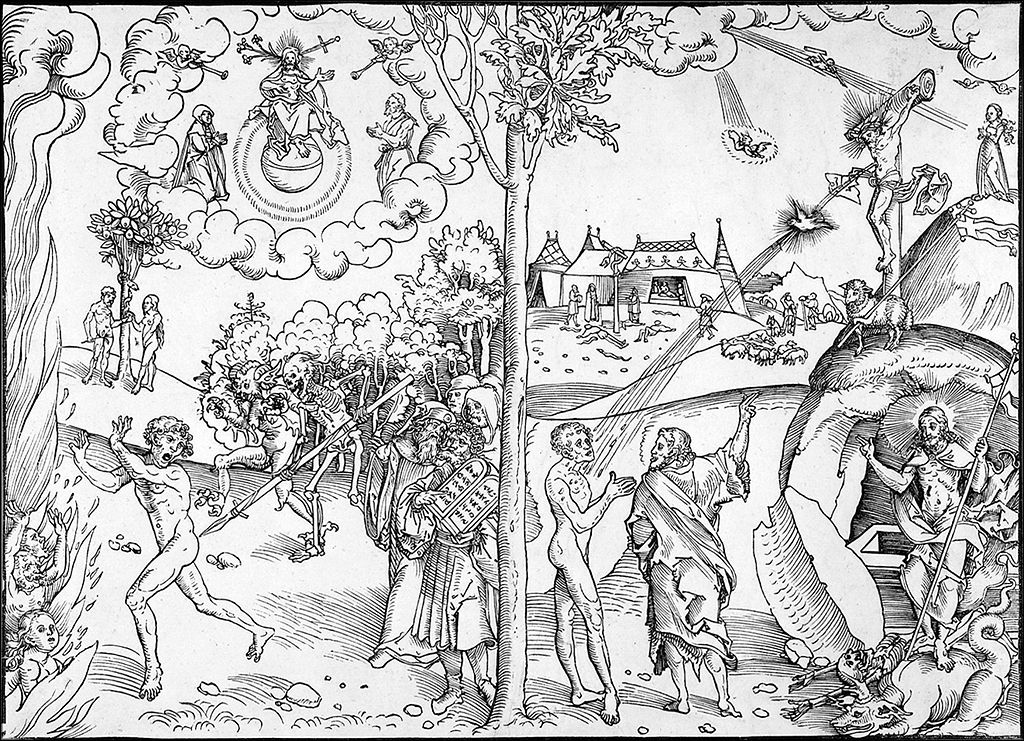
Here Moses points out the difference between the New and the Old Testament.
The New Testament is the older, promised from the beginning of the world, yes, “before the times of the world,” as Paul says to Titus (1:2), but fulfilled only under Christ. The Old Testament promised under Moses was fulfilled under Joshua.
However, there is this difference between the two: the New is founded wholly on the promise of the merciful and faithful God, without our works; but the Old is founded also on our works. Therefore Moses does not promise beyond the extent to which they keep the statutes and judgments.
For this reason the Old Testament finally had to become antiquated and be put aside; it had to serve as a figure of that New and eternal Testament which began before the ages and will endure beyond the ages. The Old, however, began in time and after some time came to an end…
Let us pray: O good and gracious God, heavenly Father + Grant us Your Spirit of Truth and Peace, that we may understand Your holy Will and follow Your Directions and trust Your Promises from the bottom of our heart all our life. Through Jesus Christ our Lord, who lives and reigns with You and the Holy Spirit – one God – now + forever. Amen.
“The calling of Elisha” by Jan Massijs (1509-1575)
The Lord said to him, “Go back the way you came and then head for the wilderness of Damascus. Go and anoint Hazael king over Syria. You must anoint Jehu son of Nimshi king over Israel, and Elisha son of Shaphat from Abel Meholah to take your place as prophet. Jehu will kill anyone who escapes Hazael’s sword, and Elisha will kill anyone who escapes Jehu’s sword. I still have left in Israel 7,000 followers who have not bowed their knees to Baal or kissed the images of him.”
Elijah went from there and found Elisha son of Shaphat. He was plowing with twelve pairs of oxen; he was near the twelfth pair. Elijah passed by him and threw his robe over him. He left the oxen, ran after Elijah, and said, “Please let me kiss my father and mother goodbye, then I will follow you.” Elijah said to him, “Go back! Indeed, what have I done to you?” Elisha went back and took his pair of oxen and slaughtered them. He cooked the meat over a fire that he made by burning the harness and yoke. He gave the people meat and they ate. Then he got up and followed Elijah and became his assistant.
1.Kings 19:15-21 (Lesson for Tuesday after the 5th Sunday after Trinity)
Occasionally one hears this saying of Luther´s quoted: “Let no one give up the faith that God wants to do a deed through him.” There is something inspiring about that. That saying is inscribed on the arch of the gate to the Wittenberg Seminary, but with this little alteration: “Let no one give up the faith that God wants to do a deed in him.” This change, trifling as it may seem, is important. And, to be sure, it is the original reading. This is Luther´s fundamental idea: that God has done something great to us. But then it was Luther who roused us to recognize that he wants to do something through us! This saying applies to every Christian, but it especially applies to ministers of the gospel.
Hermann Werdermann (Quoted in Dobberstein Pg. 274)
Refrain: Listen, listen, God is calling, through the Word inviting, offering forgiveness, comfort, and joy.
1. Jesus gve his mandate: share the good news that he came to save us And set us free.
2. Let none be forgotten throughout the world. In the triune name of God Go and baptize.
3. Help us to be faithful, standing steadfast, walking in your precepts, Led by your Word.
Kenyan song translated by Howard S. Olson (1922-2010)
This passage condemns… representations of God, which He wanted to be forbidden to a simple and childish people, but … inner representations of God, which are (as we have said above) opinions and speculations about God constructed out of ourselves without the voice of God. Here indeed the voice of His words alone is commended, and whatever is said or thought about God which is not that voice of His words is wholly godless and damnable. He wanted to have His will and His counsels delineated for us by His words alone, not by our thoughts and imagination.
Therefore it is not what seems to you to please or displease God, no matter how holy or pious it appears to you (as the founders and confessors of religions and sects have supposed), that pleases or displeases God, but what He Himself by the voice of His Word designates as pleasing or displeasing to Him.
For nobody but God Himself describes or indicates the will of God; therefore everyone errs in a godless manner if he tries this, since nobody knows the depths of God except the Spirit who is in God (1 Cor. 2:11). Therefore it is impossible for men to think properly about God, speak about Him, or worship Him, without the Word of God. The affirmation stands: “You have heard His voice.”
Martin Luther in his private lectures on Deuteronomy (LW 9, Pg. 58)
Let us pray: O good and gracious God, heavenly Father + Grant us Your Spirit of Truth and Peace, that we may understand Your holy Will and follow Your Directions and trust Your Promises from the bottom of our heart all our life. Through Jesus Christ our Lord, who lives and reigns with You and the Holy Spirit – one God – now + forever. Amen.
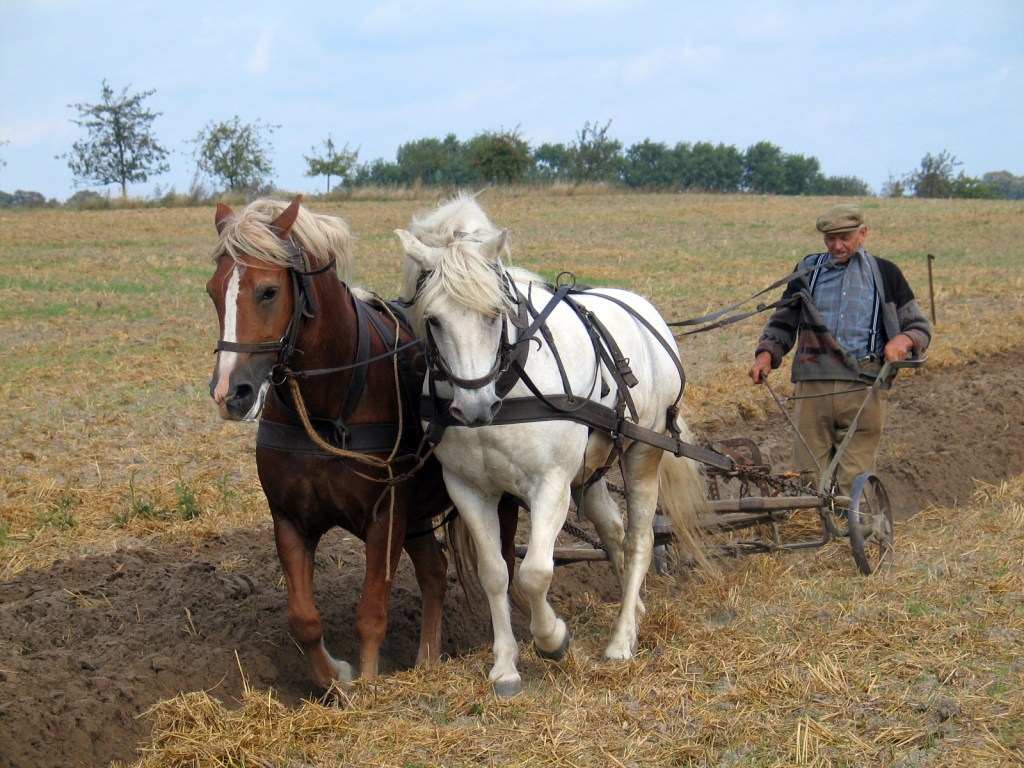
No one who puts his hand to the plow and looks back is fit for the kingdom of God. (Lk.9,62)
As they (Jesus and his disciples) were walking along the road, someone said to him, “I will follow you wherever you go.”Jesus said to him, “Foxes have dens and the birds in the sky have nests, but the Son of Man has no place to lay his head.”
Jesus said to another, “Follow me.” But he replied, “Lord, first let me go and bury my father.” But Jesus said to him, “Let the dead bury their own dead but as for you, go and proclaim the kingdom of God.”
Yet another said, “I will follow you, Lord, but first let me say goodbye to my family.” Jesus said to him, “No one who puts his hand to the plow and looks back is fit for the kingdom of God.”
Lk.9,57-62
1 Let us ever walk with Jesus, Follow His example pure, Flee the world, which would deceive us And to sin our souls allure. Ever in His footsteps treading, Body here, yet soul above, Full of faith and hope and love, Let us do the Father’s bidding. Faithful Lord, abide with me; Savior, lead, I follow Thee.
2 Let us suffer here with Jesus, To His image e’er conform; Heaven’s glory soon will please us, Sunshine follow on the storm. Though we sow in tears of sorrow, We shall reap with heav’nly joy; And the fears that now annoy Shall be laughter on the morrow. Christ, I suffer here with Thee; There, oh, share Thy joy with me!
3 Let us also die with Jesus. His death from the second death, From our soul’s destruction, frees us, Quickens us with life’s glad breath. Let us mortify, while living, Flesh and blood and die to sin; And the grave that shuts us in Shall but prove the gate to heaven. Jesus, here I die to Thee There to live eternally.
4 Let us gladly live with Jesus; Since He’s risen from the dead, Death and grave must soon release us. Jesus, Thou art now our Head, We are truly Thine own members; Where Thou livest, there live we. Take and own us constantly, Faithful Friend, as Thy dear brethren. Jesus, here I live to Thee, Also there eternally.
The 5th Sunday after Trinity is coming up and we´ve got all reason to rejoice, lift up our faces to the Lord and God of our salvation. It is He, who calls us from the ends of the world to partake in His grace and favor, which is new every morning.
Now the Lord said to Abram,
“Go out from your country, your relatives, and your father’s household to the land that I will show you. Then I will make you into a great nation, and I will bless you, and I will make your name great, so that you will exemplify divine blessing. I will bless those who bless you, but the one who treats you lightly I must curse, so that all the families of the earth may receive blessing through you.”
So Abram left, just as the Lord had told him to do, and Lot went with him
Genesis 12:1-4a: Old Testament lesson for this 5th Sunday after Trinity
Like He called our father Abraham and brought him into the promised land leading him for many years all over the fertile crescent there in the very epicenter of His miracles and wonders from of old. It never was a straightforward journey, but a life-long travail, sojourn and Ilyas. Many temptations, failures, mishaps, troubles, calamities and sins, but still, he trusted God and that God reckoned as righteousness of faith, granting him gracious favor in forgiveness and justifying the sinner be grace through faith. So that it holds true for him also, what the apostle St. Paul writes to the Ephesians:
For by grace you are savedthrough faith, and this is not from yourselves, it is the gift of God; it is not fromworks, so that no one can boast.
Eph.2,8-9 Watchword for this 5th Sunday after Trinity.
We answer to this wonderful story from ages past with the beautiful words:
The God of Abraham praise, Who reigns enthroned above; Ancient of everlasting days, And God of Love; Jehovah, great I AM! By earth and Heav’n confessed; I bow and bless the sacred name Forever blessed.
The God of Abraham praise, At whose supreme command From earth I rise—and seek the joys At His right hand; I all on earth forsake, Its wisdom, fame, and power; And Him my only portion make, My shield and tower.
The God of Abraham praise, Whose all sufficient grace Shall guide me all my happy days, In all my ways. He calls a worm His friend, He calls Himself my God! And He shall save me to the end, Thro’ Jesus’ blood.
He by Himself has sworn; I on His oath depend, I shall, on eagle wings upborne, To Heav’n ascend. I shall behold His face; I shall His power adore, And sing the wonders of His grace Forevermore.
Tho’ nature’s strength decay, And earth and hell withstand, To Canaan’s bounds I urge my way, At His command. The watery deep I pass, With Jesus in my view; And thro’ the howling wilderness My way pursue.
The goodly land I see, With peace and plenty blessed; A land of sacred liberty, And endless rest. There milk and honey flow, And oil and wine abound, And trees of life forever grow With mercy crowned.
There dwells the Lord our king, The Lord our righteousness, Triumphant o’er the world and sin The Prince of peace; On Sion’s sacred height His kingdom still maintains, And glorious with His saints in light Forever reigns.
Thomas Olivers 1725-1799
The Introit puts such trials and afflictions of the faithful into godly words too:
But as for me, my feet almost slipped; my feet almost slid out from under me. For I envied those who are proud, as I observedthe prosperityof the wicked.
Psalm 73:2-3
This Psalm however, closes off with the amazing confession, which is ours too:
I was ignorantand lacked insight; I was as senseless as an animal before you. But I am continually with you; you hold my right hand. You guideme by your wise advice, and then you will lead me to a position of honor. Whom do I have in heaven but you? On earth there is no one I desire but you. My flesh and my heart may grow weak, but God alwaysprotects my heart and gives me stability.
Psalm 73:22-26
The Sermon has the following theme: God´s call – our salvation!
God´s wish, good will and holy desire from the start was our good life and eternal salvation. That´s why He calls Abraham out of Haran and puts him on the road to the promised land. That´s why He calls St. Peter and the rest of the apostles, so that they would not just catch fish, but people – drawing them from the depths of hopeless despair and sinful misery to life with Him in eternal righteousness and everlasting blessedness and holiness. That´s why He continues calling people from the ends of the world, out of darkness to His light and out of the very shadows of death to His new life and salvation in Jesus Christ our Lord and Savior. He issues various calls like “Put out into the deep water and lower your nets for a catch” or “Come to me – all You, who are tired and heavily burdened – I will give You rest!” or “Let´s go up to Jerusalem to suffer many things – and die.” Thereby He wants to open up the way to life and salvation. He means well, because His intentions are good, meet and salutary. That´s why His wish should be our command. We should gladly, willingly and most trustingly follow Him and do as He says. However, due to sinfuldoubts, objections and straight forward bad inclination and sore disobedience and rebellion, sinners tend to oppose God´s mandates, laws, rules and declarations, institutions and creative postulates. Due to sinful pride, they think again and again, they know better than the omniscient God: “Master, we worked hard all night and caught nothing!” Due to sinful despair they oppose His salutary ways and flee His gracious presence of the ever-merciful God and Savior: “Go away from me, Lord, for I am a sinful man!” Due to sinful fear, ignorance, shame and all sorts of other errant vice they come up with alternatives, alterations and other wicked addendums to the clear and salutary mandates of our God: “No, all other – but not this and that!”
Yet, the triune God in his unfathomable love and gracious favor overcomes even the worst of our terrible doubts and grants us undeserving creatures saving faith and living hope. He goes far more than the extra mile – sheer endless meanderings with Abraham, forty years through the desert with Moses and many lifetimes with the faithful saints of old Israel and the many countless saints of the holy Christians Church ever since. He does many, many miracles and wonders calling the unwilling and undesiring and lost to Himself and building up their faith, trust and hope daily afresh – without any worthiness or merit in me – just out of sheer bottomless fatherly goodness and mercy. And He gets great results – even with chronic doubters like St. Peter: “But at your word I will lower the nets… and they caught many fish!” So many, that the nets tore and they needed even more boats to cope with the magnitude of the many, many fish! Yes, He overcomes fear and trepidation by His wonderful words of comfort and encouragement: “Do not be afraid, from now on You will be catching people!” And these doubters and long-settled-into-life-fishers-of-fish left everything (!) and followed him: “Take they our life, good, fame, child and wife – though these all be gone – our victory has been won – the kingdom ours remaineth.” (ML LSB 656) Well, that happened with Abraham and all those archfathers, judges, prophets and kings. It occurred with the holy St Peter and all the fellow apostles, brothers and sisters from Jews and gentiles right to the very ends of the world. Yes, not many high & mighty (1.Cor.1,18-25), but for us it´s proven power to conversion, salvation and eternal life. Thanks be to God – now and always.
The God who reigns on high The great archangels sing, And Holy, holy, holy! cry, Almighty King! Who was, and is, the same, And evermore shall be: Jehovah—Father—great I AM, We worship Thee!
The whole triumphant host Give thanks to God on high; Hail, Father, Son, and Holy Ghost, They ever cry. Hail, Abraham’s God, and mine! I join the heav’nly lays: All might and majesty are Thine, And endless praise.
Thomas Olivers 1725-1799
Here´s my sermon as held on this 5th Sunday after Trinity at the Old Latin School.