Bishop’s annual report for the LCSA BW diocesan synod

LCSA Dear friends of the Lutheran Church in Southern Africa:

At tomorrow’s LCSA diocesan synod in Botswana my annual report is due. With some minor changes here and there this is to be tabled at similar meetings coming up.

This posting is for those who are interested in reading it, but don’t have an episcopal visitation coming up: LCSA Bishop’s Annual Report 2011

May God bless the deliberations, plans and proceedings in every congregation and diocese of the LCSA that they may serve his glory and benefit the members of the LCSA and the Lutheran family and Christians friends beyond.

Yours sincerely

Wilhelm Weber


Posted in Uncategorized | Leave a comment

RSA: THE ROAD AHEAD … at least as some see it.

RSA: THE ROAD AHEAD

On 10 November F W de Klerk addressed the Cape Town Club on “The Road Ahead”.

De Klerk said that in a speech earlier in the year he had observed that we were approaching a pivotal point in our history where all South Africans of goodwill would have to rally around the Constitution.
Since then the balance had begun to oscillate more and more erratically between the positive and the negative.   According to De Klerk there are still many positives:

•    Expected growth of 3.1% this year was still not enough – but was a lot better than many leading economies.
•    Government debt would be ratcheted up 40% of GDP –  which was still far healthier than many leading economies where national debt now exceeded 100% of GDP.
•    President Zuma’s announcement in late October of the firing of two ministers and the suspension of the Commissioner of Police and the appointment of a commission of enquiry into the arms deal were moves in the right direction – even though they should have been taken earlier.
•    The Public Protector, Thuli Madonsela, had been playing an exemplary role in investigating maladministration.
•    Civil society was proving to be a formidable protector of constitutional values – as had been shown by its continuing role in combating the Protection of Information Bill.
•    South Africa had continued to play a prominent role in international affairs – in the AU, the Group of 20 and BRICSA;
•    The courts had proved their effectiveness in upholding the Constitution and in curbing the power of the executive.

These positives had unfortunately gone hand in hand with some disturbing negatives.

One of the central concerns was the likely impact of the ANC’s National Conference in Mangaung next year.

De Klerk said that MPs were completely under the control of their party machines because they lost their seats in parliament if they were expelled from the party that nominated them to the Assembly. This meant that what happened in the inner chambers of political parties became more important than what happened in Parliament.

At the ANC’s last national Conference in Polokwane in December 2007 a swing of just 10% of the      3 900 voting dramatically changed the face of South African politics.   The Mangaung Conference next year would determine whether President Zuma would be serve a second term.  It would lay down policy for the following five years and would show which of the Alliance’s factions would emerge as the most powerful grouping.   De Klerk said that In the months between now and the National Conference the various factions in the Alliance would be fixated on securing the support of as many delegates as possible.  “The trouble is that all this maneuvering is not conducive to clear and effective leadership”.

De Klerk said that although the ANC’s decision to suspend Julius Malema might have cut short his career it had not changed the realities that underlay the Malema phenomenon:

•    The first was the millions of unemployed and under-educated young South Africans that he claimed to represent.  The New South Africa had failed to provide most of them with basic education and the jobs that they desperately need.  Their plight required priority attention from government, business, civil society and trade unions.  “What our young people do not need are the populist and economically illiterate remedies that are being offered by the Youth League”.
•    The second disturbing factor was the ANC’s failure to take a firm public stand against increasingly racist and inflammatory rhetoric. Some months earlier, President Zuma had sat in silence on the same platform in Galashewe while Malema called whites “criminals, who have stolen our land and who should be treated as criminals
•    Finally, the real problem was that Malema’s views were not out of line with the ANC’s own National Democratic revolution ideology which called for “the elimination of the legacy of apartheid super-exploitation and inequality, and the redistribution of wealth and income to benefit society as a whole, especially the poor.”

The ultimate goal of the NDR was a society in which all aspects of control, ownership, management and employment in the state, private and non-governmental sectors would broadly mirror the demographic composition of South Africa’s population.

As  a result of this ideology, coloured employees in the Department of Correctional Services in the Western Cape had been informed that their numbers would have to be reduced from 38% to 9% to bring them into line with their share of the national population  The NDR ideology was  also evident in the Green Paper on Land Reform  which asserted that “all anti-colonial struggles are, at the core, about two things: repossession of land lost through force or deceit; and, restoring the centrality of indigenous culture.”  The authors were actually saying that seventeen years after 1994 the anti-colonialist struggle was not over; whites were colonialists; the struggle was against them; and only the indigenous culture should be central.

The Green Paper proposed a policy of ‘Agrarian Transformation’ – which it described as  “a rapid and fundamental change in the relations (systems and patterns of ownership and control) of land, livestock, cropping and community.”   De Klerk said that implementation of the Green paper would have far-reaching and negative consequences for local and foreign investment and for future food security.  It would also harm race relations and undermine property rights.

De Klerk said that no reasonable South African would question the need to promote genuine equality; to achieve fair and sustainable land reform; and to remove any barriers that might remain to black advancement in the economy or in any other sector of our national life.  He called for dialogue with the ANC and said that South Africans needed to talk with one another about these issues in the frank and constructive way that we did during the negotiations of the 1990s.

Posted in Uncategorized | Leave a comment

Auszug aus Papas Wochenbrief …


“… In den vergangenen Tagen erreichten mich die Impulse, die mein Patenjunge heute bei der Ludwig Harms Konferenz in Farven vortragen will, mit ganz großen Buchstaben und interessanten Angaben über Wirklichkeiten in Deutschland und in der Welt. Als ich die mir etwas anschaute, musste ich an einen interessanten Titel eines Buches, das ich mir vor Jahren kaufte, denken: Wie wirklich ist die Wirklichkeit. Da ist es gut, dass wir Lutheraner sind und z. B. im Abendmahl einfach selbstverständlich mit der Realpräsenz des Leibes und Blutes unseres Heilandes in Brot und Wein, die ausgeteilt und empfangen werden, rechnen. So viele Wirklichkeiten sind gar nicht wirklich, aber die Wirklichkeit, die uns der Herr Christus verheißt, ist gewiss. Da tun wir auch gut daran, dass wir es fest glauben und nicht zweifeln, was er gesagt und aufschreiben lassen hat. Er hat uns verheißen, dass der heilige Geist uns an das, was er gesagt und gelehrt hat, erinnern wird und uns in seiner Wahrheit leiten wird. Die Wirklichkeiten und Wahrheiten von menschlichen Statistiken und Prognosen dagegen lassen manche Möglichkeiten offen, dass manche Pläne, die aufgrund solcher Möglichkeiten gemacht werden, sich oft in Kürze schon als unerfüllbar ergeben. Dabei dürfen wir Lutheraner gewiss sein, dass die Zusage gilt und immer gelten wird, wo das Evangelium recht gepredigt und die Sakramente evangeliums-, wort- und stiftungsgemäß verwaltet werden, unser Herr und Heiland Jesus Christus seine Kirche auch in Zukunft bauen und wachsen lassen wird bis hin zu seiner Wiederkunft. Da schenke der Herr uns auch die nötige Treue, nicht müde zu werden, Mittel und Wege, die der Herr uns schenkt, zu nutzen, seinem Missionsauftrag gern nachzukommen. Vor allem schenke er uns allen, dass wir unseren Herrn beim Wort nehmen, wo uns im Namen des dreieinigen Gottes die Sünden vergeben werden.
Bei meinen Vorträgen über die Geschichte der LCSA hatte ich gerade gemerkt, wie vorsichtig Statisiken zu beurteilen sind. Im Missionsblatt wurden bis 1968 die Statistiken der Gemeinden der MELF jährlich veröffentlicht. Die Angaben über die Taufen von Heiden über die Jahre hin sind sicher nicht anzuzweifeln. Die kann man sicher heute noch in den Taufbüchern der Gemeinden nachzählen. 1955: 94; 1960: 129; 1965: 146; 1967: 100; 1968: 144; auch damals die meisten Taufen von Heiden im Salemer Gebiet. Die Angaben über die Seelenzahl dagegen zeigten ein unwahrscheinliches Wachstum, über dreizehn Jahre 51%: 1955: 14506; 1960: 16083; 1965: 19844; 1967: 21416; 1968: 21964. Wie schon bei einem Bericht über die Geschichte von Umhlangeni habe ich mir dieses Wachstum so erklärt. Es war die Zeit, in der die Arbeit in den Großstädten florierte. Pastor Lubede im Durbaner Raum sammelte die Gemeindeglieder, die aus den Zulugemeinden Salem, Itshe Lejuba, Ebenezer, Pella und Umhlangeni dort Arbeit gefunden hatten und dort geheiratet und dorthin umgezogen waren. Die wurden in ihren Heimatgemeinden nicht als verzogen, aber in Durban als zugezogen verzeichnet. Ganz ähnlich war das mit den Gemeindegliedern, die aus den Zulu und Tswanagemeinden im Johannesburger Raum ihre kirchliche Heimat fanden, aber “zu Hause” in Roodepoort und Botshabelo eben gern weiter zur Gemeinde gehören wollten. Da auch selbstverständlich vor allem an den Festtagen mit zum Abendmahl gingen und in den Abendmahlsregistern erschienen. Es ist schon gut, zu fragen: Wie wirklich ist die Wirklichkeit? Da dürfen wir uns gar nicht wundern, wenn junge Pastoren und Missionare sich gar nicht vorstellen können, wie damals solche Zahlen genannt werden konnten. Der Herr schenke ihnen die Freudigkeit und Gewissheit, gern aufgrund des Auftrags und der Verheißung unseres Herrn ihren Dienst noch viele Jahr zu tun, auch wenn es an großen Zahlen fehlt.”
Posted in Uncategorized | Leave a comment

LCSA Sermons for the 2nd last Sunday of the Church Year

“I believe in one God … And in one Lord Jesus Christ … He will come again to with glory to judge both the living and the dead, whose kingdom will have no end.” [Nicene Creed]

Watchword for the 2nd last Sunday in the Church year: “For we must all appear before the judgment seat of Christ, so that each one may receive what is due for what he has done in the body, whether good or evil.” (2Co 5:10 ESV)

Zulu Sermon for the 26th S.a.Trinity [2nd last Sunday in the Church Year] by Rev. John Khumalo

Tswana Sermon for the 26th Sunday after Trinity [2nd last Sunday of the Churchyear] by Rev. John Khumalo


Last Judgment Triptych (The Last Judgment)
Artist: Hans Memling;
Oil painting on panel; Size: 221×161 cm; Muzeum Narodowe, Gdansk.

The Last Judgment is a triptych which was painted by Hans Memling during 1467 and 1471. The painting was commissioned by an agent of the Medici at Bruges but was captured by a privateer from Poland.
The central panel shows Christ sitting in Judgment on the world, while St Michael the Archangel is weighing souls and driving the Damned towards Hell. On the left hand panel, the Saved are being guided into Heaven by St Peter and Angels. On the right-hand panel, the Damned are being dragged to Hell.
From the stylistic viewpoint, the figure of Christ, for the one and only time in Memling’s career, is almost a copy of the Christ in a polyptych by van der Weyden. The painter has taken great care over representation of the perspective, the light and the reflections (especially on the globe and on the archangel’s armor). Many of the elect have realistic features, suggesting that some personages had had their portraitsinserted into the painting.

Posted in Uncategorized | Leave a comment

Outstanding issues and the like …

The plucky advert of Nando’s: “The chicken come home to roost …” is relevant to this posting by the “FW de Klerk Foundation”. Things are far from settled and we might be entering the next phase in our nations turbulent history. Their chief executive Dave Steward has written the following response to the outcomes of these out-drawn proceedings.

He writes: “The FW de Klerk Foundation has taken note of the decision of the ANC’s National Disciplinary Committee to suspend Julius Malema for breaching various provisions of the ANC’s constitution.

Mr Malema’s suspension should not surprise anyone.  Nobody in any organisation can alienate so many powerful factions so abrasively for so long without paying a price.

Whatever Malema’s future may be the issues that he so aggressively articulates and the constituency that he claims to represent will not disappear.

One of the central challenges facing government – and indeed all South Africans – will be to restore some degree of hope to the millions of young – predominantly black – South Africans, whom Malema claims to represent.  Our new society has failed them dismally: it has left most of them educationally crippled and 70% are unemployed.

All this makes them susceptible to the populist promises of demagogues. The nostrums that Malema prescribes are politically and economically illiterate but enormously appealing to these millions of young people subsisting on their siblings’ children’s allowances and their grannies’ pensions.

The message is also fundamentally racist: “Look at the whites, the way they live. They stole all this from us and we must take it back.  We must take back the land; we must take the companies on the Johannesburg Stock Exchange; we must nationalize the mines – all without compensation.”

Perhaps the most disturbing aspect of Malema’s demise was the fact that he was not found guilty of sewing racial dissension.  The charge arose from his statement at a rally in Galishewe earlier this year when he had said, in President Zuma’ presence, that whites are criminals who stole our land; that they should be treated as criminals and that their land should be seized without compensation.

He was cleared of the charge of fomenting racism, arising from this statement, because it was not proved on ” balance of probabilities”.

One wonders what aspect of Malema’s Galishewe statement was ambiguous and what probabilities led the ANC’s NDC to conclude that this was not blatant racism? What was the NDC saying about the ANC’ commitment to non-racialism and what message was it sending to white South Africans?

Dave Steward: Executive Director


Posted in Uncategorized | Leave a comment

The beauty of it all … mathematically!

Here’s something to look at, think about and marvel at. Thanks RS for the link:

the-beauty-of-mathematics

Posted in Uncategorized | Leave a comment

Fundamental LCSA texts

Thankfully my father Rev. E.A.W.Weber DD has translated some key-texts for his class on the history of the Lutheran Church in Southern Africa, which he gave at the Lutheran Theological Seminary in Tshwane during the 4th Quarter of 2011. Here they are for your attention and as always I can only recommend: Tolle lege! 

1956 Independence & autonomy

1956 Guidelines

1967 General Synod in Roodepoort

1967: The road to Independance

1953 Concerning cooperation in Missions

Posted in Uncategorized | Leave a comment

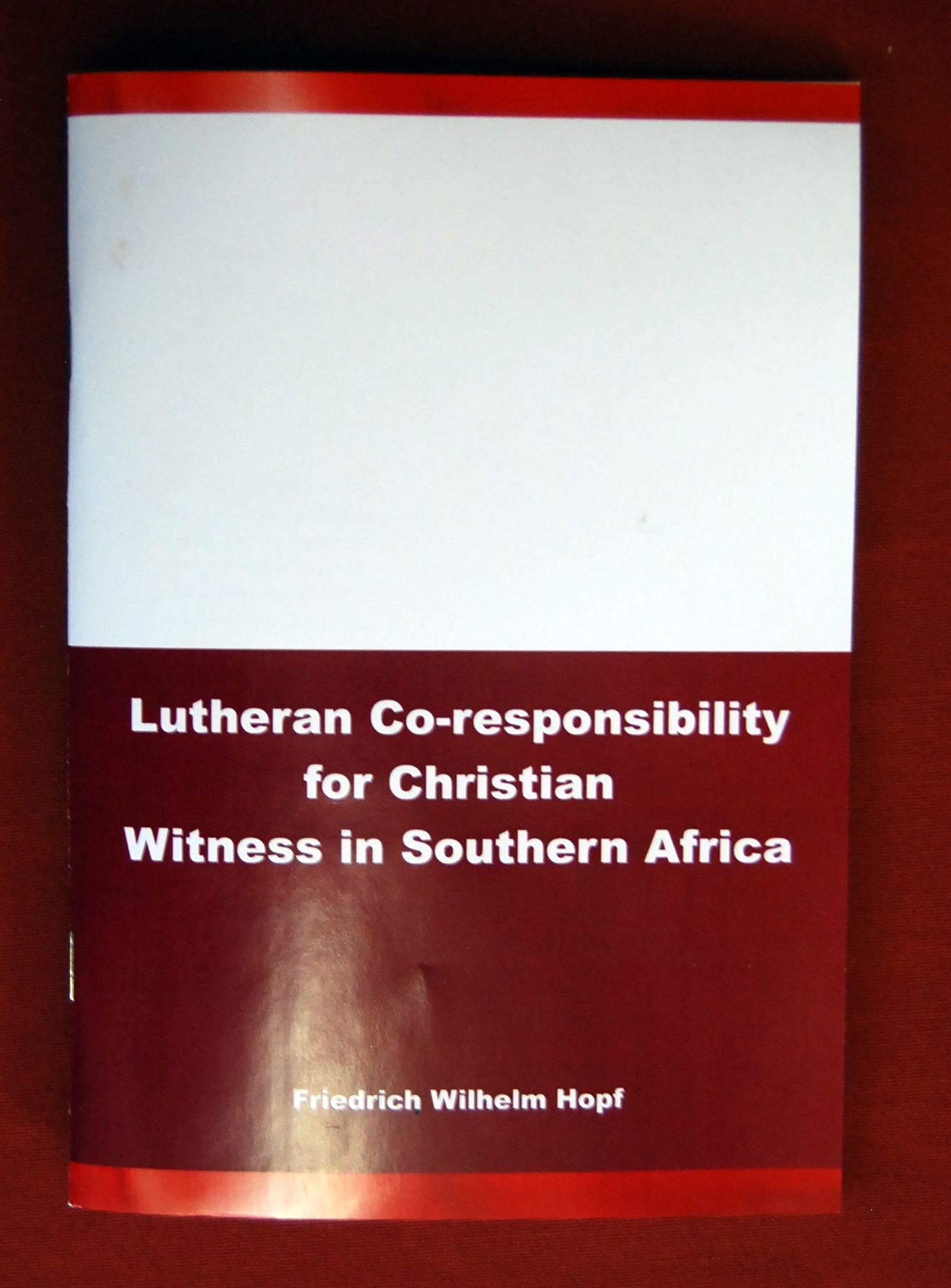
Lutheran Co-Responsibility for Christian Witness in Southern Africa

Lutherische Mitverantwortung fuer das christliche Zeugnis im suedlichen Afrika.

Lutheran co-responsibility for Christian witness in Southern Africa


Posted in Uncategorized | Leave a comment

What does Ratzinger say on Liturgy?

Read for yourself. Here is a lecture by one of South African leading Roman Catholic scholars on this topic. Thanks to Kantor Stephen Rosebrock for the link.

Lift up your hearts ...

2011 – Prof Moss on Pope Benedict XVI [Joseph Ratzinger] and the Liturgy

Posted in Uncategorized | Leave a comment

I hear the rains down in Africa …

I hear the rains down in Africa ...

Posted in Uncategorized | Leave a comment