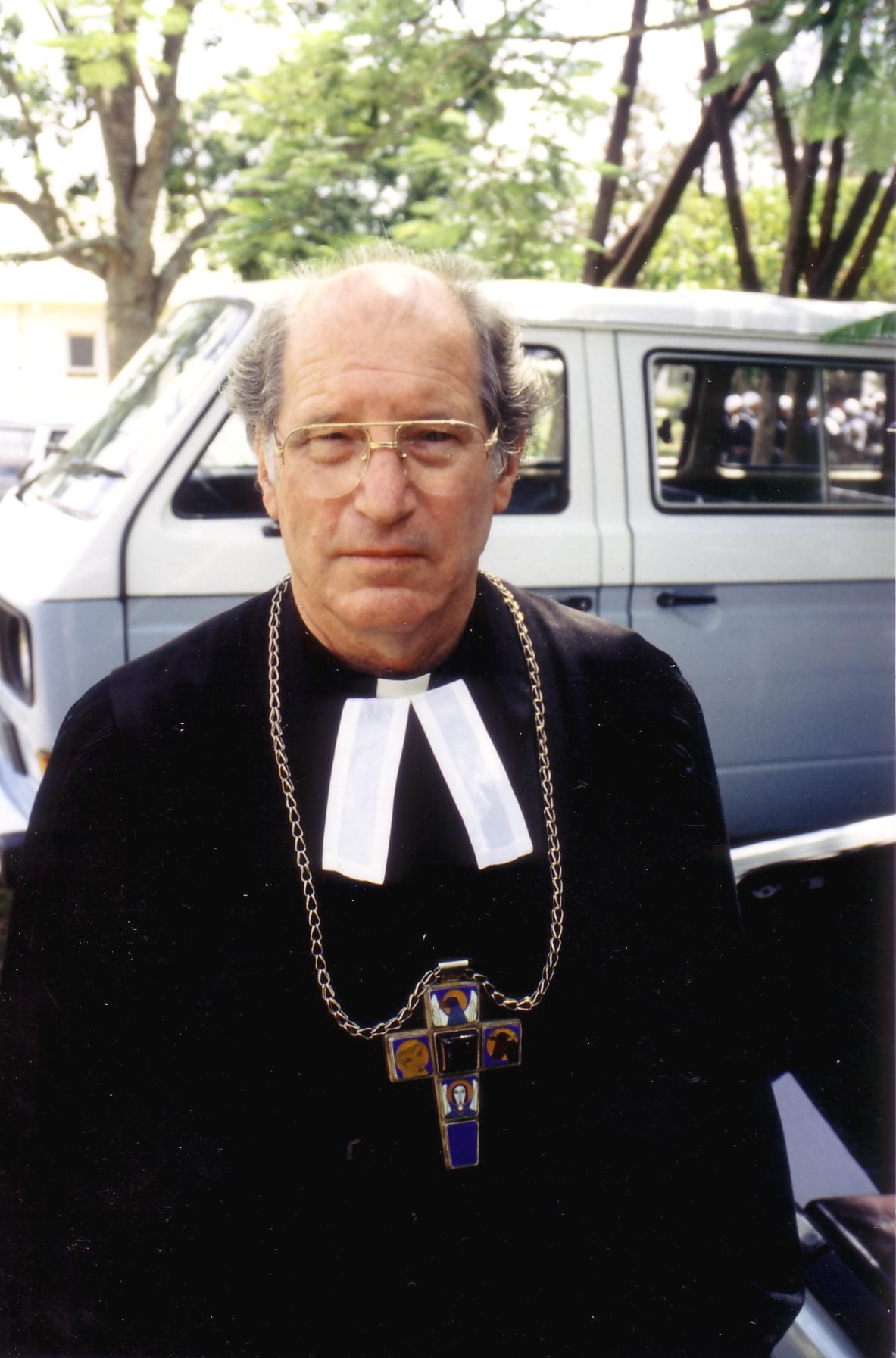
Geburtstag von Bischof Georg Schulz * 1928

GSchulz (2)Nachruf auf Bischof i. R. Georg Schulz
Ein Mittler im Dienst des einen Mittlers

Georg Schulz wurde am 24. September 1928 in Tilsit (Ostpreußen) geboren. Nach Flakhelfer-Einsatz, Kriegsgefangenschaft und Flucht wies ihn sein Pastor Werner Schwinge (inzwischen in Hamburg) an das Missionsseminar in Bleckmar (heute: Lutherische Kirchenmission). Dort begann er am 20. Mai 1948 seine siebenjährige Ausbildung zum Missionar, die auch Studienaufenthalte in Oberursel und Hamburg einschloss. Nachdem er am 3. August 1955 das Erste Theologische Examen bestanden hatte, wurde er am 23. Oktober in Bleckmar zum Missionsdienst in Südafrika abgeordnet. Am 20. Dezember traf er mit dem Schiff in Durban ein.

Während seiner Einarbeitungs- und Vikarszeit lernte er Zulu auf Salem bei Superintendent Christoph Johannes und in Pella bei Pastor Absalom Sibiya, begleitete Missionsinspektor Friedrich Wilhelm Hopf auf dessen erster Visitationsreise und ließ sich in Enhlanhleni durch Missionar Gottfried Stallmann in die Missionsarbeit einführen.
Seine Verlobte Elisabeth Heidt folgte ihm im Mai 1957 nach Südafrika; sie heirateten am
1. Oktober 1957 in Wittenberg (Transvaal). Dem Ehepaar wurden fünf Kinder geschenkt: Martin (1958), Ulrike (1960), Detlev (1962), Eckart (1964) und Angelika (1971). Nach seinem Amtsexamen wurde Georg Schulz am 20. April 1958 im südafrikanischen Wittenberg ordiniert und zunächst auf Salem im Gemeindedienst eingesetzt.
Schon 1961 wurde er als theologischer Lehrer an das Seminar in Enhlanhleni/Natal berufen, wo er vor allem die Fächer Neues Testament und Kirchengeschichte unterrichtete und dann eine ganze Generation heranwachsender afrikanischer Pastoren prägte. Zugleich baute er in den ersten Jahren eine Gemeinde im benachbarten Tholeni auf.
Noch im Jahr 1961 wurde er zusätzlich zum Missionssuperintendenten ernannt und in
dieses kirchenleitende Amt 1962 eingeführt; er verwaltete es, bis er 1986 davon entlastet
wurde. 1963 trat er mit seiner Familie seinen ersten Deutschlandaufenthalt an, dem 1972,
1980 und 1990 weitere folgten.  Als sich 1967 die „Lutherische Kirche im Südlichen Afrika“ konstituierte, wurde er am 2. April als deren Bischof berufen und zu weiteren Amtszeiten 1973 und 1985 erneut gewählt. Die neuen kirchlichen Strukturen mussten mit Leben erfüllt, Verwaltungsstrukturen neu aufgebaut werden. Äußeres Wachstum im angestammten Bereich und nach Botswana hinüber, Umsiedlungen von Gemeinden und tief greifende Veränderungen der gesellschaftlichen Rahmenbedingungen erforderten stets ein hohes Maß an umsichtigem Geschick und bedachter Kreativität. Seit 1980 entwickelte Georg Schulz eine Zusammenarbeit mit der Lutheran Church-Missouri Synod entscheidend mit. 1981 verlieh ihm das Concordia Theological Seminary in Fort Wayne den Ehrendoktor der Theologie (D. D.).

Anfang 1983 erlitt er einen Herzinfarkt, von dem er sich gut wieder erholte, aber doch
gezeichnet blieb von den Grenzen seiner Belastbarkeit. Am 2. Advent 1993 führte er dann im Rahmen einer Synode, die in Roodepoort tagte, seinen Nachfolger, Bischof David Tswaedi, in sein Amt ein und wurde selbst mit Verleihung eines Emeritenkreuzes in den Ruhestand verabschiedet. Den verlebte er in Hermannsburg, der Heimat seiner Frau. Von hier aus pflegten sie durch Besuchsreisen den Kontakt innerhalb ihrer inzwischen über die Kontinente verstreuten Familie. Am 1. April 2004 wurde Georg Schulz nach schwerer Krankheit heimgerufen.

Georg Schulz war ein Mittler im Dienst des einen Mittlers. Er stand an der Nahtstelle zwischen den die Mission tragenden Gemeinden und der Missionsleitung in Deutschland und der Mitarbeiterschaft und den Gemeinden in Afrika. Als Bischof hielt er die  Verbindung zwischen den unterschiedlichen Regionen seiner Kirche und förderte ihr Zusammenwachsen und ihre Gemeinschaft. Als theologischer Lehrer vermittelte er das biblische Fundament und die kirchliche Tradition an eine jüngere Generation in einer andern kulturellen und religiösen Umwelt.  Als weißer Bischof einer schwarzen Kirche
legte er ein Zeugnis für die alle menschlichen Unterschiede übergreifende Herrschaft
Christi ab, litt zu seinem Teil an der Apartheid mit und suchte in vielerlei Spannungen den
Ausgleich.  Als Bischof einer schwarzen lutherischen Kirche im südlichen Afrika bemühte er sich um einen gut nachbarlichen Ausgleich mit der weißen Freien Evangelisch-Lutherischen Synode in Südafrika und eine verständnisvolle Zusammenarbeit mit ihr. Als Seelsorger der Pastoren und der Mitarbeiter der Kirche setzte er sich auch in persönlichen Krisen als Mittler ein. Ebenso warb er um Verständnis für den eigenen kirchlichen Weg auch in Kontakten zu anderen Kirchen. Die zeitgeschichtlichen Entwicklungen verfolgte er mit großer Aufmerksamkeit und trug viel dazu bei, sie theologisch zu analysieren
und auf rechte christliche Weise darauf zu reagieren. All dies erforderte nicht nur Belesenheit, viel Arbeit am Schreibtisch, darunter ein reger und intensiver Briefwechsel mit dem jeweiligen Missionsdirektor, und Unterricht am Seminar, sondern auch ein ständiges Unterwegssein auf Reisen innerhalb des südlichen Afrikas und nach Europa und Amerika mit einer Unzahl von Vorträgen, Gesprächen und Predigten.

In einer Fülle von Beiträgen zum Missionsblatt leitete er zu einem vertieften Verständnis des sich wandelnden Missionsgeschehens und der an ihm beteiligten Personen an, wie auch durch seine Aufsätze in den Jubiläumsschriften der Bleckmarer Mission (1967: Der Weg zur Kirchwerdung; 1992: Das geistliche Amt nach lutherischem Verständnis in der missionarischen Situation). Diesen seinen vielfältigen Mittlerdienst verstand Georg Schulz nicht als seine eigene Lebensleistung, sondern ganz bewusst als das ihm von Christus durch die Kirche aufgetragene Amt.  Und so hat Christus selbst der  ekenntnisgebundenen lutherischen Kirche weit über das südliche Afrika hinaus durch das Lebenswerk dieses seines Dieners seine segensreiche Begleitung auf ihrem Weg durch diese Zeiten zugewandt.

Volker Stolle in “Gehet Hin”: Missionsblatt 3 (2004) 26-27
 

Posted in Lutheran Church in Southern Africa | Tagged , , , , , , , | Leave a comment

Löhe on Ephesians 4:3

Seminary tapistryMake every effort to keep the unity of the Spirit through the bond of peace. (Eph 4:3 NIV)

The doctrine about true Church unity and union is vital in a world full of differences, opposition and animosity and everyone who does not promote the ecclesial unification in the best sense sins. If you are confronted with a different opinion concerning the Christian faith or doctrine, then you should not just be flippant, but you should rather stand up for the truth according to God’s holy Word and Luther’s teaching. You are not permitted to disregard or ignore even those biblical truths that seem less central to you now. And yet you should not lightly shed the responsibility to stand up for unity and solidarity in the Church either. Even if that unity and Concordia is achieved, it must consistently be cared for and supported and actively endorsed. The devil is always actively involved to harm, corrupt and destroy the true unity of the Church through factions, splits and sectarian devotion and teaching. Would it not be just down his evil and devilish alley if the big mission goal of Jesus to gather his Church from all nations across the globe would fail, because of human divisions and differences?  One goes against the other, splits and separation are encouraged and enshrined and the unity of the Church is sacrificed on the bloody altar of godless ideology and other sinful human philosophies and considerations. At all times the struggle for the truth will remain the priority in the Church, because the sinful human heart does not automatically submit to the workings of the Holy Spirit, but has the corrupt tendency to oppose him wherever. That’s why you’ll have parties, groupings, sects and heresies. Oh, how important is it therefore to still strive for the truthful, faithful unity and confessional communion so that the band of peace continues to grow and become firmer incessantly binding the faithful ever closer together as members of one body and Jesus Christ the only head. Everybody is to be encouraged to support this communion. Through a strong, vibrant and flourishing unity in the commonly confessed truth there will come up a joy and vigor to strive for unity also in those points, where disagreement still holds sway.

Oh Lord Jesus Christ! Abide with your Church – especially in our land and on this continent. Bless those, that you have enriched and empowered with faithfulness towards your Holy Word and in the use of the most precious Sacraments!  Bless your faithful Lutheran Church everywhere. Don’t let human strength or wisdom build it, but rather let your Holy Spirit be the guide, strength, creator and ruler. Bless your one holy Christian Church wherever you are confessed – here and beyond our borders. Bless all souls, that bow before you and all hearts that confess your holy name and all, who put their trust in you. Bless this entire world with the power of your most holy and precious cross and let all those blessed come to you, where one Shepherd and one herd will be united in eternal praises of the heavenly Father. Amen. (Hermann Bezzel)

Oh, blest communion, fellowship divine! We feebly struggle, they in glory shine; Yet all are one in Thee, for all are Thine. Alleluia! Alleluia!  (William W. How, 1923-1897)

This is a rather free translation of Wilhelm Löhe’s devotion for Tuesday after the seventeenth Sunday after the high holiday and festival of the Holy Trinity. It is found on Pg. 336 in Lob sei Dir ewig, o Jesu!   (Eternal Praise to you o Jesus!) edited by A. Schuster and published in the Freimund Verlag, Neuendettelsau 1949.

Posted in Meditations by P.Wilhelm Löhe (Translation) | Tagged , , , , , , , , , | Leave a comment

Herrenhuter readings for Tuesday, the 24th September 2013

Verlorene SohnYou say: ‘I am innocent; he is not angry with me.’ But I will pass judgment on you because you say, ‘I have not sinned.’ (Jer 2:35 NIV)

I tell you that there will be more rejoicing in heaven over one sinner who repents than over ninety-nine righteous persons who do not need to repent. (Luk 15:7 NIV)

Posted in Losung & Lehrtext | Tagged , , , , , , , , | Leave a comment

Löhe on Ephesians 4:1

Seminary tapistryAs a prisoner for the Lord, then, I urge you to live a life worthy of the calling you have received. (Eph 4:1 NIV)

The apostle St. Paul is imprisoned in Rome and thinks about his congregation in Ephesus – the Christian Church there. He’s concerned about their calling or more precisely about their life, which is to be worthy of their received calling. We too have been called to be part of the one holy Christian Church and therefore to the communion and union of her various parts – amongst Jews and gentiles. The Church has been called to a large variety of parts and members and still to preserve perfect harmony and union. It is her calling to overcome the divisiveness of diversity and to rather strive for the perfect communion in unity and harmony. That means the diversity is to be seen as part of the richness, wealth and splendor of the Church – which is very different to boring uniformity and bland sameness – and is to be utilized for the one holy mission of the Church – to gain as many as possible from the ends of the earth to enter the kingdom of God, the one holy Christian Church. It is therefore the calling from diversity to unity, yes from opposition and conflicting differences to the unity of Spirit, baptism, faith and truth. Everybody who is ruled inwardly by the one Holy Spirit and outwardly by the one Lord Jesus Christ and thus stands under the care and grace of the one Holy God and Father in heaven has all and every reason to view those as brothers and sisters, who say and believe the same of themselves  – despite all those special differences, peculiarities and idiosyncrasies, which might catch our sense and distract us from the underlying baptismal and sacramental unity to which we have been called.  Therefore you too are to recognize your special calling that you have as member of the Christian congregation and Church of Jesus Christ. You are called to unity and harmony and also to life according to this high and special calling!

Holy, eternal God, you have given us the clear command by your dearly beloved Son our Lord Jesus Christ to persist in your given unity of faith and life – just as he is one with you. Look graciously upon us, who have been assembled before you and are praying for the unity of the Church and its many different members and parts. We call upon you: Be in our midst with your Holy Spirit. Grant us your wisdom from above that we don’t persist in our own ways, but rather follow your guidance only. Give us strength and patience to persist and continue even if we don’t realize any progress or success. Grant us humility not to seek our own honor or gain, but rather your honor and to serve our brothers and sisters. More than anything though grant us that love of your love, that does not seek its own, but rather the good of our brothers and sisters and care for them with all we have. Amen. (G.Mensching)

May God bestow on us his grace and favour To please him with our behaviour And live together here in love and union Nor repent this blest communion. O Lord, have mercy! Let not your good Spirit forsake us, But that heavenly minded he make us; Give you Church, Lord, to see Days of Peace and unity. O Lord, have mercy! (Martin Luther)

This is a rather free translation of Wilhelm Löhe’s devotion for the seventeenth Sunday after the high holiday and festival of the Holy Trinity. It is found on Pg. 334 in Lob sei Dir ewig, o Jesu!   (Eternal Praise to you o Jesus!) edited by A. Schuster and published in the Freimund Verlag, Neuendettelsau 1949.

Posted in Meditations by P.Wilhelm Löhe (Translation) | Tagged , , , , , , , , , , | Leave a comment

Herrenhuter readings for Monday, the 23rd September 2013

the-fortress-church-of-biertan-biertan“Be careful, keep calm and don’t be afraid. Do not lose heart.”  (Isa 7:4 NIV)

Be strong in the Lord and in his mighty power. (Eph 6:10 NIV)

Posted in Losung & Lehrtext | Tagged , , , , , , , , , , | Leave a comment

Predigt zum 17.Sonntag nach Trinitatis

zurbaran-christ-on-crossHier eine Predigt zum 17. Sonntag nach Trinitatis über Johannes 9:35-41: 

Posted in Sermon | Tagged , , , , , , , , , , , | Leave a comment

Löhe on Ephesians 4:2

leratong_kindergartenBe completely humble and gentle; be patient, bearing with one another in love. (Eph 4:2 NIV)

Since we are called to unity, our life in communion has a common goal. That is why this apostolic instruction. It presupposes the love, which bears each others burdens and without which we don’t have any humbleness, gentleness nor patience. Brotherly love views the other as a part of the integral whole. It bears the brother and sister in the very heart and treats them accordingly in daily life. This love is a supernatural, divine power, which motivates, drives and strengthens us to deal with our siblings in a brotherly way.

The first virtue of love is humility. People like to blow their own trumpet, but love shows us another way – not only to give a better example, but rather to lead our brother to repentance and conversion too. What would be if the exaltation of one, leads to the exaltation of the other – one rises and the other follows suit – just to have the clash of the prideful titans enacted live. The wholesome antidote is the humility of those, who are watchful for the salvation and healing of the other too – even more than for their own.

Gentleness is a form of humility. If you are aware of your lowliness, but are still grumpy, short tempered and hard on others, without mercy and compassion – then that humbleness is not worth much and it looses all its blessings.

Patience is necessary too. How else would humility and gentleness get to achieve anything? What would patience be without perseverance and endurance? A child without any strength to grow up. Every virtue must be continually exercised and practiced. The master in this art is Jesus, who continuously seeks and finds the lost.

Oh most faithful God! We pray, help us to humble ourselves under your mighty hand so that you might lift us up at your good time and pleasure. Let your Church recognize your way on earth as you deal with the many nations. Grant that we cast all our anxieties onto you as you care for us, who desire your faithfulness. Grant us watchful hearts, a sober being, earnest love, patience and humility and fulfill you work in us in good and bad times so that we might see you in righteousness and be satisfied at your sight. Amen. (Hermann Bezzel)

Ah, Jesus Christ, my Lord, So meek in deed and word, Thou diedst once to save us, Because Thou fain wouldst have us After earth’s life of sadness Heirs of Thy heavenly gladness.

So be it, then I say, With all my heart each day; Guide us while here we wander, Till safely landed yonder, We too, dear Lord, adore Thee, And sing for joy before Thee. (Tr Catherine Winkworth, 1827-1878)

This is a rather free translation of Wilhelm Löhe’s devotion for Monday after the seventeenth Sunday after the high holiday and festival of the Holy Trinity. It is found on Pg. 335 in Lob sei Dir ewig, o Jesu!   (Eternal Praise to you o Jesus!) edited by A. Schuster and published in the Freimund Verlag, Neuendettelsau 1949.

Posted in Meditations by P.Wilhelm Löhe (Translation) | Tagged , , , , , , , , , , , , , | Leave a comment

Herrenhuter readings for Sunday, the 22nd September 2013

Church in GhanaSix days you shall labor and do all your work, but the seventh day is a sabbath to the LORD your God. On it you shall not do any work (Exo 20:9-10 NIV)

Anyone who enters God’s rest also rests from their works, just as God did from his. (Heb 4:10 NIV)

Posted in Losung & Lehrtext | Tagged , , , , , , , , , , | Leave a comment

“Der Herbst” von Friedrich Hölderlin

Herbst

Die Sagen, die der Erde sich entfernen,
Vom Geiste, der gewesen ist und wiederkehret,
Sie kehren zu der Menschheit sich, und vieles lernen
Wir aus der Zeit, die eilends sich verzehret.

Die Bilder der Vergangenheit sind nicht verlassen
Von der Natur, als wie die Tag’ verblassen
Im hohen Sommer, kehrt der Herbst zur Erde nieder,
Der Geist der Schauer findet sich am Himmel wieder.

In kurzer Zeit hat vieles sich geendet,
Der Landmann, der am Pfluge sich gezeiget,
Er siehet, wie das Jahr sich frohem Ende neiget,
In solchen Bildern ist des Menschen Tag vollendet.

Der Erde Rund mit Felsen ausgezieret
Ist wie die Wolke nicht, die abends sich verlieret,
Es zeiget sich mit einem goldnen Tage,
Und die Vollkommenheit ist ohne Klage.

Friedrich Hölderlin: „Sämtliche Gedichte“. Herausgegeben von Jochen Schmidt. Deutscher Klassiker Verlag im Taschenbuch, Frankfurt am Main 2005. 1152 S., br., 18,00 €.

Posted in Uncategorized | Leave a comment

Löhe on Ephesians 3:20-21

gottesdienst-MenschenNow to him who is able to do immeasurably more than all we ask or imagine, according to his power that is at work within us, to him be glory in the church and in Christ Jesus throughout all generations, for ever and ever! Amen. (Eph 3:20-21 NIV)

The apostle praises God for building the Church. This edification is a mystery. St. Paul describes this as the fact that the pagans and gentiles are also heirs of the divine promises in Christ Jesus through the gospel. This was hidden beforehand from even the wisest and most prudent amongst God’s people. Even if they had not excluded the other nations entirely from God’s plan of salvation, still they had no clue of God’s plan to expand his kingdom amongst the gentiles without them become Jews and subject to the Old Testament laws and commandments – and yet allow them to become full members of the Church. This was possible through the gospel which justifies sinners not by works of the law, but only through faith in Jesus Christ and his vicarious justification attained on the cross and through his victorious resurrection. And probably had ever imagined the one holy Christian Church as a communion of saints from all nations, languages and backgrounds. This huge and extraordinary idea of God concerning one herd and one shepherd was not common place amongst them at all. It was hidden and very far away from their mind to be sure. St. Paul declares that it was a strange idea to the angels even. They did not know, how far the salvation by grace through Jesus Christ should eventually reach. Only when the time was fulfilled, when Christ had completed and finished all his awesome work of salvation, then God revealed his most precious and dearly beloved idea of building his Church from all nations across the globe. And now those, who received this revelation of the miraculous reach of God’s church and Christian communion initially where like blind people getting their sight back and seeing the sun for the first time and all of the most wonderful creation. This amazement and astonishment turned into praise and worship and thanks towards God, who had brought about this most wonderful and gracious and lovely idea of the holy Christian Church.

O Lord Jesus Christ – you good shepherd of your sheep. You have given your life for the salvation of all people. Bring those, who are not yet part of your herd, that they too may be part of the one herd under you the one and only good shepherd. When the fill of all nations has entered your kingdom, then every mouth will praise you and each tongue will confess you as Lord and Savior to the greater glory of your heavenly Father. Amen. (Liturgy of Neuenburg 1713)

One herd, one shepherd – oh, what will that be like, o globe, if his final day of glory and judgment appears? Rejoice o little flock, rise and shine for Jesus faithfully keeps all his promises.

O watchman is the night nearly over? The pastures are already clad in green and the glory of the Lord appears to the distant gentile nations. Blind pilgrims requesting light: Jesus keeps his promises.

Come, oh come dear good Shepherd turn the night into day. Now still many a sheep goes astray far off from you and your Church. Little flock don’t despair: Jesus faithfully keeps all his promises. (Friedrich Adolf Krummacher 1767-1845)

This is a rather free translation of Wilhelm Löhe’s devotion for Saturday after the sixteenth Sunday after the high holiday and festival of the Holy Trinity. It is found on Pg. 333 in Lob sei Dir ewig, o Jesu!   (Eternal Praise to you o Jesus!) edited by A. Schuster and published in the Freimund Verlag, Neuendettelsau 1949.

Posted in Meditations by P.Wilhelm Löhe (Translation) | Tagged , , , , , , , , , | Leave a comment