 Speaking to one another with psalms, hymns, and songs from the Spirit. Sing and make music from your heart to the Lord. (Eph 5:19 NIV)
Wherever we find this spiritual communication of speaking, singing and making music to the Lord, there a prudent lifestyle reigns. Yet some people are plagued by the delusion that God’s Spirit could dim or even obscure a realistic view and perspective on life. That’s a serious misunderstanding which has no grounding in reality and is not found in sober, pious hearts either. Even if there may be people who sing Psalms and hymns while nurturing strange and even crazy ideas, then that is not a result of a holy and spiritual life – on the contrary. We know from the authoritative mouth of the holy Apostle that a proper, decent and orderly Christian lifestyle is promoted and advanced most beneficially through the Holy Spirit and the most holy practices mentioned in this bible verse Eph.5:19. The first Christians were mutually supportive and most obligated to promote each others upliftment, sanctification and edification. Whenever they met, they would let melodious Psalms, hymns and songs from the Spirit be heard. This holy music accompanied by strings and other instruments gave voice to their grateful and joyous faith, hope and love. Therefore we should not put down the Holy Spirit wherever he gives rise to such beautiful music and holy tunes. Rather we implore you most earnestly to promote this sanctified practice as a gift of the Holy Spirit, who himself is active and moving in this regard.
Oh Lord Jesus Christ, you are a true master of joy and jubilation too. Fill our hearts with happiness and thankfulness for all the good gifts, which we have received from your bounteous goodness and mercy so that we would continuously sing your praises in Psalms, Hymns and songs of the Holy Spirit thereby edifying the Christian congregation also. Grant that even in misery and hardship we would continue to glorify your wonderful and beautiful name and honour – like Paul and Silas in the prison of Philippi. Grant this in your grace and in fulfilment of your precious promises. Amen.
Sing praise to God, the highest good, The author of creation, The God of love who understood Our need for His salvation. With healing balm our souls He fills And ev’ry faithless murmur stills: To God all praise and glory!
What God’s almighty pow’r has made, In mercy He is keeping. By morning glow or evening shade His eye is never sleeping. Within the kingdom of His might All things are just and good and right: To God all praise and glory!
We sought the Lord in our distress; O God, in mercy hear us. Our Savior saw our helplessness And came with peace to cheer us. For this we thank and praise the Lord, Who is by one and all adored: To God all praise and glory!
He never shall forsake His flock, His chosen generation; He is their refuge and their rock, Their peace and their salvation. As with a mother’s tender hand, He leads His own, His chosen band: To God all praise and glory!
All who confess Christ’s holy name, Give God the praise and glory. Let all who know his pow’r proclaim Aloud the wondrous story. Cast ev’ry idol from its throne, For God is God, and He alone: To God all praise and glory! (J.J. Schütz 1640-1690 tr Frances E.Cox 1812-1897)
This is a rather free translation of Wilhelm Löhe’s devotion for Thursday after the twentieth Sunday after the high holiday and festival of the Holy Trinity. It is found on Pg. 359 in Lob sei Dir ewig, o Jesu! (Eternal Praise to you o Jesus!) edited by A. Schuster and published in the Freimund Verlag, Neuendettelsau 1949.

 For the LORD your God is a merciful God; he will not abandon or destroy you. (Deu 4:31 NIV)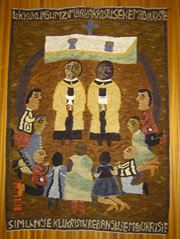


 Wilhelm's space
Political comment: F.W. de Klerk speaking at the 30 Club in London
It is a great pleasure for me to be able to address you on “Africa today and Africa Tomorrow”.
It is an important topic – because whichever way we look at it the future of Africa it will, for better or for worse, have a significant impact on people in the United Kingdom and Europe. Africa could become an increasingly important trading partner and supplier of essential minerals and foods. It could also become a favourite tourist destination and a lucrative market for British and European exports.
However, if the continent fails, it could present Europe with almost insurmountable moral, financial and strategic challenges. The world is still shocked by the deaths of hundreds of Africans – mostly Eritreans – who were drowned when their hopelessly inadequate vessel sank on its way to Italy. But what would happen to Europe’s porous southern borders if there were persistent man-made crises or famines in Africa?
In 2000, at the beginning of the new millennium, South Africa’s President Thabo Mbeki claimed that the 21st century would belong to Africa:
After five hundred years of exploitation and domination by Europe, Africa would finally emerge from the shadows of global affairs and take its rightful place on the world stage.
The World Bank’s response was “Yes, Africa can claim the new century … but this is a qualified yes”. It was “conditional on Africa’s ability – aided by its development partners – to overcome the development traps that kept it confined to a vicious cycle of underdevelopment, conflict, and untold human suffering for most of the 20th century”.
In its lecture to African leaders, the World Bank proposed development strategies that would be focused on:
How has Africa fared since then – and is it still on track to claim the 21st century as the African century?
Read full text of speech HERE.
Share this: