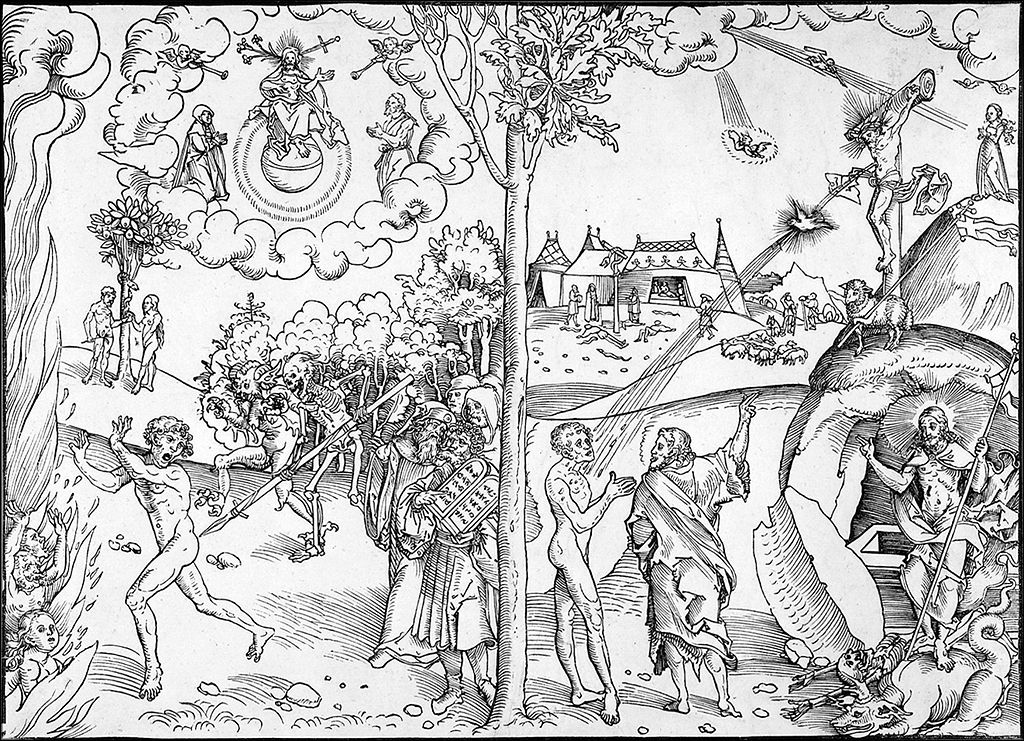
Here Moses points out the difference between the New and the Old Testament.
The New Testament is the older, promised from the beginning of the world, yes, “before the times of the world,” as Paul says to Titus (1:2), but fulfilled only under Christ. The Old Testament promised under Moses was fulfilled under Joshua.
However, there is this difference between the two: the New is founded wholly on the promise of the merciful and faithful God, without our works; but the Old is founded also on our works. Therefore Moses does not promise beyond the extent to which they keep the statutes and judgments.
For this reason the Old Testament finally had to become antiquated and be put aside; it had to serve as a figure of that New and eternal Testament which began before the ages and will endure beyond the ages. The Old, however, began in time and after some time came to an end…
Let us pray: O good and gracious God, heavenly Father + Grant us Your Spirit of Truth and Peace, that we may understand Your holy Will and follow Your Directions and trust Your Promises from the bottom of our heart all our life. Through Jesus Christ our Lord, who lives and reigns with You and the Holy Spirit – one God – now + forever. Amen.
“The calling of Elisha” by Jan Massijs (1509-1575)
The Lord said to him, “Go back the way you came and then head for the wilderness of Damascus. Go and anoint Hazael king over Syria. You must anoint Jehu son of Nimshi king over Israel, and Elisha son of Shaphat from Abel Meholah to take your place as prophet. Jehu will kill anyone who escapes Hazael’s sword, and Elisha will kill anyone who escapes Jehu’s sword. I still have left in Israel 7,000 followers who have not bowed their knees to Baal or kissed the images of him.”
Elijah went from there and found Elisha son of Shaphat. He was plowing with twelve pairs of oxen; he was near the twelfth pair. Elijah passed by him and threw his robe over him. He left the oxen, ran after Elijah, and said, “Please let me kiss my father and mother goodbye, then I will follow you.” Elijah said to him, “Go back! Indeed, what have I done to you?” Elisha went back and took his pair of oxen and slaughtered them. He cooked the meat over a fire that he made by burning the harness and yoke. He gave the people meat and they ate. Then he got up and followed Elijah and became his assistant.
1.Kings 19:15-21 (Lesson for Tuesday after the 5th Sunday after Trinity)
Occasionally one hears this saying of Luther´s quoted: “Let no one give up the faith that God wants to do a deed through him.” There is something inspiring about that. That saying is inscribed on the arch of the gate to the Wittenberg Seminary, but with this little alteration: “Let no one give up the faith that God wants to do a deed in him.” This change, trifling as it may seem, is important. And, to be sure, it is the original reading. This is Luther´s fundamental idea: that God has done something great to us. But then it was Luther who roused us to recognize that he wants to do something through us! This saying applies to every Christian, but it especially applies to ministers of the gospel.
Hermann Werdermann (Quoted in Dobberstein Pg. 274)
Refrain: Listen, listen, God is calling, through the Word inviting, offering forgiveness, comfort, and joy.
1. Jesus gve his mandate: share the good news that he came to save us And set us free.
2. Let none be forgotten throughout the world. In the triune name of God Go and baptize.
3. Help us to be faithful, standing steadfast, walking in your precepts, Led by your Word.
Kenyan song translated by Howard S. Olson (1922-2010)
This passage condemns… representations of God, which He wanted to be forbidden to a simple and childish people, but … inner representations of God, which are (as we have said above) opinions and speculations about God constructed out of ourselves without the voice of God. Here indeed the voice of His words alone is commended, and whatever is said or thought about God which is not that voice of His words is wholly godless and damnable. He wanted to have His will and His counsels delineated for us by His words alone, not by our thoughts and imagination.
Therefore it is not what seems to you to please or displease God, no matter how holy or pious it appears to you (as the founders and confessors of religions and sects have supposed), that pleases or displeases God, but what He Himself by the voice of His Word designates as pleasing or displeasing to Him.
For nobody but God Himself describes or indicates the will of God; therefore everyone errs in a godless manner if he tries this, since nobody knows the depths of God except the Spirit who is in God (1 Cor. 2:11). Therefore it is impossible for men to think properly about God, speak about Him, or worship Him, without the Word of God. The affirmation stands: “You have heard His voice.”
Martin Luther in his private lectures on Deuteronomy (LW 9, Pg. 58)
Let us pray: O good and gracious God, heavenly Father + Grant us Your Spirit of Truth and Peace, that we may understand Your holy Will and follow Your Directions and trust Your Promises from the bottom of our heart all our life. Through Jesus Christ our Lord, who lives and reigns with You and the Holy Spirit – one God – now + forever. Amen.
No one who puts his hand to the plow and looks back is fit for the kingdom of God. (Lk.9,62)
As they (Jesus and his disciples) were walking along the road, someone said to him, “I will follow you wherever you go.”Jesus said to him, “Foxes have dens and the birds in the sky have nests, but the Son of Man has no place to lay his head.”
Jesus said to another, “Follow me.” But he replied, “Lord, first let me go and bury my father.” But Jesus said to him, “Let the dead bury their own dead but as for you, go and proclaim the kingdom of God.”
Yet another said, “I will follow you, Lord, but first let me say goodbye to my family.” Jesus said to him, “No one who puts his hand to the plow and looks back is fit for the kingdom of God.”
Lk.9,57-62
1 Let us ever walk with Jesus, Follow His example pure, Flee the world, which would deceive us And to sin our souls allure. Ever in His footsteps treading, Body here, yet soul above, Full of faith and hope and love, Let us do the Father’s bidding. Faithful Lord, abide with me; Savior, lead, I follow Thee.
2 Let us suffer here with Jesus, To His image e’er conform; Heaven’s glory soon will please us, Sunshine follow on the storm. Though we sow in tears of sorrow, We shall reap with heav’nly joy; And the fears that now annoy Shall be laughter on the morrow. Christ, I suffer here with Thee; There, oh, share Thy joy with me!
3 Let us also die with Jesus. His death from the second death, From our soul’s destruction, frees us, Quickens us with life’s glad breath. Let us mortify, while living, Flesh and blood and die to sin; And the grave that shuts us in Shall but prove the gate to heaven. Jesus, here I die to Thee There to live eternally.
4 Let us gladly live with Jesus; Since He’s risen from the dead, Death and grave must soon release us. Jesus, Thou art now our Head, We are truly Thine own members; Where Thou livest, there live we. Take and own us constantly, Faithful Friend, as Thy dear brethren. Jesus, here I live to Thee, Also there eternally.
The 5th Sunday after Trinity is coming up and we´ve got all reason to rejoice, lift up our faces to the Lord and God of our salvation. It is He, who calls us from the ends of the world to partake in His grace and favor, which is new every morning.
Now the Lord said to Abram,
“Go out from your country, your relatives, and your father’s household to the land that I will show you. Then I will make you into a great nation, and I will bless you, and I will make your name great, so that you will exemplify divine blessing. I will bless those who bless you, but the one who treats you lightly I must curse, so that all the families of the earth may receive blessing through you.”
So Abram left, just as the Lord had told him to do, and Lot went with him
Genesis 12:1-4a: Old Testament lesson for this 5th Sunday after Trinity
Like He called our father Abraham and brought him into the promised land leading him for many years all over the fertile crescent there in the very epicenter of His miracles and wonders from of old. It never was a straightforward journey, but a life-long travail, sojourn and Ilyas. Many temptations, failures, mishaps, troubles, calamities and sins, but still, he trusted God and that God reckoned as righteousness of faith, granting him gracious favor in forgiveness and justifying the sinner be grace through faith. So that it holds true for him also, what the apostle St. Paul writes to the Ephesians:
For by grace you are savedthrough faith, and this is not from yourselves, it is the gift of God; it is not fromworks, so that no one can boast.
Eph.2,8-9 Watchword for this 5th Sunday after Trinity.
We answer to this wonderful story from ages past with the beautiful words:
The God of Abraham praise, Who reigns enthroned above; Ancient of everlasting days, And God of Love; Jehovah, great I AM! By earth and Heav’n confessed; I bow and bless the sacred name Forever blessed.
The God of Abraham praise, At whose supreme command From earth I rise—and seek the joys At His right hand; I all on earth forsake, Its wisdom, fame, and power; And Him my only portion make, My shield and tower.
The God of Abraham praise, Whose all sufficient grace Shall guide me all my happy days, In all my ways. He calls a worm His friend, He calls Himself my God! And He shall save me to the end, Thro’ Jesus’ blood.
He by Himself has sworn; I on His oath depend, I shall, on eagle wings upborne, To Heav’n ascend. I shall behold His face; I shall His power adore, And sing the wonders of His grace Forevermore.
Tho’ nature’s strength decay, And earth and hell withstand, To Canaan’s bounds I urge my way, At His command. The watery deep I pass, With Jesus in my view; And thro’ the howling wilderness My way pursue.
The goodly land I see, With peace and plenty blessed; A land of sacred liberty, And endless rest. There milk and honey flow, And oil and wine abound, And trees of life forever grow With mercy crowned.
There dwells the Lord our king, The Lord our righteousness, Triumphant o’er the world and sin The Prince of peace; On Sion’s sacred height His kingdom still maintains, And glorious with His saints in light Forever reigns.
Thomas Olivers 1725-1799
The Introit puts such trials and afflictions of the faithful into godly words too:
But as for me, my feet almost slipped; my feet almost slid out from under me. For I envied those who are proud, as I observedthe prosperityof the wicked.
Psalm 73:2-3
This Psalm however, closes off with the amazing confession, which is ours too:
I was ignorantand lacked insight; I was as senseless as an animal before you. But I am continually with you; you hold my right hand. You guideme by your wise advice, and then you will lead me to a position of honor. Whom do I have in heaven but you? On earth there is no one I desire but you. My flesh and my heart may grow weak, but God alwaysprotects my heart and gives me stability.
Psalm 73:22-26
The Sermon has the following theme: God´s call – our salvation!
God´s wish, good will and holy desire from the start was our good life and eternal salvation. That´s why He calls Abraham out of Haran and puts him on the road to the promised land. That´s why He calls St. Peter and the rest of the apostles, so that they would not just catch fish, but people – drawing them from the depths of hopeless despair and sinful misery to life with Him in eternal righteousness and everlasting blessedness and holiness. That´s why He continues calling people from the ends of the world, out of darkness to His light and out of the very shadows of death to His new life and salvation in Jesus Christ our Lord and Savior. He issues various calls like “Put out into the deep water and lower your nets for a catch” or “Come to me – all You, who are tired and heavily burdened – I will give You rest!” or “Let´s go up to Jerusalem to suffer many things – and die.” Thereby He wants to open up the way to life and salvation. He means well, because His intentions are good, meet and salutary. That´s why His wish should be our command. We should gladly, willingly and most trustingly follow Him and do as He says. However, due to sinfuldoubts, objections and straight forward bad inclination and sore disobedience and rebellion, sinners tend to oppose God´s mandates, laws, rules and declarations, institutions and creative postulates. Due to sinful pride, they think again and again, they know better than the omniscient God: “Master, we worked hard all night and caught nothing!” Due to sinful despair they oppose His salutary ways and flee His gracious presence of the ever-merciful God and Savior: “Go away from me, Lord, for I am a sinful man!” Due to sinful fear, ignorance, shame and all sorts of other errant vice they come up with alternatives, alterations and other wicked addendums to the clear and salutary mandates of our God: “No, all other – but not this and that!”
Yet, the triune God in his unfathomable love and gracious favor overcomes even the worst of our terrible doubts and grants us undeserving creatures saving faith and living hope. He goes far more than the extra mile – sheer endless meanderings with Abraham, forty years through the desert with Moses and many lifetimes with the faithful saints of old Israel and the many countless saints of the holy Christians Church ever since. He does many, many miracles and wonders calling the unwilling and undesiring and lost to Himself and building up their faith, trust and hope daily afresh – without any worthiness or merit in me – just out of sheer bottomless fatherly goodness and mercy. And He gets great results – even with chronic doubters like St. Peter: “But at your word I will lower the nets… and they caught many fish!” So many, that the nets tore and they needed even more boats to cope with the magnitude of the many, many fish! Yes, He overcomes fear and trepidation by His wonderful words of comfort and encouragement: “Do not be afraid, from now on You will be catching people!” And these doubters and long-settled-into-life-fishers-of-fish left everything (!) and followed him: “Take they our life, good, fame, child and wife – though these all be gone – our victory has been won – the kingdom ours remaineth.” (ML LSB 656) Well, that happened with Abraham and all those archfathers, judges, prophets and kings. It occurred with the holy St Peter and all the fellow apostles, brothers and sisters from Jews and gentiles right to the very ends of the world. Yes, not many high & mighty (1.Cor.1,18-25), but for us it´s proven power to conversion, salvation and eternal life. Thanks be to God – now and always.
The God who reigns on high The great archangels sing, And Holy, holy, holy! cry, Almighty King! Who was, and is, the same, And evermore shall be: Jehovah—Father—great I AM, We worship Thee!
The whole triumphant host Give thanks to God on high; Hail, Father, Son, and Holy Ghost, They ever cry. Hail, Abraham’s God, and mine! I join the heav’nly lays: All might and majesty are Thine, And endless praise.
Thomas Olivers 1725-1799
Here´s my sermon as held on this 5th Sunday after Trinity at the Old Latin School.
Good morning. I’m firmly of the opinion that you get one really good peach a year, if you’re lucky, if you don’t live in the South or next to a peach orchard. One peach, soft and juicy and sweet. That’s something to treasure. When I get one, I eat it slowly, with joy…
Well, I remember those cling-peaches planted by my father on the missionstation “Roodepoort” near Ventersdorp in the old West-Transvaal just before we moved to “Enhlanhleni.” They would ripen after the mild and soaking “yellow-peaches-rain” (“geel perske rëen”) at the height of summer in February. They were the best – not just going by the looks, but also by taste. They could be enjoyed plucked from the tree, stuffed into puddings and cakes, liquified and fired-up to last as “mampoer” (peach brandy) or just laid out on racks to dry in the sun – something of a vegetarian version of biltong/jerky.
Here along the backwaters of the Elbe, I´ve not found the right peach yet. Not this year anyway, but the year is long from over. The ones I´ve tried look ok, but they are more like some foreign version of edible paper or sponge than fruit. So, I´ll keep looking as I remember the good ones – “daar in die ou Transvaal”:
From blossoms comes this brown paper bag of peaches we bought from the boy at the bend in the road where we turned toward signs painted Peaches.
From laden boughs, from hands, from sweet fellowship in the bins, comes nectar at the roadside, succulent peaches we devour, dusty skin and all, comes the familiar dust of summer, dust we eat.
O, to take what we love inside, to carry within us an orchard, to eat not only the skin, but the shade, not only the sugar, but the days, to hold the fruit in our hands, adore it, then bite into the round jubilance of peach.
There are days we live as if death were nowhere in the background; from joy to joy to joy, from wing to wing, from blossom to blossom to impossible blossom, to sweet impossible blossom.
Long, long ago there lived a people… No computers. No smartphones. No email. No texting. Just the lost art of sending a letter… I got to know some of them. My parents were both avid communicators and diligent composers of weekly letters – as were both my grandmothers too. My granny told her daughter – my mother: “Every day I get a letter from You is mother´s day!” I remember my father standing in the dining room before lunch to open the mail, which Hanns Gnauk had picked up punctually in Pomeroy at 11h00 every day. And most of these forebears I can still picture at some table inside or outside the house, drafting letters by hand. It was only later on, when my siblings came of age, that my parents switched to the typewriter as the young ones couldn´t read their handwriting, which was perfectly legible, very structured and uniform really. Still, that´s how things change in large families as the years pass and the generations change. I never got to see a letter from either of my grandfathers as far as I know. There might be some note of my grandfather Weber in the old books still…
My grandfather Paul Ziegenhagen wrote letters to his young bride from the Russian front, sometimes even twice a day. Then one day these letters stopped. My grandmother stopped writing, but not hoping yet. That would happen years later… On the way out – not when they tried to flee from the Russians on the last train, but rather when they were later expelled by the Poles, all those love letters were scattered violently in their house. Worse happened, so nobody considered gathering old letters. No use to cry over spilled milk. My grandmother later voiced her hope, that nobody would have been able to read her husband´s handwriting anyway. As her father had quipped: “That´s not a handwriting, that´s an impertinence!” (“Zumutung!”) So, in the end none of those letters made it to prosperity, but got lost in the ensuing chaos of a lost war. The other grandfather – Christian Heinrich Wilhelm Weber – had probably just outgrown that habit of writing letters by the time I was able to read anything.
A letter from Pomeroy (“Enhlanhleni” P.O.Box 11) took a few day to get to the board school in Wartburg (“Wartburg Kirchdorf Schülerheim”) and just about the same to get to Pretoria (Boekenhout: “Mans koshuis” UP) and “Valhalla”, “Voortrekkerhoogte”, “Murrayhill” and all the other army bases). Even to Altkönigstraße 150 (Oberursel i.T) or Fahrstraße 15 (Erlangen, Franken) it didn´t take longer than that. A letter a week – that was the regular norm. We even planned our wedding in Lüneburg, KZN using the mail back then, but that´s another story…
Some of my best friends still use this ancient style, which has proven itself over the ages – and not only at Christmas or Thanksgiving. Thank God! It´s a good feeling opening the postbox and getting a letter all the way from Seattle or Melbourne even. Sometime in the nineties I switched my weekly circular to email and just stopped using snail-mail. My father continued both methods to the end – and I´m sure, his old friends not connected by email were grateful for that.
Here in Germany the postbox is not red like in the old colony South Africa, but yellow. Even the old GDR, which had some of the most beautiful stamps – just like Romania, Bulgaria and Poland in those days, used those colours. Well, there´s still a box like that fixed to our house in Wittenberg – and the postman comes by every day – punctual as ever. Even though I´m no longer waiting for post from Africa – that just doesn´t happen that way anymore. It´s either email or nothing. I guess it does save some paper and every time the computer rings “You´ve got mail“, I´m bound to jump and sing:
Kommt ein Vogel geflogen, setzt sich nieder auf mein’ Fuß, hat ein’ Zettel im Schnabel, von der Mutter ein’ Gruß.
Lieber Vogel, fliege weiter, nimm ein Gruß mit und ein Kuss, denn ich kann dich nicht begleiten, weil ich hier bleiben muss.
As a deer longs for streams of water, so I long for you, O God! I thirst for God, for the living God.
I say, “When will I be able to go and appear in God’s presence?” I cannot eat; I weep day and night. All day long they say to me,“Where is your God?”
I will remember and weep. For I was once walking along with the great throng to the temple of God shouting and giving thanks along with the crowd as we celebrated the holy festival.
Why are you depressed, O my soul? Why are you upset? Wait for God! For I will again give thanks to my God for his saving intervention.
I am depressed, so I will pray to you while in the region of the upper Jordan, from Hermon, from Mount Mizar. One deep stream calls out to another at the sound of your waterfalls; all your billows and waves overwhelm me.
By day the Lord decrees his loyal love, and by night he gives me a song, a prayer to the God of my life. I will pray to God, my high ridge: “Why do you ignore me? Why must I walk around mourning because my enemies oppress me?” My enemies’ taunts cut me to the bone, as they say to me all day long, “Where is your God?”
Why are you depressed, O my soul? Why are you upset? Wait for God! For I will again give thanks to my God for his saving intervention.
Psalm 42: For the music director, a well-written song by the Korahites.
Good morning from lovely Wittenberg. The sun is out. The little rain we got, is long gone even as the clouds hang in there and the summer heat is not quite back yet. Like every morning the people walk their dogs, people open up their windows, the organists drives in on her bicycle to unlock St. Mary´s staircase to go through her routine and the pretty woman in bright colors and from the Far East does her round past St. Marys to start off another day in these parts.
My task is cut out. I´ve got the basics laid out. The chapel is cleaned out. The floors swept, the chairs straightened, and the many bookmarkers adjusted to the right place. Well, it´s all about our good Lord´s big and gracious invitation on this 2nd Sunday after Trinity. His huge banquet is prepared. He´s just so eager to welcome all his invited guests at his table. He´s done all and everything to make sure, that´s all is set for us and our salvation. His invitation has gone out – and he´s full of great expectations to see his house full and the party started and everybody having a ball. He´s burning with longing to have you as his guest and with him too. Now, that´s no surprise. He is like that. From the very start. The great prophet Isaiah puts this holy desire into words for our Old Testament lesson:
“Hey, all who are thirsty, come to the water! You who have no money, come! Buy and eat! Come! Buy wine and milk without money and without cost. Why pay money for something that will not nourish you? Why spendyour hard-earned money on something that will not satisfy? Listen carefully to me and eat what is nourishing! Enjoy fine food. Pay attention and come to me. Listen, so you can live. Then I will make an unconditional covenantal promise to you, just like the reliable covenantal promises I made to David.
Look, I made him a witness to nations, a ruler and commander of nations.” Look, you will summon nations you did not previously know; nations that did not previously know you will run to you, because of the Lord your God, the Holy One of Israel, for he bestows honor on you.
Isaiah 55:1-5
And we respond to this ancient goodness and godly pining with this Sunday´s Introit
O Lord, your loyal love reaches to the sky, your faithfulness to the clouds. Your justice is like the highest mountains, your fairness like the deepest sea; you, Lord, preserve mankind and the animal kingdom. How precious is your loyal love, O God! The human race finds shelter under your wings. They are filled with food from your house, and you allow them to drink from the river of your delicacies. For with you is the fountain of life; in your light we see light.
Psalm 36:6-10
So far, so good. Everybody in his right mind would now agree and intone: “Blessed is everyone who will feast in the kingdom of God!” No surprises there. That speaks for itself. And that´s the introduction for this Sunday´s gospel. Our good Lord Jesus Christ, however, points out, that there is unexpected and really very serious trouble. This is our fault – humankind´s sin in general. Something like original sin. Instead of taking this wonderful invitation seriously, we find all sorts of excuses, find better things to do than to follow the calling of our good Lord and get lost in all sorts of other business. It´s mind boggling and downright impudent. Imagine Your best friend hosting a huge celebration and you´re invited in good time, but you´re just not interested and stay away. Surely, this is unheard of. It´s just not done. It´s disrespectful, disloyal and just plain rude. However, that´s the message of his story retold in this Sunday´s gospel.
When one of those at the meal with Jesus heard this, he said to him, “Blessed is everyone who will feastin the kingdom of God!” But Jesus said to him, “A man once gave a great banquet and invited many guests. At the time for the banque the sent his slave to tell those who had been invited, ‘Come, because everything is now ready.’ But one after another they all began to make excuses. The first said to him, ‘I have bought a field, and I must go out and see it. Please excuse me.’Another said, ‘I have bought five yoke of oxen, and I am going out to examine them. Please excuse me.’ Another said, ‘I just got married, and I cannot come.’ So,the slave came back and reported this to his master. Then the master of the household was furious and said to his slave, ‘Go out quickly to the streets and alleys of the city, and bring in the poor, the crippled, the blind, and the lame.’ Then the slave said, ‘Sir, what you instructed has been done, and there is still room.’ So, the master said to his slave, ‘Go out to the highways and country roads and urge people to come in, so that my house will be filled. For I tell you, not one of those individuals who were invited will taste my banquet!’”
Luke 14:15-24
Yes. It is quite understandable that the man got furious. But he´s no fool. Instead of ruining the feast, he goes on and makes it even better. The house gets filled. The party gets going and it´s a heavenly sensation and once in a life-time celebration – going on without end. However, not with the first choice, but rather with the second and third … smallest, most unlikely and very last groups, the outcasts and good-for-nothings. He says: ‘Go out quickly to the streets and alleys of the city, and bring in the poor, the crippled, the blind, and the lame.’ And then, when that´s successfully accomplished and there´s still room: ‘Go out to the highways and country roads and urge people to come in, so that my house will be filled.” In other places, he categorized these very last remnants and leftovers (“Allerletzten”) as “prostitutes and tax-collectors”! And that, because the first choice, the eldest brothers, the scribes and leaders, the crème de la crème – just wouldn´t come. Too proud! Too rich! Too self-satisfied, complacent and smug in their own little world to heed the call of God out of this passing world and into His coming kingdom.
Please, can I have some more +
So, our Lord passes out the invitation. It´s standing. It´s open – still. He invites all and every one: “Come to me, all you who are weary and burdened, and I will give you rest.” (Watchword from Mt.11:28) Who would not think of those, who are breathing heavily because of Coronna or of those, who are suffocating under the heavy knee of brutal force, racism, slavery, political discrimination and other terrible exploitation? Misuse of police authority and parental abuse comes to mind. Our Lord invites them, to come to him and find peace with him – solace there! He is the peace maker. He forgives sins and heals all our iniquities. Just as the epistle for this Sunday makes us recall:
Therefore remember that formerly you, the Gentiles in the flesh—who are called “uncircumcision” by the so-called “circumcision” that is performed on the body by human hands— that you were at that time without the Messiah, alienated from the citizenship of Israel and strangers to the covenants of promise, having no hope and without God in the world. But now in Christ Jesus you who used to be far away have been brought near by the blood of Christ. For he is our peace, the one who made both groups into one and who destroyed the middle wall of partition, the hostility, when he nullified in his flesh the law of commandments in decrees. He did this to create in himself one new man out of two, thus making peace, and to reconcile them both in one body to God through the cross, by which the hostility has been killed. And he came and preached peace to you who were far off and peace to those who were near, so that through him we both have access in one Spirit to the Father. So then you are no longer foreigners and noncitizens, but you are fellow citizens with the saints and members of God’s household, because you have been built on the foundation of the apostles and prophets, with Christ Jesus himself as the cornerstone. In him the whole building, being joined together, grows into a holy temple in the Lord,in whom you also are being built together into a dwelling place of God in the Spirit.
Ephesians 2: (11-16) 17-22
Our good Lord himself rejoices in this salvation and heavenly celebration of sinners being saved, little children finding their heavenly Father and foreign strangers a new birthright and lasting citizenship in God´s family and Christian Church. The words for this Sunday´s sermon:
At that time Jesus said,“I praise you, Father, Lordof heaven and earth, because you have hidden these things from the wise and intelligent and have revealed them to little children. Yes, Father, for this was your gracious will. All things have been handed over to me by my Father. No one knows the Son except the Father, and no one knows the Father except the Son and anyone to whom the Son decidesto reveal him. Come to me, all you who are weary and burdened, and I will give you rest. Take my yoke on you and learn from me, because I am gentle and humble in heart, and you will find rest for your souls. For my yoke is easy to bear, and my load is not hard to carry.”
Matthew 11:25-30
So, we confess with all the Christian Church exclaiming “My God is my rocky summit where I take shelter, my shield, the horn that saves me, and my refuge.” (Psalm 18:2) and sing joyfully as we gladly follow His gracious invitation:
Come, we that love the Lord, And let our joys be known; Join in a song with sweet accord, And thus surround the throne.
Refrain: We’re marching to Zion, Beautiful, beautiful Zion; We’re marching upward to Zion, The beautiful city of God.
The sorrows of the mind Be banished from the place; Religion never was designed To make our pleasures less.
Let those refuse to sing, Who never knew our God; But children of the heav’nly King May speak their joys abroad.
The men of grace have found Glory begun below; Celestial fruits on earthly ground From faith and hope may grow.
The hill of Zion yields A thousand sacred sweets Before we reach the heav’nly fields, Or walk the golden streets.
Then let our songs abound, And every tear be dry; We’re marching through Immanuel’s ground To fairer worlds on high.
A good friend of mine and foreign pastor in these lands phoned me yesterday. Whereas I only use the phone for urgent messages, something like the original telegraph, he obviously uses it to catch up on visitation and the blessings per mutuum colloquium et consolationem fratrum (Smalcald Articles III,4: Concerning the gospel), which William Russel translates as “through the mutual conversation and consolation of brothers and sisters.” (Kolb/Wengert, Pg.319). How grateful can we be for the Lord´s promise: “Where 2 or 3 are gathered in my name, there I am with them!” (Mt.18:20)
Matthias Grünewald: St. Paul and St. Anthony in the desert (Isenheimer Altar)
In these times of “social distancing” this telephonic chatroom is a wonderful way to share comforts of a friendly voice and catch up on some fraternal news outside the provincial bubble. Thank God, we have such good fellowship even as we rejoice in that of our books, podcasts and films too. Of course, this ever growing freight is also a great distraction and can become an excessive overload. The good old Saint Anthony – like all desert fathers and other hermits – knew all about these temptations – even outside in the desert. The present situation is very helpful in reducing this ever-expanding surplus of diversions to a healthy, still stimulating, but sustainable level. Very much like a necessary fast or at least healthy diet. Part of the basic daily schedule remains the quality time in dialogue with our maker – the triune God – in reading His Word and bringing our all to Him in prayer. For me it works best to start the day with that before I get lost in daily business…
You, however, must continue in the things you have learned and are confident about. You know who taught you and how from infancy you have known the holy writings, which are able to give you wisdom for salvation through faith in Christ Jesus. Every scripture is inspired by God and useful for teaching, for reproof, for correction, and for training in righteousness… (2.Tim.3,14ff)
This morning’s readings prompted these subsequent thoughts. So, allow me to share those with You too, starting off in reverse order i.e. from the passages in the “Anthology” (Dobberstein Pg. 354-6) for Thursdays – to the Scriptural meditations for the day on “The minister as pastor” (ebd. 34) – on Ezekiel 34:1-16 and Isaiah 40:11. Here are those readings from the Anthology on “Christ´s curates” and on “being close to the Chief Shepherd”:
Lest You be overwhelmed with the greatness of Your task, remember no church is given to any man without the Saviour of the church and of him. After all it is Christ´s Church more than yours. He is the real Pastor of every real church, and the Bishop of its minister. You are but his curate.
When Jesus handed over to Simon Peter the charge of the Christian Church, he was careful to use the possessive pronoun “my”. “Feed my lambs! Tend My sheep! Feed my sheep!” It is the mightiest pronoun in the New Testament for the saving or the minister from lordliness. “Simon, son of Jonas, feed my lambs . They are not yours, they are mine, but I wish you to look after them for a little while. I do not give them to you. They belong to me. Mine they always shall remain, but I ask you to tend them for a season for me. Feed my sheep. They are not yours. Not all one of them shall ever pass from my possession, but I am going away for a few days, and I leave them with you. Guard them, feed them, guide them, be good to them for my sake. Follow me. Remember my gentleness, my watchfulness, my considerateness, my patience, my compassion, my readiness to help, my swiftness to heal, my gladness to sacrifice. Be the kind of shepherd to my lambs and my sheep that I have been to you. Follow me!
The real vital question of the ministry is that every individual Shepherd be constantly and earnestly concerned to be remaining in immediate contact with the chief Shepherd, from whom he has received his office and to whom he will one day be accountable for it … only daily, direct encounter with the Chief Shepherd will keep the shepherd alert to the cares and needs of his flock. Only this will carry him across the abyss of proud or conceited self-satisfaction on the left or the abyss of tedium and resignation on the right. The shepherd needs the Chief Shepherd; if he is no longer conscious of this, if he constructs his own ministry, he’s already lost.
For pastors, therefore, it must again become simply a matter of course that there shall be time set aside for daily Scripture reading and daily prayer, and this not only in the form of general family worship. The pastoral ministry requires pastoral study of the Scriptures and pastoral prayer. This is not merely a pious pastime which a few pastors indulge in alongside of the ministry. Because of his office and for the sake of his office the pastor must study the Bible. When a man knows of no more than texts of the pericopes and Bible class lessons on which he has to speak to the congregation it will soon be found, when his work is objectively tested, that he cannot preach rightly on these texts either.
And for the sake of his office the pastor must continue in prayer. He cannot be a real pastor to the endangered and suffering in his congregation without practising priestly intercession for them. Here, too, there’s a deep gulf between pastoral care with prayer and pastoral care without prayer. Let not the pastor tell himself, that he is “praying without ceasing”. Let him set aside a daily quiet time for Scripture reading and prayer. Many an error and scandal in the doctrine life of our church would have been prevented if all pastors had kept this rule, if they had not allowed themselves to be led astray by the business of their Sunday and everyday life into the slothfulness of the inner man.
Thank God, He himself keeps the bad shepherds out and takes good care of His own as the very good Shepherd – Jesus Christ:
The Lord’s message came to me: “Son of man, prophesy against the shepherds of Israel; prophesy, and say to them—to the shepherds: ‘This is what the Sovereign Lord says: Woe to the shepherds of Israel who have been feeding themselves! Should not shepherds feed the flock? 3 You eat the fat, you clothe yourselves with the wool, you slaughter the choice animals, but you do not feed the sheep! 4 You have not strengthened the weak, healed the sick, bandaged the injured, brought back the strays, or sought the lost, but with force and harshness[b] you have ruled over them. 5 They were scattered because they had no shepherd, and they became food for every wild beast.[c]6 My sheep wandered over all the mountains and on every high hill. My sheep were scattered over the entire face of the earth with no one looking or searching for them.
“‘Therefore, you shepherds, listen to the Lord’s message: 8 As surely as I live, declares the Sovereign Lord, my sheep have become prey and have become food for all the wild beasts. There was no shepherd, and my shepherds did not search for my flock, but fed themselves and did not feed my sheep. 9 Therefore, you shepherds, listen to the Lord’s message. 10 This is what the Sovereign Lord says: Look, I am against the shepherds, and I will demand my sheep from their hand. I will no longer let them be shepherds;[d] the shepherds will not feed themselves anymore. I will rescue my sheep from their mouths, so that they will no longer be food for them.
11 “‘For this is what the Sovereign Lord says: Look, I myself will search for my sheep and seek them out. 12 As a shepherd seeks out his flock when he is among his scattered sheep, so I will seek out my flock. I will rescue them from all the places where they have been scattered on a cloudy, dark day.[e]13 I will bring them out from among the peoples and gather them from foreign countries; I will bring them to their own land. I will feed them on the mountains of Israel, by the streams and all the inhabited places of the land. 14 In a good pasture I will feed them; the mountain heights of Israel will be their pasture. There they will lie down in a lush[f] pasture, and they will feed on rich grass on the mountains of Israel. 15 I myself will feed my sheep and I myself will make them lie down, declares the Sovereign Lord. 16 I will seek the lost and bring back the strays; I will bandage the injured and strengthen the sick, but the fat and the strong I will destroy. I will feed them—with judgment!
Ezekiel 34:1-16
And the brief passage for meditation on this:
Like a shepherd he tends his flock; he gathers up the lambs with his arm; he carries them close to his heart; he leads the ewes along.
Isaiah 40:11
We sing and praise His name – now and always:
1 What a friend we have in Jesus, all our sins and griefs to bear! What a privilege to carry everything to God in prayer! O what peace we often forfeit, O what needless pain we bear, all because we do not carry everything to God in prayer!
2 Have we trials and temptations? Is there trouble anywhere? We should never be discouraged; take it to the Lord in prayer! Can we find a friend so faithful who will all our sorrows share? Jesus knows our every weakness; take it to the Lord in prayer!
3 Are we weak and heavy laden, cumbered with a load of care? Precious Savior, still our refuge– take it to the Lord in prayer! Do your friends despise, forsake you? Take it to the Lord in prayer! In his arms he’ll take and shield you; you will find a solace there.




 Wilhelm's space