
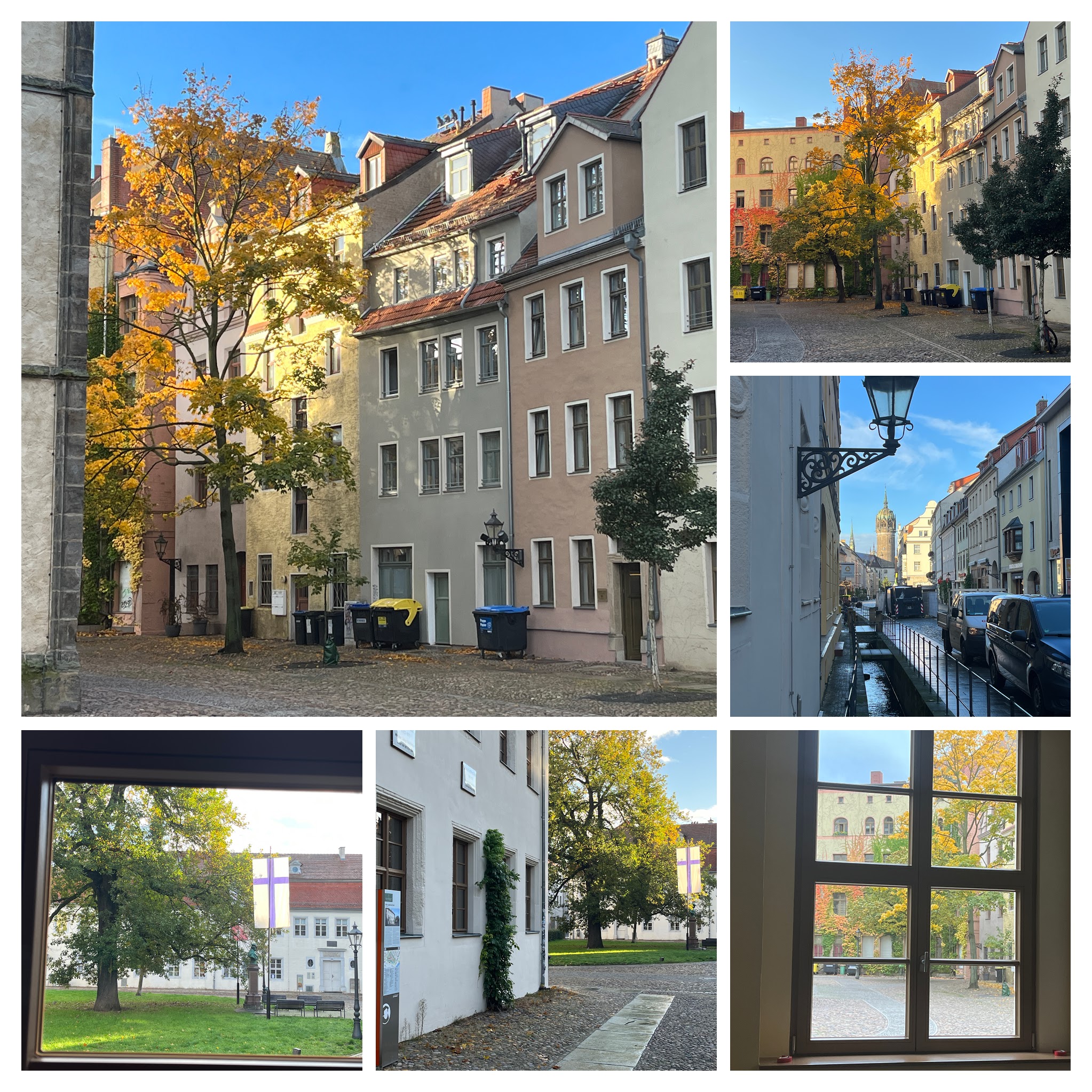
This fall, we decided to combine two of our joys, the joy of serving others and the joy of travel. This led us to ask Director Rev. Dr. Wilhelm Weber of the Old Latin School [Alte Latein Schule auf Deutsch] in Wittenberg Germany, if we could come and spend two weeks assisting the ministry there in any capacity. He approved our request and suggested that the best time to come would be late September-early October. This became the centerpiece of our trip and the most significant purpose thereof.
The flight to Berlin and on September 15 and train to Wittenberg was supposed to be simple and looked so on paper. However, the reality was our flight in Kansas City was canceled due to mechanical problems, which meant we missed our connecting flight. This led to being routed through Chicago, then to Frankfurt, and finally to Berlin. Two of those flights were also delayed, but we finally made it to Wittenberg and were greeted by our Airbnb host, Frau Kuehner, an energetic, friendly woman who immediately made us feel at home. She was thoughtful enough to supply us with grocery necessities, as the stores were closed and would be on Sunday, the next day. We were very tired after a 27 hour day of travel.
We first met the Weber’s at the Old Latin School [referred to as OLS] at 9:00 the next morning for the English language service. Although the attendance was very small, Dr. Weber did not cut any corners and offered us Word and Sacrament. I might add that he is an excellent preacher. Angelica, his gracious wife, is a language teacher in a local private Christian school and also conducts German language classes for the Ukrainian refugees housed at the OLS.
Sunday was a time to get acclimated to our apartment and home for the next two weeks. It was on the third, actually fourth level of a European style building of the 1700’s. I think Peggy counted 46 steps to climb each time we entered; I didn’t bother. Our spacious apartment with its thoroughly modern conveniences served us well for the next two weeks. Of course, it took us a while to figure out the appliances etc., especially translating the German instruction book for the washing machine!
The next day, we reported for “work” at the OLS, but not before a trip to the Baekerei [Bakery] for fresh breads etc. for breakfast. This became a daily pleasurable event. Dr. Weber, Wilhelm, explained what our “duties’ ‘ would be. This consisted of stamping books in the OLS library, a task that was partially done but put on hold by the staff of one. Up and down the ladder, stamping the books, returning them in order did not tax us. It gave us ample opportunity to marvel at the collection of books, many of them very old [some printed in the early 1500’s] contained in the Library. Most were Theology related; many commentaries, Greek and Hebrew texts, dictionaries, dogmatics, apologetics, church history etc. It was easy to wander off task and lose oneself in the treasure trove of books. We did our fair share of browsing during our “work” time.
While working in the Library next to the office, we were also tasked with receiving at the front desk. There is usually not a steady stream of traffic in and out of the School, but someone does need to greet when a visitor comes. This allowed Dr. Weber a free hand to do whatever he needed to during the middle of the day.
The OLS is home to 27-29 Ukrainian refugees in family units. They have come through the auspices of Lutheran Church bodies, worship in their own language with their own pastors at the OLS chapel. Their children attend German schools. The men and many women have jobs. They attend language classes and are at work incorporating into German society while hoping to return to their native land. They were very friendly, polite and did not want to disturb anyone. English was not well known. We enjoyed our short times of mingling with them.
WORSHIP EXPERIENCES
I already spoke of our first worship experience at the OLS. Immediately after worship on that first Sunday, the bells tolled at the Marien Kirche, St. Mary’s, or City Church, a UNESCO World Heritage Site, located about 20 paces from the OLS. We took advantage of that opportunity and attended the Gottesdienst [worship service] in the German language. There were a surprising number of people in attendance, mostly elderly, [of course, that describes us as well!] that gathered at the mother church of the Reformation, the church where Luther preached his hundreds upon hundreds of sermons, and that houses famous works of art by Lucas Cranack and others. There is also a short chapel service [Mittagsgebet] there during the week, which I tried to attend. The hearing environment was challenging, but I could usually at least catch the drift of what was going on.
The Castle Church [Schosskirche] anchoring the west end of Old Wittenberg is where on this day – I’m writing on October 31 – in 1517, Dr. Luther posted 95 Theses or statements mostly against the sale of indulgences, an abuse that had crept into the Medieval Church. This, of course, immediately reverberated not just locally, but eventually throughout the world. The Castle Church contains the tombs of Luther, Melanchthon, and other reformers. The original doors were destroyed by fire in the 1700’s and were replaced with bronze doors with the 95 Theses inscribed on them.
A Lutheran entity called the Wittenberg English Ministry, WEM for short, also conducts chapels and worship services in both the Castle Church of 95 Theses fame, and the City Church. Guest Pastors from the USA come for two week intervals to conduct the services. They are also served by Deputy Directors who provide logistical support. We met the Directors who just happened to be St. John’s College [Peggy and Jeremy’s Alma Mater] as well as Concordia Seward Alumni! We had much to talk about. The visiting Pastor had attended Concordia Portland and had grown up in the LCMS. These spiritual leaders provided additional worship opportunities. I even got conned into playing the small parlor organs for a chapel and one of the worship services at the OLS. I blame Peggy for that.
I would add that each Friday, there is a brief 30 minute organ concert at either the Schlosskirche or the Stadtkirche. They both have magnificent Sauer organs and very proficient Cantors/organists! It was such a treat to hear the organs for worship and concert.
Wittenberg: The City
Wittenberg is a small city of about 40,000 with an extremely well-preserved Altstadt. The Allies refrained from bombing the town during WW2 due to its historical significance, thus preserving its medieval character. The Marktplatz, or City Square, is a lively place lined with hotels, coffee shops, bakeries, restaurants, shops etc. and is a gathering place for many events. During our time there, Wittenberg hosted a “Toepfer” [pottery] festival complete with over 70 various pottery vendors. Peggy made a purchase – boiled egg holders! Some of our best German food was at the food tents at the festival. Without a car during the first two weeks, we walked and walked and walked some more. We enjoyed seeing the biking culture with people of all ages [including those elderly spoken of earlier] riding not just for pleasure, but as part of their daily routine. It was most interesting to observe the Germans in this small city during the course of a two week period conducting their daily affairs. Most were quite friendly and helpful when asked. “Good mornings” and casual “hello’s” weren’t usually initiated by them and were often unanswered much to Peggy’s dismay.
Another attraction of the city is the Lutherhuas, the Augustinian monastery that became the home of the Luther’s and also housed students at the University in Luther’s day. Today, the Lutherhaus contains a museum of manuscripts, objects, artwork etc. of the Reformation era – very interesting!
Stammtisch:
On Thursday evenings, a small group of people gather at the OLS for an event called Stammtisch. It was begun a number of years ago by the Burgermeister [Mayor] of Wittenberg as a forum to develop congeniality, cooperation, harmony, etc. within the city. The language is English, and anyone is welcome to attend. Beer and wine are served [of course] while conversation develops and deepens amongst the participants. We attended two of these events and found them fascinating. The small group contained historians, authors, businessmen, psychologists, etc. all contributing to lively and congenial conversations. This is not a ministry of the OLS, but it is certainly a forum where Christian caring and concern can be demonstrated and displayed. It was especially interesting to hear from the historians/authors about life after WW2 going into the Communist era and beyond. They lived this history.
Woerlitzer:
Our Airbnb hosts, whom we came to appreciate and know rather well, invited us to visit the Woerlitzer Park, another UNESCO World Heritage site that is very near Wittenberg. On a stunningly beautiful day, we crossed the Elbe River, drove through several picturesque German villages and arrived at the Woerlitzer. The Park is a gigantic English style garden that was developed by Prince Leopold II. Architects, engineers, artists, horticulturists etc. all collaborated to produce grounds of beauty and grace. We enjoyed a picnic lunch with the Kuehner’s, conducting our conversation in German and in English. Dr. Kuehner is a retired chemical engineer whose Australian daughter owns our apartment. We certainly thought our hosts went above and beyond to treat us to this day!
Guests:
We came to serve, but were served in many ways by others. For example, a young woman from Turkey helped us navigate the Berlin air terminal and find our train platform. Another example is above. Dr. Wilhelm and Angelica invited us into their home after our second Sunday service for a sumptuous German style breakfast. Beautifully displayed cheeses, breads, sausages, eggs, marmalades, coffee, juices along with delightful conversation highlighted our morning. What a treat this was for us. They also invited a U.S. guest from Georgia who had worked in Wichita and knew many of the same people we did! We were treated very, very well.
Home Away From Home:
After two weeks in our adopted home town in Germany, we began to feel at home. We started to recognize people on the street and even knew them by name thanks to the Stammtisch. Repeated trips to the baekereis and café’s led us to know by sight some of the staff even if we didn’t know their names. The Webers and Kuehners made us feel at home. English ministry staff provided connections to our church bodies etc. We experienced more of the Church as the Body of Christ! With a touch of sadness, we repacked, strolled to the Bahnhof, and bade a fond farewell to Wittenberg before entering the next phase of our journey. [I might add that the Hauptbahnhof in Wittenberg has a great bakery and coffee!] On to Leipzig!

 Wilhelm's space