
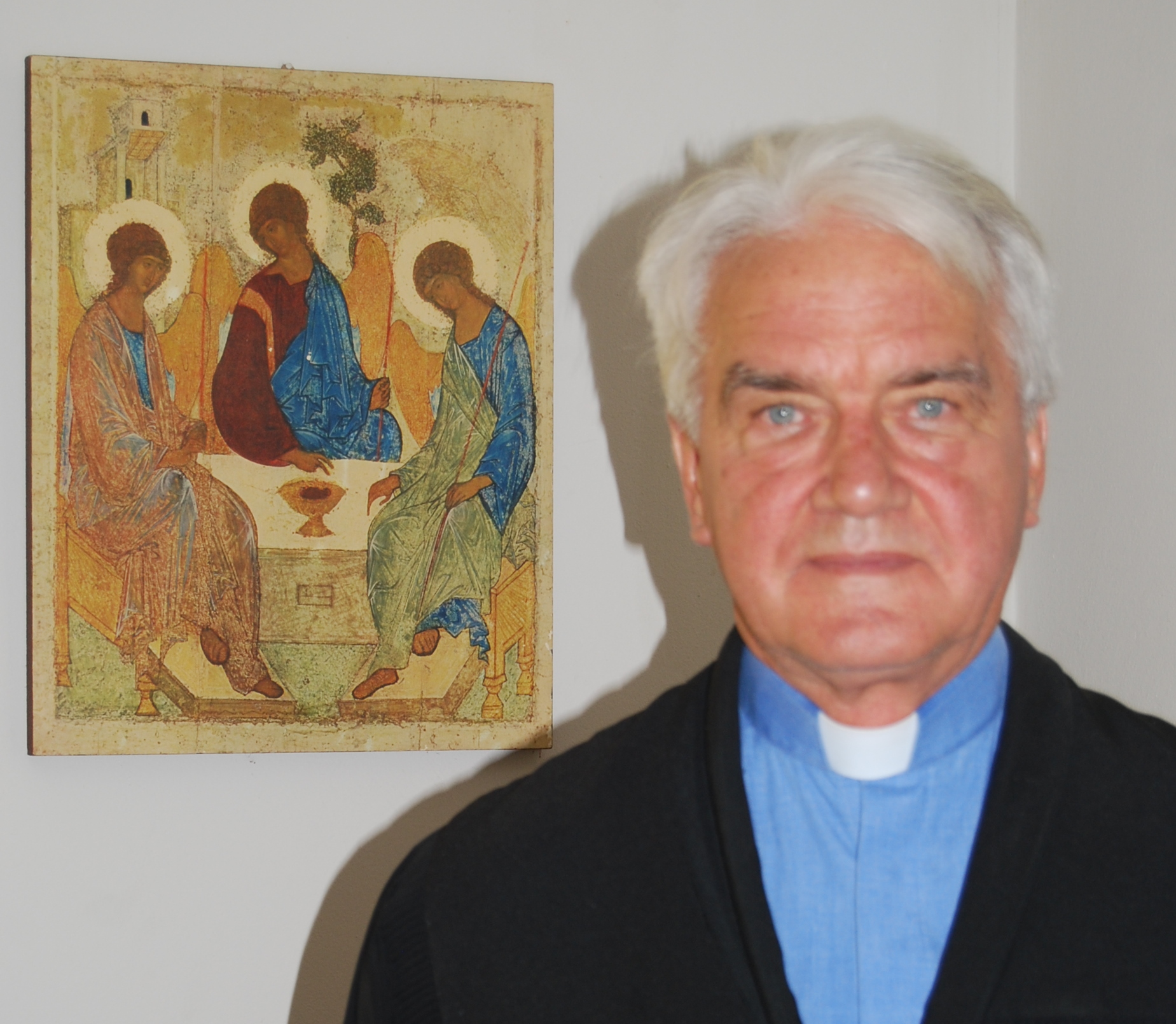
After Matins in St. Timothy's Chapel at LTS
“The Liturgical Heritage of Theodor Kliefoth.” In J. Bart Day and others (eds), Lord Jesus Christ, Will You Not Stay. Essays in Honor of Ronald Feuerhahn on the Occasion of his Sixty-Fifth Birthday. The Feuerhahn Festschrift Committee: Houston, 2002, 105-120.
John W. Kleinig
In 1 Corinthians 12:28 St Paul mentions a rather surprising charisma that God gives to some people in the church. This charisma is a complex of abilities that may be characterized as “gifts of administration.” By the use of the Greek word kybernêseis [1] Paul compares those who have these gifts to a captain who steers his ship skillfully across the ocean and brings it safely to its port of destination.
God raises up leaders with this charisma most frequently in stormy times. Then churchmen are needed who can pilot the ship of the church with a clear head and a steady hand. It is indeed a rare gift, for it combines qualities that do not usually coexist in the same person. Such a person blends theological acumen with organizational ability, spiritual discernment with liturgical flair, personal warmth with sober judgment, passion with pragmatism, a large vision with an ability to pay close attention to details.
Theodor Kliefoth had this charisma in rich measure. He was one of the great confessional Lutheran churchmen of the nineteenth century. While he had much in common with the other important Lutheran leaders of his day, such as Harms and Harless, Vilmar and Walther, he, like Loehe, was also a liturgical theologian. But, unlike Loehe, he was a bishop of the church. He knew that leadership in the church had to do with liturgical oversight and guidance in worship. That is what set him apart from his peers. They offered theological and pastoral leadership in those troubled times; he gave liturgical leadership as well.
A decade ago David Fagerberg wrote a rather challenging book called: What Is Liturgical Theology? [2] He argued, as many scholars now do, for the primacy of liturgical theology over systematic theology in the life of the church. In his analysis he distinguishes between three different ways of understanding the relationship between liturgy and theology (9-27). The first approach, which is exemplified by Prenter [3] and Vajta [4], is a theology of worship. It deals with worship rather than liturgy; its topic is the theological understanding of worship as abstracted from any actual liturgical enactment. The second approach, which is followed by Brunner [5], is a theology from worship. It shows how the doctrine of the church is communicated and expressed in the liturgy of the church. It too ends up treating doctrine as an entity apart from its liturgical enactment. The third approach, which Fagerberg advocates, is liturgical theology. It presupposes that in practice theology cannot be abstracted from its concrete enactment in the liturgy. The liturgical rite, together with its structure and contents as well as its function and the function of each part of it in its context, is the subject of study for the liturgical theologian.
Even though Fagerberg does not mention Kliefoth, his liturgical studies fit this approach. He was a true liturgical theologian because he attempted to show how God’s word was enacted as law and gospel in the Lutheran liturgy. Like many of his contemporaries he was interested in the Biblical foundations of the divine service, its historical development, its theology, and the tradition of its proper performance. But he differed from them in that he used all this data to understand the order of the divine service, its theological dynamics, and its actual function. Whereas they were interested in the meaning of the divine service, he was concerned with what was done by the Triune God and the church in it. This approach meant that he studied the classical Lutheran church orders and became an expert in them at a time when they were regarded by most academic theologians as a cause for theological embarrassment. He did not theorize about worship but reflected on the divine- human dynamic in the order of the divine service from the Old Testament to the Lutheran Church of his day.
His approach was historical and practical. He held that there were two main reasons for the liturgical chaos in his church [6]. On the one hand, the teachers of the church had forgotten its history. They had not passed on its liturgical heritage but had destroyed it by encouraging pastors to arrange the liturgy according to their personal whims and fancies. And so the church no longer knew what it had once possessed, nor did it know what to do with the remnants that it still possessed. On the other hand, the discarnate subjective spirituality of his age prized formlessness and promoted informality because it was convinced that any set liturgical order suppressed spiritual vitality and hindered the work of the Holy Spirit. Kliefoth, however, argued that the liturgy of the church depended on historical continuity. He had little time for liturgical scholars who concocted new orders that expressed their pet theories and imposed them on the church without any regard for its history. The way to go was to begin with what the church had received and to build on that, no matter how much that contradicted fashionable opinion and led to charges of repristination, that bogyman of revolutionary liberalism.
Even though he was widely read in his day, Kliefoth and his liturgical writings have now been largely forgotten [7]. If he is mentioned at all, he is lumped together with Vilmar as a narrow minded, high church, reactionary, conservative neo-Lutheran. He is not even read by those of us who are his heirs confessionally and theologically [8]. Luther Reed knew of his work but had, at best, a limited appreciation of its importance [9]. Peter Brunner does not interact with him at all. Despite his interest in the catholicity of Lutheran worship, Senn mentions his work only in passing but does not seem to have read anything that he published [10]. Yet we do have much to learn from him in our present context. We cannot, of course, merely repeat his work. Far too much has happened since his day. But we can take over from him and carry on the project that he began. His work should be studied by those of us who hold that the gospel is enacted most fully in the divine service.
This essay is a tribute to my dear friend and brother confessor Ron Feuerhahn. Since we first met in Cambridge where he was the precentor of Westfield house our lives have intertwined in wonderful ways. Even though I am not a historian, I would like to present this historical sketch to him on the occasion of his 65th birthday in appreciation for his philadelphia, his brotherly kindness and his love for the great Lutheran churchmen of the nineteenth century. It is no accident that I first learnt about Kliefoth from my teacher Hermann Sasse. My hope is that this essay will encourage a new generation of scholars to explore the liturgical work of Kliefoth, assess its continuing worth, and use it to build up our Lutheran liturgical heritage in its ecumenical context.
 The Life of Theodor Kliefoth
Theodor Kliefoth was born in 1810 and died in 1895 [11]. He spent the first part of his life in the village of Körchow in the province of Mecklenburg where his father was a Lutheran pastor. He belonged to the generation of Lutherans that rediscovered the reality of sin and redemption through faith in Christ in the revival movements that swept across Europe in the wake of the Napoleonic wars. He studied theology from 1829-1832, first in Berlin where he came under the influence of Neander and Hengstenberg, Hegel and Schleiermacher, and then at Rostock where he was so appalled at the standard of teaching that he largely taught himself. In Berlin and Rostock he gathered a circle of students around himself that later became leaders with him in Mecklenburg.
After spending some time at a teacher training seminary in Berlin, he became a tutor to the sons of the Arch Duke of Mecklenburg from 1837- 1839. He accompanied the Crown Duke Friedrich Franz to Dresden and formed a close friendship with him. His time in Dresden gave him the leisure to complete his theological studies and write his Introduction to the History of Dogma [12]. This work, influenced as it was by Schleiermacher and Hegel, explores the history of the church as a living organism with the development of its dogma as a historical process [13]. It gained him two separate doctorates, the one from Rostock and the other from Königsberg.
After ordination he became the pastor at Ludwigslust from 1840-1844. He quickly distinguished himself as a passionate preacher who opposed the prevailing rationalism that had swept through the city and devastated the congregation. While there he gradually became a confessional Lutheran with a passion for the mission of the church and the evangelism of the unchurched. Despite his busy schedule he wrote a book on the Theory of the Cultus in the Evangelical Church (1844). This monograph, which was strongly influenced by Schleiermacher, was later repudiated by Kliefoth as far too subjective and speculative in its understanding of the liturgy as the self-expression of the congregation. By virtue of his close association with the Arch Duke he too became involved in plans for the synodical government of the Lutheran Church in Mecklenburg and its ministry. In 1844 he became the superintendent of Schwerin and the main pastor at its cathedral. He, in effect, became the head of the church in that province. As soon as he had been installed he issued an appeal to all the pastors and teachers in his diocese to join him in working for the spiritual renewal of the church. This was followed by work towards the production of a new agenda [14] for the province by the publication of a series of Liturgical Papers for Mecklenburg from 1845 -1847. These papers contained the first edition of the Original Order of the Divine Service in the German Churches of the Lutheran Confession, its Destruction and Reformation which was later published separately [15]. The breadth of scholarship in these essays and their relevance to the situation of the Lutheran churches in Germany quickly established his reputation as liturgical scholar and an expert in the history and content of the Lutheran church orders. This expertise led to the choice of him as regular keynote speaker in the annual liturgical conferences from 1852-1862 that were later established for representatives of the Lutheran churches in the aftermath of the Eisenach Conference. The material from these two sources was later revised and drawn together in his chief liturgical publication, Liturgical Essays [16]. Together with Otto Kade, a prominent church musician, he brought out the Cantionale for the Duchy of Mecklenburg in four volumes, a comprehensive collection of Lutheran liturgical music.
As the leading churchman in Mecklenburg Kliefoth was caught up in the tumultuous events of the 1848 revolution that swept through this province, as elsewhere, and led to the replacement of the old feudal order with a new more democratic constitution. He was appointed to a commission that was established to prepare for the synodical organization of the church. When the old political order was restored he became a member of the council that ran the church and ensured that it operated independently. He used his position to build new churches and renovate those that had become dilapidated. Under his influence confessional Lutheran theologians were appointed to the faculty at Rostock, annual pastors’ conferences were held to achieve consensus, and the visitation of parishes by the superintendents of the dioceses became a regular practice. Kliefoth gradually was recognized as one of the leading Lutheran churchmen in Germany during the second half of the nineteenth century. His reputation was enhanced by his involvement in the Eisenach Church Conference from 1852-1872 and his role in establishing the General Evangelical Lutheran Conference in 1862. He used his position on it, and his role as its president after the death of Harless in 1874, to promote the unity of the confessional Lutheran churches and to oppose the program of the unionism that emanated from Prussia.
Even though he was a busy man he continued to write copiously. He edited the Church Periodical with Professor O. Meier from 1854-1860 as well as its successor, the Theological Magazine from 1861-1864 together with his friend Dieckhoff. He published the first four volumes of the Eight Books of the Church [17]. He, however, never got around to finishing that project. In it he argued for four things: the divine institution of the church by the Triune God as a living organism and institution that transcended each congregation; the foundation of the church on the presence and ongoing activity of the risen Lord Jesus and on his bestowal of the Holy Spirit through the means of grace; the divine institution of the ministry of word and sacrament; the need for the organization of the church as an institution with an appropriate order and system of government. During the later part of his life he devoted his scholarship to the study of eschatology. This led to the publication of commentaries on Zechariah (1862), Ezekiel (1864), Daniel (1864), and Revelation (1874). It culminated in his last major theological book on Christian Eschatology [18].
When he died in 1895 he had put his stamp on the Lutheran Church of Mecklenburg. It was well-run and free from the interference of the state. Its pastors were united in their adherence to the Lutheran confessions and in their acceptance of the classical dogmas of the church. The decay in its liturgical life had been reversed. Those who disagreed with its orthodox position had left the Duchy or gone underground. He was so successful that the liberal theological establishment regarded it as the bastion of reactionary Lutheran conservatism.
The Liturgical Essays of Theodor Kliefoth
Kliefoth ends his Liturgical Essays with these words [19]:
These are my proposals. Others will decide, time will tell, and the Lord will judge whether they are appropriate or not. But I must say that, during the twenty one years that I have been a preacher, not a day has passed when I have not thought about these matters and studied them.
As he himself admits he had an abiding concern for the divine service and its performance. All other aspects of his work were peripheral to his love of the liturgy. For him as a bishop of the church the order of the divine service was the heart of the matter, well worth the immense expenditure of time and mental energy that he devoted to it.
Liturgical matters were so important to him because he understood, more clearly than most of his contemporaries, that the Triune God had instituted the divine service in the church to enact the gospel which it had received from Christ. In this appreciation of tradition he stood against the Enlightenment with its emphasis on reason as well as pietism with its emphasis on subjectivity. As a student of theology he had come under the spell of Hegel and Schleiermacher. But as a result of his own study of the Scriptures and the history of the church he came to see that the church was not established to communicate a religious philosophy of life, an all-embracing system of spiritual ideas, or to promote the religious sensibility of individuals, the development of increased divine consciousness. Rather the church was built on the words and deeds of the living God. In it the incarnate Christ continued his ministry through the means of grace. It was the place where the risen Lord Jesus was at work in word and deed, the place where he gave his Holy Spirit through the ministry of reconciliation. He was therefore interested in the history of the church and the shape of the divine service, for through its involvement in the divine service the church participated in the saving work of the Triune God and received the fullness of Christ as it gradually appropriated it on its journey through human history.
These convictions shaped the focus and method of his liturgical studies. They were characterized by three emphasizes: the institution of the divine service by God in the Sacred Scriptures, the history of its development in the church, and the ordered enactment of God’s word in it. He did not concentrate as much on the meaning of the liturgy as on its actual function. The key to that lay in its divine institution and its ritual shape. He therefore did not disparage ritual, like most of the children of the Enlightenment, but appreciated its importance, even though he never devoted a separate study to it. Yet at the same time he was not a ritualist but always recognized the limitations of all ritual enactments.
His liturgical work was gathered together in the eight volumes of his Liturgical Essays. This huge collection of studies on liturgy was not designed to be read all at once. It is far too large and complicated for that. It was constructed as an encyclopedic resource for liturgical study. In it Kliefoth always worked directly with the original sources, whether they are Biblical or ecclesiastical. His interest in understanding the liturgy historically led him to study the vast array of Lutheran church orders from the Reformation to his day and to use them to outline the Lutheran dynamic and pattern of worship that was evident in all their diversity. Since he sought to discover a common tradition of performing the divine service in all the confessional Lutheran churches of Germany his scholarship helped to prepare the way for the production in the North America of the Church Book in 1868 and the Common Service in 1888. [20]
Because the Liturgical Essays appeared separately from 1854-1861 there is no general table of contents to guide the reader through these studies. The arrangement of the material is hard to follow because the various sections and subsections are not set out clearly and consistently. It is therefore easy to be overwhelmed by the sheer bulk of the work. The following summary of its contents may help future readers and researchers find their way in it and identify what is of interest to them.
Broadly speaking, the Liturgical Essays fall into two main parts. The first three volumes cover occasional, pastoral services, while the last five volumes deal with the order of the divine service.
Volume One. Marriage, Burial, Ordination, and Installation (1854)
i. The Blessing of a Marriage (1-158)
Introduction (1-11)
- The preconditions for marriage (11- 66)
- The liturgical shape of marriage (66-158)
ii. Burial (159-340)
Introduction (159-340)
- Dogmatic presuppositions (172-184)
- Conduct of burial by the church (184-236)
- The liturgical rite of burial (236-340)
iii. Ordination and Installation (341-501)
- The place and function of ordination and installation (348-457)
- The liturgical rite of ordination and installation (458-501)
- Ordination (458-490)
- Installation (490-501)
Volume Two. Confession and Absolution (1856)
Introduction
i. The History of Confession and Absolution (5-491)
1. The New Testament (6-17)
2. The Early Church until Augustine (17-112)
3. From Augustine to the Reformation (112-254)
4. The Reformation (254- 420)
5. The period since Spener (420- 491)
ii. Proposals for Restoration [21](491-512)
Volume Three. Confirmation (1856) [22]
Introduction (1-4)
i. Differing Views on the Function of Confrmation (4-148)
ii. The Rite of Confirmation (148-218)
Volume Four. [23] The Divine Service in the Scriptures and the Early Church (1858)
General Introduction to volumes 4-8 (1-6)
i. The Service of the Old and New Testament (7-268)
Introduction (7-14)
- The Divine Service in the Old Testament (17-175)
- The Divine Service in the New Testament (175-268)
ii. The Order of the Divine Service in the Early Church (269- 478)
Volume Five. The Roman Liturgy
iii. The Roman Medieval Cultus
Introduction (1-28)
- The Eastern liturgy (28-119)
- The African liturgy (119-227)
- The liturgy of Milan (227-255)
- The Spanish liturgy (255-324)
- The Gallic liturgy (324-462)
Introduction (324-342)
- Until 450 AD (342-366)
- From 450 AD to 600 AD (366-416)
- From 600 AD to 750 AD (416-462)
Volume Six. The Roman Liturgy
- The Roman Mass
Introduction (1-4)
- Until 500 AD (4-64)
- From 500 AD to 750 AD (64-244)
- After 750 AD (244-442)
Volume Seven. The Lutheran Liturgy
iv. The Lutheran Order for the Divine Service
Introduction (1-3)
- The Formation and Shape of the Lutheran Order for the Divine Service in the 16th and 17th Centuries [24]
Introduction (3-5)
a. The liturgical principles of the Lutheran Church (5-310)
b. The church year in the Lutheran Church (310-519)
Volume Eight. The Lutheran Liturgy (continued)
c. The liturgical construction of the divine service in the Lutheran Church
(1-206)
Introduction (1)
(1) The liturgical shape of the main service for Sundays and festivals (1-164)
(2) The liturgical shape of the minor services (164-206)
2. The Destruction of the Order for the Lutheran Service in the 18th Century
(207-276)
3. The Reconstruction of the Lutheran Order for the Divine Service in the its
Present State (277-388)
Index (i-xii)
This overview of the Liturgical Essays gives some idea of the ambitious scope of the project as well as erudition of the author. It may also help to explain why it has been neglected by his heirs. It is far too big for anyone to assimilate fully and much to complex to evaluate quickly. So most of its readers make general comments about its general character or mention particular points of interest. No one has yet analyzed the whole of it and assessed its main argument. That remains to be done.
C. Some Observations on the Liturgical Legacy of Kliefoth
The liturgical tradition of the Lutheran Church is once again under attack. Yet things may not as desperate as they were in the first half of the nineteenth century. The threats are similar and yet the times are different. Generally speaking, Kliefoth’s work fell on deaf ears, for he stood out against the liberal spirit of his age and battled against the entrenched forces of modernism in church and society. But the monolithic consensus of the liberal humanism has now collapsed. It no longer sets the terms for public discourse. We now live in a post-modern world which may be much more hospitable to Kliefoth’s emphasis on the enactment of the faith by word and deed in the divine service. Throughout the church there is a new interest in what is actually done in its liturgy. After the liturgical experimentation and disorder that affected all denominations in the seventies and eighties there is a new ecumenical appreciation for the importance of order and structure in public worship. Much can learned from Kliefoth on this. We would therefore like to stimulate further study of his work by mentioning five aspects of his liturgical heritage that may be helpful for those of us who have been called to maintain and promote our Lutheran liturgical heritage in the English speaking world.
Unlike many Christian scholars of the twentieth century Kliefoth held that the divine service in the church was derived theologically from the sacrificial ritual of the temple. He therefore understood the work of Christ liturgically in the light of the Old Testament. Christ is our true sin offering, burnt offering and peace offering. In him alone we now have forgiveness of sins, God’s approval, and fellowship with God the Father. [25] The continuity between the divine service of Israel and the divine service in the church is provided by Christ. He does not abolish the ritual legislation of the Pentateuch; he fulfills it. Consequently Kliefoth proposes three principles for the interpretation of ritual legislation.[26] First, cultic institutions, such as the office of the high priest, cease in their original form if they have been fulfilled by Christ. Secondly, if they have been fulfilled by Christ, they are replaced by something higher and more perfect. So, for example, all the faithful who serve as priests together with Christ eat the body of Christ instead of the meat from the sin offerings of the people. Thirdly, those institutions that are only completely fulfilled at Christ’s return, such as the Sabbath, are transformed by Christ’s appearance. So the divine service in the church completes what was begun in Israel’s temple service. Yet despite this emphasis on continuity, Kliefoth still has a clear appreciation for what is new in Christian worship. Thus through Christ’s death and resurrection God’s word has become a life-giving, regenerating, nurturing means of grace that now replaces the burnt offering at the centre of the divine service. His death and resurrection produces the proclamation of the gospel, the Lord’s Supper, Sunday and the church year .[27] All this is new even if each has its antecedents in the Old Testament.
In response to those anti-liturgical scholars who argued that the worship of the Early Church was informal and unstructured, Kliefoth maintains that according to Acts 2:42 the four main elements of the divine service that are found in Justin already existed in the mother church of Jerusalem. The four components that constituted the divine service in the Early Church were the preaching of the apostolic word, the presentation of a common offering by the whole congregation, the breaking of the bread in Holy Communion, and the presentation of intercessory prayers.[28] These determined the shape of the divine service from the very beginning of the church. Yet even the church in Jerusalem did not create this pattern of worship; it received it from Christ and his apostles.
More than any other Lutheran liturgical scholar of the nineteenth century Kliefoth expounded and popularized the liturgical distinction between the sacramental and sacrificial moments in the divine service. [29] This distinction that had first been enunciated by Melanchthon in the Apology (xxiv, 69-77) was developed by Kliefoth and used as a key to the divine-human interaction of the liturgy in Lutheran terms. In the sacramental side of the divine service the Triune God acted on the congregation and gave out his gifts to those who assembled in his presence; in the sacrificial side of the divine service the congregation responded to God’s giving of himself and his gifts by presenting its offerings to him. It brought its Spirit-produced, God-pleasing sacrifices to God the Father in prayer and praise, confession and thanksgiving, the giving of gifts and self-giving love for the people of God. The two sides belong together. They coexist in the liturgy. Yet the sacrificial reaction depends on the sacramental action and is empowered by it. The proper balance between these two is upset by the Roman Catholic Church with its teaching on the Mass as a propitiatory sacrifice as well as by the Reformed churches with their teaching on the Lord’s Supper as an Eucharistic offering. [30] He also warns against two common misunderstandings of this distinction in Lutheran circles. On the one hand, even though the sacramental function of the divine service may be distinguished from its sacrificial function, they cannot ever be separated. They often occur simultaneously, like the preaching of the word and the faithful hearing of it, for, as Melanchthon had already noted (Ap xxiv, 75), the same ritual act can have more than one purpose. On the other hand, the sacramental function of the service is not performed exclusively by the pastor, nor is the sacrificial function performed only by the congregation. Thus the members of the congregation act sacramentally when they proclaim God’s word to each other communally in sacred song. Likewise the pastor acts sacrificially when he leads the congregation in prayer.[31] Even though Kliefoth argued passionately for the priority of God’s giving in the divine service, much of his work was, in fact, devoted to the promotion of God-pleasing sacrifices in the main service as well as in all the minor services.
4. Kliefoth’s liturgical theology was shaped by his realistic understanding of God’s word as a means of grace. He held that when Christ instituted the divine service with its ministry of preaching and enacting the sacraments, he empowered its operation by that word. Like Luther, he taught that there was a close connection between the word of God and the Holy Spirit. The task of the church was to enact the Spirit-giving word of God in the divine service. Since God’s word was inspired by God’s Spirit, it was powerful, effective, performative. Where it was enacted the Spirit was at work in the hearts of the faithful. It was not just enacted in baptism, absolution, proclamation, the Lord’s Supper, and benediction; it was also enacted in the confession of sins, the confession of faith, prayer, thanksgiving, and praise. God’s word empowered the sacrificial side of the service so that it was performed in faith under the impetus of the Holy Spirit. This understanding of the ritual enactment of the word comes out most clearly in his analysis of the Lutheran rite of ordination. [32] He calls attention to the connection in it between the readings about the office of the ministry and the laying on of hands with prayer. He says:
God instituted the office of preaching; he also gave the words about its institution, its responsibilities, his promises about it, and his blessing of it in his word…. When someone therefore enters this office, the church takes these divine words of institution and blessing, places them on the person through the ministry of the word, and thus enacts God’s word upon the person. [33]
Thus through the rite of ordination the mandate for the ministry is enacted on those receive the laying on of hands; through his word the risen Lord Jesus places people into the office of the ministry and empowers them to perform that ministry by the bestowal of the Holy Spirit. Through the word of God and prayer the ordinands are consecrated as ministers of the apostolic word. That word works faith in the commands and promises of God about the ministry. It promotes prayer for the power of the Holy Spirit to perform the work of the Lord in the church.
5. Kliefoth provides us with some helpful reflections on the need for liturgical order in the church. [34] In these reflections he begins with the assumption that the divine service is a communal enactment in which the risen Lord Jesus meets with the congregation and interacts with it corporately. This interaction requires four things. First, since the congregation cannot receive the whole of God’s word in one sitting, different parts of it need to be selected, read, and expounded to the congregation over the length of a year or a longer period of time so that the whole of God’s counsel is set before the congregation. The sacrament also needs to be enacted in such a way that its enactment conforms to Christ’s institution of it and clearly announces what is received by those who participate in it, and how. Secondly, the congregation needs to respond communally to its Lord, and the gifts that they receive from God the Father through him, in common thanksgiving and confession, common petition and intercession, common praise and adoration. These things cannot be done all at once and at random but must happen in turn, at the right time, and in an appropriate manner. Common gifts evoke a communal response from their recipients. Thirdly, Christ conveys himself and his Spirit to the whole person physically through the language of bodily gesture and posture in acts and rites. His gifts are presented outwardly so that they can be appropriated inwardly. The congregation therefore responds to him corporately through its use of appropriate posture and gesture. These physical modes of expression need to be ordered by tradition and the consensus of the congregation if they are to involve the whole congregation in its communal enactment of the divine service. Fourthly, the whole congregation can only be actively involved in the divine service if it follows a familiar pattern and ordered sequence of words and deeds. This pattern must be broad enough and concrete enough to communicate the full content of God’s word so that the common faith of the congregation can be nurtured even as the specific needs of each person are met.
Conclusion
Kliefoth is, without doubt, one of the great liturgical teachers of the Lutheran Church. He lived in an age that exalted subjective spirituality over ordered liturgy, an age that rejected tradition and cherished the freedom for personal self-expression. The forces of pietism in the church had combined with the cult of reason in the universities to produce contempt for ritual and a lack of interest in the liturgy. Under the onslaught of these social movements the solidarity of congregations had been weakened all over Europe. The piety of people had been disconnected from the liturgy and the real presence of Christ in the sacrament. Yet at the same time revival movements had swept through the churches, bringing people to repentance and personal faith in Christ. The challenge that lay before Kliefoth and his contemporaries was to initiate these converts more fully into the whole of the divine service so that their personal piety would be enriched by the sacraments, safeguarded from sectarianism, protected from discarnate spiritualism, and rounded off by the faith of the whole church.
This challenge galvanized Kliefoth and motivated his tireless study of the liturgy. What he wrote was therefore never merely of academic interest but was always relevant to the life of the church, for it was forged in practice and tested by events. He canvassed the whole of the Scriptures, the entire history of the church, and the full heritage of his German Lutheran tradition to help his fellow pastors to perform the liturgy well, to teach their people to participate more fully in the divine service, and to minister to them liturgically. As far as we can gather he was only temporally successful in his endeavors, for what he advocated was just as unfashionable then as it is now.
Haack makes the following claim about Kliefoth and his Liturgical Essays: This…work…is one of the most important publications in theology of all times; like Chemnitz’s Examination of the Council of Trent in another area, it will remain a source from which Lutheran theologians will draw, a source which no students of liturgy dare overlook. [35]
His judgment has proved to be wrong. He overestimated the lasting impact of Kliefoth’ liturgical legacy in Lutheran circles. But he may not be entirely mistaken. The work of Kliefoth may be rediscovered. He may yet speak powerfully to a new generation of Lutheran and ecumenical scholars.
press F9 within no to update number
[1] Paul borrows this figure of speech from Proverbs (1:5; 11:14; 24:6). There it is used for the skill of a wise person who knows how to lead a community by formulating and implementing good policies. The good guidance of wise person is contrasted with the treacherous guidance of the wicked (Prov 12:5)
[2] David W. Fagerberg. What Is Liturgical Theology? A Study in Methodology. The Liturgical Press: Collegeville, Minnesota, 1992.
[3] Regin Prenter. Theologie und Gottesdienst. Denmark: Vandenhoeck & Ruprecht, 1977.
[4] Vilmos Vajta. Luther on Worship. An Interpretation. Translated by U.S. Leupold, Muhlenberg: Philadelphia, 1958.
[5] Peter Brunner. Worship in the Name of Jesus. Translated by M.H.Bertram, St Louis: Concordia, 1968.
[6] T. Kiefoth. Liturgische Abhandlungen 1. Stiller’sche Hof-Buchhandlung: Schwerin and Rostock, 1854, i-iv.
[7] As far as we can gather no articles or monographs on him have been published in English.
[8] Thus in the essay “Ecclesia Orans” (Logia 2/2, 1992, 28-33) Hermann Sasse rightly laments (33): “Why do we know practically nothing about the greatest liturgical scholars of our church in the nineteenth century, about Loehe and Kiefoth?” Since then the work of Loehe has been rediscovered, but not that of Kliefoth.
[9] Luther D. Reed. The Lutheran Liturgy. Fortress: Philadelphia, 1947 (107, 123, 147, 153-54, 233, 246, 328, 396).
[10] Frank C. Senn. Christian Liturgy. Catholic and Evangelical. Fortress: Minneapolis, 1997, 579-80.
[11] See Ernst Haack. “Kliefoth, Theodor Friedrich Dethloff,” Kirchliches Handlexikon 4, 1894, 11-13; “Kliefoth, Theodor Friedrich Dethlof,” Realencyklopädie für protestantische Theologie und Kirche 10, 1901, 566-75; D. Theodor Kliefoth. Ein Charakterbild aus der Zeit der Erneuerung des christlichen Glaubenslebens und der lutherischen Kirche im 19. Jahrhundert. Fr. Bahn: Schwerin, 1910.
[12] Einleitung in die Dogmengeschichte. Hinstorff: Parchim and Ludwigslust, 1839.
[13] See Martin Obst. “Theodor Kliefoths ‘Einleitung in die Dogmengeschichte’.” Ein Beitrag zur Genese des ‘Neuluthertums,’ ” Kerygma und Dogma 38 (1992) 47-70.
[14] This was meant to update and replace the one published in 1602.
[15] T. Kliefoth. Die ursprüngliche Gottesdienstordnung in den deutschen Kirchen lutherischen Bekenntnisses, ihre Destruktion und Reformation. Stiller’sche Hof-Buchhandlung: Rostock and Schwerin, 1847. The contents are arranged as follows:
Introduction (7-8)
- The older order for the divine service in the German Lutheran confessional Churches (7-188)
(1) The general principles of the Lutheran Church in its cult and divine service (8-31)
(2) The church year in the Lutheran Church (32-79)
(3) The construction of its congregational services (80-188)
- Its Destruction (188-225)
- Its Reformation (226-245)
[16] T. Kliefoth. Liturgische Abhandlungen 1-8. Stiller’sche Hof-Buchhandlung: Schwerin and Rostock, 1854-1861.
[17] T. Kliefoth. Acht Bücher der Kirche. Stiller’sche Hofbuchhandlung: Schwerin, 1854.
[18] T. Kliefoth. Christliche Eschatologie. Dörffling and Franke: Leipzig, 1886.
[19] Liturgische Abhandlungen 8, 1861, 388.
[20] Luther D. Reed. Worship. A Study of Corporate Devotion. Muhlenberg: Philadelphia, 1959, 61-62.
[21] The literal translation of the heading is: “What should now be done?”
[22] Kliefoth had intended to include a section on baptism in this volume, but never got around to writing it, partly because much of what he had intended to say was covered by Höfing in his Das Sakrament der Taufe, 1846 and 1848.
[23] The actual title of this and the next four volumes is: The Original Order for the Divine Service in the German Churches of the Lutheran Confession. The titles given here are my own.
[24] This section carries over until page 206 of the next volume.
[25] Liturgische Abhandlungen 4, 178.
[26] Liturgische Abhandlungen 4, 175-77.
[29] Liturgische Abhandlungen 7, 68-72,100-101; 8, 221-22. His ideas are summarised by G. F. Spieker. “The Sacrificial Idea in Christian Worship,” Memoirs of the Lutheran Liturgical Association iii (1900-1901) 89-100.
[30] Liturgische Abhandlungen 7, 79-81.
[31] Liturgische Abhandlungen 7, 102-103.
[32] Liturgische Abhandlungen 1, 394-413. See Joachim Heubach. Die Ordination zum Amt der Kirche. Lutherisches Verlagshaus: Berlin, 1956, 23-29, for a good summary of his case.
[33] Liturgische Abhandlungen 1, 405.
[34] Liturgische Abhandlungen 7, 162-64.
[35] Kirchliches Handlexikon 4, 12.

 Wilhelm's space